TL;DR:
- Forged aluminum wheels have a continuous, aligned grain structure, making them stronger and more durable than cast or flow-formed wheels. They deform gradually under impact to prevent sudden failure, offering better impact resistance and longer fatigue life. E6 Carbon produces these wheels from aerospace-grade 6061-T6 billets, limiting their lineup to four designs for maximum performance and safety.
Forged aluminum is defined as aluminum that has been compressed under extreme hydraulic pressure to create a continuous, aligned grain structure free of internal voids. This process gives forged wheels 26% higher tensile strength and 37% greater fatigue life than comparable cast alloys. Those numbers explain why forged aluminum trumps cast and flow formed alternatives for any driver who actually pushes a car. E6 Carbon machines its E6 Forged wheels from aerospace-grade 6061-T6 billets compressed under 10,000-ton hydraulic presses, producing thinner spokes and lighter wheels that hold their integrity under high-G cornering. A wheel is not just a wheel. The manufacturing method determines whether it bends gracefully or cracks suddenly.
Why forged aluminum trumps cast and flow formed alternatives: the manufacturing difference
The gap between forged, cast, and flow-formed wheels starts at the factory, not on the road.
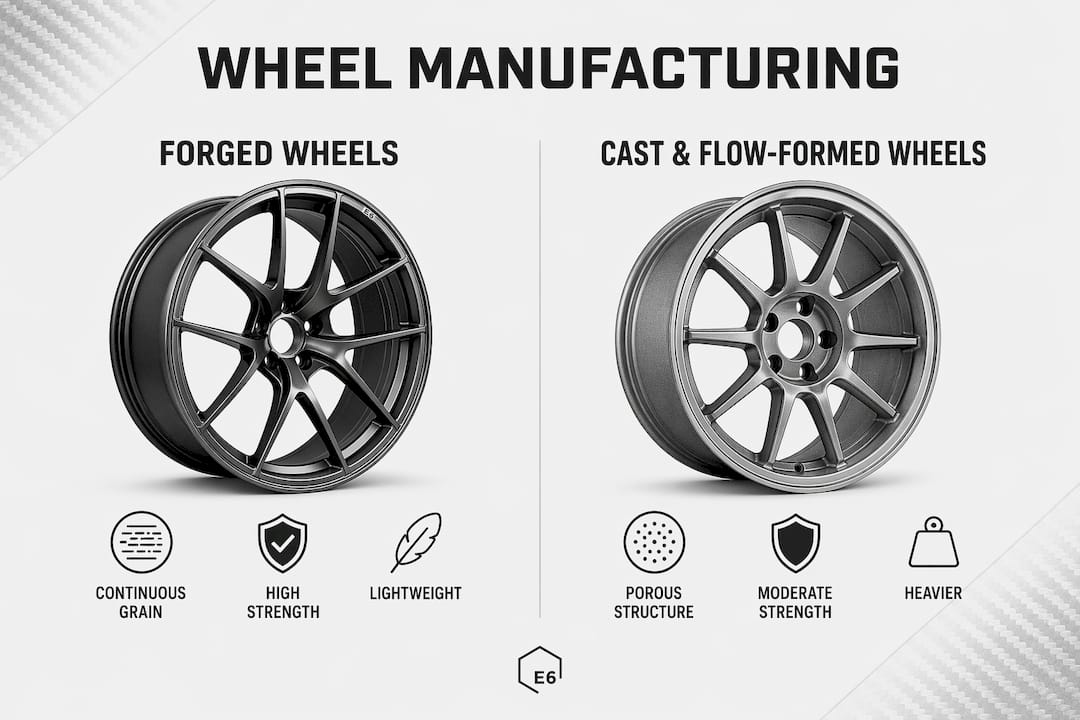
Casting pours molten aluminum into a mold and lets it cool. As the metal solidifies, gas escapes unevenly, leaving behind microscopic pores and voids throughout the structure. The grain inside a cast wheel runs in random directions. That random grain is the root cause of brittleness.
Flow forming improves on casting but only partially. The process spins a cast wheel blank while rollers press and stretch the barrel. This reduces barrel thickness by 30–50% and aligns the grain in that zone. The problem is the wheel face and spoke junctions remain cast and porous, with a yield strength of only 207–276 MPa. Flow-formed wheels carry a structural split: forged-quality barrel, cast-quality face.
Forging eliminates that split entirely. A solid billet of 6061-T6 aluminum sits under a hydraulic press and gets compressed with enough force to reshape the grain into continuous directional flow. No gas pockets. No voids. No weak zones. The grain follows the contours of the spoke from hub to rim edge without interruption.
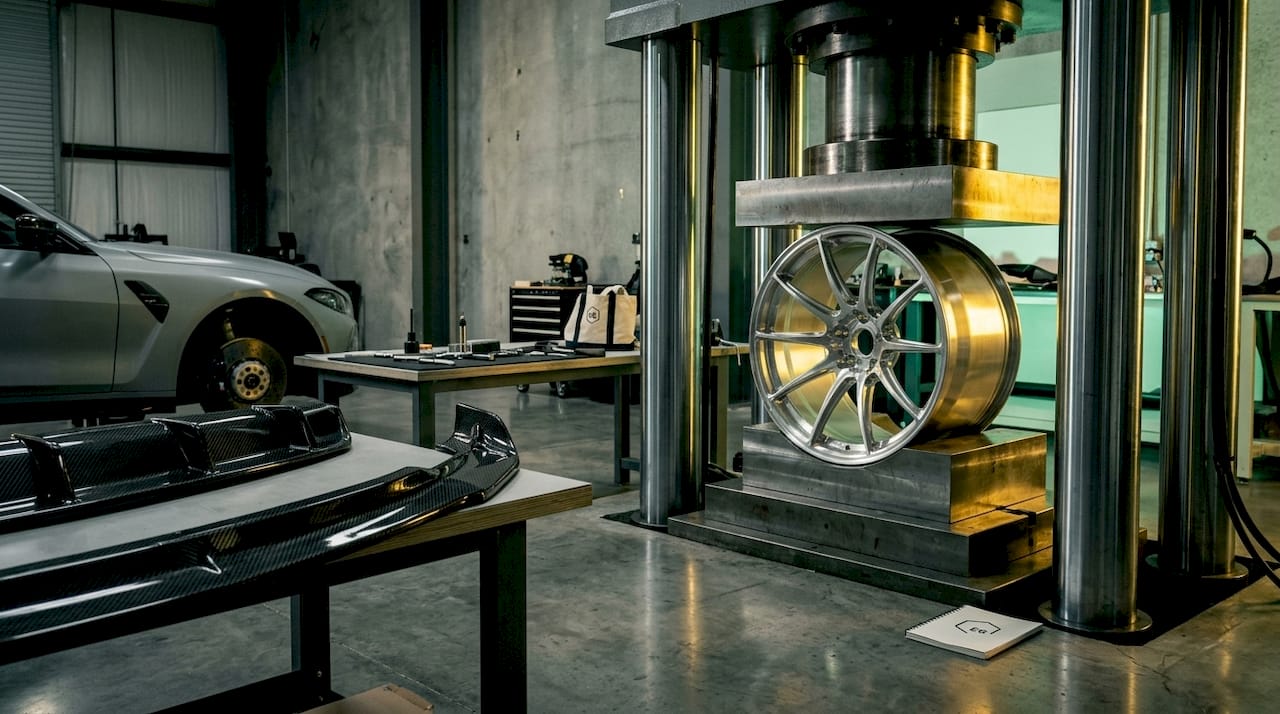
The cost of forging is real. It requires expensive dies, longer machining time, and tighter quality control at every step. That cost buys consistency that casting cannot match.
What mechanical advantages do forged wheels offer over cast and flow-formed?
The mechanical gap between forged and cast wheels shows up exactly where you do not want a surprise: under impact or at the limit of a corner.
How porosity causes cast wheels to fail
Cast wheels contain micro-shrinkage cavities throughout their structure. Under a sharp pothole impact or repeated track loads, stress concentrates at those cavities. The crack propagates fast because the brittle, random grain offers no resistance. Cast wheels crack suddenly, often without warning, dropping tire pressure instantly.
Forged wheels behave differently under the same load. The dense, continuous grain resists crack propagation. When a forged wheel reaches its limit, it deforms gradually rather than fracturing. Engineers call this “graceful failure.” The wheel bends, but it holds air pressure long enough for the driver to react.
Weight savings without the structural trade-off
Forged aluminum’s density allows engineers to remove material from spoke profiles without weakening the wheel. Flow-formed wheels need extra material in the cast face to compensate for porosity, which adds weight compared to fully forged wheels with uniform grain flow. Every pound of unsprung weight reduction improves steering response, ride quality, and braking performance. A lighter forged wheel does more work with less mass.
- Impact resistance: Forged grain absorbs and distributes impact energy across the full spoke cross-section.
- Fatigue life: Forged wheels sustain repeated stress cycles without crack initiation at internal voids.
- Ductile deformation: Under extreme overload, forged wheels bend rather than shatter, preserving tire pressure.
- Spoke geometry: Thinner, lighter spoke profiles are structurally viable only with forged grain density.
Pro Tip: If you track your car even occasionally, inspect cast wheels after every event. Forged wheels still need inspection, but the risk of sudden fracture is dramatically lower due to their defect-free grain structure.
Why does E6 Carbon limit its lineup to four forged designs?
E6 Carbon’s wheel catalog is deliberately narrow. The lineup covers exactly four configurations: monoblock, beadlock, two-piece, and AeroDisc. Limiting the lineup to these four designs simplifies manufacturing, maintains structural integrity across every SKU, and keeps engineering focus on the performance outcomes that matter.
Three-piece wheels are not offered. The additional hardware interfaces in a three-piece design introduce potential failure points and add weight at the rim edge, which is the worst place to carry mass for rotational inertia.
Each of the four designs serves a specific performance or application purpose:
- Monoblock: Single-piece forged construction with no joints or fasteners. Maximum structural rigidity. The preferred choice for track use on platforms like Mercedes-AMG GT and McLaren 720S.
- Beadlock: Mechanical ring secures the tire bead to the rim. Designed for extreme off-road or competition environments where tire pressure drops are intentional.
- Two-piece (2pc): Forged center mated to a forged or spun outer barrel. Allows wider offset customization for fitment on Lamborghini Urus, Lexus LC500, and similar platforms.
- AeroDisc: Closed-face or near-closed design that reduces aerodynamic drag at the wheel. Measurable at highway speeds and on track.
| Design | Construction | Primary advantage | Typical application |
|---|---|---|---|
| Monoblock | Single forged piece | Maximum rigidity, no joints | Track and street performance |
| Beadlock | Forged with mechanical bead ring | Tire retention at low pressure | Competition and off-road |
| Two-piece | Forged center, forged or spun barrel | Offset flexibility | Fitment-specific luxury and exotic platforms |
| AeroDisc | Closed-face forged | Aerodynamic drag reduction | High-speed track and EV applications |
How do forged wheels balance performance, safety, and long-term cost?
The upfront price of forged wheels is higher than cast or flow-formed alternatives. The total cost over the life of the wheel tells a different story.
Forged aluminum’s fatigue resistance reduces the frequency of crack inspections and lowers the risk of wheel-related failures. Cast wheels on a track car require post-event inspection every session. A cracked cast wheel that goes undetected can cause sudden deflation at speed, with consequences that extend well beyond the wheel itself.
Engineers classify forged aluminum as essential for mission-critical safety parts because its consistent, defect-free structure eliminates the unpredictability of solidification defects. For a performance driver, that predictability is not a luxury. It is the baseline requirement.
- Fewer inspections: Forged wheels need less frequent crack checks, reducing maintenance time between track days.
- Suspension protection: A wheel that deforms rather than shatters absorbs impact energy before it reaches control arms and wheel bearings.
- Resale value: Forged wheels retain value better than cast alternatives because their structural integrity is verifiable and long-lasting.
- Driver confidence: Knowing the wheel will not fracture suddenly under a hard corner changes how a driver commits to the limit.
Pro Tip: When buying forged wheels, always confirm the alloy grade. Aerospace-grade 6061-T6 is the benchmark. Lower alloy grades can be forged but will not deliver the same fatigue life or strength-to-weight ratio.
Key Takeaways
Forged aluminum wheels outperform cast and flow-formed alternatives because their continuous grain structure eliminates the porosity and brittleness that cause sudden wheel failure under real driving stress.
| Point | Details |
|---|---|
| Grain structure is everything | Forging aligns aluminum grain continuously, eliminating voids that cause cast wheels to crack under impact. |
| Flow-formed wheels have a structural split | The barrel gains forged-quality grain, but the face and spoke junctions remain cast and porous. |
| Graceful failure saves lives | Forged wheels deform under extreme overload rather than fracturing, maintaining tire pressure long enough to react. |
| E6 Carbon offers four designs only | Monoblock, beadlock, two-piece, and AeroDisc cover every performance need without the failure points of three-piece hardware. |
| Total cost favors forged | Lower inspection frequency and longer fatigue life make forged wheels more cost-efficient over time despite higher upfront cost. |
What I’ve learned from watching cast wheels fail under real loads
Most enthusiasts underestimate what a wheel actually endures. A hard corner on a track puts lateral loads on the spoke roots that a cast wheel was never designed to sustain repeatedly. I have seen cast wheels crack at the spoke base after a single aggressive track session, with no visible warning beforehand. The driver had no idea until the tire went flat at speed.
The common misconception is that a heavier wheel is a stronger wheel. Cast wheels are often heavier than forged alternatives precisely because they need extra material to compensate for internal porosity. That extra weight sits at the worst possible location for unsprung mass. You pay a weight penalty and still get a weaker structure.
Matching your wheel choice to your driving environment matters more than most buyers realize. A street driver who occasionally attends track days needs the same fatigue resistance as a dedicated track car, because the consequences of failure are identical. Forged wheels are not reserved for professional motorsport. They are the correct engineering choice for anyone who drives with intent.
— E6 Engineering
E6 Forged wheels: built from aerospace-grade 6061-T6 billets
E6 Carbon’s forged wheel lineup starts with aerospace-grade 6061-T6 aluminum and ends with a finished wheel that is lighter, stronger, and more consistent than anything cast or flow-formed at a comparable weight.
Every E6 Forged wheel goes through 10,000-ton hydraulic compression before a single machining pass. The result is a spoke profile that carries full structural load at a fraction of the mass of a cast equivalent. Whether you are fitting a Mercedes-AMG GT, a Lexus LC500, or a McLaren 720S, the engineering behind each wheel is the same. Explore the full range of E6 Forged wheel designs and find the monoblock, two-piece, beadlock, or AeroDisc configuration that fits your platform and your driving goals.
FAQ
What is the main difference between forged and cast aluminum wheels?
Forged aluminum wheels have a continuous, aligned grain structure with no internal voids, giving them 26% higher tensile strength and 37% greater fatigue life than cast wheels. Cast wheels cool from molten aluminum in a mold, leaving random grain and microscopic porosity that causes brittleness.
Are flow-formed wheels as strong as fully forged wheels?
Flow-formed wheels are stronger than standard cast wheels in the barrel only. The wheel face and spoke junctions remain cast with a yield strength of 207–276 MPa, making them weaker than fully forged wheels in the highest-stress zones.
Why do forged wheels cost more than cast alternatives?
Forging requires expensive dies, longer machining time, and tighter quality control than casting. The higher upfront cost is offset by lower inspection frequency, longer fatigue life, and reduced risk of sudden failure over the wheel’s lifespan.
What alloy does E6 Carbon use for its forged wheels?
E6 Carbon machines its E6 Forged wheels from aerospace-grade 6061-T6 aluminum billets compressed under 10,000-ton hydraulic presses, producing a defect-free grain structure suited for high-G cornering and track use.
Does E6 Carbon offer three-piece forged wheels?
E6 Carbon does not offer three-piece wheels. The lineup is limited to monoblock, beadlock, two-piece, and AeroDisc designs, which cover every performance application without the added failure points of three-piece hardware interfaces.