

TL;DR:
- Concave wheels feature inward-curving spokes and are constructed as 3-piece forged, monoblock forged, flow-formed, or cast alloy, each with distinct weight, strength, and cost characteristics. Selecting the appropriate construction and concavity depth depends on vehicle fitment, brake clearance, and intended use, with proper verification vital to avoid costly mistakes. For optimal performance and aesthetics, platform-specific engineering and fitment validation should guide the choice, emphasizing weight reduction and precise geometry.
Concave wheels are defined by spokes that curve inward toward the hub, creating a bowl-shaped face that sets them apart from flat or convex designs. The four primary types of concave wheels are 3-piece forged, monoblock forged, flow-formed, and cast alloy, each with distinct trade-offs in weight, strength, customization depth, and cost. For owners of Mercedes-AMG, Lexus LC500, McLaren, and Lamborghini platforms, choosing the right construction type is as much an engineering decision as an aesthetic one. Getting it wrong costs you handling precision, brake clearance, and in some cases, structural safety.
1. Types of concave wheels: construction categories explained
The construction method determines everything downstream: weight, concavity potential, price, and fitment flexibility. Understanding these four categories is the foundation of any concave wheels selection guide.
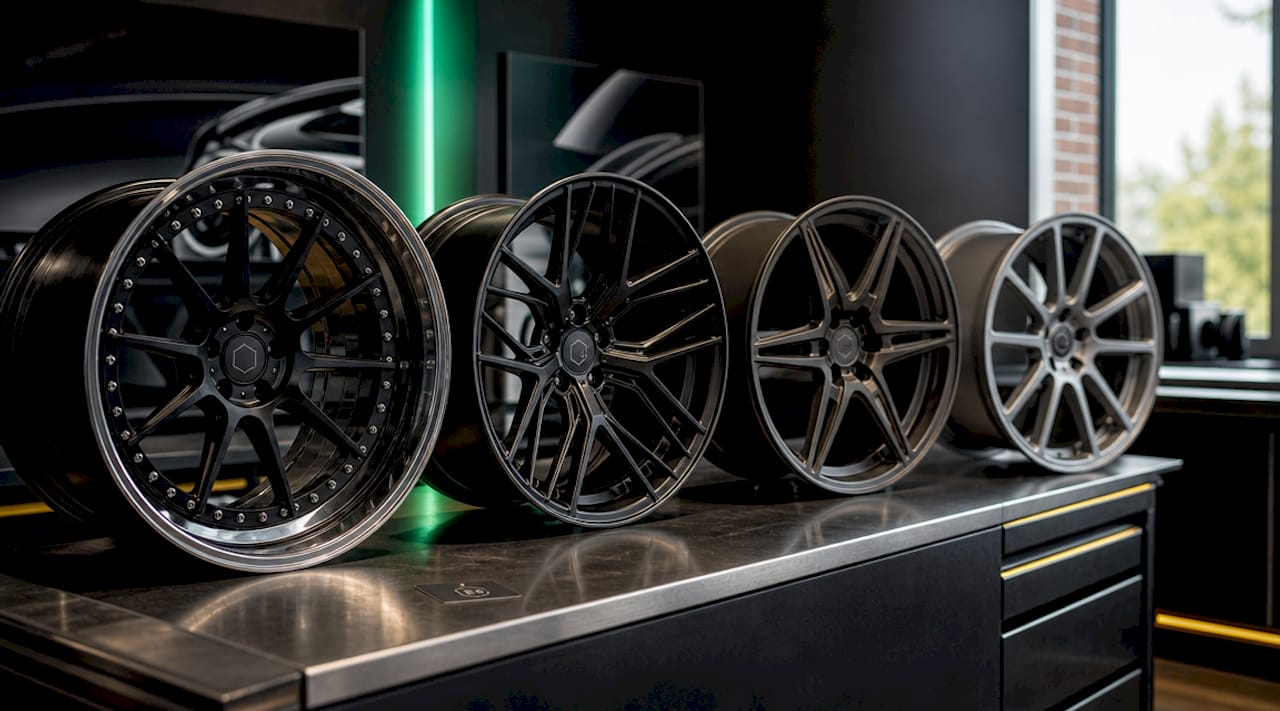
- 3-piece forged: Separate barrel, center, and outer rim are bolted together. This three-piece construction delivers maximum design freedom and the deepest concavity profiles available. It is the preferred choice for show cars and high-end luxury builds on platforms like Mercedes-AMG S-Class and Lamborghini Urus. Cost is the highest of any construction type.
- Monoblock forged: Machined from a single billet of aerospace-grade aluminum. Monoblock forged wheels deliver superior strength-to-weight ratios and are standard in sports car and racing applications. The McLaren 720S and Mercedes-AMG GT benefit directly from the unsprung weight reduction a monoblock provides.
- Flow-formed: Heat and pressure stretch the aluminum barrel after initial casting, aligning the grain structure. Flow forming produces thinner, stronger rims than conventional casting at a fraction of forging costs. This is the practical choice for Lexus LC500 owners who want concavity without a full forged budget.
- Cast alloy: The most common and budget-friendly option. Cast wheels are heavier and offer less customization, making them suitable for entry-level concave aesthetics but not for performance-focused builds.
| Construction | Weight | Customization | Best Use Case |
|---|---|---|---|
| 3-piece forged | Low | Maximum | Show cars, luxury builds |
| Monoblock forged | Lowest | High | Track, sports cars |
| Flow-formed | Medium | Moderate | Street performance |
| Cast alloy | Highest | Minimal | Budget builds |
Pro Tip: Reducing unsprung weight via forged or flow-formed construction delivers tangible handling improvements and extends suspension component life far beyond what a deeper concave profile alone can achieve.
2. Examples of concave wheel designs and concavity depths
Concavity depth is not a single setting. It runs on a spectrum from mild to extreme, and each level creates a different visual and functional signature. Understanding these design options is critical before selecting a wheel for any specific platform.
Mild concave wheels feature a subtle inward curve, typically 10 to 15mm of dish. These suit daily-driven Mercedes-AMG C43 and E53 builds where brake caliper clearance is tight and a conservative look is preferred. The spoke face sits just behind the outer lip, giving a clean, understated depth.
Medium concave designs push the spoke face 20 to 30mm inward. This is the most popular range for Lexus LC500 fitments, where the wide rear track and generous fender clearance accommodate the additional depth without requiring aggressive offset changes. The visual effect is pronounced without crossing into show-car territory.
Deep concave wheels are the most dramatic, with spoke faces recessed 35mm or more. These are the signature look of 3-piece forged builds on Lamborghini Huracán and McLaren 720S platforms. It is worth noting that concave design refers to inward spokes toward the hub, while deep-dish refers to a visible wide outer rim lip. A wheel can combine both, which is exactly what high-end multi-piece forged designs do for maximum visual impact.
Popular concave wheel finishes that complement each depth level include:
- Satin black and gloss black, which dominate sales due to their ability to mask brake dust on performance vehicles
- Brushed bronze and matte gunmetal for contrast against dark body colors on AMG and Lexus platforms
- Machined two-tone effects that highlight spoke geometry on deep concave designs
- Polished lip with matte center, a classic combination for 3-piece forged wheels on McLaren and Lamborghini builds
3. Fitment and clearance: what you must verify before buying
Fitment is where concave wheel builds succeed or fail. Proper fitment requires accounting for brake caliper clearance (the X-factor), fender clearance, and steering lock range. These are not calculator estimates. They require physical templates and vehicle-specific guides for accuracy.
The X-factor is the distance between the inner spoke face and the brake caliper at its widest point. On platforms like the Mercedes-AMG GT63 S and McLaren 720S, large brake packages require bespoke spoke shaping and precise offset tuning to maintain clearance. A wheel that clears the caliper at rest may contact it under suspension compression. This is why E6 Carbon’s Fitment First engineering approach validates clearance across the full suspension travel range, not just static measurements.
Follow these steps to verify fitment before committing to a concave wheel purchase:
- Confirm your vehicle’s bolt pattern, center bore, and hub diameter against the wheel specification sheet.
- Measure brake caliper height and width at the widest point, then compare against the wheel’s inner spoke clearance data.
- Check wheel offset (ET value) against the manufacturer’s recommended range for your specific model year and trim level.
- Use a physical caliper template or cardboard mock-up to test clearance before the wheel ships.
- Verify fender clearance at full steering lock and maximum suspension compression, not just at ride height.
Pro Tip: For daily-driven vehicles, maintaining OEM-compatible offsets and choosing lighter construction protects steering geometry and prevents premature bearing wear far better than chasing maximum concavity depth.
You can explore the technical side of monoblock vs. multi-piece construction in detail to understand how each approach affects fitment tolerance and spoke clearance geometry.
4. Comparing concave wheels by vehicle type and enthusiast goal
The right concave wheel type depends on the platform and the purpose. A track-focused Mercedes-AMG C63 R and a show-spec Lamborghini Urus require fundamentally different approaches, even if both owners want deep concavity.
| Vehicle / Use Case | Recommended Construction | Concavity Depth | Priority |
|---|---|---|---|
| Mercedes-AMG GT / C63 Track | Monoblock forged | Medium | Weight and clearance |
| Lexus LC500 Street | Flow-formed or 3-piece forged | Medium to deep | Aesthetics and fitment |
| McLaren 720S / 765LT | Monoblock forged | Medium | Unsprung weight |
| Lamborghini Huracán / Urus | 3-piece forged | Deep | Show and customization |
| Daily driver (any platform) | Flow-formed | Mild to medium | Durability and cost |
For track use, monoblock forged wheels are the correct answer on every performance platform. The weight savings translate directly into faster steering response, reduced rotational inertia, and lower stress on suspension components. For the Lexus LC500, which sits at the intersection of grand touring and show car culture, a 3-piece forged wheel with medium-to-deep concavity in a brushed bronze or machined two-tone finish is the most complete expression of the platform’s character. For Lamborghini and McLaren builds where the visual statement is the primary goal, 3-piece forged wheels in deep concave configurations remain the standard in the show car and high-end luxury market.
Many enthusiasts believe any wheel can be made deeply concave by simply widening it or adjusting offset. That is incorrect. Concavity is limited by brake package size and vehicle geometry, not just wheel dimensions. This is the most common and costly mistake in concave wheel selection.
Key takeaways
The most effective concave wheel selection combines construction type, concavity depth, and platform-specific fitment verification rather than treating any one factor as sufficient on its own.
| Point | Details |
|---|---|
| Construction defines performance | 3-piece forged maximizes customization; monoblock forged minimizes weight for track use. |
| Concavity depth has limits | Brake caliper size and vehicle geometry cap achievable depth regardless of wheel width. |
| Fitment requires physical verification | Caliper templates and suspension travel checks are mandatory, not optional, for concave builds. |
| Platform matters | Mercedes-AMG, McLaren, and Lamborghini each require bespoke offset and spoke clearance solutions. |
| Weight reduction pays dividends | Forged and flow-formed construction improves handling and suspension longevity beyond aesthetics alone. |
The concavity trap most enthusiasts fall into
After working with Mercedes-AMG, Lexus LC500, and McLaren builds across both track and show configurations, one pattern repeats itself: buyers select concavity depth first and fitment second. That order is backwards, and it costs real money to correct.
The most aggressive deep concave profile means nothing if the spoke geometry conflicts with a 6-piston Brembo caliper or the offset pulls the tire into the fender liner at full lock. We have seen builds on AMG GT platforms where the chosen wheel cleared the caliper at static ride height but made contact under hard braking compression. The fix required a complete wheel replacement.
What actually works is starting with the platform’s brake package dimensions and suspension geometry, then selecting the maximum concavity depth that fits within those constraints. On a Lexus LC500, that process typically lands you in the 25 to 30mm concavity range with a 3-piece forged wheel at a platform-specific offset. On a McLaren 720S, the large carbon ceramic brake package often limits you to a medium concave monoblock where every millimeter of spoke clearance is engineered, not assumed.
The wheel that looks best on your specific car is the one built around your car’s actual geometry. Everything else is guesswork.
— E6 Engineering
Build your concave wheel setup with E6 Forged
E6 Carbon’s E6 Forged multi-piece wheel catalog is built specifically for the platforms where concavity matters most. The AR01, AR03, JF10, and SS7 multi-piece forged configurations are engineered for Mercedes-AMG, Lexus LC500, McLaren, and Lamborghini fitments, with spoke geometry and offset options validated against each platform’s brake package and suspension travel range.
Every E6 Forged wheel is produced to forged wheel tolerances that meet the demands of both competitive track use and exclusive street presence. If you are ready to specify a concave build that performs as well as it looks, explore the full E6 Forged wheel catalog and configure your fitment with the E6 Carbon engineering team.
FAQ
What are the main types of concave wheels?
The four main types are 3-piece forged, monoblock forged, flow-formed, and cast alloy. Each differs in weight, customization potential, concavity depth capability, and cost.
What is the difference between concave and deep-dish wheels?
Concave refers to spokes that curve inward toward the hub, while deep-dish describes a wide visible outer rim lip. A single wheel can incorporate both design elements simultaneously.
How deep can concave wheels go on a Mercedes-AMG or McLaren?
Achievable concavity depth is limited by the brake caliper package and vehicle geometry. Large brake systems on AMG GT and McLaren 720S platforms typically restrict practical concavity to the medium range without bespoke spoke engineering.
Are flow-formed wheels good for concave designs?
Flow-formed wheels offer a strong balance of weight savings and cost, making them a practical choice for mild to medium concave profiles on street-driven platforms like the Lexus LC500.
Why do monoblock forged wheels suit track use better than 3-piece forged?
Monoblock forged wheels are machined from a single billet, eliminating the hardware and sealing points of multi-piece construction. This reduces unsprung weight and improves structural integrity under the thermal and mechanical stress of track driving.