
TL;DR:
- The McLaren 750S’s aerodynamic efficiency relies on a software-controlled active rear wing and a precisely engineered front splitter, both made from lightweight, rigid autoclave-cured carbon fiber. These components dynamically optimize downforce and drag to deliver superior performance in cornering, acceleration, and braking, maintaining aerodynamic balance at high speeds. Proper manufacturing, professional installation, and material integrity are crucial to maximizing the system’s performance benefits.
McLaren 750S aero efficiency is defined by two precision-engineered components working in concert: the active rear wing and the front splitter, both constructed from autoclave-cured 2×2 twill carbon fiber. Together, they solve the fundamental aerodynamic problem every high-performance car faces. You need maximum downforce in corners and under braking, and minimum drag on the straight. The 750S does not compromise between those two states. It switches between them dynamically, and the engineering behind that switch is worth understanding in full.
How does the McLaren 750S active rear wing work?
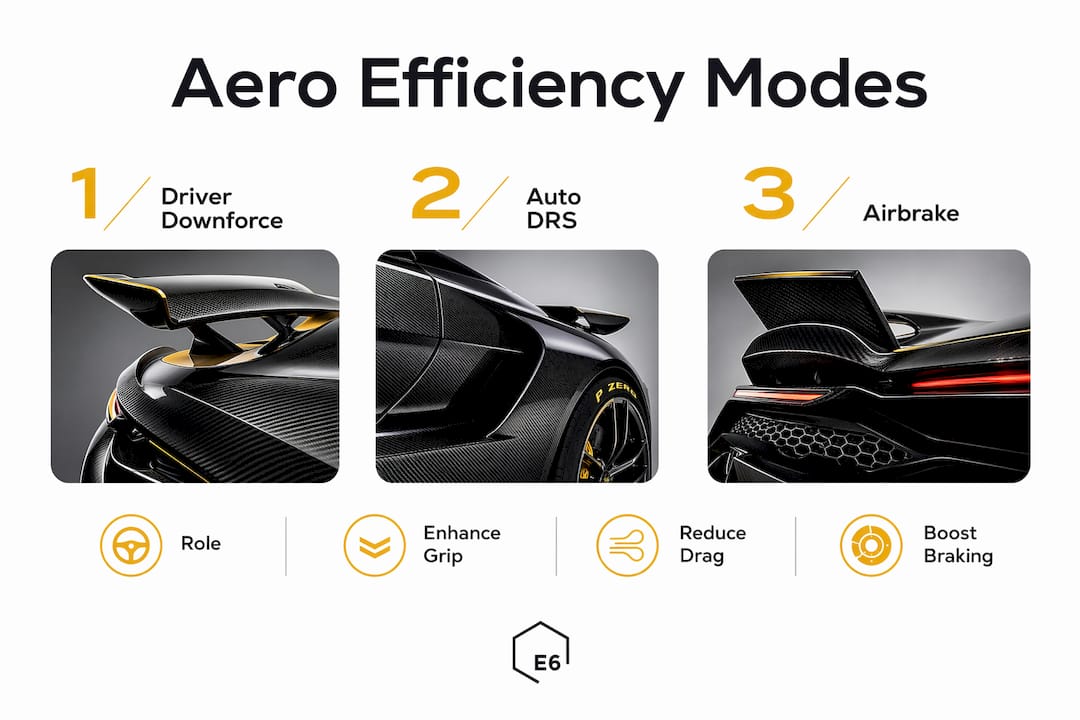
The active rear wing is the centerpiece of McLaren 750S aerodynamics, and it operates across three distinct modes that target specific driving conditions with precision.
Driver Downforce mode deploys the wing at a high angle of attack during cornering, generating the grip load needed to keep the car planted through high-speed direction changes. Auto-DRS mode flattens the wing during straight-line acceleration, cutting aerodynamic drag so the car can reach its 206 mph top speed without fighting its own bodywork. High-Speed Braking mode flips the wing upright as an airbrake the moment the driver applies hard braking, increasing downforce precisely when rear stability is most critical.
The wing itself is 20% larger in surface area than the unit on the 720S, yet weighs less because of its autoclave-cured carbon fiber construction. That combination matters. A larger wing generates more downforce when deployed, and a lighter wing reduces the rotational inertia penalty on the rear axle. The result is more grip when you need it, with less mass working against you when you do not.
What separates the 750S from cars with static rear wings is the software-controlled timing of wing positions. Aero mode control logic optimizes grip versus drag dynamically rather than locking the car into one aerodynamic state. A fixed high-downforce wing would cost you top speed. A fixed low-drag wing would cost you cornering stability. The 750S avoids both penalties.
- Driver Downforce mode: high angle of attack for cornering grip
- Auto-DRS mode: flat position for drag reduction during acceleration
- High-Speed Braking mode: airbrake position for rear stability under deceleration
- Mode transitions: software-controlled, tied to real-time driving inputs
Pro Tip: Think of the rear wing less as a spoiler and more as an active aerodynamic actuator. Its value is not in its static position but in how quickly and accurately it transitions between positions based on your driving inputs.
What role does the front splitter play in aerodynamic balance?
The front splitter on the McLaren 750S is not a standalone downforce device. It functions as the front anchor of an integrated airflow management system that includes the underfloor and side vents, and its primary job is to maintain front-to-rear aerodynamic balance as the rear wing cycles through its modes.

When the rear wing deploys in Driver Downforce mode, it increases rear downforce significantly. Without a properly engineered front splitter generating corresponding front downforce, the car would develop understeer at high speed as the rear grip outpaces the front. The front splitter channels airflow beneath the car and into the side vents, building front downforce that keeps the balance neutral and predictable. This is why quantitative splitter metrics are rarely published in isolation. The splitter’s performance is inseparable from the system it anchors.
The material specification matters as much as the geometry. Autoclave-cured 2×2 twill carbon fiber delivers the dimensional stability required to maintain precise splitter geometry at speed. A splitter that flexes under aerodynamic load changes its effective angle of attack unpredictably, which undermines the balance the entire system is calibrated to achieve. Autoclave curing eliminates the void content and resin inconsistencies that cause flex in lower-grade carbon parts.
Pro Tip: Any carbon fiber splitter replacement or upgrade must be professionally sealed at all mounting points and edges. Unsealed carbon fiber absorbs moisture, which causes delamination over time and degrades the structural integrity that makes the part worth installing in the first place.
How does carbon fiber construction affect aero efficiency and weight?
Autoclave-cured 2×2 twill carbon fiber is the material specification that makes the 750S’s active aero system viable at the performance level McLaren targets. The properties that matter most for aerodynamic components are stiffness-to-weight ratio, dimensional stability under thermal and aerodynamic load, and surface finish consistency.
The key characteristics of autoclave-cured 2×2 twill carbon fiber in this application:
- Stiffness: Higher fiber volume fraction than wet-lay or vacuum-infused carbon, meaning the part holds its shape under aerodynamic pressure
- Weight: Significantly lighter than aluminum or fiberglass equivalents, reducing unsprung weight and overall vehicle mass
- Thermal stability: Autoclave curing produces a fully cross-linked resin matrix that resists heat-induced deformation near brake and exhaust sources
- Surface consistency: The 2×2 twill weave pattern produces a uniform surface that minimizes aerodynamic turbulence across the part
The weight reduction benefit compounds across the vehicle. Lighter aerodynamic components mean less mass the suspension must manage, which improves the speed and accuracy of the car’s dynamic responses. When the rear wing transitions from airbrake to flat position, a lighter wing completes that transition faster. Faster transitions mean the car spends more time in the optimal aerodynamic state for each driving condition.
Professional installation is not optional for carbon fiber aero components. Improper torque on mounting hardware can crack the laminate. Gaps in edge sealing allow moisture ingress. Either failure mode degrades the part’s structural performance and, by extension, the aerodynamic performance it was installed to deliver.
What performance results does the 750S aero system deliver at speed?
The performance numbers that define the McLaren 750S are direct outputs of its aerodynamic design. The car reaches 0 to 60 mph in 2.3 seconds and 100 mph in 4.8 seconds. Those figures depend on Auto-DRS reducing drag during the acceleration phase so the twin-turbocharged V8 is not fighting aerodynamic resistance at the moment it needs to transfer power to the road.
The braking data is equally telling. The 750S stops from 70 mph in 136 feet and from 100 mph in 264 feet. Those distances reflect the airbrake mode improving stability under hard deceleration, keeping the rear planted and preventing the yaw instability that can develop when a car decelerates faster than its aerodynamic balance can accommodate.
| Performance metric | Result |
|---|---|
| 0 to 60 mph | 2.3 seconds |
| 0 to 100 mph | 4.8 seconds |
| Braking: 70 to 0 mph | 136 feet |
| Braking: 100 to 0 mph | 264 feet |
| Top speed | 206 mph |
The active aero balancing downforce and drag dynamically is what separates these numbers from what a static wing setup could achieve. A fixed high-downforce configuration would add drag that blunts acceleration. A fixed low-drag configuration would compromise braking stability and cornering grip. The 750S delivers all three performance outcomes because its aero system never commits to a single state.
Key takeaways
The McLaren 750S achieves its performance benchmarks because its active rear wing and front splitter function as a coordinated aerodynamic system, not as independent components.
| Point | Details |
|---|---|
| Active rear wing modes | Three distinct positions target cornering grip, drag reduction, and braking stability independently. |
| Wing surface area increase | The rear wing is 20% larger than the 720S unit while weighing less due to carbon fiber construction. |
| Front splitter function | The splitter anchors front-to-rear aero balance, working with the underfloor and side vents as a system. |
| Material specification | Autoclave-cured 2×2 twill carbon fiber delivers the stiffness and dimensional stability aero parts require. |
| Professional sealing | All carbon fiber aero components must be professionally sealed to prevent moisture ingress and delamination. |
Why the aero mode timing matters more than the hardware
From our perspective at E6 Engineering, the most common misconception we encounter is that rear wing size is the primary driver of aero performance. Enthusiasts see a larger wing and assume more downforce equals better performance. The 750S proves that logic incomplete.
The wing’s airbrake function is a useful illustration. The wing does not simply stay deployed for maximum downforce at all times. If it did, the car would be slower in a straight line and no more stable under braking than a well-sorted static setup. The performance gain comes from the precision of the transitions, specifically from how quickly and accurately the software reads driving conditions and repositions the wing. That is the engineering achievement worth appreciating.
We apply the same logic to aftermarket carbon fiber aero components. A correctly specified, professionally installed autoclave-cured part that holds its geometry under load will outperform a heavier, less precise part every time. The material and the fitment are inseparable from the aerodynamic outcome. When we build carbon components for McLaren platforms, dimensional accuracy and edge sealing are treated as performance specifications, not finishing details. If you are considering aero upgrades for your 750S, evaluate the manufacturing process and installation standard as rigorously as you evaluate the part itself.
— E6 Engineering
Upgrade your McLaren’s aero with E6 Carbon

E6 Carbon manufactures autoclave-cured 2×2 twill carbon fiber aerodynamic components built to OEM-plus fitment standards for McLaren platforms. Every part in our catalog is engineered to the dimensional tolerances that active aero systems demand, because a component that shifts under load or admits moisture at the edge seams undermines the performance you are paying for. Our carbon fiber components for the McLaren lineup are designed to complement the factory active aero system, not fight it. If you are building a 750S that performs as precisely as it looks, professional fitment and correct material specification are where that build starts. Explore our full catalog at E6 Carbon and speak with our engineering team about your platform.
FAQ
What are the three modes of the McLaren 750S rear wing?
The McLaren 750S rear wing operates in Driver Downforce mode for cornering grip, Auto-DRS mode for drag reduction during acceleration, and High-Speed Braking mode as an airbrake for rear stability under hard deceleration.
How does the front splitter improve 750S stability?
The front splitter works with the underfloor and side vents to generate front downforce that balances the rear wing’s output, keeping the car aerodynamically neutral through corners and at high speed.
Why does autoclave-cured carbon fiber matter for aero parts?
Autoclave curing produces a higher fiber volume fraction and a fully cross-linked resin matrix, which delivers the stiffness and dimensional stability that aerodynamic components require to hold their geometry under load.
What is the McLaren 750S top speed and braking performance?
The 750S reaches 206 mph and stops from 100 mph in 264 feet, with the active rear wing’s airbrake mode contributing directly to the braking stability behind those figures.
Do carbon fiber aero parts require professional sealing?
Yes. All carbon fiber aerodynamic components must be professionally sealed at mounting points and edges to prevent moisture ingress, which causes delamination and degrades structural and aerodynamic performance over time.