TL;DR:
- Monoblock wheels are single-piece forged or flow-formed aluminum constructions that offer higher strength and lower weight compared to multipiece wheels. Multipiece wheels are assembled from separate components with hardware, providing greater customization and fitment flexibility but requiring more maintenance and repair. The choice between them depends on application priorities such as track performance, aesthetic needs, and ease of repair.
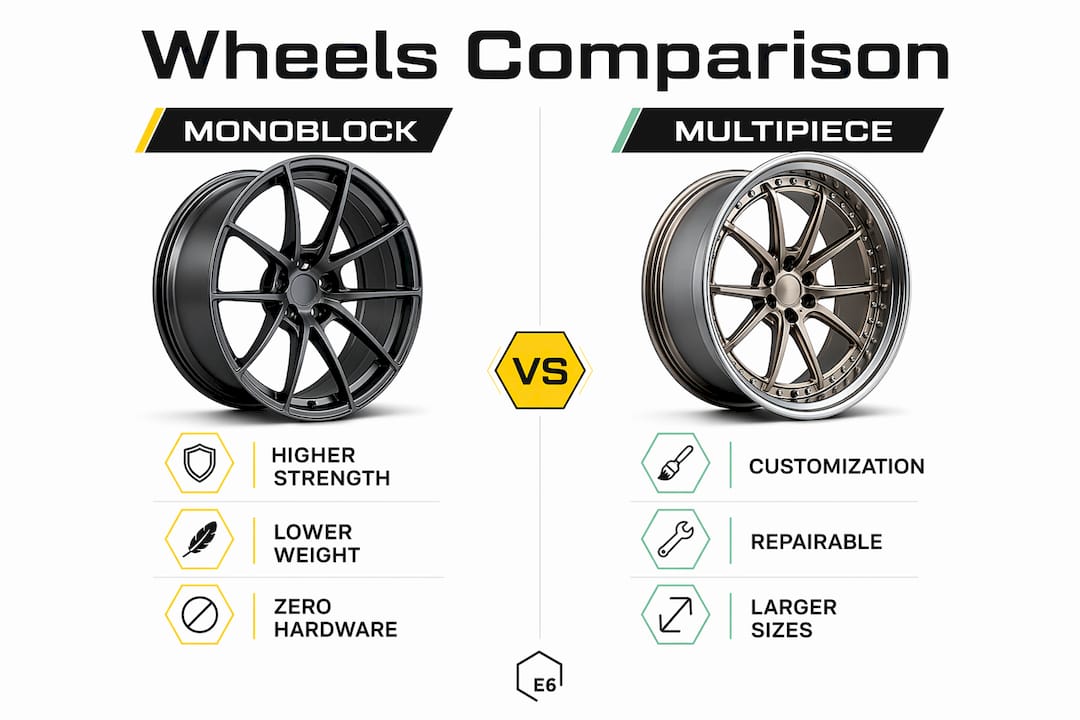
Monoblock wheels are defined as single-piece forged or flow-formed aluminum constructions with no assembly hardware, while multipiece wheels are built from two or three separate forged components bolted and sealed together. The monoblock vs. multipiece wheels comparison is the most consequential decision in any serious wheel build, and the right answer depends entirely on whether your priority is outright track performance or bespoke fitment and aesthetics. Platforms like Mercedes-AMG, Lexus LC500, McLaren, and Lamborghini each demand different answers. Highest-performing monoblocks use 6061-T6 or 7075-T73 aluminum alloys, delivering the strength-to-weight ratio that separates purpose-built performance wheels from decorative ones.
Monoblock vs. multipiece wheels: construction and performance differences
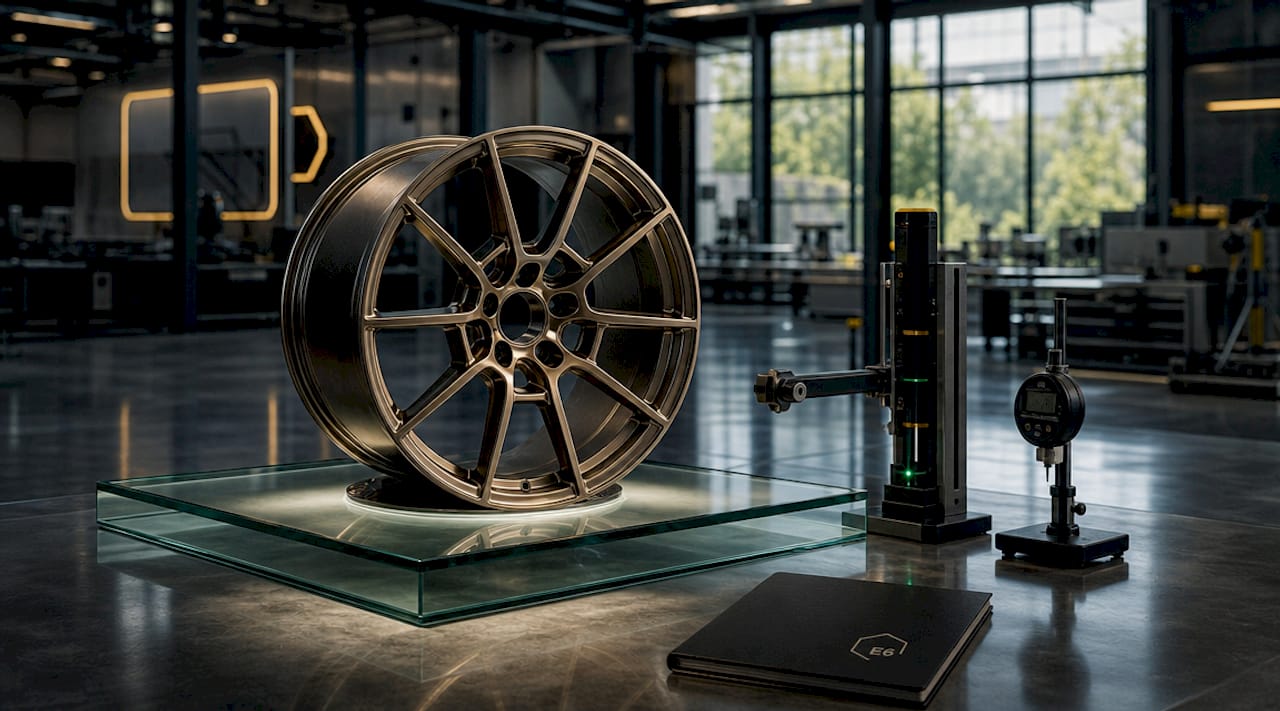
The core engineering distinction between monoblock and multipiece wheels is grain structure. Forged monoblocks are pressed from a single aluminum billet under extreme pressure, aligning the metal’s grain flow continuously from center to lip. This produces uniform grain flow and tensile strength that no assembled wheel can replicate at equivalent weight.
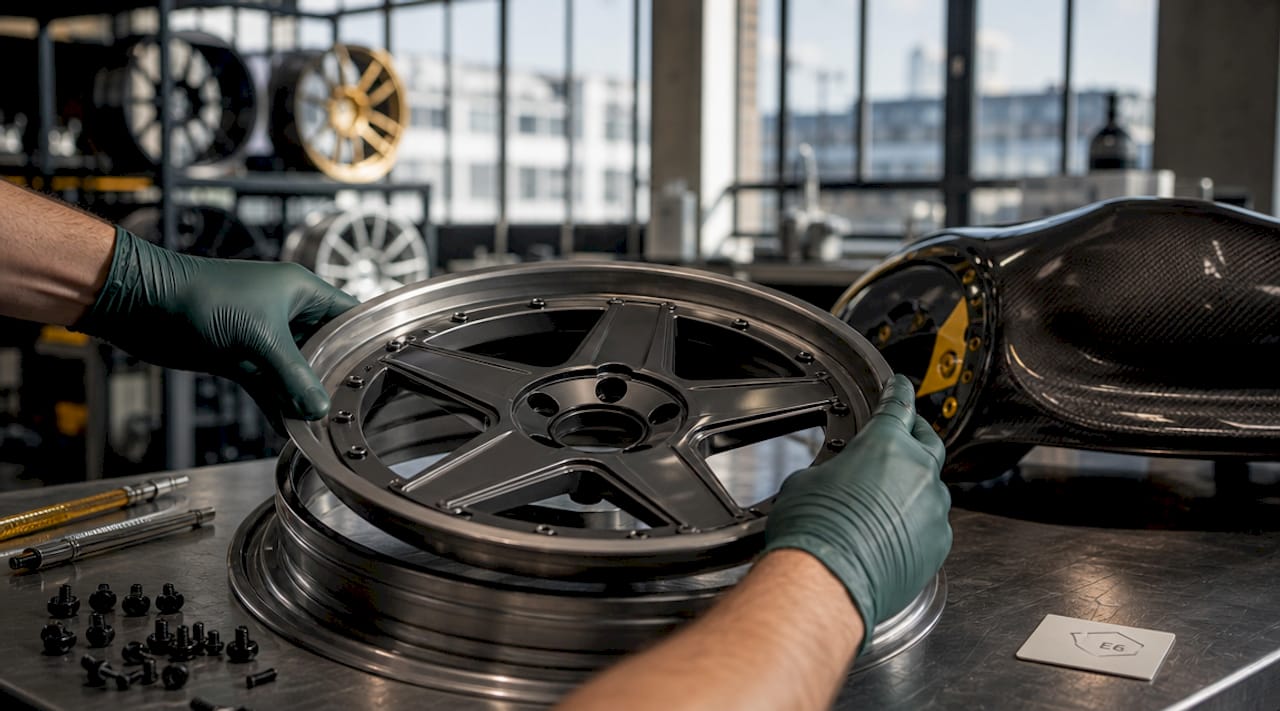
Multipiece wheels assemble a forged center with separate inner and outer barrels, connected by stainless or titanium hardware and sealed with silicone. The modularity is the point, but it introduces variables. Each bolt interface creates a potential shear stress concentration, and the silicone seal between barrel sections degrades over time. Monoblock continuous barrels eliminate bolt-induced shear stress entirely, maximizing lateral stiffness for sharper steering response.
Brake heat dissipation is a critical and often overlooked metric. Monoblock uniform construction conducts heat more efficiently away from the rotor and caliper interface, which matters on track days where a Mercedes-AMG GT3 or McLaren 720S is generating sustained thermal load through repeated hard braking zones.
| Metric | Monoblock | Multipiece |
|---|---|---|
| Tensile strength | Higher (continuous grain flow) | Lower (hardware interfaces) |
| Lateral stiffness | Maximum | Reduced at bolt interfaces |
| Unsprung weight | Lowest achievable | Higher due to hardware |
| Heat dissipation | Superior (solid construction) | Moderate |
| Customization range | Limited offsets and widths | Extreme offsets, deep lips |
Pro Tip: Grain structure alignment in forged monoblocks directly improves fatigue resistance under cyclic loading. For track use, request a manufacturer’s fatigue cycle rating, not just a static load number. NDT testing for micro-fractures is advisable for any wheel used in competitive driving.
What are the maintenance requirements for monoblock vs. multipiece wheels?
Monoblock wheel maintenance is straightforward: clean, inspect for curb damage, and balance. There are no bolts to re-torque, no seals to replace, and no seam corrosion to monitor. This simplicity is a genuine performance advantage for track-focused builds where wheel reliability must be absolute.
Multipiece wheels carry a different ownership profile. Multipiece wheels require periodic bolt torque checks and seal replacements to prevent air leaks and structural compromise. Neglecting these intervals is not a minor oversight. Improper assembly or degraded seals can cause catastrophic air loss, particularly under the thermal and mechanical stress of track use.
The repair advantage of multipiece wheels is real and financially significant. A damaged outer lip on a 3-piece wheel can be replaced individually without scrapping the center or inner barrel. On a monoblock, a cracked or severely bent lip means replacing the entire wheel. For a Lamborghini Huracán owner running aggressive curb-weight street driving, that repairability can justify the multipiece premium on its own.
Key maintenance considerations by wheel type:
- Monoblock: Annual visual inspection for micro-cracks, standard balancing, no hardware checks required
- Multipiece: Bolt torque verification every 6,000 to 8,000 miles, silicone seal inspection annually, seam corrosion check after winter or wet-weather exposure
- Both types: Modular wheels trap water in seams, accelerating corrosion and seal degradation if not dried and inspected after wet conditions
Pro Tip: Multi-piece assembly requires trained technicians using calibrated torque wrenches and fresh silicone sealant at every disassembly. Never allow a general tire shop to service 3-piece hardware. The consequences of inconsistent torque application are structural, not cosmetic.
How do customization options compare between monoblock and multipiece wheels?
Monoblock wheels offer a refined but constrained customization range. Offset, width, and finish are set at the time of forging. You can specify a deep concave face or a stepped lip profile, but the geometry is locked once the billet is pressed. For most Mercedes-AMG C63 or Lexus LC500 builds running factory-width fenders, this is entirely sufficient.
Multipiece wheels exist precisely for builds where standard geometry is not enough. Multipiece wheels provide the greatest customization flexibility for rim width, lip depth, offset, and complex finishes. A widebody McLaren 720S or Lamborghini Urus running aggressive fender flares requires extreme negative offset and deep outer lips that only a 3-piece construction can deliver without compromising structural integrity.
The finish possibilities also diverge significantly:
- Monoblock: Single uniform finish applied post-machining. Polished, brushed, anodized, or powder-coated as a complete unit.
- Multipiece: Each component can carry a different finish. Polished outer lip with a matte black center and brushed inner barrel is a common combination for show-quality builds.
- Lip replacement: A scuffed or corroded outer lip on a 3-piece wheel can be swapped for a fresh component in a new finish without touching the center or inner barrel.
E6 Forged produces both configurations precisely because neither is universally superior. The monoblock catalog serves track-priority and refined street builds, while the 3-piece lineup addresses widebody and deep-dish applications where fitment geometry cannot be compromised.
What performance trade-offs matter most when choosing wheel type?
Properly engineered forged monoblocks are the strongest and lightest wheel option available for racing and high-performance applications. Unsprung weight reduction is the most direct performance variable: every kilogram removed from the rotating assembly reduces the gyroscopic load the suspension must manage, improving turn-in response and ride compliance simultaneously.
Multipiece wheels carry additional mass from hardware and multiple forged sections. The weight penalty varies by design, but a well-engineered 3-piece wheel from a premium manufacturer will still outperform a cast monoblock. The comparison is meaningful only when both constructions are forged to equivalent quality standards.
| Performance Factor | Monoblock advantage | Multipiece advantage |
|---|---|---|
| Rotational inertia | Lower (lighter overall) | Higher |
| Lateral stiffness | Higher (no bolt interfaces) | Moderate |
| Steering precision | Sharper | Slightly reduced |
| Brake heat management | Superior | Adequate |
| Fitment range | Standard offsets | Extreme offsets |
| Repairability | Full replacement required | Component-level repair |
For a Lexus LC500 running track days at Willow Springs or Streets of Willow, the monoblock’s stiffness and weight advantage translates to measurable lap time improvement. For a widebody Lamborghini Huracán Performante on a show circuit, the 3-piece’s fitment range and visual depth are non-negotiable. Vehicle platform and use case define the correct answer, not a universal performance hierarchy.
When should you choose monoblock or multipiece wheels?
Monoblock wheels suit track and performance street vehicles while multipiece wheels excel in widebody and show-car contexts requiring maximum fitment versatility. The decision framework is straightforward when you define your priorities clearly.
Choose monoblock wheels when:
- Track use is the primary application and lap time or reliability is the priority
- The vehicle runs factory fender width with standard offset requirements
- Low maintenance and zero hardware failure risk are non-negotiable
- The platform is Mercedes-AMG, Lexus LC500, or a BMW M car where standard fitment geometry is available in forged monoblock sizing
Choose multipiece wheels when:
- The build involves widebody bodywork on a McLaren or Lamborghini requiring extreme negative offset
- Deep-dish aesthetics and mixed-finish styling are central to the build concept
- Repairability of individual components is a priority over outright weight savings
- The 2-piece construction balance of performance and style suits a premium street build that does not see competitive track use
E6 Engineering’s take on the monoblock debate
The persistent myth in the enthusiast community is that multipiece wheels are inherently more premium than monoblocks. This is wrong. A properly forged monoblock in 7075-T73 aluminum is structurally superior to any assembled wheel at equivalent diameter and width. The multipiece construction is a fitment and aesthetic solution, not a performance upgrade over a well-engineered monoblock.
What I have observed across Mercedes-AMG GT builds and McLaren widebody projects is that the choice is almost always dictated by fender geometry before any other variable. If the fender clears a monoblock at the required offset, the monoblock wins on every performance metric. If the build demands a lip depth that only a 3-piece can provide, the 3-piece is the correct engineering answer, not a compromise.
The maintenance discipline required for multipiece wheels is consistently underestimated. Owners who treat 3-piece wheels like cast monoblock replacements, skipping torque checks and seal inspections, create safety risks that have nothing to do with the wheel’s inherent quality. The wheel is only as reliable as the assembly practice behind it.
E6 Forged’s fitment-first approach means every wheel, monoblock or 3-piece, is engineered to the specific platform’s load rating and offset requirements before aesthetics enter the conversation. That sequence matters.
— E6 Engineering
Explore E6 Forged’s monoblock and multipiece wheel catalog
E6 Forged engineers both monoblock and 3-piece forged wheels for Mercedes-AMG, Lexus LC500, McLaren, and Lamborghini platforms, with every configuration built to verified load ratings and platform-specific fitment geometry.
The 3-piece lineup supports extreme offset widebody builds on McLaren 720S and Lamborghini Huracán with lip depths and barrel widths unavailable in standard monoblock sizing. The monoblock catalog delivers the lowest unsprung weight and highest lateral stiffness available for track-priority builds. Every wheel leaves production with documented forged wheel tolerances verified against platform specifications. Browse the full E6 Forged wheel lineup or request a technical consultation to match construction type, alloy grade, and fitment geometry to your specific build.
Explore E6 Forged wheels and configure your monoblock or multipiece set with engineering support from the E6 team.
Key takeaways
Monoblock wheels deliver superior strength, lower weight, and zero hardware maintenance, making them the correct choice for track-focused builds, while multipiece wheels are the engineering solution for widebody fitment and bespoke aesthetics.
| Point | Details |
|---|---|
| Monoblock strength advantage | Continuous grain flow in forged monoblocks produces higher tensile strength and lateral stiffness than any assembled wheel. |
| Multipiece fitment range | 3-piece construction enables extreme offsets and deep lips required for widebody McLaren and Lamborghini builds. |
| Maintenance gap | Monoblocks require no hardware checks; multipiece wheels need periodic bolt torque and seal inspection to remain safe. |
| Repairability trade-off | A damaged multipiece lip replaces individually; a damaged monoblock requires full wheel replacement. |
| Platform-driven decision | Mercedes-AMG and Lexus LC500 track builds favor monoblocks; widebody exotic builds favor 3-piece for fitment geometry. |
FAQ
What is the main difference between monoblock and multipiece wheels?
A monoblock wheel is forged from a single aluminum billet with no assembly hardware, while a multipiece wheel assembles two or three forged components with bolts and silicone seals. Monoblocks offer higher stiffness and lower weight; multipiece wheels offer greater fitment and finish flexibility.
Are monoblock wheels stronger than multipiece wheels?
Properly forged monoblock wheels in 6061-T6 or 7075-T73 aluminum are generally stronger and lighter than multipiece wheels at equivalent sizing, because continuous grain flow eliminates the stress concentrations created by bolt interfaces in assembled designs.
How often do multipiece wheels need maintenance?
Multipiece wheels require bolt torque verification every 6,000 to 8,000 miles and annual silicone seal inspection. Neglecting these intervals risks air loss and structural compromise, particularly under track or high-load driving conditions.
Which wheel type is better for a widebody build?
Multipiece wheels are the correct choice for widebody builds on platforms like McLaren and Lamborghini, because 3-piece construction allows the extreme negative offsets and deep outer lips that widebody fender geometry requires.
Can a damaged multipiece wheel be repaired without replacing the whole wheel?
A damaged outer lip or inner barrel on a 3-piece wheel can be replaced individually, which is a significant cost advantage over monoblocks, where structural damage to any section requires replacing the complete wheel.