
TL;DR:
- Forged wheels are highly valued for their strength-to-weight ratio and aesthetic appeal, but even the best have measurable geometric deviations. Tolerances, typically around 0.030 inches, influence ride smoothness, tire wear, and handling, with radial and lateral runout affecting performance differently. Regular measurement with a dial indicator helps ensure wheels stay within acceptable limits, protecting performance and appearance.
Forged wheels sit at the top of the performance wheel hierarchy, prized for their strength-to-weight ratio, visual impact, and the precision that goes into making them. But here’s what most owners don’t realize: even the finest forged wheel isn’t geometrically perfect. Every wheel comes off the manufacturing line with measurable deviations, and those tiny numbers, fractions of an inch that you’d never spot with your eye, can directly affect how your car rides, handles, and looks. Understanding forged wheel tolerances isn’t just for engineers. It’s essential knowledge for anyone serious about squeezing real performance and flawless aesthetics from their build.
Table of Contents
- What are forged wheel tolerances?
- Types of wheel runout: Radial vs. lateral tolerances
- How to measure forged wheel tolerances accurately
- Why forged wheel tolerances matter for performance and aesthetics
- What most people miss about forged wheel tolerances
- Get the most from your forged wheels
- Frequently asked questions
Key Takeaways
| Point | Details |
|---|---|
| Tolerances exist on all wheels | No forged wheel is perfectly true—small deviations are both expected and manageable. |
| Runout affects performance | Exceeding 0.030 inches can impact ride, handling, and tire life—especially at high speeds. |
| Measure both radial and lateral | Check both runout types at the rim edge to get a full picture of wheel health. |
| Community guides are valuable | Online community standards provide practical guidance that often reflects real-world best practices. |
| Address issues early | Minor tolerance problems can rapidly worsen if ignored—regular checks keep performance and appearance optimal. |
What are forged wheel tolerances?
Tolerance, in the context of forged wheels, refers to the allowable deviation from perfect geometry. A perfectly true wheel would spin without any wobble, offset, or variation from an ideal circle. In reality, that perfection doesn’t exist. Manufacturing processes, even the advanced closed-die forging methods used for premium wheels, introduce microscopic inconsistencies into the final product. Tolerance defines how much deviation is acceptable before a wheel is considered out of spec.
The main categories of tolerance you need to know are:
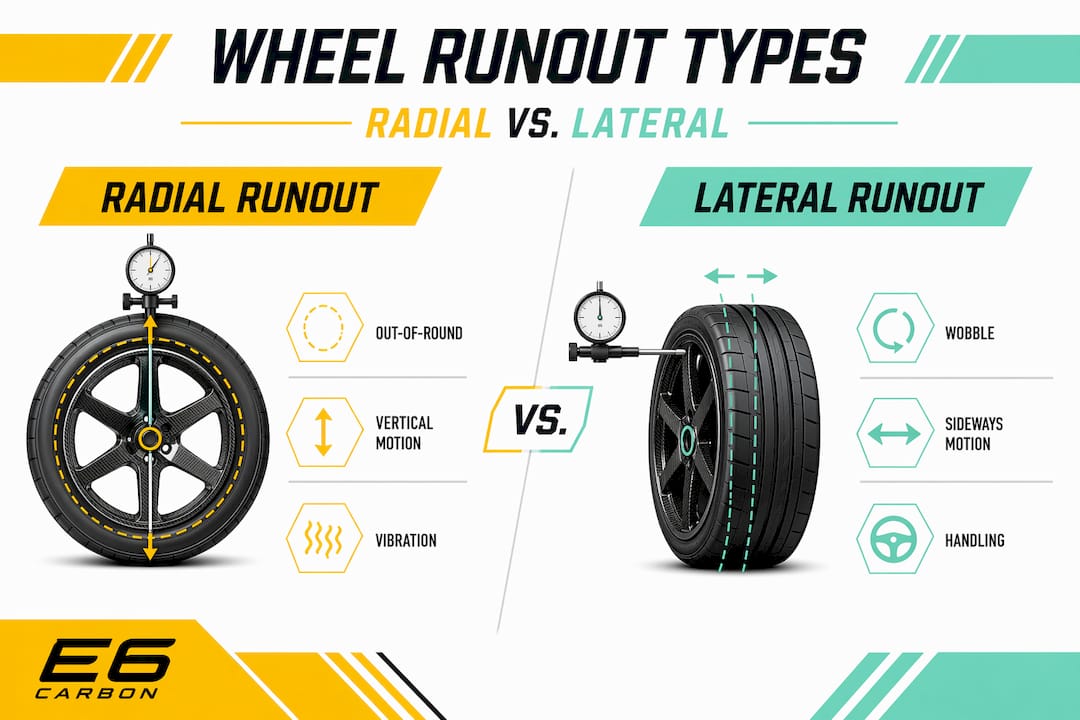
- Radial runout: How much the wheel deviates from a perfect circle as it rotates, measured as an up-and-down movement at the rim surface.
- Lateral runout: How much the wheel wobbles side to side during rotation, measured perpendicular to the rotational axis.
- Mounting face irregularities: Variations in the hub contact surface that can prevent flush, consistent seating against the vehicle’s hub flange.
Forged wheels outperform cast wheels in tolerances because the forging process produces a denser, more uniform grain structure with less porosity. But “better than cast” doesn’t mean “perfect.” Even top-tier forged wheels carry some runout from machining, from the heat cycle during forming, and from post-process finishing steps like drilling and painting.
Community-tested guidance, backed by real-world measurement across multiple wheels, points to ~0.030 inches as the acceptable maximum for both radial and lateral runout on street-driven vehicles. That’s roughly 1/32 of an inch, about the thickness of a credit card folded in half. Exceed that, and the consequences stack up quickly: vibrations felt through the steering wheel or seat, uneven tire wear that costs you tread life, degraded handling response, and visual wobble that’s painfully obvious on large-diameter luxury wheels.
Pro Tip: Before you blame your tires or suspension for a persistent shimmy, always check your wheel runout first. A dial indicator tells the truth when everything else points nowhere.
Understanding tolerances also helps you navigate the custom wheels buying process more confidently, and it gives you a concrete standard to hold manufacturers to. If a seller can’t provide runout specs for their forged wheels, that’s a red flag worth taking seriously. Pair this knowledge with a solid grasp of wheel fitment for high-end cars and you’ll make purchasing decisions that pay off on the road and at the track.
Types of wheel runout: Radial vs. lateral tolerances
With those definitions in hand, let’s get into what each type of runout actually does to your driving experience and how differently each affects your vehicle.
Radial runout
Radial runout describes out-of-roundness. As the wheel rotates, it bounces slightly up and down. This creates a rhythmic, speed-dependent vibration felt through the chassis and, in more severe cases, the steering wheel. At low speeds the effect is subtle. At 80 miles per hour, a radial runout of just 0.035 inches can generate a noticeable buzz. On track, where you’re pushing 100-plus mph through sustained corners, the effect compounds dramatically. Radial runout also creates uneven contact between tire and road, accelerating wear in specific zones around the tread.

Lateral runout
Lateral runout is a side-to-side wobble. Where radial runout affects ride comfort, lateral runout directly attacks steering feel and stability. A wheel with excessive lateral runout will feel like it’s wandering slightly at highway speed. You’ll notice it most during high-speed straight-line driving and during braking, when the wheel fights to stay on its intended plane. Aesthetically, lateral runout is the one that catches your eye in a slow rolling shot: that slight wobble in the wheel face that ruins an otherwise stunning build.
“Edge case to watch: runout tolerances depend on what you measure (radial vs lateral; where on the wheel you place the probe; whether the wheel is installed/balanced). The same ‘wheel runout’ spec can mean different things depending on measurement method, which is why some community guidance exists alongside manufacturer-controlled inspection claims.”
Comparison: Radial vs. lateral runout at a glance
| Characteristic | Radial runout | Lateral runout |
|---|---|---|
| Direction of deviation | Up and down | Side to side |
| Primary symptom | Speed-dependent vibration | Steering wander, wobble |
| Most noticeable at | Mid to high speeds | Highway speeds, braking |
| Aesthetic effect | Minimal visual impact | Visible wheel wobble |
| Main wear consequence | Uneven tire tread wear | Bearing and suspension stress |
| Acceptable maximum | ~0.030 in | ~0.030 in |
Key points to keep in mind when interpreting runout readings:
- Measurement location matters enormously. Probe position at the outer rim lip versus the inner barrel can return different values on the same wheel.
- Installed versus off-car readings often diverge because hub and rotor runout stack with wheel runout when the assembly is bolted together.
- A wheel that reads within spec off the car may read out of spec once hub face runout is added to the equation.
The impact on suspension and handling from accumulated runout across the full rolling assembly is significantly larger than any single wheel reading suggests, which is why measuring at multiple points gives you a far more accurate picture.
How to measure forged wheel tolerances accurately
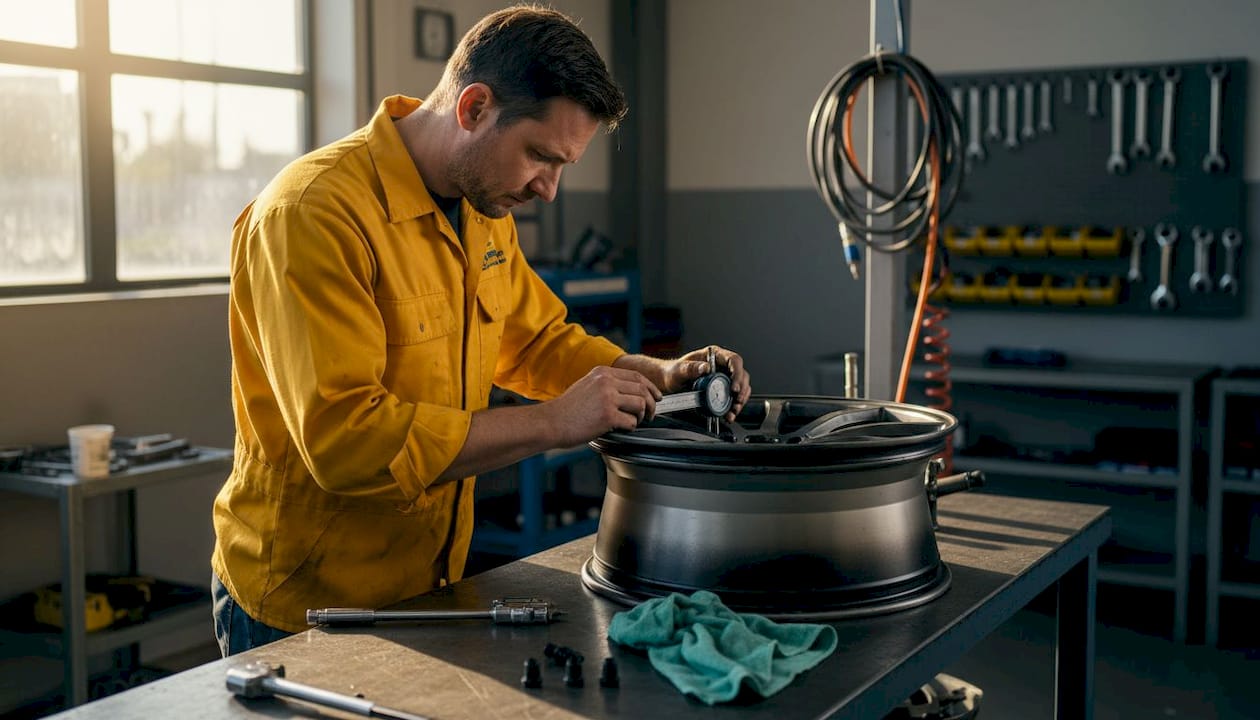
You understand what to look for. Here’s how to actually check your forged wheels’ tolerances at home or with a professional setup.
What you need
- A dial indicator (also called a test indicator) with 0.001-inch resolution
- A magnetic base or adjustable indicator stand
- A clean, flat work surface or an axle stand that allows free wheel rotation
- Painter’s tape or a marker for reference points
Step-by-step measurement process
- Mount the wheel securely. Place the wheel on a dedicated wheel balancing stand or rotate it on the vehicle with the caliper cleared. The wheel must spin freely without any binding at the center bore.
- Position the dial indicator for radial runout. Place the probe at the outer bead seat of the rim, perpendicular to the wheel surface. This is the most commonly referenced measurement point for radial runout.
- Zero the indicator. Rotate the wheel slowly and set zero at the lowest reading. Then rotate through a full 360 degrees, noting the total indicator run (TIR), meaning the difference between the highest and lowest readings.
- Reposition for lateral runout. Move the probe to the inner rim flange, perpendicular to the wheel’s rotational axis. Zero and rotate through 360 degrees again.
- Record both values. Your radial and lateral TIR readings are your runout numbers. Compare them against the ~0.030-inch maximum threshold that community experience and refurbishers widely treat as the street-driving cutoff.
- Check the mounting face. Place the indicator on the hub contact surface and rotate the wheel slowly, watching for face runout that could affect how evenly the wheel seats against your hub.
- Document and compare. Measure all four wheels. A single reading in isolation tells you little. Comparing all four reveals patterns and flags the outlier causing your problem.
Pro Tip: Always clean the bead seat and mounting face before measuring. Dirt, corrosion, or old wheel weight adhesive can skew your readings by several thousandths of an inch, turning a passing wheel into a false failure.
Important context: A wheel reading 0.028 inches radial runout off the car may still produce noticeable vibration once hub runout of 0.010 inches stacks on top, pushing the installed assembly total past 0.038 inches. This is why a full forged wheel inspection always includes a hub face check, not just an isolated wheel check. Before any new set goes on, running through a complete installation guide that addresses torque sequence and hub prep dramatically reduces the chance of tolerance stacking.
Why forged wheel tolerances matter for performance and aesthetics
Now let’s connect these microscopic numbers to real-world consequences that every enthusiast actually cares about.
Performance impact by tolerance level
| Runout level | Driver experience | Long-term consequences |
|---|---|---|
| 0.000 to 0.015 in | Essentially undetectable | Minimal additional wear |
| 0.016 to 0.030 in | Borderline, may notice at speed | Mild additional tire wear |
| 0.031 to 0.050 in | Noticeable vibration at highway speeds | Accelerated tire and bearing wear |
| 0.051 in and above | Clear vibration, steering instability | Rapid component degradation |
The performance case against tolerance exceedances is well-established. Geometric quality issues, particularly runout, directly affect wheel performance, ride quality, and appearance in ways that compound over time and miles.
At street speeds, the consequences are annoyances: a slight shimmy at 70 mph, front tires that wear their center tread faster than the edges. But translate those same numbers to a track session, and the stakes climb sharply. At 120 mph through a sweeping corner, a 0.040-inch lateral deviation becomes a handling variable that your chassis wasn’t designed to absorb. The suspension geometry that your engineers calibrated assumes a true, stable wheel surface. Runout outside tolerance breaks that assumption.
Aesthetically, the stakes are just as real for high-end builds. Large-diameter wheels, think 22-inch and above on luxury SUVs or wide-body sports cars, amplify lateral runout visually because the wobble radius is much larger. A deviation that’s invisible on a 17-inch wheel becomes an obvious, distracting shimmy on a 22-inch centerlock. For show cars, concours entries, or any vehicle where visual perfection is part of the brief, tolerance management is as much an aesthetic discipline as a mechanical one.
Here’s a practical checklist for evaluating tolerance impact on your build:
- Does the vibration appear at a specific speed window and disappear above or below it? That’s a wheel balance or runout signature.
- Are you seeing diagonal or patchy tire wear rather than even tread loss? Runout is a likely contributor.
- Does the steering feel sharper after rotating tires but not after balancing? Lateral runout on a specific corner is worth investigating.
- Is one wheel visually wobbling in slow-speed video while others track true? Lateral runout on that corner needs measuring immediately.
The relationship between wheel design and performance is always tied back to these foundational geometry numbers, and the effects on handling at both ends of your car amplify any tolerance problem you ignore.
What most people miss about forged wheel tolerances
Here’s an opinion worth considering: the pursuit of sub-thousandth-inch perfection in forged wheel tolerances is mostly theater for street and even aggressive track-day use. That’s not permission to run sloppy tolerances. It’s a call for calibrated priorities.
The 0.030-inch threshold that experienced refurbishers and community members use as their practical cutoff isn’t arbitrary. It emerged from real-world measurements on real cars, tested under real driving conditions. It reflects the point where deviation becomes mechanically and perceptually meaningful, not where it theoretically first appears. A wheel running at 0.022 inches radial runout is not meaningfully worse than one running at 0.008 inches, at least not on public roads or club track days.
What we see too often is enthusiasts chasing numbers to the detriment of actually addressing the variables that matter most: hub face runout, tire mounting quality, and torque sequence consistency. A beautifully forged wheel with 0.010-inch runout, installed on a hub with 0.025-inch face runout using inconsistent torque, will behave worse than a 0.028-inch wheel installed correctly on a clean, true hub. The system is what you’re optimizing, not the individual component in isolation.
The wisdom of community-adopted standards is that they encode thousands of hours of hands-on experience into a single, actionable number. Rigid manufacturer spec sheets often target controlled lab conditions that don’t reflect the tolerance stack you’re actually living with once four wheels are bolted to a real car. Treat the 0.030-inch guideline as a meaningful ceiling, not a failure threshold to obsess over.
The art of working with tolerances, rather than against them, is understanding when a number actually demands action and when the more productive move is to look elsewhere. Your car’s feedback is always the final measurement tool. Explore wheel concavity and performance considerations as part of that same systems-level thinking, because everything from spoke geometry to offset plays into how tolerances manifest at the contact patch.
Get the most from your forged wheels
Ready to take the next step in your automotive journey? Here’s where to go for inspection guides, step-by-step tools, and top-tier forged wheels.
Understanding tolerances is only valuable when paired with action. Before your next drive, run a proper inspection using the steps above, starting with a safety inspection guide that covers everything from runout to structural integrity checks. If you’re planning to mount a new set, the installation step-by-step guide walks you through hub prep, torque sequences, and the details that protect your investment from day one.

At E6 Forged, every wheel in our catalog is manufactured to tight runout tolerances as a baseline, not as an upgrade. If you’re ready to move from correcting problems to eliminating them at the source, our premium forged wheel options are built for the standards this article describes. Precision starts at the forge, and it’s maintained through every step of finishing, machining, and quality control before a wheel reaches your vehicle.
Frequently asked questions
What is the maximum allowable runout for forged wheels?
Most community and industry guidance suggests a maximum of around 0.030 inches for both radial and lateral runout on street-driven and performance vehicles. Exceeding this threshold is where perceptible vibration and wear typically begin.
Can small forged wheel tolerances really affect driving?
Yes. Even minor deviations cause vibrations and handling changes that become significantly more pronounced at higher speeds and can accelerate tire, bearing, and suspension wear over time.
How is wheel runout measured in a garage setting?
Wheel runout is most accurately measured using a dial indicator placed at the rim, with the wheel rotating slowly through a full 360 degrees to capture the total indicator run between the highest and lowest readings.
Is a perfectly true forged wheel possible?
Achieving zero runout is essentially impossible in practice. Even premium forged wheels carry small tolerances from manufacturing, machining, and finishing processes, which is precisely why defined tolerance standards exist to define what’s acceptable versus what requires correction.