

TL;DR:
- Directional wheel design features rotationally oriented spoke patterns that require separate left and right configurations to optimize aesthetics and mechanical stiffness. Properly engineered spoke geometry enables independent tuning of stiffness parameters, improving handling and load response, unlike purely visual designs. Accurate installation and verification of fitment, load ratings, and engineering specifications are essential to realize these performance benefits.
Directional wheel design is defined as a spoke configuration where the geometry is rotationally oriented, requiring distinct left and right wheel configurations to maintain correct visual flow and, in advanced applications, optimized mechanical stiffness properties. The spoke pattern angles toward the wheel’s rotation direction, producing a turbine-like appearance that conveys forward motion even at rest. Understanding this concept matters beyond aesthetics: 2026 SAE research confirms that engineered spoke geometry in directional wheels can decouple longitudinal, lateral, and vertical stiffness independently, delivering measurable handling advantages on platforms like Mercedes-AMG, Lexus LC500, and McLaren.
How directional spoke patterns shape aesthetics and perceived motion
The visual logic of directional wheel design is straightforward but precise. Spokes flow outward like turbine blades, angled in the direction of wheel rotation, creating a sense of planted aggression and forward momentum even when the car is parked. This effect is not accidental. Designers deliberately mirror the left and right wheel spoke patterns so the visual sweep on both sides of the vehicle converges toward the front, reinforcing the car’s forward stance.

Manufacturers like ALT11 Forged Wheels have built their entire catalog around this principle, offering directional spoke sets that work across a wide range of platforms without requiring platform-specific visual compromises. The result is an aggressive aesthetic that reads consistently whether fitted to a Lamborghini Huracán or a Lexus LC500. The turbine flow also creates depth perception in the wheel face, making a 20-inch wheel appear larger and more dynamic than a comparable radial-spoke design.
Key visual features that define directional wheel design include:
- Swept spoke geometry angled in the direction of rotation, distinct from symmetrical radial spokes
- Mirror-image left and right wheels so the visual sweep is consistent on both sides of the vehicle
- Turbine-like spoke flow that creates a sense of rotational energy and planted stance
- Aggressive face depth achieved through spoke curvature that adds visual mass to the wheel face
Pro Tip: When specifying directional wheels for a Mercedes-AMG GT or Lexus LC500, always confirm left and right designations at the point of order. Reversing the pair produces a backward-spinning visual effect that undermines the entire design intent.
What are the mechanical engineering principles behind directional stiffness?
The most significant development in directional wheel mechanics comes from 2026 SAE research on meta-wheels with three-dimensional discrete curved spokes. This work proves that adjusting two geometric parameters, the curvature angle (α) and the inclination angle (β), allows engineers to independently tune longitudinal, lateral, and vertical stiffness within a single wheel structure.
The inclination angle β is the primary driver of stiffness decoupling. Increasing β raises longitudinal stiffness while simultaneously reducing lateral stiffness, with vertical stiffness remaining nearly unchanged at approximately 1.4% variation. This matters enormously for handling: higher longitudinal stiffness improves braking response and acceleration traction, while reduced lateral stiffness allows the wheel to absorb cornering loads with greater compliance, reducing harshness without sacrificing structural integrity.
| Parameter | Effect on stiffness | Handling implication |
|---|---|---|
| Inclination angle β (increased) | Raises longitudinal, reduces lateral | Better braking response, improved cornering compliance |
| Curvature angle α (adjusted) | Tunes stiffness ratio between axes | Enables platform-specific handling balance |
| Vertical stiffness | Remains ~1.4% unchanged | Load capacity preserved under all conditions |
The engineering workflow that enables this is equally important. Simulation and analytical screening maps desired stiffness ratios to geometric parameters before full-wheel verification, compressing the design feasibility phase significantly. For engineers specifying wheels for a McLaren 720S or Mercedes-AMG C63, this means stiffness targets can be defined at the outset and verified computationally before a single forged blank is cut.
Pro Tip: Visual directionality alone does not produce these stiffness benefits. Performance gains are tied specifically to spoke geometry parameters α and β, not simply to the spoke pattern appearing to rotate in one direction.
Directional vs. asymmetric wheels: which design performs better?
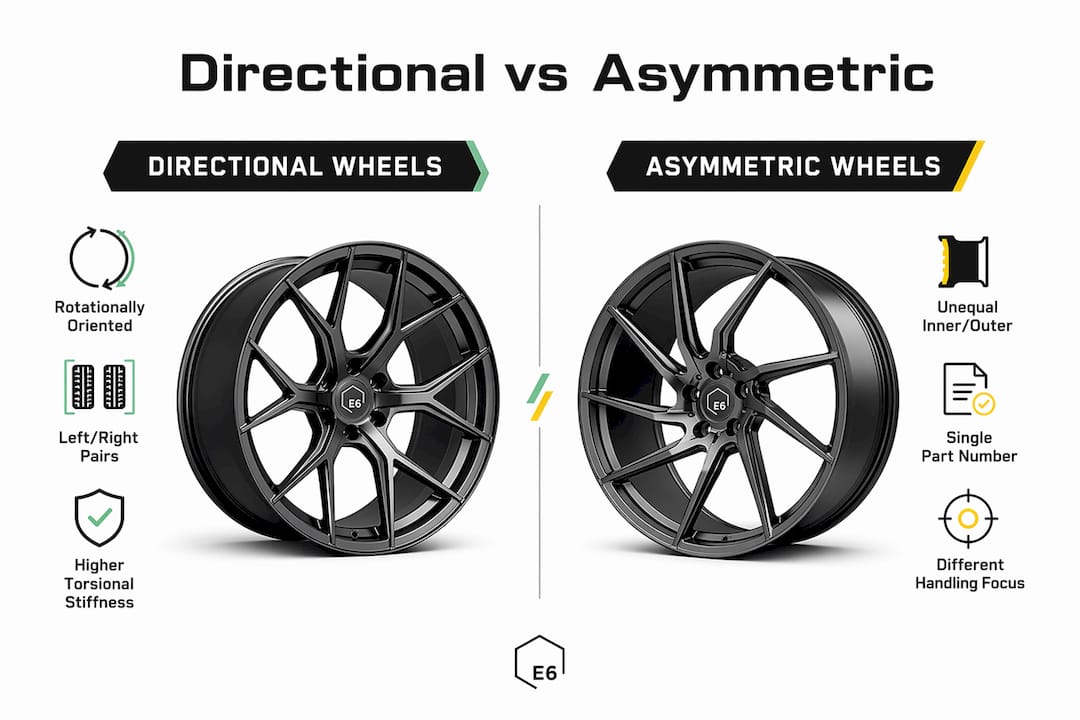
Directional and asymmetric wheels are frequently confused, but they address fundamentally different engineering problems. Directional wheels have rotationally oriented spoke patterns requiring left and right configurations. Asymmetric wheels have distinct inner and outer spoke profiles on a single wheel, allowing the same wheel to be mounted on either side of the vehicle.
The performance differences between these two designs are quantifiable. Directional wheels show up to 19% higher torsional rigidity compared to asymmetric designs under equivalent load conditions. Torsional rigidity directly affects steering precision and lateral stability, which is why directional designs are favored in track-focused applications on platforms like the Lamborghini Urus Performante and McLaren Artura. Asymmetric wheels, by contrast, exhibit better radial compliance and fatigue resistance, making them more suitable for daily-driven performance vehicles where ride quality over imperfect surfaces matters.
Thermal behavior also differs. Directional spoke geometry creates more consistent airflow across the brake rotor face, improving heat dissipation during repeated hard braking. Asymmetric designs prioritize structural load distribution across the wheel face, which benefits fatigue life under sustained lateral loading. For a Mercedes-AMG E63 used primarily on track days, directional geometry is the stronger specification. For a Lexus LC500 covering mixed road and occasional circuit use, asymmetric construction may offer a better balance of compliance and longevity.
Procurement adds another layer of complexity. Directional sets require separate left and right part numbers, doubling inventory requirements and increasing the risk of mismatched fitment. Tight manufacturing tolerances and runout controls are non-negotiable for directional wheels to perform as specified. A wheel with even minor runout deviation will compromise the stiffness decoupling benefits that justify the design in the first place.
Practical considerations for selecting and installing directional wheels
Getting directional wheel fitment right requires attention to four specific areas:
- Confirm left and right designations before mounting. Incorrect installation reverses the visual flow and can alter the mechanical stiffness orientation relative to the vehicle’s load paths. Always verify wheel markings against the manufacturer’s fitment guide.
- Match bolt pattern, offset, and hub bore to the platform. Mercedes-AMG platforms typically run 5×112 bolt patterns with hub-centric bore requirements. Lexus LC500 uses 5×114.3. McLaren and Lamborghini fitments vary by model year and require verified offset data to avoid contact with suspension geometry.
- Check regulatory compliance markings. Directional wheels sold for road use in the United States must carry DOT-compliant load ratings. Confirm that left and right wheels are individually labeled with directional rotation indicators.
- Do not assume visual directionality equals performance directionality. A wheel with swept spokes but no engineered variation in α or β parameters is an aesthetic product. The handling benefits described in the SAE research require deliberate geometric engineering, not just a turbine-style spoke pattern.
Pro Tip: When ordering directional wheels for a McLaren or Lamborghini, request the manufacturer’s stiffness specification sheet alongside the fitment data. If no stiffness data exists, the wheel is a visual directional design only.
Key takeaways
Directional wheel design delivers both visual and mechanical advantages, but only when spoke geometry is engineered to specific stiffness parameters rather than styled for appearance alone.
| Point | Details |
|---|---|
| Definition of directional wheels | Spoke patterns are rotationally oriented, requiring distinct left and right wheel configurations. |
| Mechanical stiffness decoupling | Adjusting angles α and β independently tunes longitudinal, lateral, and vertical stiffness. |
| Directional vs. asymmetric | Directional wheels offer up to 19% higher torsional rigidity; asymmetric designs provide better fatigue resistance. |
| Fitment precision | Incorrect left/right mounting reverses visual flow and misaligns mechanical stiffness orientation. |
| Aesthetics vs. performance | Visual directionality does not guarantee stiffness benefits without engineered spoke geometry parameters. |
Where directional design is heading, and what it means for your build
From where E6 Engineering sits, the most underappreciated aspect of directional wheel design is the gap between what the market sells and what the engineering actually requires. Most wheels marketed as directional are visual products. The spokes sweep convincingly, the turbine effect is real, and the aesthetic payoff is significant. But the stiffness decoupling work coming out of SAE research in 2026 represents a genuine shift in what directional geometry can accomplish mechanically.
The practical implication for enthusiasts specifying wheels for a Mercedes-AMG GT63 or a Lexus LC500 is this: ask harder questions. A wheel that looks directional is not the same as a wheel engineered with controlled α and β parameters to deliver specific longitudinal and lateral compliance ratios. The difference shows up in lap times and in how the car communicates through the steering on a fast sweeper.
The next generation of forged directional wheels will close this gap. Manufacturers who invest in computational stiffness screening during the design phase, rather than applying directional aesthetics after the fact, will produce wheels that justify their price through measurable performance. That is the standard E6 Carbon holds its own engineering to, and it is the standard worth demanding from any wheel you put on a serious performance build.
— E6 Engineering
Build your directional wheel specification with E6 Carbon
E6 Carbon engineers directional forged wheels with the precision tolerances that separate a performance product from an aesthetic one. Every wheel in the E6 Forged catalog is built to verified fitment data for Mercedes-AMG, Lexus LC500, McLaren, and Lamborghini platforms, with monoblock and multi-piece configurations available to match your stiffness and weight targets.

Unsprung weight reduction and runout control are built into the manufacturing process, not added as afterthoughts. If you are specifying directional wheels for a track build or a high-end street presence, start with E6 Forged wheel tolerances to understand what precision manufacturing actually delivers. For platform-specific fitment across the full E6 Forged catalog, explore the E6 Forged wheel range and configure your build with verified offset, bolt pattern, and stiffness data.
FAQ
What does directional wheel design mean?
Directional wheel design means the spoke pattern is oriented to rotate in a specific direction, requiring separate left and right wheel configurations. This creates a turbine-like visual effect and, when engineered with controlled spoke geometry, enables directional stiffness tuning.
Do directional wheels actually improve handling?
Handling improvement depends on spoke geometry, not visual appearance alone. SAE 2026 research confirms that adjusting inclination angle β raises longitudinal stiffness and reduces lateral stiffness, producing measurable handling benefits when engineered deliberately.
What is the difference between directional and asymmetric wheels?
Directional wheels use rotationally oriented spokes requiring left and right pairs. Asymmetric wheels have distinct inner and outer profiles on a single wheel. Directional designs offer up to 19% higher torsional rigidity, while asymmetric designs provide better radial compliance and fatigue resistance.
Can you mount a directional wheel on the wrong side?
Mounting a directional wheel on the incorrect side reverses the visual flow and misaligns the mechanical stiffness orientation relative to the vehicle’s load paths. Always verify left and right markings before installation.
Are directional wheels the same as directional tires?
No. Directional tires use tread patterns designed to rotate one way for grip and water evacuation. Directional wheels refer to spoke geometry orientation. Both require correct rotational mounting, but they are separate components with distinct engineering functions.