TL;DR:
- Shipping forged wheels safely requires precise immobilization within engineered packaging that prevents internal movement and protects against transit hazards. Proper materials, step-by-step packing protocols, and accurate documentation with insurance coverage are essential to avoid damage, delays, and disputes during international transport. Layering immobilization and comprehensive preparation ensures high-value forged wheels arrive intact and ready for installation.
Shipping forged wheels safely requires complete immobilization of each wheel inside engineered packaging that eliminates internal movement and protects against every transit hazard. A monoblock or multi-piece forged wheel set for a Mercedes-AMG GT or Lexus LC500 represents thousands of dollars in precision manufacturing. One drop, one unsupported rim lip contacting a cardboard wall, or one moisture-compromised box can compromise that investment before the wheels ever touch a hub. This guide covers the exact packaging protocol, shipping method trade-offs, documentation requirements, and insurance strategies that protect high-value forged wheel shipments from origin to delivery.
How to ship forged wheels safely: materials you need first
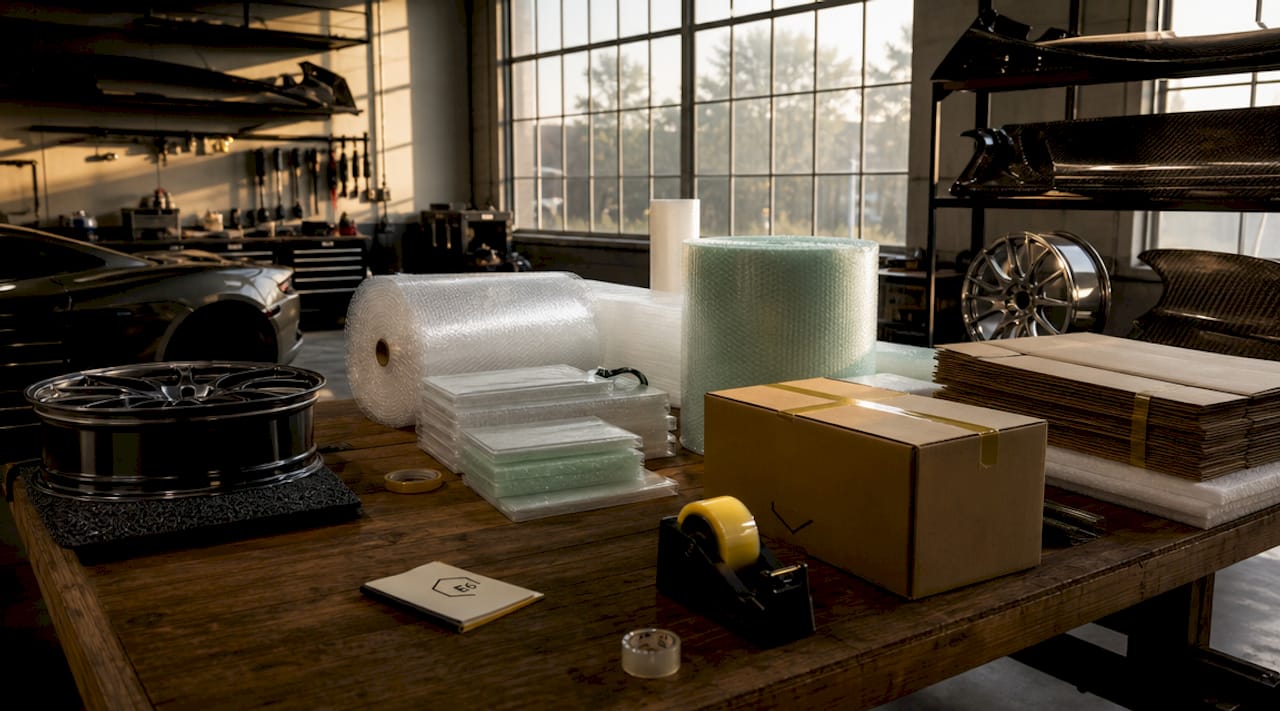
The packaging you select is not padding. It is an immobilization system designed to hold each wheel in a fixed position regardless of what happens outside the box. Every material choice must serve that single engineering objective.
Required packaging materials:
- Heavy-duty double-wall corrugated boxes sized to wheel diameter plus a minimum 4-inch clearance on all sides for cushioning layers
- High-density foam cradles or inserts cut or molded to match the wheel profile and lock it in position at the center bore and outer barrel
- Rigid corner protectors made from molded foam or reinforced cardboard to prevent box corner collapse under stacking loads
- Bubble wrap or closed-cell foam sheeting applied directly to the wheel face and spoke surfaces to prevent abrasion and finish damage
- Moisture-resistant plastic film or poly bags to seal the wheel against humidity, condensation, and sea freight moisture exposure
- Heavy-duty packing tape rated for shipping stress, used in the H-taping method on all box seams
- Ratchet straps and pallet wrap for bulk shipments of four or more wheels on a wooden pallet
| Material | Purpose | Minimum spec |
|---|---|---|
| Double-wall corrugated box | Structural containment | 275 lb burst strength |
| High-density foam cradle | Wheel immobilization | 2 lb/ft³ density minimum |
| Poly moisture barrier | Moisture protection | 4-mil polyethylene film |
| Corner protectors | Edge and corner reinforcement | Rigid foam or triple-wall card |
| Heavy-duty tape | Seam sealing | 2-inch wide, 3.0 mil minimum |
Pro Tip: Never reuse boxes from previous shipments. Damp or weakened cardboard fails under transit stress at a rate that makes the cost savings irrelevant. Fresh, rated boxes are non-negotiable for forged wheel shipments.
Step-by-step packing protocol to prevent movement and damage
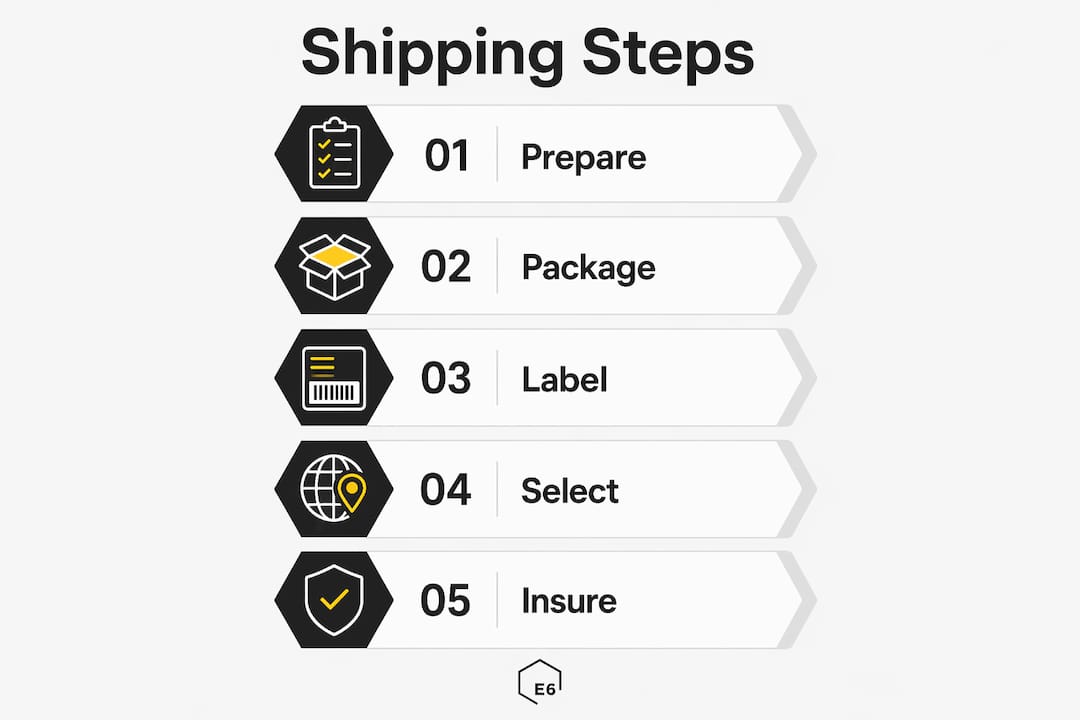
The step-by-step packing protocol for forged wheels follows a specific sequence. Skipping any step introduces a failure point that compounds under the vibration, stacking, and impact loads of real freight transit.
Measure the wheel accurately. Record the overall diameter, width, and offset. Select a box that provides at least 4 inches of clearance on every face after foam cradles are installed. A tight box with thin cushioning is worse than a properly sized box with full foam coverage.
Reinforce the box base before loading. Apply two full strips of heavy-duty tape across the bottom flaps in an H-pattern, then add two diagonal strips across the corners. The base absorbs the highest compressive load during stacking.
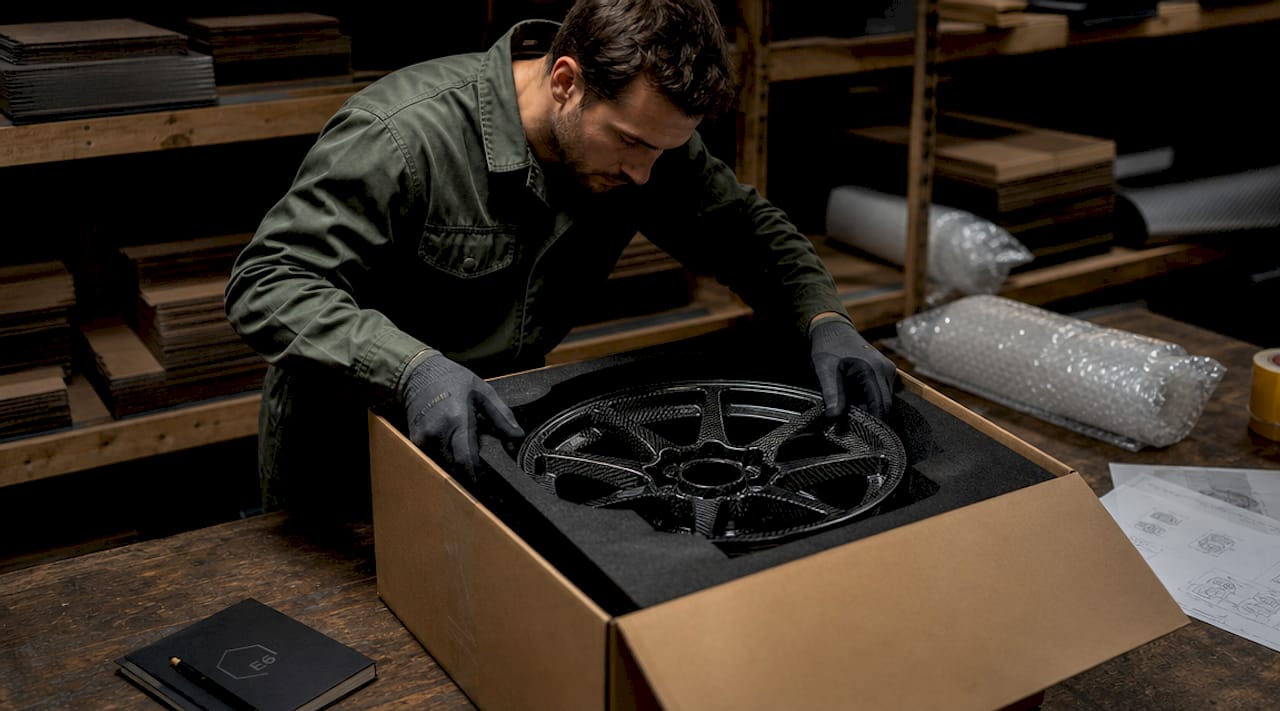
Install foam cradles in the box corners and base. Cut high-density foam to create a cradle that supports the wheel at its center bore and prevents the barrel from contacting the box walls. The rim lip must never contact the cardboard wall, even during a corner drop or side impact. Direct contact causes rim deformation that compromises both finish quality and structural integrity.
Wrap the wheel face and spokes. Apply two layers of closed-cell foam sheeting or bubble wrap across the entire wheel face, securing with tape. For wheels with machined or polished finishes, add a soft microfiber layer directly against the surface before the foam wrap.
Place the wheel face-up in the box. Lower it onto the foam cradle so the barrel rests in the cradle without touching the box walls. The face-up orientation protects the most visible and most finished surface from contact damage.
Fill all void spaces completely. Pack high-density foam blocks or crumpled kraft paper into every gap between the wheel and box walls. Zero movement inside the box is the target. Shake the closed box before sealing. If you hear or feel any movement, add more fill material.
Apply plastic protective film over the wheel face before closing the box flaps. This creates a final moisture barrier and protects against condensation during sea freight transit.
Seal all seams using the H-taping method. Run tape along the center seam, then two perpendicular strips across the ends. This pattern guards against moisture ingress and prevents seam separation under load.
Pro Tip: After sealing, affix orientation arrows on all four sides and a “Fragile” label flat on the top face. Proper labeling with HS codes and handling instructions reduces rough handling and speeds customs processing.
What shipping method is best for forged wheels?
The choice between sea freight and air freight for shipping forged wheels is a direct trade-off between cost, transit time, and risk exposure. Sea freight costs $1.50 to $3.00 per kilogram with a 20 to 30 day transit window. Air freight runs $5 to $15 per kilogram with a 5 to 7 day transit window. A typical four-wheel set for a McLaren 720S or Lamborghini Urus weighs 80 to 100 kilograms, which makes the cost differential significant on every shipment.
Sea freight delivers cost savings of 60% to 80% over air freight for bulk shipments. That advantage only holds when you plan ahead. Last-minute sea freight bookings eliminate the cost benefit and add risk from rushed packaging. For bulk orders of eight or more wheels, palletizing with blocking, bracing, and ratchet strapping nearly eliminates internal movement during ocean transit and is the professional standard for export logistics.
Air freight suits urgent deliveries, single-wheel replacements, and high-value one-off shipments where the cost premium is justified by delivery speed. Note that air carriers price bulky forged wheels on dimensional weight, not actual weight. A large-diameter wheel in a properly sized box will often trigger dimensional weight pricing that exceeds the actual weight rate.
Freight forwarder selection matters. Work with forwarders who have documented experience handling automotive parts and understand the specific fragility of forged alloy wheels. A general freight forwarder without automotive experience will not flag improper stacking or inadequate handling instructions.
How to manage documentation, customs, and insurance
International wheel shipments require three core documents prepared before handoff to the carrier: a commercial invoice with accurate declared value, a packing list with exact weights and dimensions, and a certificate of origin. Accurate documentation prevents customs holds, fines, and delivery delays that can add weeks to transit time.
Declare the true replacement or market value on all shipping documents. Undervaluing a set of forged wheels to reduce duties creates two problems: it exposes you to customs penalties, and it caps your insurance recovery at the declared amount, not the actual loss. For DDP (Delivered Duty Paid) shipments, negotiate this term with your freight forwarder to eliminate surprise duty charges for the recipient.
Layering declared value coverage with third-party cargo insurance is the correct approach for high-value forged wheel shipments. Carrier declared value coverage only applies when the carrier is at fault. Third-party cargo insurance covers broader risks including handling damage, theft, and weather events. Insurance fees typically run 0.1% to 2% for declared value coverage and 0.5% to 3% for cargo insurance. Against the replacement cost of a bespoke forged set, that premium is minimal.
Pro Tip: Photograph every stage of the packaging process before sealing the box. Timestamped photos of the wheel condition, foam cradle placement, and sealed box create the documentation trail needed to support a damage claim without dispute.
Common mistakes that damage forged wheels in transit
Most shipping damage to forged wheels traces back to a small set of repeatable errors. Recognizing them before you pack is cheaper than filing a claim after delivery.
- Reusing compromised boxes. Cardboard that has absorbed moisture loses up to 50% of its compressive strength. A box that held a wheel safely once will not necessarily do so again.
- Allowing rim contact with box walls. Even a single corner drop transfers enough force through direct contact to deform a rim lip or crack a machined barrel edge. Foam cradles must prevent this contact under all impact orientations.
- Insufficient void fill. Any internal movement during transit is cumulative impact damage. A wheel that shifts 2 inches inside a box during a 30-day ocean crossing sustains thousands of micro-impacts.
- Incomplete customs documentation. Missing HS codes, incorrect declared values, or absent certificates of origin trigger holds that can strand a shipment for weeks.
- Underinsuring the shipment. A set of monoblock forged wheels for a Mercedes-AMG GT63 S can exceed $8,000 in replacement value. Carrier liability limits rarely cover more than a fraction of that figure.
Packaging is not the last step before shipping. It is the first line of engineering defense for every wheel you put in transit.
Key takeaways
Shipping forged wheels without damage requires treating the packaging as an engineered immobilization system, not a simple protective wrap, and layering that with correct documentation and insurance coverage.
| Point | Details |
|---|---|
| Immobilization is the primary goal | Foam cradles and void fill must eliminate all internal wheel movement before sealing. |
| Rim contact causes structural damage | Wheel lips and barrels must never touch box walls, even during corner drops or side impacts. |
| Sea vs. air freight is a cost-speed decision | Sea freight saves 60% to 80% on cost; air freight cuts transit to 5 to 7 days for urgent shipments. |
| Documentation prevents customs delays | Commercial invoice, packing list, and certificate of origin must be accurate and complete before carrier handoff. |
| Layer your insurance coverage | Combine declared value coverage with third-party cargo insurance to protect the full replacement value of high-value forged sets. |
What shipping forged wheels has taught us at E6 Carbon
The most consistent failure mode we see is not inadequate packaging materials. It is the assumption that packaging is about protection rather than immobilization. Those two objectives sound similar but produce very different packaging designs. Protection thinking leads to wrapping a wheel in bubble wrap and hoping for the best. Immobilization thinking leads to engineering a foam cradle that holds the wheel in a fixed position regardless of what the box experiences outside.
The second lesson is documentation. Photographing every stage of the packaging process before sealing has resolved more potential disputes than any other single practice. When a recipient claims damage, timestamped photos showing the wheel in perfect condition inside a properly constructed package shift the burden of proof immediately. This is not just dispute protection. It is professional practice that signals to freight forwarders and customs agents that the shipment was handled with precision.
For international shipments of bespoke forged sets to platforms like the Lexus LC500 or McLaren 720S, we recommend working with freight forwarders who specialize in automotive parts. The difference in handling quality between a general forwarder and an automotive specialist is measurable in damage rates. The cost premium for a specialist forwarder is consistently lower than the cost of a single damage claim on a high-value set.
— E6 Engineering
E6 Carbon forged wheels: engineered to ship and perform
E6 Carbon builds every forged wheel set to tolerances that demand equally precise handling from manufacturing through delivery. Our monoblock and multi-piece forged configurations for Mercedes-AMG, Lexus LC500, and McLaren platforms are inspected against forged wheel safety standards before packaging, so the wheel that leaves our facility is the wheel that arrives at yours.
Every E6 Carbon wheel ships with engineered foam cradles, moisture-barrier film, and double-wall corrugated packaging built to the specifications covered in this guide. If you are selecting a new forged set or replacing a damaged wheel, explore the full E6 Carbon catalog at E6 Forged Wheels to find the correct configuration for your platform, offset, and finish specification.
FAQ
What is the most important rule when packing forged wheels?
Complete immobilization is the single most critical requirement. Foam cradles must hold the wheel in a fixed position so the rim lip and barrel never contact the box walls, even during corner drops or side impacts.
How long does international forged wheel shipping take?
Sea freight transit runs 20 to 30 days at significantly lower cost. Air freight delivers in 5 to 7 days at a cost of $5 to $15 per kilogram, making it the correct choice for urgent or single-wheel replacement shipments.
Do I need cargo insurance for shipping forged wheels?
Yes. Carrier declared value coverage only applies when the carrier is at fault. Third-party cargo insurance covers the full range of transit risks and is the correct approach for any high-value forged wheel shipment.
What documents are required for international wheel shipments?
A commercial invoice, packing list, and certificate of origin are required before carrier handoff. Accurate HS codes and declared values prevent customs holds and protect your insurance recovery in the event of a claim.
Can I reuse a box from a previous wheel shipment?
No. Cardboard that has absorbed moisture or sustained previous transit stress loses structural integrity. Always use fresh, heavy-duty double-wall corrugated boxes rated for the weight and dimensions of your specific wheel set.