
TL;DR:
- Valved exhaust systems route gases through quiet or straight paths, controlling sound and performance based on driver input. They improve low-RPM torque, eliminate highway drone, and elevate exhaust sound at high RPM by opening valves fully. These systems use materials like titanium and Inconel for durability and fit specifically on models like the Lexus LC500 and Mercedes-AMG GT.
A valved supercar exhaust system is an adaptive exhaust mechanism that routes engine gases through two distinct paths, one quiet and baffled, one straight and raw, depending on driver input or ECU command. The daily drivability of valved supercar exhaust systems is the defining reason modern grand tourers like the Lexus LC500 and Mercedes-AMG GT can serve as both executive transport and track weapons. The butterfly valve at the core of these systems controls backpressure, sound volume, and exhaust scavenging in real time. No other single exhaust technology delivers this range of character without a hardware swap.
How do valved exhaust systems control backpressure and sound?
The butterfly valve is a disc-shaped plate mounted inside the exhaust pipe. When closed, it restricts flow and forces exhaust gases through a secondary path lined with resonators and sound-dampening baffles. This restriction increases backpressure at low RPM, which is an intentional engineering feature. Higher backpressure at low engine speeds improves exhaust gas velocity and boosts torque, exactly what you need pulling out of a parking garage or cruising city streets.
The baffled routing also eliminates the resonance drone that plagues fixed-pipe exhaust systems at highway cruising speeds. Resonators and mufflers integrated within the closed-valve path preserve sound clarity without choking flow efficiency. The result is a cabin experience closer to a luxury sedan than a race car, which is precisely the point for daily driving supercars.
| Condition | Backpressure | Cabin Noise | Torque Character |
|---|---|---|---|
| Valves closed, city cruise | High | Low, refined | Strong low-RPM pull |
| Valves closed, highway | Moderate | Minimal drone | Smooth, linear |
| Valves open, spirited drive | Low | Aggressive, full volume | Peak mid-to-high RPM |
| Valves open, wide-open throttle | Minimal | Motorsport level | Maximum scavenging |
Pro Tip: If your daily commute runs through noise-restricted residential zones, keep valves closed until you reach open road. The baffled path cuts exterior sound output significantly without any loss of throttle response.
What happens when you open the exhaust valves fully?
Opening the exhaust valves fully removes the butterfly disc from the flow path and straightens the gas routing to a near-direct pipe. Backpressure drops sharply. Exhaust scavenging, the process where exiting gases pull fresh charge into the cylinder, reaches its peak efficiency. The engine breathes freely, and horsepower climbs toward its rated ceiling.

The acoustic change is equally dramatic. The muted, baffled tone disappears and the full exhaust note fills the cabin and the surrounding air. On a Mercedes-AMG GT with a 4.0-liter twin-turbocharged V8, that note shifts from a composed rumble to a sharp, layered crack on upshifts. On a Lexus LC500 with its naturally aspirated 5.0-liter V8, the open-valve sound is a high-revving, operatic wail that no fixed exhaust can replicate on demand.
Key changes when valves open fully:
- Backpressure drops to near-zero, freeing maximum horsepower
- Exhaust scavenging efficiency peaks, improving volumetric efficiency
- Sound transitions from refined to full motorsport character
- Throttle response sharpens noticeably at mid-to-high RPM
- Straight-through routing eliminates the acoustic filtering of baffles
Pro Tip: Engage open-valve mode before entering a highway on-ramp or a track session, not mid-corner. The torque character shifts toward the top of the rev range, so your throttle inputs need to adjust accordingly.
What materials make valved exhaust systems last?
Grade-5 titanium and Inconel 625 are the two materials that separate a purpose-built valved system from a catalog bolt-on. Grade-5 titanium, also called Ti-6Al-4V, delivers tensile strength comparable to steel at roughly 40% of the weight. That weight reduction matters for unsprung mass and for the thermal cycling stress that exhaust systems endure across thousands of heat-and-cool cycles. You can read more about lightweight material benefits in performance applications to understand why mass reduction compounds across the drivetrain.
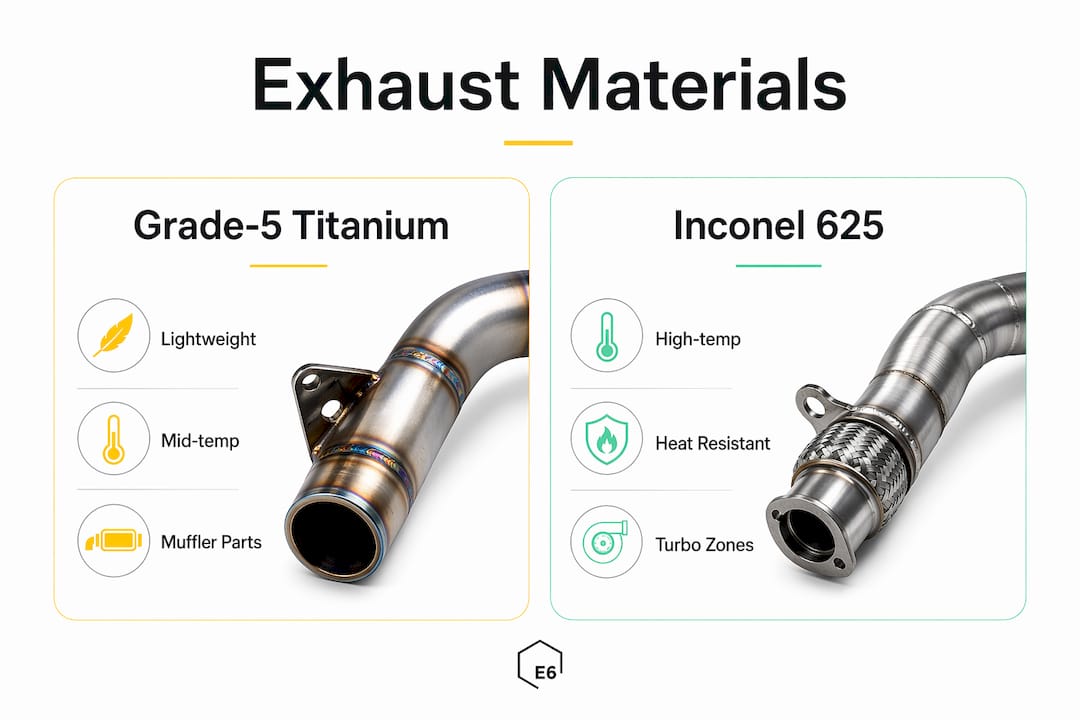
Inconel 625 handles what titanium cannot. This nickel-chromium superalloy maintains structural integrity above 1,800°F, making it the correct material for primary headers and collector sections where exhaust gas temperatures peak. At those temperatures, standard stainless steel begins to lose yield strength. Inconel 625 does not. For high-output platforms like the AMG GT or top-tier performance exhaust builds, this thermal stability is non-negotiable.
Digital 3D modeling at millimeter-level precision optimizes every bend, collector, and transition in the exhaust path. This is not aesthetic work. Every degree of bend angle and every collector diameter affects gas velocity, turbulence, and the acoustic frequency the system produces. Precise modeling means the open-valve sound is tuned, not accidental.
| Material | Max Temp Rating | Weight vs. Steel | Primary Application |
|---|---|---|---|
| Grade-5 titanium | ~1,200°F sustained | ~40% lighter | Mid-pipe, muffler housing |
| Inconel 625 | Above 1,800°F | Heavier than titanium | Headers, collectors |
| 304 stainless steel | ~1,600°F | Baseline | Budget systems |
| 321 stainless steel | ~1,650°F | Baseline | Mid-grade systems |
The executive cruise vs. the supercar experience
The dual-character nature of a valved system is most visible on the Lexus LC500 and Mercedes-AMG GT, two cars that owners genuinely drive daily and push hard on weekends.
The executive cruise (valves closed)
With valves closed, exhaust gases route through the full baffled path. The cabin stays quiet enough for phone calls and music at normal volume. The LC500’s V8 settles into a composed, low-frequency hum that suits long-distance highway travel. The Mercedes-AMG GT feels like a grand tourer rather than a race car. Ride compliance, steering weight, and exhaust note all align toward comfort. This is the mode for airport runs, valet arrivals, and residential neighborhoods.
The supercar experience (valves open)
ECU integration via electric servo motors or vacuum actuators means valve position changes in under a second from an interior control module or automatically based on throttle position and RPM. The transition is immediate. On the AMG GT, Sport Plus or Race mode triggers valve opening and the exhaust character changes before the driver finishes pressing the button. The E6 Motorsports valved exhaust line is engineered for platforms like the LC500 and AMG GT, with fitment-first design that preserves OEM sensor placement and catalytic converter compliance while unlocking the full acoustic and performance range.
- Select your drive mode from the interior control module or dedicated exhaust button.
- The ECU signals the servo motor to rotate the butterfly valve to the open position.
- Exhaust gases bypass the baffled secondary path and flow straight through.
- Sound volume and character shift within one engine cycle.
- Throttle response and peak power availability increase immediately.
The E6 Motorsports catback exhaust for the E63 AMG demonstrates how this platform-specific engineering translates to real-world fitment precision on Mercedes-AMG applications.
Key Takeaways
Valved supercar exhaust systems deliver genuine dual-character performance by routing exhaust gases through baffled paths when quiet and straight-through paths when full power and sound are demanded.
| Point | Details |
|---|---|
| Butterfly valve function | Closed valves increase backpressure to boost low-RPM torque and eliminate highway drone. |
| Open-valve performance | Full valve opening maximizes scavenging, horsepower, and aggressive exhaust acoustics. |
| Material selection | Inconel 625 handles temperatures above 1,800°F; Grade-5 titanium cuts weight by roughly 40% vs. steel. |
| ECU integration | Servo-actuated valves switch modes in under a second via interior controls or automatic RPM triggers. |
| Platform fit | E6 Motorsports systems are engineered specifically for Lexus LC500 and Mercedes-AMG GT with OEM-compatible fitment. |
Why valved exhausts are non-negotiable for serious supercar owners
The conventional wisdom says you choose between a quiet daily driver and a loud performance car. That framing is wrong, and I have seen it proven wrong on every LC500 and AMG GT build we have worked on at E6 Carbon. A properly engineered valved system does not compromise either character. It delivers both, on demand, without the owner thinking about it.
What most articles miss is the maintenance angle. The butterfly valve mechanism, whether servo-driven or vacuum-actuated, is a moving part inside a high-heat environment. Owners who ignore periodic inspection of the actuator seals and valve disc condition will eventually find the valve stuck open or stuck closed. Neither failure is catastrophic, but a valve stuck open means you lose the quiet mode permanently. For an executive who drives the AMG GT to client meetings, that matters.
The emotional case for valved exhausts is equally real. The ability to press a button and transform the acoustic character of your car is not a gimmick. It changes how you engage with the drive. I have watched owners who commute in near-silence all week open the valves on a Saturday morning and rediscover why they bought a supercar in the first place. That transition is what makes these systems worth the engineering investment.
For LC500 and AMG GT owners specifically, the E6 Motorsports valved exhaust line represents the most direct path to this dual-character capability without compromising OEM fitment standards.
— E6 Engineering
E6 Motorsports valved exhaust systems for LC500 and AMG GT owners
E6 Carbon’s E6 Motorsports exhaust line is built for owners who refuse to accept a single-mode exhaust on a dual-purpose supercar. Systems are handcrafted using Grade-5 titanium and Inconel 625, with digital 3D modeling applied to every collector and transition point for precise flow control and tuned acoustics.

Compatibility covers the Lexus LC500 V8 and Mercedes-AMG GT platforms, with fitment-first engineering that preserves OEM sensor locations and emissions compliance. For owners building a complete performance package, E6 Carbon’s performance wheel upgrade guide pairs directly with exhaust upgrades to address both rotational mass and acoustic character in one build plan. Explore the full E6 Motorsports catalog at e6carbon.com to configure the right valved exhaust solution for your platform.
FAQ
What does a valved exhaust system do?
A valved exhaust system uses a butterfly valve to route exhaust gases through either a baffled, quiet path or a straight-through, high-flow path. This gives the driver control over both sound level and performance character from inside the cabin.
Do valved exhausts improve horsepower?
Opening the valves reduces backpressure and maximizes exhaust scavenging, which increases horsepower and sharpens throttle response at mid-to-high RPM.
How do valved exhausts reduce highway drone?
Closed valves route gases through resonators and sound-dampening baffles that absorb the resonance frequencies responsible for drone at cruising speeds.
What materials are used in high-performance valved exhausts?
Grade-5 titanium handles mid-pipe and muffler sections for weight reduction, while Inconel 625 withstands temperatures above 1,800°F in header and collector applications.
Are valved exhaust systems compatible with daily driving?
Valved systems are specifically engineered for daily use. ECU-integrated actuators adjust valve position automatically based on RPM and throttle load, requiring no manual input from the driver in standard operation.