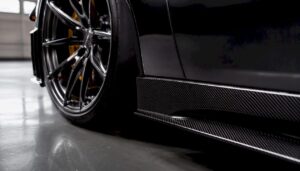
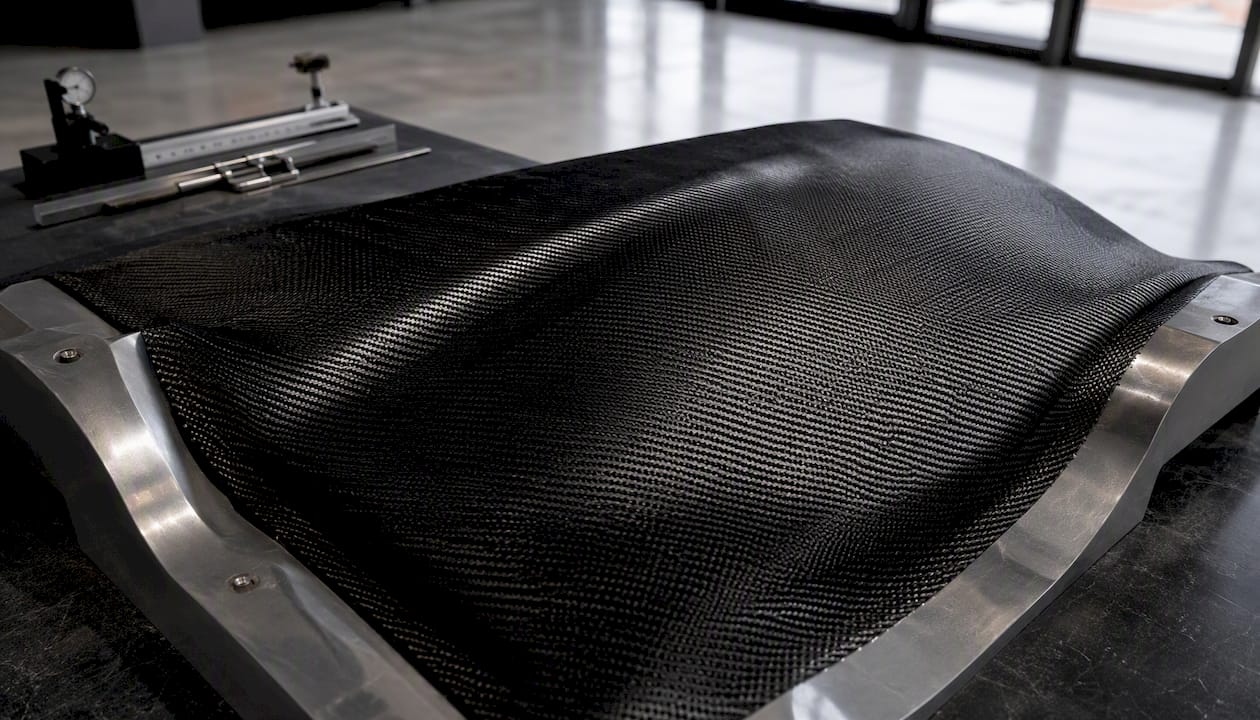
For flat panels and tubes, plain weave is the call. For visible automotive panels on a Mercedes-AMG, Lexus LC500, or McLaren, 2×2 twill carbon fiber is the industry standard. Complex 3D contours need harness satin (4HS, 5HS, or 8HS) or spread-tow cloth. Structural plies that carry directional load belong to unidirectional (UD) fabric.
Quick selection map:
- Plain weave (1×1): Best for flat panels, tubes, and high-stability layups where drape is not needed.
- 2×2 twill: The go-to for visible automotive exterior panels — balances drape, stability, and the classic diagonal weave aesthetic.
- 4×4 twill: Easier to conform over moderate compound curves; slightly less stable than 2×2.
- 4HS / 5HS / 8HS satin: Reserved for tight 3D contours and show-quality surfaces where drape is the priority.
- Spread-tow: Lowest crimp, smoothest surface, highest visual clarity — worth the cost for show panels and top-coat plies.
- UD fabric: Direction-specific structural layers only; not a visible weave finish.
Manufacturing process matters as much as weave geometry. Autoclave curing rewards 2×2 twill’s predictable fiber alignment; hand layup tolerates twill and satin; RTM and vacuum infusion work across most weave families when fabric weight and resin flow are matched correctly.
Key Takeaways
The single most important rule in carbon fiber weave selection: match the weave’s drape capability to the part’s contour complexity before considering any other variable.
| Point | Details |
|---|---|
| Plain weave for flat geometry | Use 1×1 plain weave for flat panels and tubes where fabric stability matters more than drape. |
| 2×2 twill for visible automotive panels | Autoclave-cured 3K 2×2 twill balances drape, stability, and surface finish for exterior automotive parts. |
| Satin for complex 3D shapes | 4HS, 5HS, or 8HS satin conforms to tight compound curves but requires careful handling to avoid distortion. |
| Tow count sets visual scale | 3K reads as premium at close range; 12K plain weave looks blocky and suits structural, non-cosmetic work. |
| E6 Carbon specification | E6 Carbon uses autoclave-cured 3K 2×2 twill for Mercedes-AMG, Lexus LC500, and McLaren/Lamborghini panels. |
Table of Contents
- What woven carbon-fiber fabric actually is — and the terms that matter
- Plain weave (1×1): stable, predictable, and limited to flatter geometry
- Twill weaves (2×2 and 4×4): why 2×2 is the automotive sweet spot
- Harness satin weaves (4HS, 5HS, 8HS): maximum drape for complex 3D shapes
- Spread-tow vs. standard tow: when the extra cost is worth it
- Unidirectional (UD) fabrics: structural muscle, not a visible finish
- Tow counts and fabric weights: how they change look, handling, and strength
- How to choose the right weave for your project
- Which weave is used where: automotive, aerospace, marine, and beyond
- Why premium builders favor 2×2 twill and autoclave processes
- How weave pattern affects durability in outdoor and harsh conditions
- Autoclave-cured carbon body kits built for your platform
- Sources
- FAQ
What woven carbon-fiber fabric actually is — and the terms that matter
Woven carbon-fiber fabric is made by interlacing bundles of carbon filaments, called tows, in two perpendicular directions: the warp (running lengthwise on the roll) and the weft (running across). The pattern of those interlacings defines the weave family. Every time a tow crosses over or under another, it bends slightly. That bend is called crimp.
Crimp is the central trade-off in weave selection. More crimp means higher fabric stability (the cloth holds its shape on the bench and resists distortion during handling) but lower in-plane tensile strength, because bent fibers carry load less efficiently than straight ones. Less crimp means better mechanical performance and smoother surface finish, but the fabric becomes harder to handle and more prone to distortion.
Tow count describes how many individual carbon filaments are bundled into each tow. Common designations:
Fabric weight is measured in grams per square meter (g/m²) or ounces per square yard (oz/yd²). A 200 g/m² 3K 2×2 twill is the most common commercial specification for automotive visible panels, and it is the weight at which most hand layup and vacuum infusion resin quantities are calibrated.
Plain weave (1×1): stable, predictable, and limited to flatter geometry
Plain weave is the simplest carbon fiber weave pattern: every warp tow passes over one weft tow, then under the next, in a strict checkerboard. The result is the highest crimp of any woven architecture and the tightest interlocking structure. According to DragonPlate’s composites reference, plain weave delivers high fabric stability but low conformability, making it better suited to flat panels and tubes than to complex aerodynamic contours.
Pros:
- Highest fabric stability — resists distortion during cutting and layup
- Symmetrical structure simplifies ply orientation planning
- Good for flat panels, square tubes, and simple curved sections
- Widely available in 3K and 6K at competitive prices
Cons:
- Poor drape over compound curves — the fabric bridges rather than conforms
- High crimp creates localized stress concentrations under load
- Checkerboard pattern is visually busy at larger tow counts (6K, 12K)
- Not suitable for tight 3D shapes without darts or cuts
Pro Tip: When using plain weave for an automotive flat panel or tube, orient one ply at 0°/90° and a second at 45°/45° to distribute load more evenly and reduce the stress concentration penalty from high crimp.
Twill weaves (2×2 and 4×4): why 2×2 is the automotive sweet spot
The 2×2 twill is the most widely specified carbon fiber weave pattern for visible automotive exterior work, and the reason is straightforward: it sits at the intersection of drape, stability, and appearance that no other weave matches at the same price point. Fibre Glast’s product data reports tensile strengths above 610 KSI for top-grade 3K 2×2 twill, versus approximately 500 KSI for many mass-market alternatives — a gap that matters on high-speed aerodynamic parts.
In a twill weave, each tow passes over n tows and under n tows in a repeating diagonal offset. The 2×2 pattern (over 2, under 2) creates the classic herringbone diagonal that most people picture when they think of carbon fiber. The 4×4 variant (over 4, under 4) produces a more pronounced diagonal and longer floats, which improves drape further but reduces stability.
| Property | 2×2 Twill | 4×4 Twill |
|---|---|---|
| Drape / conformability | Good | Better |
| Fabric stability | Good | Moderate |
| Crimp level | Low-moderate | Low |
| Surface finish | Classic diagonal, clean | Bolder diagonal, slightly smoother |
| Typical applications | Automotive panels, fairings, hoods | Moderate compound curves, larger panels |
| Fraying risk | Low-moderate | Moderate |
| Process compatibility | Hand layup, vacuum bag, RTM, autoclave | Hand layup, vacuum bag |
TotalBoat’s fabrication guidance confirms that 2×2 twill drapes easily over curved surfaces, wets out smoothly, and produces a glossy finished surface — exactly what Mercedes-AMG hood panels, Lexus LC500 side skirts, and McLaren front splitters demand.
A practical note on layup bias: rotating a 2×2 twill ply to 45° relative to the mold’s primary axis significantly improves conformability over moderate compound curves without switching to a satin weave. This is a standard technique in autoclave-cured body kit production.
Harness satin weaves (4HS, 5HS, 8HS): maximum drape for complex 3D shapes
Satin weaves are where the geometry gets interesting. A 4-harness satin (4HS) has each warp tow passing over three weft tows before going under one. A 5HS passes over four, under one. An 8HS passes over seven, under one. Those long “floats” are the key: they let tows slide against each other during forming, which is why satin fabric conforms to tight compound curves that would force a plain or twill weave to wrinkle or bridge.
Elevated Materials’ weave guide is direct on the trade-off: satin weaves provide the highest formability and smoothest surface finish, but lower fabric stability and higher fraying risk during manual handling. That fraying is not a minor inconvenience — on a complex mold, a distorted satin ply can shift during bagging and create resin-rich zones that show through the clearcoat.
When to use satin:
- Tight 3D contours: door mirror housings, intake scoops, helmet shells, complex fairings
- Show-quality surfaces where the long floats produce a near-mirror smoothness under clearcoat
- Aerospace wing skins where drape over tooling is critical and the part will be autoclave-cured under controlled conditions
When to avoid satin:
- Safety-critical structural parts where fabric distortion during layup cannot be fully controlled
- High-volume production where handling speed matters (satin frays faster and requires more careful cutting)
- Builders new to composite layup — the low stability makes ply placement harder to get right
The 8HS is the most formable and the most demanding to handle. For most automotive applications, 5HS is the practical ceiling: enough drape for complex shapes, manageable enough for experienced fabricators.
Spread-tow vs. standard tow: when the extra cost is worth it
Standard tow weaves bundle filaments into a roughly circular or oval cross-section. Spread-tow fabric flattens those bundles into thin, wide tapes before weaving, which dramatically reduces the crimp angle at each crossover point. The result is a flatter, smoother surface with less visual “crossover bump” and higher apparent stiffness per ply thickness.
Elevated Materials notes that spread-tow material reduces crossover defects and crimp angle, producing smoother surfaces and higher apparent strength for show-quality parts compared with the same fiber in a standard tow weave.
Best uses for spread-tow:
- Outermost cosmetic plies on show panels where surface smoothness under clearcoat is the priority
- Top-coat layers over a structural UD or twill laminate
- Body panels where the reduced crossover bump eliminates the need for heavy fill-coat sanding
- Marine fairings and consumer goods where visual clarity of the weave pattern is a selling point
Spread-tow is available in both plain and twill configurations. Spread-tow plain gives the flattest possible surface; spread-tow twill adds a subtle diagonal pattern with nearly the same surface quality.
Pro Tip: Spread-tow fabric frays more aggressively than standard tow at cut edges because the flattened bundles have less mechanical interlock. Seal every cut edge immediately with a thin bead of compatible resin or tape before handling, and plan your ply drops carefully — repositioning a spread-tow ply mid-layup almost always distorts it.
In an autoclave process, spread-tow performs well because the controlled pressure consolidates the flat tows evenly. In wet layup, it requires more care: the low crimp means resin can pool at crossovers if application is not uniform.
Unidirectional (UD) fabrics: structural muscle, not a visible finish
UD fabric contains all fibers running in a single direction, held together by a light binder or thin cross-stitched backing. There is no weave, no crimp, and no interlacing. That makes UD the highest-tensile-strength option per ply thickness in any given fiber grade, but it also means the fabric has almost no inherent stability and will not hold a shape on its own during layup.
DragonPlate’s composites guide explains that UD fabrics deliver high tensile strength and stiffness in the fiber axis but require additional plies or woven covers for machinability and durable surface finishes. A UD laminate trimmed without a woven cover ply tends to delaminate at cut edges under vibration.
Where UD belongs in automotive builds:
- Structural core plies in hoods, splitters, and diffusers where stiffness in a specific axis is engineered
- Reinforcement layers in high-load zones (hinge points, mounting tabs, strut tower braces)
- Bicycle frames, suspension components, and any part where directional stiffness is the primary design driver
- Combined with a 2×2 twill outer ply for parts that need both structural performance and a visible woven finish
What UD is not for: visible surface finish on its own. The unidirectional fiber lines look industrial and uneven under clearcoat, and the lack of weave structure means the surface telegraphs every resin void. Always plan a woven cover ply when UD is part of a cosmetic panel stack.
Tow counts and fabric weights: how they change look, handling, and strength
Tow count and fabric weight set the visual scale of the weave and determine how the fabric handles in the shop. Higher filament counts produce coarser-looking weaves and stiffer fabrics off the roll; lower counts give finer, tighter patterns that photograph well and wet out faster.
A 200 g/m² 3K 2×2 twill is the most common commercial specification for automotive visible panels, compatible with hand layup, vacuum infusion, and RTM. At 0.2 mm per ply, it builds up predictably in multi-ply laminates.
Rules of thumb:
- Choose 3K for any panel that will be seen up close — the fine weave reads as premium under clearcoat.
- Choose 6K for larger structural panels where visual scale matters less than layup speed and resin economy.
- Avoid 12K plain weave for cosmetic work — the blocky checkerboard pattern at that tow size looks unfinished, not purposeful.
- Heavier fabrics (above 300 g/m²) wet out more slowly and trap air more easily in wet layup; vacuum bagging or autoclave processing is strongly preferred.
The interaction between tow size and weave pattern is real: a 12K twill can look elegant on a large hood, while a 3K satin on a small mirror housing reads as almost glassy smooth. Match the scale of the weave to the scale of the part.
How to choose the right weave for your project
Follow this checklist in order. Each step narrows the field before you commit to fabric.
- Define the function. Is this a structural ply, a cosmetic surface ply, or both? Structural-only layers can be UD or plain weave. Cosmetic surfaces need twill, satin, or spread-tow.
- Assess contour complexity. Flat or gently curved: plain or 2×2 twill. Moderate compound curves: 2×2 twill at 45° bias or 4×4 twill. Tight 3D contours: 4HS or 5HS satin, or spread-tow twill.
- Pick tow count and weight. Visible panels: 3K at 150–220 g/m². Larger structural panels: 6K. Structural-only: 12K is acceptable. Match weight to your resin system’s recommended fiber-to-resin ratio.
- Align with your process. Autoclave: 2×2 twill prepreg is the most predictable. Vacuum infusion: 2×2 twill or 4×4 twill at 200–300 g/m². Hand layup: twill or satin, lighter weights preferred. RTM: plain or 2×2 twill for consistent resin flow. Understanding prepreg vs. wet layup differences before committing to a process saves expensive rework.
- Plan your finishing. Spread-tow or 5HS satin reduces fill-coat sanding. Plain weave and 12K fabrics need more surface prep. Budget finishing time into your weave decision, not just material cost.
Pro Tip: Before cutting your full panel, run a test patch on scrap tooling using the same resin, temperature, and bag pressure you plan to use on the real part. A 12-inch test square reveals bridging, resin pooling, and fiber distortion before they ruin an expensive mold.
The real cost of premium carbon fiber is not just the fabric — it is the process control that keeps crimp and voids in spec. Cheap fabric in an autoclave still produces a cheap part if the weave geometry was wrong from the start.
Which weave is used where: automotive, aerospace, marine, and beyond
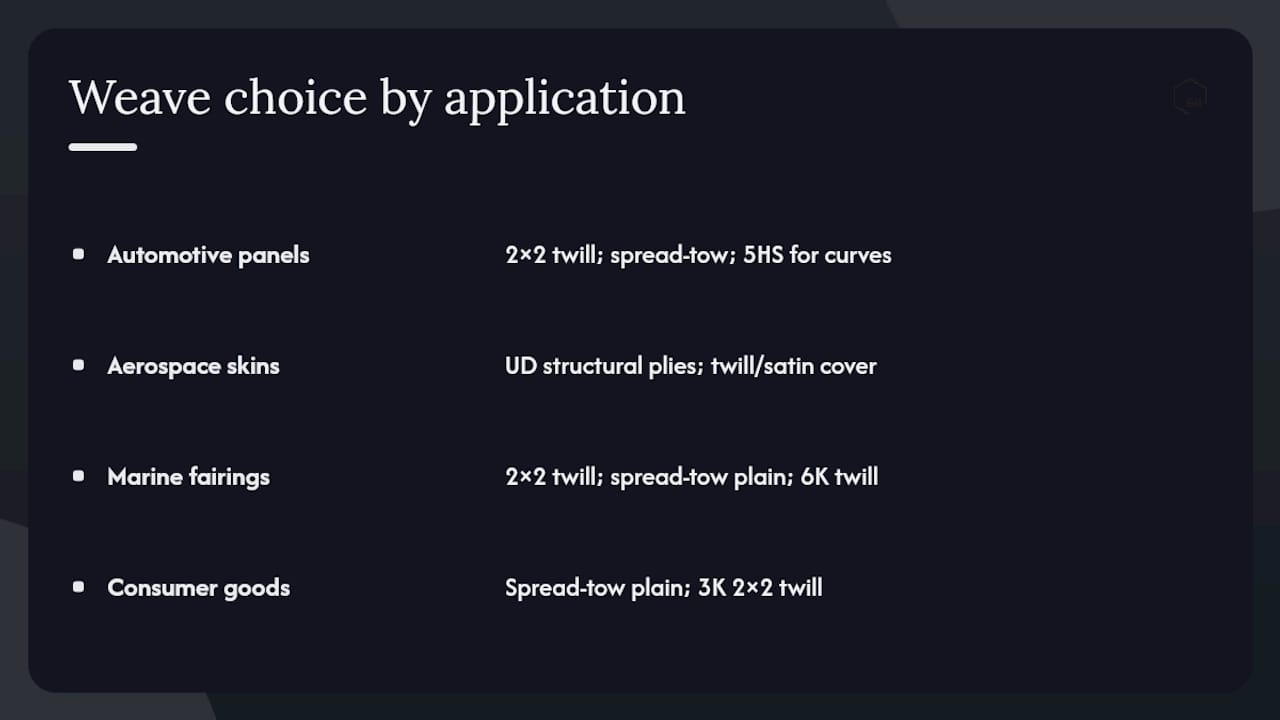
Weave choice follows application almost predictably once you know the constraints. Visible automotive panels demand 2×2 twill; structural aerospace skins use UD with satin or twill cover plies; marine fairings favor twill and spread-tow for their wet-out behavior and surface quality.
Automotive exterior panels (Mercedes-AMG, Lexus LC500, McLaren/Lamborghini):
E6 Carbon specifies autoclave-cured 2×2 twill for visible panels on Mercedes-AMG platforms — hoods, front lips, diffusers, and door trim. The 2×2 twill’s lower crimp versus plain weave reduces localized stress concentrations, and autoclave pressure keeps void content tight enough for repeatable fitment across production runs. For the Lexus LC500, the same 3K 2×2 twill specification applies to exterior aero components, with spread-tow used selectively on the outermost cosmetic ply for mirror housings and vent covers where surface smoothness is the primary visual requirement. McLaren and Lamborghini builds, with their tighter body tolerances and more complex panel geometry, often require 5HS satin for sections with aggressive compound curves, backed by UD structural plies.
Aerospace wing skins and fairings:
UD plies carry the primary tensile load; a 2×2 or 5HS twill/satin cover ply provides the machineable, inspectable surface. Autoclave curing is standard.
Marine fairings and hulls:
2×2 twill and spread-tow plain are common for fairings where wet-out consistency and surface finish matter. Heavier 6K twill is used for structural hull sections.
Consumer goods and motorsport accessories:
Spread-tow plain and 3K 2×2 twill dominate show-quality consumer items — laptop shells, helmet liners, interior trim. The fine weave scale reads as premium at close viewing distances.
For platform-specific guidance on the Lexus LC500, the dry vs. wet carbon guide covers process selection in detail.
Why premium builders favor 2×2 twill and autoclave processes
E6 Engineering’s recommendation is unambiguous: for visible, fitment-critical panels on exotic and luxury platforms, autoclave-cured 3K 2×2 twill is the correct specification. The reasoning is not aesthetic preference — it is process control.
Ant Composites’ technical reference confirms that weave selection directly affects the finished part’s performance-to-weight, and that autoclave curing with controlled pressure and temperature is critical for minimizing void content and preserving tow alignment. Fiber crimp creates local stress concentrations; autoclave pressure collapses those concentrations and consolidates the laminate to a degree that wet layup cannot reliably replicate.
Key engineering reasons for the 2×2 twill and autoclave combination:
- Crimp management: 2×2 twill’s lower crimp versus plain weave means fewer stress concentration points in the cured laminate, which matters at high aerodynamic loads.
- Void minimization: Autoclave pressure drives out entrapped air that vacuum bagging alone leaves behind, producing a denser, more consistent laminate.
- Fitment repeatability: Consistent fiber alignment across production runs means panel gaps stay within tolerance across multiple units — critical for Mercedes-AMG and McLaren fitment standards.
- Surface finish: The diagonal float of 2×2 twill under autoclave pressure produces a surface that requires minimal fill-coat work before clearcoat.
Top-grade 3K 2×2 twill from aerospace-grade suppliers reports tensile strengths above 610 KSI, a meaningful performance margin over mass-market alternatives at approximately 500 KSI. For high-speed aerodynamic parts, that margin is not academic. Understanding why cheap carbon fiber parts fail at high speeds makes the case for process discipline more concretely than any specification sheet.
How weave pattern affects durability in outdoor and harsh conditions
Carbon fiber itself does not corrode, but the resin matrix that holds the weave together is vulnerable to UV degradation, moisture ingress, and thermal cycling. The weave pattern influences how well a part resists those stressors over time.
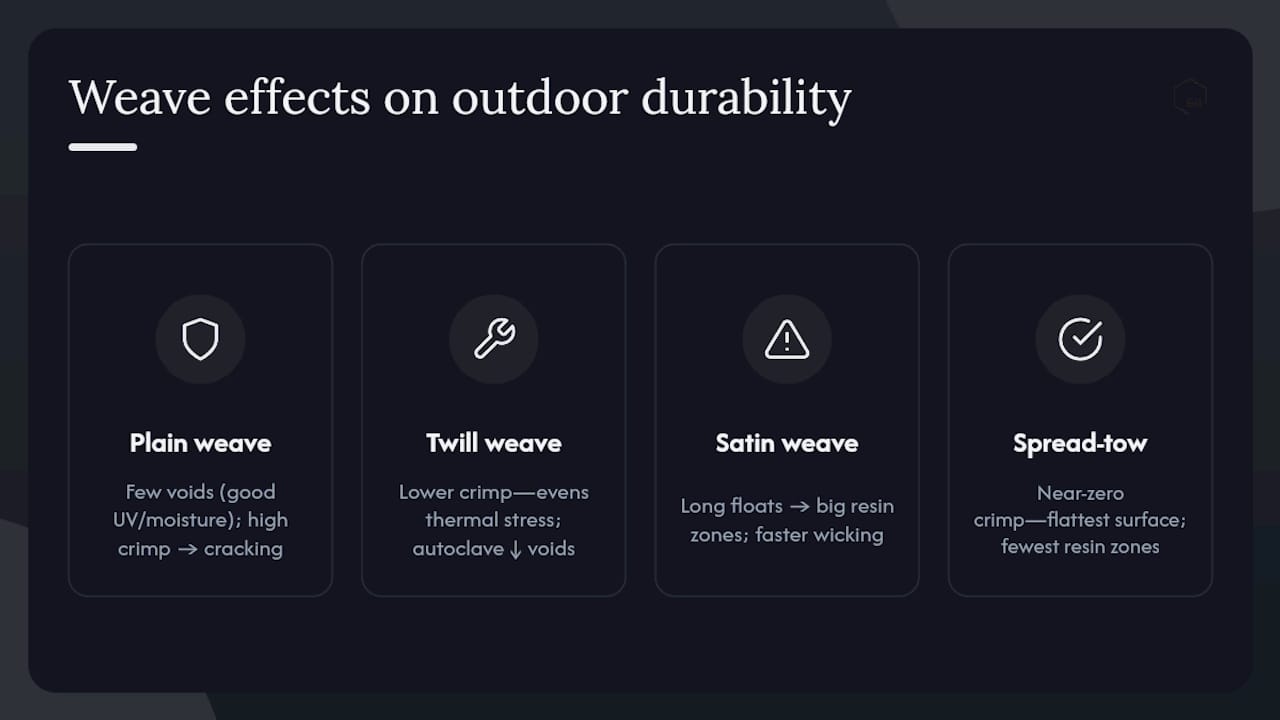
Plain weave’s tight interlocking structure gives the resin fewer large voids to fill at crossover points, which reduces the surface area exposed to UV and moisture. That is an advantage in outdoor structural applications. The downside is that plain weave’s high crimp creates micro-stress points that can initiate matrix cracking under repeated thermal cycling — a real concern for parts that see track days in summer and cold storage in winter.
Twill weaves, with their lower crimp, distribute thermal stress more evenly across the laminate. A properly autoclave-cured 2×2 twill panel with a UV-stable clearcoat will outlast a wet-laid plain weave panel in outdoor conditions, not because of the weave geometry alone, but because the lower void content from autoclave processing leaves fewer sites for moisture to penetrate.
Satin weaves present a different challenge outdoors. The long floats that make 5HS and 8HS so conformable also create larger resin-rich zones at crossovers. If the clearcoat fails — a chip, a scratch — moisture can wick along those resin channels faster than in a tighter weave. For parts that will see prolonged UV exposure or salt spray (marine applications, track cars without garage storage), a UV-resistant resin system and a quality clearcoat are non-negotiable regardless of weave choice.
Spread-tow fabric, with its minimal crossover bump and near-zero crimp, produces the flattest clearcoat surface and the fewest resin-rich zones — which means fewer moisture ingress points and better long-term UV resistance when the finish is maintained.
The trade-offs we navigate on every build
The question we hear most often is some version of: “Can I get the satin drape and the twill stability in the same ply?” The honest answer is no. Every weave is a compromise, and the fabricator’s job is to decide which compromise fits the part.
On complex panels for Mercedes-AMG and McLaren builds, the team at E6 Carbon regularly faces the choice between a 5HS satin that conforms perfectly to a tight radius and a 2×2 twill that requires a dart or a split ply to make the same corner. The satin wins on drape. The twill wins on predictability in the autoclave and on long-term fitment consistency. Most of the time, the answer is a hybrid stack: 2×2 twill for the structural plies, spread-tow or 5HS for the outermost cosmetic ply where surface finish is the priority. That combination captures most of the visual benefit of satin without surrendering the dimensional stability that fitment-critical parts demand.
If you are working through a weave selection decision for a specific platform or panel geometry, the E6 engineering team is available for technical consultation.
Autoclave-cured carbon body kits built for your platform
The weave families covered here are not abstract choices when you are ordering a body kit for a Mercedes-AMG GT, a Lexus LC500, or a McLaren 720S. Every panel E6 Carbon ships is autoclave-cured 3K 2×2 twill, engineered to the platform’s OEM gap tolerances and finished to show-car standards.

What that means in practice: no bridging at compound curves, no resin-rich voids telegraphing through the clearcoat, and fitment that does not require persuasion at installation. E6 Carbon’s catalog covers front lips, rear diffusers, side skirts, hoods, and bespoke aero components for Mercedes-AMG, Lexus LC500, and McLaren/Lamborghini platforms. Every component is engineered with the same fitment-first discipline that governs the weave and process selection described in this article. Visit E6carbon to review platform-specific fitment specs or request a consultation on a custom panel.
Sources
Technical references used in this article, listed for readers who want to go deeper on specific topics:
- Carbon Fiber 101: Understanding Weaves and Fabrics | DragonPlate
- Carbon Fiber Weaves: What they are and why to use them – Elevated Materials
- Carbon Fiber Fabric | Ant Composites
- 200g 2/2 Twill 3k Carbon Fibre Fabric – Resin Library
FAQ
What is the best carbon fiber weave pattern for automotive body panels?
The 2×2 twill is the standard choice for visible automotive panels. It balances drape over moderate curves, fabric stability during layup, and the classic diagonal surface finish that reads as premium under clearcoat.
How does tow count affect the appearance of a carbon fiber weave?
Lower tow counts (3K) produce finer, tighter weave patterns that look premium at close range. Higher counts (12K) create a coarser, blockier pattern better suited to structural, non-cosmetic applications.
When should I use a satin weave instead of a twill?
Use 4HS or 5HS satin when a panel has tight compound curves that a 2×2 twill cannot conform to without darts or splits. Satin’s long floats allow the fabric to slide into complex 3D shapes, though handling requires more care to prevent distortion.
What is spread-tow carbon fiber and when is it worth the extra cost?
Spread-tow fabric flattens tow bundles before weaving, reducing crimp and producing a smoother surface with less crossover bump. It is worth the cost for outermost cosmetic plies on show panels where surface finish under clearcoat is the priority.
Does weave pattern affect how long a carbon fiber part lasts outdoors?
Yes. Lower-crimp weaves like 2×2 twill distribute thermal stress more evenly and, when autoclave-cured, have fewer voids for moisture to penetrate. Satin weaves have larger resin-rich zones at floats that can wick moisture if the clearcoat is damaged. A UV-stable resin and quality clearcoat matter more than weave choice alone for long-term outdoor durability.