TL;DR:
- Forged titanium bolts offer superior fatigue resistance and strength compared to machined or cast options. They are made from Grade 5 titanium, which combines high strength with low weight, making them ideal for high-performance vehicles. Proper geometry, anti-seize application, and forging certification are essential for safety and longevity.
Forged titanium bolts are defined as fasteners manufactured through a controlled deformation process that aligns the metal’s grain structure and induces compressive residual stresses, producing superior fatigue resistance and strength compared to machined or cast alternatives. The industry standard alloy for these applications is Grade 5 titanium, designated Ti-6Al-4V and governed by AMS 4928, which delivers the highest strength-to-weight ratio available in a production fastener. For engineers building on Mercedes-AMG, Lexus LC500, McLaren, or Lamborghini platforms, understanding why forged titanium bolts matter is the difference between a build that performs and one that fails under load.
Why forged titanium bolts outperform machined and cast alternatives
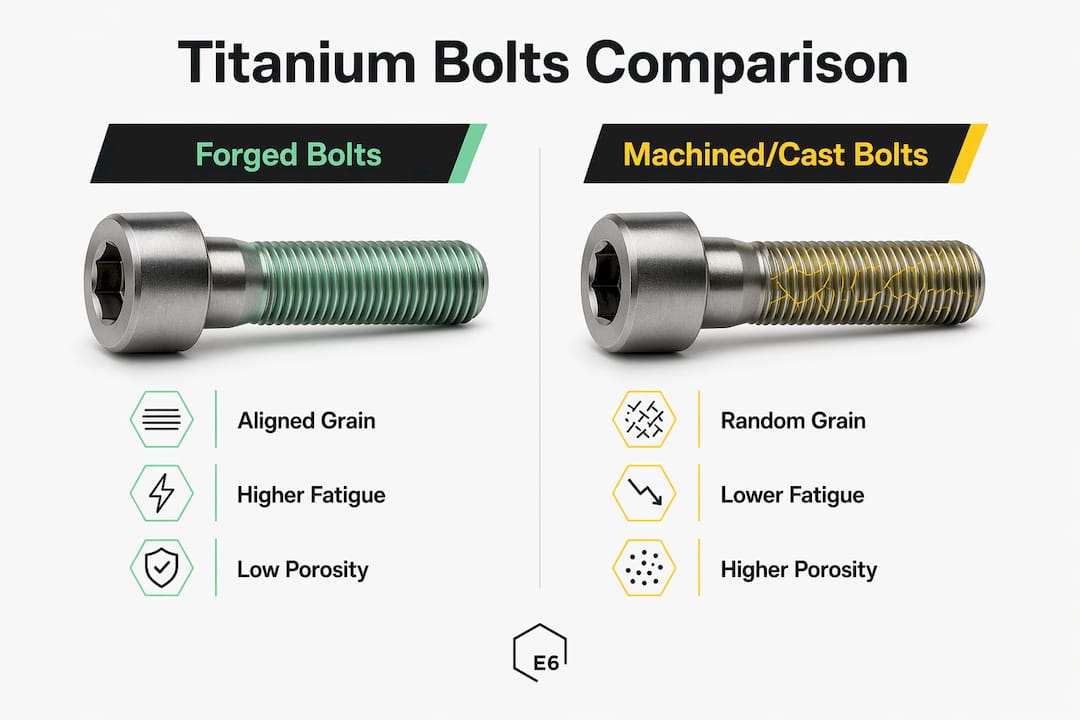
The forging process is the defining variable in titanium bolt performance. Cold forging increases tensile toughness and fatigue life by 25–30% compared to CNC-machined parts, driven by grain alignment and compressive residual stress. That 25–30% gain is not incremental. It is the margin between a fastener that survives 100,000 vibration cycles and one that cracks at 70,000.
Forging at 850°C–950°C aligns titanium grains to follow the thread contour, forcing micro-cracks to oppose grain orientation and increasing fatigue strength exponentially. CNC machining from bar stock severs that grain flow entirely. The result is a stress riser at every cut surface, which is exactly where fatigue cracks initiate under dynamic automotive loads.
Casting introduces a third failure mode: porosity. Cast titanium traps gas voids during solidification, creating internal weak points that are invisible to the naked eye but catastrophic under cyclic loading. Forging eliminates porosity by mechanically consolidating the material under pressure.
| Manufacturing method | Grain flow | Fatigue life | Porosity risk |
|---|---|---|---|
| Hot/cold forging | Continuous, aligned to geometry | Highest (+25–30% vs. machined) | None |
| CNC machining from bar | Severed at cut surfaces | Moderate | None |
| Casting | Random, uncontrolled | Lowest | High |
Pro Tip: When sourcing titanium bolts, ask the supplier for a forging process certificate and a material test report referencing AMS 4928. If they cannot provide both, the bolt is almost certainly machined from bar stock.
What makes Grade 5 titanium the right choice for performance vehicles?
Grade 5 titanium, Ti-6Al-4V, is the correct alloy for automotive fasteners because it combines the tensile strength of medium-grade steel with a density roughly 40% lower. Forged Grade 5 titanium wheel bolts reduce weight by 40–45% compared to steel equivalents. On a platform like the Mercedes-AMG GT, where unsprung rotational mass directly affects steering response and suspension compliance, that reduction is measurable on a data logger.
The advantages extend well beyond weight. Grade 5 titanium bolts deliver:
- Fatigue resistance under shock loading. Forged titanium fasteners withstand shock loads exceeding 5,000 N·m in Formula 1 suspension systems. That load threshold exceeds what most road-going supercars generate, which means the safety margin is substantial.
- Corrosion immunity. Titanium forms a stable titanium dioxide passivation layer that resists salt, brake fluid, and road chemicals without coating or plating. Steel wheel bolts corrode and seize. Titanium bolts do not.
- Long service life. The combination of corrosion resistance and fatigue strength means a properly installed forged titanium bolt outlasts the vehicle’s service interval without degradation.
- Unsprung mass reduction. On the Lexus LC500, replacing steel wheel hardware with forged titanium reduces unsprung mass at each corner. Lower unsprung mass improves tire contact patch consistency, which translates directly to cornering grip and ride quality.
For McLaren and Lamborghini platforms, where the engineering brief already demands minimum mass at every point in the suspension geometry, forged titanium wheel bolts are a logical extension of the factory philosophy. The weight savings in unsprung components compound with other reductions like forged wheels and carbon body panels to produce a vehicle that responds faster and loads its tires more evenly.
What are the critical engineering pitfalls with titanium bolts?
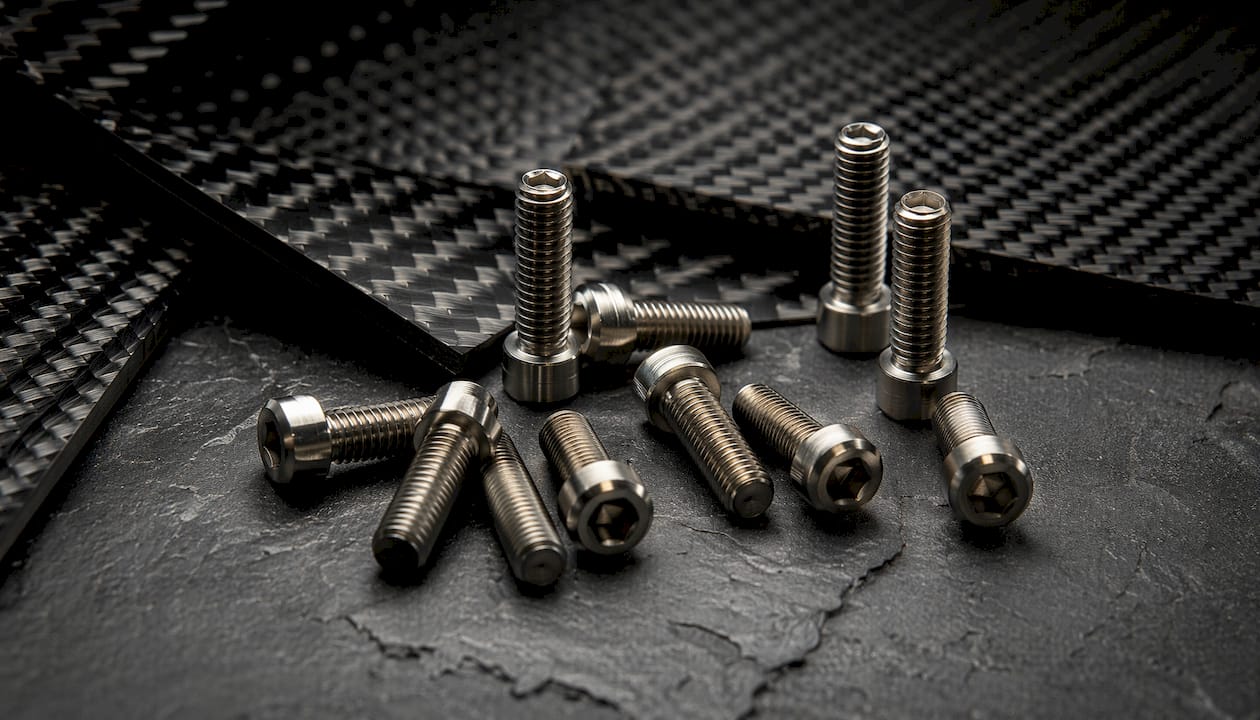
The primary value of forged titanium is reliable performance in the right application, not universal superiority over steel. Choosing titanium bolts without understanding their specific requirements creates failure modes that steel bolts would never produce.
The most dangerous pitfall is geometry. Sharp 90-degree corners at the head-to-shank junction act as stress multipliers with a Kt of approximately 5.0, risking sudden brittle fracture under vibration loads. A hot-forged fillet radius of R0.8–1.2mm at that junction reduces the stress concentration dramatically. Engineers auditing titanium bolts for safety-critical applications must verify fillet geometry before installation.
- Verify fillet radius. Confirm R0.8–1.2mm at the head-to-shank junction on every safety-critical bolt. A sharp corner at that transition is a fracture waiting to happen.
- Apply anti-seize paste. Titanium must be installed with anti-seize paste to prevent galling and seizure. Without it, the oxide layer breaks down under torque, and the bolt cold-welds to the mating surface. Proper lubrication enables clean removal even after 15 years of service.
- Reject machined-from-bar bolts. Low-quality titanium bolts fully machined from bar stock lack forging’s grain alignment, making them more prone to failure. The price difference between forged and machined bolts is small. The performance difference is not.
- Follow torque specifications exactly. Titanium has a lower modulus of elasticity than steel. Applying steel torque values to titanium bolts risks yielding the fastener or stripping the thread.
Pro Tip: Inspect forged titanium bolts under a 10x loupe before installation. Any surface seam, lap, or fold in the shank indicates a forging defect. Reject the bolt immediately.
How do forged titanium bolts improve vehicle dynamics?
The engineering benefit of a 40–45% weight reduction in wheel hardware compounds across the entire suspension system. Unsprung mass is the portion of vehicle weight not supported by the suspension spring. Lower unsprung mass means the suspension can react faster to road surface changes, keeping the tire in contact with the pavement through direction changes and over surface irregularities.
On the Mercedes-AMG C63 or E63, where the adaptive suspension system operates at high frequency, reducing unsprung mass at each corner allows the dampers to work within their optimal range. The tire contact patch stays consistent, and the vehicle’s lateral grip increases without any change to spring rates or alignment.
The table below shows the practical effect of switching from steel to forged Grade 5 titanium wheel hardware across key performance metrics:
| Performance factor | Steel wheel bolts | Forged Grade 5 titanium bolts |
|---|---|---|
| Weight per bolt set | Baseline | 40–45% lighter |
| Shock load tolerance | Moderate | Exceeds 5,000 N·m |
| Corrosion resistance | Requires coating | Inherent passivation layer |
| Fatigue life vs. machined | Baseline | +25–30% |
For the Lexus LC500 and McLaren 720S, the titanium wheel hardware standard for two-piece forged wheel assemblies reflects this engineering logic. Every gram removed from the rotating and unsprung mass budget improves the vehicle’s dynamic response without requiring changes to the powertrain or chassis.
The numbered sequence below captures how the performance chain works in practice:
- Forged titanium bolts reduce unsprung rotational mass at each wheel corner.
- Lower unsprung mass reduces the inertia the suspension must overcome during wheel travel.
- Faster suspension response improves tire contact patch consistency through corners.
- Consistent contact patch increases lateral grip and reduces lap times.
- Reduced vibration transmission to the chassis improves driver feedback and fatigue.
Understanding forged wheel grain structure alongside titanium bolt metallurgy gives engineers a complete picture of how forging benefits every rotating component in the system.
Key Takeaways
Forged Grade 5 titanium bolts deliver 40–45% weight reduction and 25–30% higher fatigue life than machined alternatives, making them the correct fastener choice for safety-critical, high-vibration automotive applications.
| Point | Details |
|---|---|
| Forging process superiority | Grain alignment and compressive stress increase fatigue life by 25–30% over CNC-machined bolts. |
| Weight reduction impact | Grade 5 titanium bolts cut weight by 40–45% vs. steel, directly reducing unsprung mass. |
| Fillet geometry is safety-critical | A fillet radius of R0.8–1.2mm at the head-to-shank junction prevents brittle fracture under vibration. |
| Anti-seize is mandatory | Titanium galls without anti-seize paste, causing cold welding that makes bolt removal impossible. |
| Reject machined-from-bar bolts | Only forged bolts maintain continuous grain flow. Machined bar stock creates stress risers at cut surfaces. |
The engineering case that most builders miss
From E6 Engineering: The conversation around titanium bolts almost always starts with weight. That is the right starting point, but it is the wrong place to stop. The builders who get the most out of forged titanium hardware are the ones who treat it as a reliability upgrade first and a weight reduction second.
The detail that separates a safe titanium bolt from a dangerous one is not the alloy grade. It is the fillet radius at the head-to-shank junction. A bolt machined from Grade 5 bar stock with a sharp 90-degree corner will fail before a properly forged bolt made from Grade 4. Geometry matters more than marketing claims about alloy purity.
The other misconception I see constantly is that titanium bolts are maintenance-free. They are not. They require anti-seize on every installation, correct torque values specific to titanium’s modulus, and periodic inspection for surface damage. Treat them like the precision components they are, and they will outlast the vehicle. Treat them like steel bolts, and you will have a seized fastener or a fatigue fracture at the worst possible moment.
— E6 Engineering
Precision forged hardware starts with the right wheel system
E6 Carbon engineers every component in the wheel and hardware system to work together. The same forging philosophy that produces superior grain alignment in titanium fasteners drives the manufacturing of E6 Forged wheel assemblies for Mercedes-AMG, Lexus LC500, McLaren, and Lamborghini platforms.
When you pair forged titanium wheel hardware with a properly engineered forged wheel set, the unsprung mass reduction compounds across the entire rotating assembly. E6 Carbon’s monoblock and multi-piece forged wheels are built to the same AMS material standards and dimensional tolerances that make forged titanium bolts worth specifying. If you want to understand how forged aluminum outperforms cast alternatives across every performance metric, the engineering logic is identical to what makes forged titanium the correct fastener choice.
FAQ
What is the best titanium alloy grade for automotive bolts?
Grade 5 titanium, Ti-6Al-4V per AMS 4928, is the correct choice for automotive fasteners. It delivers the highest strength-to-weight ratio and fatigue resistance available in a production titanium alloy.
Are forged titanium bolts cost-effective for street builds?
Forged titanium bolts cost more upfront than steel but eliminate corrosion-related replacement and provide a longer service life. For performance builds where unsprung mass and reliability matter, the total cost over the vehicle’s life favors titanium.
Why do titanium bolts require anti-seize paste?
Titanium’s oxide layer breaks down under friction during torquing, causing the bolt to cold-weld to the mating surface. Anti-seize paste prevents galling and ensures the bolt remains removable after years of service.
How do I identify a forged titanium bolt vs. a machined one?
Request a forging process certificate and an AMS 4928 material test report from the supplier. Visually, forged bolts have smooth, radiused fillets at the head-to-shank junction. Machined bolts often show sharp corners or tool marks at that transition.
What shock load can forged titanium fasteners handle?
Forged titanium fasteners withstand shock loads exceeding 5,000 N·m in Formula 1 suspension applications, which exceeds the dynamic loads generated by road-going performance vehicles under hard driving conditions.