
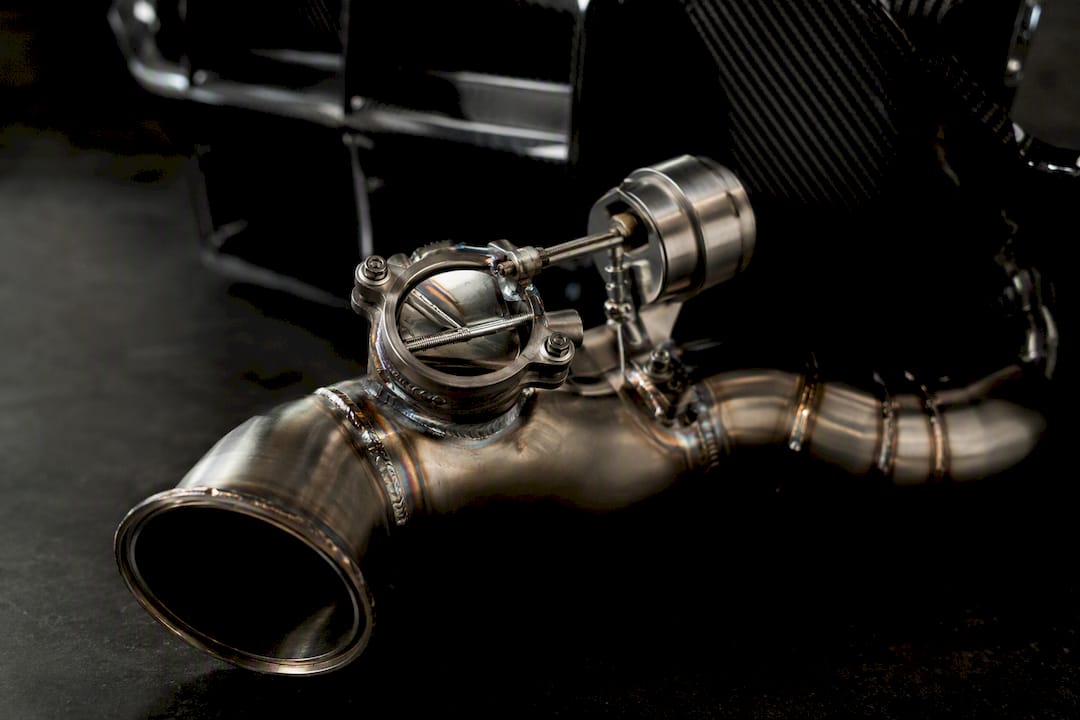
Valved exhausts deliver both silent executive refinement and an uncorked track roar. E6 Motorsports builds systems tuned specifically for Lexus LC500 and Mercedes-AMG platforms, using electronically actuated valves that route exhaust gas through two entirely different paths depending on the mode you select.
Closed, the valve forces gas through a muffled chamber that kills drone and keeps cabin conversation civil at 80 mph. Open, it drops into a low-restriction bypass that lets the V8 or twin-turbo V8 breathe and sing the way the engineers who designed it originally intended.
Quiet mode delivers:
- Drone-free highway cruising with no fatigue on long drives
- Valet and concierge friendliness at hotels, clubs, and city driving
Track mode delivers:
- A resonant, unfiltered exhaust note with audible pops and crackles on lift-off
- Reduced backpressure for sharper throttle response at high RPM
On the Lexus LC500, E6’s center-exit layout integrates directly with the matching E6 LC500-F dry carbon rear diffuser, a fitment pairing engineered as one system rather than two aftermarket parts bolted together. Professional installation is strongly recommended for proper valve routing and electronic integration; readers ready to move forward should consult E6’s product pages for platform-specific fitment data before ordering.
TL;DR:
- Proper fitment and electronic integration are crucial, as poor actuator routing and heat shielding are the main causes of system failures and warning lights.
- Platform-specific systems, like E6’s LC500 center-exit exhaust, are engineered for seamless compatibility with diffuser and bodywork, avoiding compromises of universal kits.
- Response speed and reliability are greatly improved with motor-driven electronic valves versus vacuum-actuated ones, especially on turbocharged or high-performance platforms.
- Material choices shape the system’s tone and durability, with titanium offering a lighter, more resonant sound and stainless steel providing cost-effective longevity.
- Maintaining appropriate noise control by keeping valves closed on public roads prevents legal issues and protects warranty coverage, reserving open mode for track or private use.
Table of Contents
- How Valved Exhaust Systems Control Flow and Sound
- Why Dual-Mode Acoustics Matter for Executive Ownership
- Fitment Notes for AMG, LC500, and Beyond
- Installer Checklist for Reliable Valve Operation
- Titanium, Stainless, and What Separates Premium Builds
- What Kind of Power Gains Should You Expect?
- Noise Rules, Warranty Paperwork, and Sensible Use
- The E6 Engineering Verdict on Dual-Mode Exhaust Systems
- History and Evolution of Valved Exhaust Systems
- Valved vs. Fixed Exhaust: What Actually Changes
- Manual Switch vs. Automatic Drive-Mode Control
- Emissions Impact of Exhaust Valve Tuning
- Warranty and Service Support to Expect
- An Honest Read on What Actually Matters Here
- Bring Executive Refinement and Track Sound to Your LC500 or AMG
- Key Takeaways
- Sources
- FAQ
How Valved Exhaust Systems Control Flow and Sound
A valved exhaust is really two exhaust systems occupying one housing. When the valve is closed, gas travels through a muffled path packed with sound-deadening material designed to attenuate low-frequency drone, the resonant frequency that builds inside a cabin between 1,800 and 2,400 RPM and turns a highway cruise into an endurance test. When the valve opens, that same gas diverts into a straighter, larger-diameter bypass with far less acoustic resistance. The result is a muffled street tone and a raw, track-like note when opened, controlled by the same hardware.
Two actuation types dominate the premium segment. Electronic motor-driven valves respond in a fraction of a second to a dash-mounted switch or drive-mode selector, and they hold position reliably regardless of exhaust pulse pressure. Vacuum-actuated valves are cheaper to produce but depend on engine vacuum signal strength, which means they can behave inconsistently at idle or under boost, a real liability on turbocharged AMG platforms where vacuum swings are wider than on naturally aspirated V8s.
Valve diameter and blade geometry also shape harmonic content. A larger valve bore relative to pipe diameter produces a fuller, more resonant note when open, while an undersized valve can create a raspy, unrefined edge at partial throttle. Pipe diameter downstream of the valve matters just as much: too narrow, and you choke high-RPM flow even with the valve wide open; too wide, and low-end torque delivery goes soft.
Key acoustic variables engineers tune:
- Valve bore-to-pipe-diameter ratio
- Muffler chamber volume in closed mode
- Bypass pipe length and bend radius
Industry data backs the tradeoff directly: opening the valve reduces backpressure and produces a louder, throatier tone suited to track use, while the closed path exists specifically to suppress that same character for daily driving.
Why Dual-Mode Acoustics Matter for Executive Ownership
Owning a six-figure exotic means living two lives with the same car: the boardroom commute and the weekend track day. A fixed exhaust forces a compromise between the two. A valved system does not.
- Daily civility. Closed-valve mode keeps cabin noise low enough for phone calls, sleeping passengers, and residential neighborhoods that enforce quiet hours, without sacrificing the engine’s underlying character.
- Valet and concierge friendliness. Hotels, private clubs, and parking structures increasingly flag loud exotics for extra scrutiny. A quiet mode means your LC500 or AMG GT draws attention for its design, not its decibels.
- Track-day theatrics on demand. Flip to open mode and the same car delivers pops and crackles on throttle lift, plus measurably reduced backpressure for a louder, more aggressive tone, with no parts swap required.
- Improved top-end breathing. Because the bypass path carries less restriction, engines running in open mode typically see quicker exhaust scavenging at higher RPM, translating to a crisper feel through the top third of the tachometer.
- Resale protection. A documented, professionally installed valved system with OEM-style integration tends to read as a thoughtful upgrade rather than a red flag, unlike a fixed straight-pipe setup that limits the next buyer’s options.
Factory-integrated active exhausts already link valve behavior to drive-mode selection, and aftermarket valved systems extend that same selectable range with a wider spread between quiet and aggressive settings than most OEM setups allow.
Fitment Notes for AMG, LC500, and Beyond
Fitment engineering is where a valved exhaust either becomes an invisible upgrade or a permanent source of rattles, heat soak, and warning lights. E6 builds platform-specific systems rather than universal-fit kits, because tolerance stacking on a Lexus LC500 differs meaningfully from an AMG GT’s rear subframe geometry.
Lexus LC500. The V8’s factory layout uses a quad-tip rear-exit design, but E6’s center-exit configuration is engineered specifically to pair with the E6 LC500-F dry carbon rear diffuser, so the tip spacing, heat clearance, and diffuser cutout align without secondary trimming. This is fitment-first engineering applied to acoustics and aerodynamics simultaneously, not two separate aftermarket purchases forced to coexist.
Mercedes-AMG. AMG platforms commonly run rear-exit or quad-exit layouts with tighter underbody packaging around the rear diffuser and heat shielding for the standard exhaust valve module. E6’s AMG-specific systems use mandrel-bent stainless or titanium tubing matched to factory hanger points, avoiding the stress cracking that comes from forcing a generic bend radius into a chassis it wasn’t mapped for.
McLaren and Lamborghini. These platforms present tighter packaging constraints around mid-mounted engines and shorter exhaust runs, which limits valve placement options and demands closer tolerance on actuator clearance. E6’s expansion into these platforms follows the same fitment-verification process used on AMG and LC500 builds before any system ships.
What to request from any installer or manufacturer:
- Documented fitment proofs for your exact model year and trim
- Emissions and noise compliance disclaimers in writing
- Threaded, not clamped, flange connections at the manifold
Pro Tip: Ask for a photo of the actual test-fit on your platform’s chassis, not a rendering. Tolerance issues on center-exit layouts almost always show up at the diffuser cutout first.
Installer Checklist for Reliable Valve Operation
Professional installation is strongly recommended for proper valve routing on every E6 Motorsports valved exhaust system. E6 holds zero liability for improper installation, and the reasons why become obvious once you understand what can go wrong.
- Actuator placement. The valve motor needs clearance from the catalytic converter and any high-heat zone; mounting it too close accelerates wear on the internal motor windings and shortens actuator life.
- Heat shielding. Premium installs use high-temp woven shielding or ceramic-coated barriers around the actuator housing, not generic wrap, to keep ambient temperature within the motor’s rated range.
- Electronic integration path. Shops must choose between wiring the valve into the factory drive-mode system or running an independent controller. Factory integration feels seamless with existing drive modes, while independent controllers offer broader customization but require extra wiring and calibration.
- OBD-II calibration. Improper signal calibration on the valve actuator can trigger a persistent check engine light, sometimes requiring a specialized diagnostic module to clear correctly.
The most common failure mode in this category isn’t the exhaust hardware itself. Poor actuator routing and inadequate heat shielding are what cause premature valve motor failure and recurring CEL issues, not the valve mechanism.
Pro Tip: If a shop can’t explain how they’re integrating the valve signal with your car’s ECU, that’s your answer on whether to trust them with the job.
Titanium, Stainless, and What Separates Premium Builds
Material choice shapes tone, weight, and how long the system survives thousands of open-close cycles in a 900°F exhaust environment. Titanium delivers a lighter overall system, a distinctly higher-pitched and more resonant tone, and superior corrosion resistance, but it commands a premium price and requires more specialized welding. Stainless steel costs less, offers excellent longevity, and produces a deeper, slightly less exotic tone that many owners still prefer on V8 platforms.
What separates a premium build from a budget one:
- Valve housings built from high-temp alloys with ceramic or high-temp coatings for actuator protection in sustained heat environments
- Internal muffler architecture engineered around specific chamber volumes, not generic packing
- Pipe sizing matched to the platform’s factory flow characteristics rather than a one-size catalog part
- TIG-welded joints and aircraft-grade fasteners rated for thermal cycling
Vendors who cut corners on any of these four points tend to produce systems that rattle within a year or lose valve responsiveness after repeated heat cycling. Read the titanium versus stainless breakdown for the LC500 before deciding which material fits your driving pattern.
What Kind of Power Gains Should You Expect?
Reducing backpressure through an open valve improves exhaust scavenging, and most owners see a modest but real gain in throttle response and top-end power rather than a dramatic horsepower jump. Treat any exhaust-only power claim conservatively until it’s verified on a dyno for your specific platform.
- Confirm gains with staged dyno mapping, not seat-of-the-pants impressions
- Map valve-opening strategy to RPM and load, not a simple on/off switch tied only to drive mode
- Watch air-fuel ratio and check engine light behavior closely for the first several hundred miles post-install
- Decide on an ECU tune based on platform: some AMG and LC500 setups run cleanly without one, while others benefit from a light recalibration to account for the reduced backpressure
An ECU tune isn’t mandatory for a valved exhaust to function correctly, but it’s the difference between a system that merely sounds different and one that’s actually optimized for the new flow characteristics.
Noise Rules, Warranty Paperwork, and Sensible Use
Open mode sounds fantastic at a track day and can create real problems on a public road. Local noise ordinances vary widely, and many owners default to closed mode for all street driving, reserving open mode for track sessions or private property where noise restrictions don’t apply.
- Keep the valve closed on public roads in areas with active noise enforcement, and treat open mode as a track-only setting
- Document professional installation and keep every invoice; insurers and warranty providers both ask for this if a claim ever touches the exhaust system
- Establish a personal policy for when open mode is appropriate, and stick to it the way you’d stick to a track-only tire policy
- Inspect actuator wiring and heat shielding at every oil change interval to catch early wear before it becomes a failure
None of this is legal advice specific to your municipality. It’s the pattern most experienced exotic owners follow to protect both their neighbors’ patience and their own warranty coverage.
The E6 Engineering Verdict on Dual-Mode Exhaust Systems
A valved exhaust gives you two distinct cars in one chassis: silent on the highway, resonant on the track, with nothing to swap between the two. That’s the entire case for the technology, and it holds up under scrutiny.
The mistake most buyers make is treating a valved exhaust as a bolt-on accessory rather than a fitment-engineering problem. Center-exit integration on an LC500, or a rear-exit AMG layout, only works when the exhaust, the diffuser, and the electronic control system are designed together from the start. Universal-fit kits force compromises at exactly the tolerances that matter most.
E6’s approach pairs autoclave-cured carbon components like the LC500-F diffuser with exhaust systems engineered for that same chassis, not a generic template. Owners considering this upgrade should request an engineering consultation before ordering and commit to professional installation from the outset.
— E6 Engineering
History and Evolution of Valved Exhaust Systems
Valved exhaust technology started as a motorsport solution decades before it reached luxury showrooms. Early race applications used simple mechanical butterfly valves, manually adjustable, to let teams tune exhaust note and backpressure between qualifying and race conditions. There was no electronics involved, just a wrench and a fixed setting for the weekend.
Electronic actuation changed everything once manufacturers realized drivers wanted both the race character and the daily comfort without choosing one permanently. Vacuum-actuated valves arrived first on performance trims through the 2000s, offering a basic quiet-or-loud toggle tied to throttle position or RPM threshold. They were serviceable but inconsistent, prone to sticking and slow to respond.
Motor-driven electronic valves became the standard on serious performance and luxury platforms because they respond instantly and hold position regardless of exhaust pulse pressure. This is the technology behind modern factory active exhaust systems on AMG and Lexus performance trims, and it’s the same principle E6 Motorsports builds on for aftermarket applications.
What’s changed most in the last decade isn’t the valve mechanism itself but the integration. Factory systems now tie valve position to drive-mode selectors, so switching from Comfort to Sport doesn’t just adjust suspension and throttle mapping, it reshapes the acoustic signature too. Aftermarket systems have followed that lead, offering the same seamless mode-linked behavior with a wider tonal range than most factory setups allow.
Valved vs. Fixed Exhaust: What Actually Changes
A fixed exhaust is a single, unchangeable acoustic and flow profile. What you hear at idle is what you hear at redline, on the highway, and in your garage at 6 AM. That simplicity has real appeal: fewer moving parts, nothing to fail electronically, and typically a lower price point.
A valved system trades that simplicity for range. You get two flow paths and two acoustic profiles in one housing, controlled electronically rather than fixed at the time of manufacture. The tradeoff is added complexity: an actuator, wiring, and a control strategy that has to be integrated correctly to avoid the failure modes covered earlier in this article.
For most affluent exotic owners, the calculation favors the valved system despite the added complexity. A fixed straight-pipe or aggressive cat-back exhaust that sounds incredible at a track day is often unbearable during a two-hour highway drive home, and a fixed exhaust tuned for quiet street use will never deliver real track theatrics no matter how hard you push the throttle. Valved systems solve both sides of that equation because the valve itself is what determines which flow path and which acoustic character you get at any given moment, not the fixed geometry of the pipe.
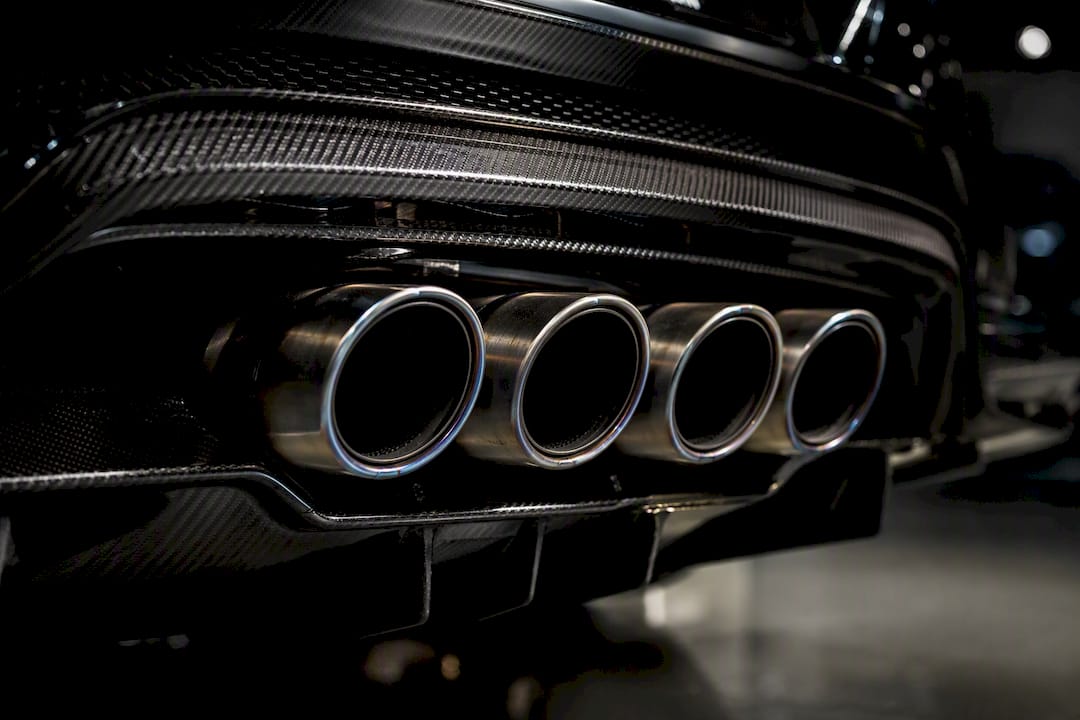
The one scenario where a fixed exhaust still makes sense is a dedicated track-only build with no meaningful street use, where the added cost and complexity of valve actuation delivers no practical benefit.
Manual Switch vs. Automatic Drive-Mode Control
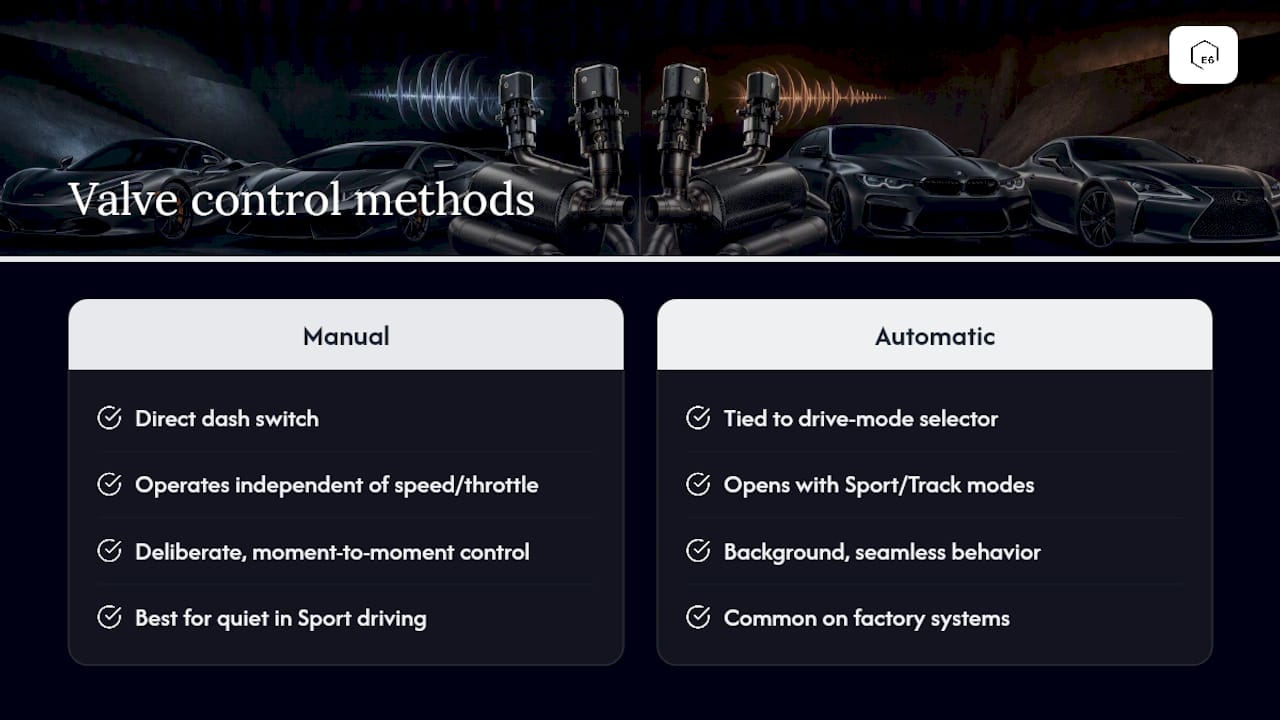
Owners have two real options for controlling valve position: a manual dash-mounted switch, or automatic behavior tied to the car’s existing drive-mode selector.
Manual control gives you direct, deliberate authority over acoustic mode regardless of how you’re driving otherwise. Flip the switch, and the valve opens or closes independent of throttle position, speed, or drive mode. This suits owners who want the exhaust decision separated entirely from performance settings, useful if you want a quiet exhaust in Sport mode for a spirited but discreet backroad drive.
Automatic, drive-mode-linked control ties valve behavior to the same selector that adjusts throttle mapping, suspension, and transmission logic. Select Sport or Track, and the valve opens without a separate input. This is how most factory active exhaust systems behave, and it’s the more seamless option for owners who don’t want to think about exhaust mode as a separate decision.
E6’s aftermarket systems typically support both approaches depending on the platform’s electronic architecture. AMG owners running factory drive-mode wiring can often integrate the valve into that existing system for automatic control. LC500 and other builds may use an independent controller that supports manual switching, a small remote, or a hybrid approach with both options available depending on installer preference. The right choice comes down to whether you want the exhaust as a background decision or a deliberate one you control moment to moment.
Emissions Impact of Exhaust Valve Tuning
Valve position affects exhaust flow characteristics, but it does not change the catalytic converter’s function or bypass emissions equipment on a properly engineered system. A quality valved exhaust routes gas around the muffler chamber, not around the catalytic converter itself, so emissions compliance components remain active in both open and closed modes.
Where owners run into trouble is aftermarket systems that alter piping diameter or catalytic converter placement without regard to factory emissions calibration. That’s an installation and design problem, not an inherent flaw in valved technology. A properly engineered valved exhaust preserves the factory emissions path while only changing the acoustic and backpressure characteristics downstream.
There’s a legitimate environmental consideration around ECU calibration after installation. If a tune adjusts air-fuel ratio without accounting for the new flow characteristics, it can push combustion outside its optimal range, which affects both performance and emissions output. This is exactly why post-install diagnostics and, where needed, a professional ECU recalibration matter beyond just avoiding a check engine light. Owners who skip this step risk a system that sounds right but runs slightly rich or lean, with real consequences for long-term engine health and emissions performance.
Warranty and Service Support to Expect
Warranty coverage on a valved exhaust system typically centers on the actuator and valve mechanism, the components most likely to experience wear from repeated open-close cycling. Reputable manufacturers back these parts against motor failure and defects in materials or welds, though exact terms vary by builder and should be confirmed before purchase.
Service support matters as much as the warranty document itself. A manufacturer that provides platform-specific fitment data, wiring diagrams, and diagnostic guidance gives your installer a real path to correct troubleshooting if something goes wrong, rather than guesswork. This is particularly important for the electronic integration side of the system, where a persistent check engine light or a valve that won’t hold position often traces back to a wiring or calibration issue rather than a hardware defect.
Ask any manufacturer directly what their coverage includes on the actuator motor, the valve housing, and the exhaust piping itself, since these often carry different terms. Also confirm whether warranty coverage requires professional installation documentation, since many manufacturers, E6 Motorsports included, tie coverage validity to installation records that prove the system was routed and integrated correctly. Keeping your installation invoice isn’t just good practice for insurance purposes; it’s frequently a warranty requirement in its own right.
An Honest Read on What Actually Matters Here
The conventional advice on valved exhausts stops at “quiet when closed, loud when open,” and that’s technically true but misses where the real value and the real risk both sit: integration.
Most owners get seduced by the sound clips and skip past the fitment and electronics questions entirely. That’s backwards. The acoustic difference between a well-integrated system and a poorly routed one is smaller than most people assume, but the reliability difference is enormous. A valve that sticks, an actuator that cooks itself against a heat shield that wasn’t rated for the job, a CEL that won’t clear without a diagnostic module, these are integration failures, not exhaust failures.
What should you prioritize first? Fitment proof for your exact platform and year, not sound samples. A dyno-verified baseline before and after installation. And a straight answer from your installer on exactly how they’re wiring the valve into your car’s electronics. The tone comes free once those three things are handled correctly. Skip them, and no amount of titanium or track-day theatrics will save you from a warning light on your dash six months in.
Bring Executive Refinement and Track Sound to Your LC500 or AMG
E6 Motorsports builds the LFA-style valved exhaust for the LC500 V8 specifically to pair with the platform’s center-exit geometry, giving owners a system engineered around the same tolerances as the matching diffuser rather than a universal-fit compromise. The center-exit layout integrates directly with the Elite Kit’s dry carbon rear diffuser, so tip spacing, heat clearance, and panel fitment are solved together instead of forcing two separate purchases to coexist. Owners rounding out the rear-end aesthetic often pair the exhaust with M-Style carbon fiber mirrors for a cohesive carbon presence front to back. For owners exploring broader compatible components across exotic platforms, Supercars offers additional fitment and parts context worth reviewing alongside E6’s own catalog. Professional installation remains strongly recommended for correct valve routing and electronic integration on every build. Reach out through E6’s product pages to request a fitment consultation before you order.
Key Takeaways
Valved exhaust systems succeed when fitment-first engineering ties the valve, the actuator wiring, and platform-specific bodywork together as one integrated system.
| Point | Details |
|---|---|
| Two acoustic modes, one system | Closed mode routes gas through a muffled path for quiet driving; open mode uses a low-restriction bypass for track sound. |
| Electronic actuation outperforms vacuum | Motor-driven valves respond faster and hold position more reliably than vacuum-actuated designs, especially on turbocharged platforms. |
| Fitment determines reliability | Poor actuator routing and inadequate heat shielding cause the majority of valve motor failures and persistent check engine lights. |
| Material choice shapes tone and longevity | Titanium offers a lighter, higher-pitched build; stainless steel costs less and delivers strong long-term durability. |
| E6 builds platform-specific integration | E6 Motorsports engineers its LC500 center-exit exhaust to pair directly with the LC500-F dry carbon diffuser for verified fitment. |
Sources
- What Is a Valvetronic Exhaust? How It Works & Pros/Cons
- What Is Active Exhaust? Benefits, Modes & Upgrade Guide | AmericanMuscle
- Valved Exhaust Systems Explained: Quiet on Demand, Loud When You Want – AP Tuning
FAQ
Are Valved Mufflers Illegal?
Valved mufflers themselves are legal; the issue is decibel output in open mode, which can violate local noise ordinances depending on where you drive. Most owners keep valves closed on public roads and reserve open mode for track use or private property.
Which Car Brand Has the Best Exhaust Sound?
This comes down to personal preference and platform, but naturally aspirated V8s like the Lexus LC500’s tend to produce a more resonant, higher-revving character than turbocharged AMG platforms, which lean toward a deeper, more aggressive low-end note. A well-integrated valved system lets either platform express both a refined and an aggressive personality on demand.
How Much Does a Valvetronic Exhaust System Cost?
Pricing varies significantly by platform, material choice, and integration complexity, with titanium builds and center-exit configurations like E6’s LC500 system commanding a premium over stainless cat-back options. Request a platform-specific quote directly, since generic pricing rarely reflects true fitment-engineered systems.
Do I Need an ECU Tune After Installing a Valved Exhaust?
Not always. Some LC500 and AMG platforms run cleanly on a valved exhaust without recalibration, while others benefit from a light ECU tune to account for reduced backpressure and maintain correct air-fuel ratio.
Can I Install a Valved Exhaust Myself?
Professional installation is strongly recommended for proper valve routing, heat shielding, and electronic integration. E6 Motorsports holds zero liability for issues arising from improper installation.