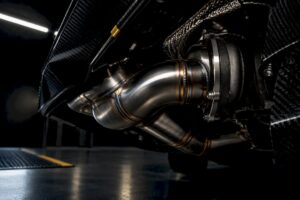
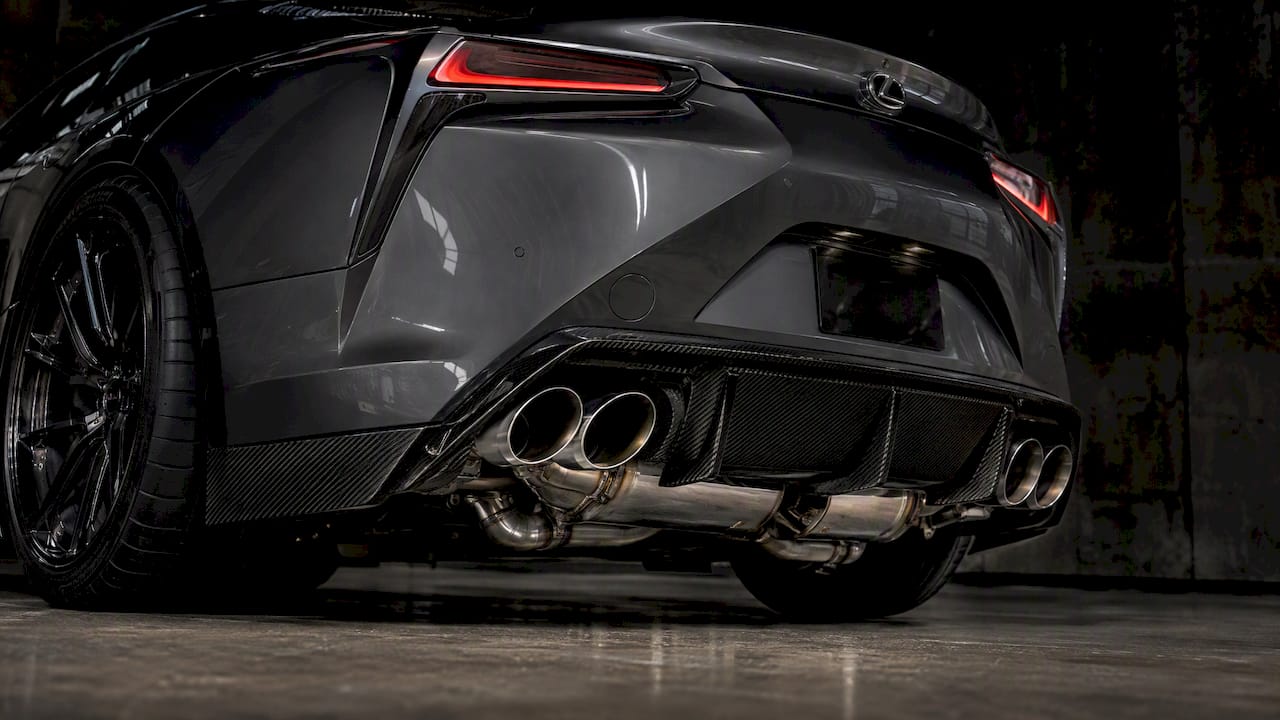
E6’s valvetronic cat-back unlocks a louder, sharper LC500 V8 note on open-valve while preserving quiet cruising through its dual-mode valve control. Built in T304 stainless or titanium, it pairs with our Carbon Elite aero and staggered Forged wheels for a coordinated sound, weight, and visual upgrade.
TL;DR:
- The valvetronic exhaust uses electronically controlled gates, allowing the V8 to produce a sharper sound when open and stay quiet during cruising.
- Weight savings are available with titanium piping, which also offers faster heat dissipation and a higher-pitched tone compared to stainless steel.
- The system fits all LC500 models with the 5.0L V8, but factory muffler part numbers changed around 2020, affecting sound characteristics.
- Professional installation is recommended, with manual override options helping maintain daily usability in noise-sensitive areas.
- Expect minimal horsepower changes, with primary benefits in sound, throttle response, and reduced backpressure rather than significant power gains.
Table of Contents
- What the E6 valvetronic exhaust is and how it’s built
- How the exhaust changes sound and performance on the 2UR-GSE V8
- T304 stainless vs titanium: choosing your build
- Fitment and compatibility across LC500 model years and trims
- Installation, driving modes, and daily usability
- Why choose E6: engineering proof points and system integration
- Maintenance, warranty, and ownership considerations
- Engineer perspective: design tradeoffs and acoustic targets
- Buy and next steps for your LC500 build
- FAQ
- Sources
What the E6 valvetronic exhaust is and how it’s built
The E6 Motorsports valvetronic exhaust for the LC500 is a valved cat-back system built around high-flow midpipes, engineered to let the naturally aspirated 5.0L 2UR-GSE V8 breathe without the acoustic ceiling Lexus built into the factory system. It takes design cues from the LFA’s valved exhaust architecture, using electronically controlled gates rather than a fixed muffler core.
A complete kit replaces the factory muffler section and connects to the stock catalytic converters, routing exhaust gas through a valve assembly that opens or closes based on throttle input, RPM, and drive mode selection. The system includes:
- Valved muffler sections with factory-style electronic actuators for OEM-level control integration
- High-flow midpipes sized to reduce backpressure without disrupting factory sensor readings
- Mounting hardware and brackets engineered for a direct, no-modification fit
- A choice of T304 stainless steel or titanium piping and muffler housings
The valve actuation is the core of the system. In closed or partially closed position, exhaust gas routes through a quieter path that keeps cabin noise low for commuting. Under wide-open throttle, or when the driver selects a sport mode, the valves open fully and gas flows through a lower-restriction path that lets the V8’s natural exhaust note come through unfiltered. This is not a static muffler swap. It is a controlled system that behaves differently depending on how the car is being driven, which is the entire point of a valvetronic design over a straight-pipe or fixed-core aftermarket exhaust.
How the exhaust changes sound and performance on the 2UR-GSE V8
The sound difference is the primary reason LC500 owners look at this upgrade. In closed-valve mode, the exhaust stays close to factory loudness, suitable for early morning starts or quiet neighborhoods. Open the valves and the character shifts: a deeper, more resonant idle, a harder-edged mid-range growl as RPM climbs, and a sharper top-end snarl near redline that the factory system dampens considerably.

The 2UR-GSE is a naturally aspirated V8 rated at approximately 471 to 477 horsepower and 398 lb-ft of torque from the factory, a specification also reflected in Kelley Blue Book’s listing for the 2025 LC500. A cat-back exhaust working behind the stock catalytic converters does not fundamentally change those baseline numbers on a dyno in a meaningful way. What it changes is perceived throttle response and the acoustic feedback that makes a V8 feel alive under load. Reduced backpressure from the high-flow midpipes can modestly improve exhaust scavenging, but the dominant benefit here is auditory and experiential rather than a horsepower chase.
A naturally aspirated V8 rated at roughly 471 to 477 hp and 398 lb-ft gives this exhaust a strong baseline to work with, since the factory system already restrains a genuinely capable engine’s voice more than its output.
T304 stainless vs titanium: choosing your build
Material choice shapes tone, weight, and long-term ownership experience as much as it shapes the invoice.
- T304 stainless steel produces a slightly deeper, more resonant tone with more low-frequency presence, holds up well against road salt and moisture, and costs less than titanium for an equivalent kit.
- Titanium delivers a sharper, higher-pitched note with less mass dampening the resonance, cuts meaningful weight from the rear of the car, and resists heat discoloration differently than stainless.
- Weight savings from titanium contribute to unsprung weight reduction at the rear subframe area, which has a small but real effect on rear-end responsiveness during hard driving.
- Titanium’s thermal characteristics mean it dissipates heat faster, which can matter for ground clearance and heat-soak in tight engine bay or undertray areas.
- Finish options differ: stainless typically ships in a polished or brushed finish, while titanium can develop a natural blue-purple heat tint over time that many owners prefer uncoated.
Pro Tip: If you’re chasing a deeper exhaust note for cruising and don’t need the weight savings, T304 stainless is the more cost-effective choice; if you’re building a track-focused car where every pound matters, titanium earns its premium.
Fitment and compatibility across LC500 model years and trims
The E6 valvetronic exhaust is engineered around the LC500’s 5.0L 2UR-GSE platform, which has remained the naturally aspirated V8 offering across the model’s production run. Fitment is consistent across the standard LC500, Inspiration Series, and Ultimate editions, since these trims share the same exhaust architecture and factory valve control logic, with cosmetic and interior differences rather than drivetrain changes.
One detail worth flagging before ordering: owner reports on ClubLexus forums describe factory muffler part-number changes occurring around 2020, which shifted baseline sound character between earlier and later production LC500s. That factory revision is part of why some owners chasing the earlier “2019 sound” in newer cars have found stock muffler swaps and valve-disabling hacks increasingly unreliable on later models, reinforcing the case for a purpose-built valved system instead.
Before ordering, gather the following:
- Your VIN, to confirm production year and any mid-cycle hardware revisions
- The factory muffler part number, if accessible, especially for cars built in or after 2020
- Photos of the rear undercarriage showing the factory valve actuator wiring and mounting points
- Confirmation of trim level (base, Inspiration Series, or Ultimate) for record-keeping with your order
This upfront check avoids delays and ensures the actuator wiring harness and mounting brackets match your car’s exact configuration.
Installation, driving modes, and daily usability
Installation is a bolt-on process for a qualified exhaust or performance shop: removing the factory muffler section, connecting the E6 valved assembly to the existing midpipes or factory catalytic converters, and wiring the valve actuators into the factory control logic or an E6-supplied controller. We recommend professional installation to ensure actuator calibration and clearance checks are done correctly.
Valve behavior follows drive mode selection on most installations: comfort or eco modes keep the valves closed for quiet operation, while sport or sport+ modes open them automatically. Many owners also prefer a manual override switch wired in separately, giving control independent of drive mode for situations like late-night street parking or quiet residential driving.
- Daily usability stays strong since the closed-valve mode keeps cabin drone to a minimum on the highway
- Open-valve mode is best reserved for backroads, track days, or moments you want the V8 heard
- Noise and emissions compliance varies by state and locality, so check local regulations on aftermarket exhaust modifications before committing to an always-open configuration
- Expect a short break-in period as actuators settle into their new range of motion
Pro Tip: Wire in a manual valve override if your daily commute passes through noise-sensitive areas, it gives you control the factory drive modes don’t.
For more detail on valve mapping and drone mitigation across valved systems generally, our daily drivability guide covers the tuning considerations in depth.
Why choose E6: engineering proof points and system integration
Our approach starts with Fitment First engineering: every component, from exhaust brackets to carbon aero pieces, is designed against the exact factory mounting geometry of the LC500 rather than adapted from a generic template. That matters as much for a valved exhaust actuator as it does for a diffuser bracket.
- Fitment First engineering means actuator wiring, clamps, and hangers are built to factory tolerances, not trimmed to fit after the fact
- Our carbon fiber components use autoclave-cured 2×2 twill construction for consistent strength and finish quality
- Our forged wheel programs span monoblock and multi-piece construction for owners balancing weight against repairability
- Pairing the exhaust with our Carbon Elite dry carbon diffuser kit improves rear aero balance while complementing the exhaust’s lower-restriction heat routing
- Staggered E6 Forged Monoblock wheels cut unsprung weight at each corner, a change that pairs naturally with a titanium exhaust’s own weight savings for a measurably lighter rear end
For deeper acoustic engineering background on valve design and target frequencies, see our acoustic engineering overview.
Maintenance, warranty, and ownership considerations
A valved exhaust has more moving parts than a static muffler, so a short maintenance routine keeps it reliable long-term.
- Inspect clamps and fastener torque every 10,000 to 12,000 miles, or sooner after track use
- Check valve actuator wiring connections annually for corrosion or loose terminals
- Stainless steel holds up well to road salt with minimal care; titanium needs no coating but benefits from occasional wipe-down to control heat tint if a uniform finish is preferred
- Ask about warranty coverage on the actuator assembly specifically, since it is the component most likely to need service over the exhaust’s lifespan
- Confirm whether your installer offers fitment guarantees before paying for labor
Engineer perspective: design tradeoffs and acoustic targets
Every valvetronic exhaust is a negotiation between two competing goals: a quiet car at 7 AM and an aggressive one at redline. We tuned valve logic around real throttle and RPM thresholds rather than a simple open-or-closed switch, because owners drive the LC500 in both modes often, sometimes in the same ten-minute drive. Material choice compounds that tradeoff: titanium’s lighter resonance rewards aggressive driving, while stainless holds a fuller tone at idle. There is no universally correct answer, only the one that matches how you actually drive your car.
— E6 Engineering
Buy and next steps for your LC500 build
If you’re ready to hear what your 2UR-GSE V8 actually sounds like unrestricted, start with our LFA-style valved exhaust product page to review part numbers and material options. Confirm your VIN and trim details, request a fitment quote, and schedule installation through our professional in-house installation services.
For a complete build, pair the exhaust with our Carbon Elite dry carbon diffuser kit to complement the rear-end weight and aero changes, and browse E6 Forged Monoblock wheels for a staggered fitment that finishes the look. Rare OEM hardware or reference parts are sometimes available through marketplaces like Supercars if you need factory components during the swap.

FAQ
Which years of the Lexus LC 500 should I avoid?
There is no officially documented problem year for the LC500, and the model has a reputation for strong reliability across its production run. Owners on forums do note that factory muffler part numbers changed around 2020, which affected baseline exhaust sound rather than mechanical reliability.
What is the top speed of the Lexus LC 500 without the electronic limiter?
The LC500 is electronically limited to approximately 168 mph from the factory. Removing or raising that limiter is a separate tuning consideration from exhaust work and depends on aerodynamic and tire-rating factors beyond the scope of a cat-back upgrade.
Is the Lexus LC 500 going up in value?
Values for distinctive, limited-production naturally aspirated grand tourers like the LC500 can trend upward as production winds down, though this depends heavily on trim, mileage, and condition rather than a single market-wide pattern. We recommend checking current listings and valuation guides like Kelley Blue Book for an up-to-date read on your specific configuration.
Can the LC 500 be tuned?
Yes, the LC500’s 2UR-GSE V8 and supporting systems accept a range of aftermarket upgrades, including valved exhaust systems like ours that change acoustic character and modestly improve exhaust flow. Deeper tuning for notable power gains on a naturally aspirated engine typically requires more comprehensive work than a cat-back exhaust alone.
Does the E6 valvetronic exhaust affect emissions compliance?
The system connects behind the factory catalytic converters, so it does not alter emissions equipment, but noise regulations for aftermarket exhaust modifications vary by state and locality. Check your local rules before running in open-valve mode regularly on public roads.
Sources
- Lexus LC — Wikipedia
- New 2025 Lexus LC LC 500 Prices | Kelley Blue Book
- How to get 2019 sound in a 2026 LC – ClubLexus forum
Recommended
- Acoustic Engineering of the E6 Motorsports LC500 Exhaust
- E6 Motorsports LFA Style Valved Exhaust for LC500 V8
- Fitment First E6 Two Piece Forged Wheels With Carbon Aero for LC500
- Engineer Led Fitment Guide to E6 Carbon Taillight Covers for LC500
Pricing, custom fitment options, and surface finishes subject to availability. Please contact E6 Carbon or E6 Forged directly to confirm vehicle-specific offset parameters, brake clearances, and current lead times prior to placing your order.