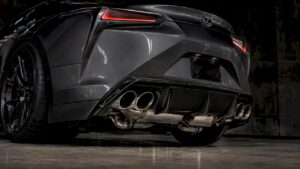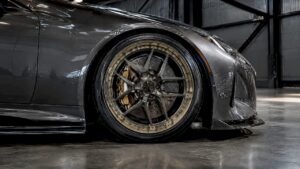

The E6 Forged B20M is a 6061-T6 forged monoblock wheel built in 18 to 22 inch diameters with custom widths and offsets for luxury and exotic platforms. Forging cuts unsprung weight and rotational inertia versus cast wheels. Our Fitment First engineering governs every spec, so check the sheet below before you order.
TL;DR:
- Custom B20M wheels are forged from 6061-T6 aluminum, significantly reducing weight and rotational inertia compared to cast wheels.
- Fitment verification requires measuring brake clearance, fender lip distance at full compression, and calculating backspacing to ensure safety and proper fit.
- Ordering a bespoke wheel involves providing vehicle VIN, hub, and caliper photos, with lead times longer than stock wheels due to the forging process.
- Monoblock construction eliminates joint lines and fasteners, making the wheels lighter and more suited for high-performance applications on specific platforms.
- Proper specification and measurement reduce the risk of fitment revisions, with final clearance confirmed at static and full suspension travel before use.
Table of Contents
- B20M spec sheet: diameters, widths, offsets, and clearances
- How to verify fitment before you place an order
- Why 6061-T6 forging outperforms cast and flow-formed wheels
- Building a track-ready setup around B20M wheels
- Ordering, lead times, and rim marking obligations
- What Fitment First engineering means for monoblock builds
- Get a custom B20M fitment consult
- FAQ
- Sources
B20M spec sheet: diameters, widths, offsets, and clearances
Every B20M build starts from a published envelope rather than a guess, which keeps staggered setups and big brake fitment predictable from the first conversation with our engineering team.
- Diameters: 18 to 22 inches, machined in single-inch increments to match factory and aftermarket tire charts.
- Widths: 8.0 to 13.0 inches, with staggered pairings common on Mercedes-AMG and Lexus LC500 builds (front narrower, rear wider for power delivery).
- Offsets: specified per application rather than a universal number; front and rear offsets on AMG GT and LC500 platforms typically diverge by 10 to 20 millimeters to balance scrub radius against fender clearance.
- Center bore and bolt pattern: machined hub-centric to the vehicle’s factory hub diameter, eliminating the need for centering rings on most applications.
- Brake clearance: confirmed against caliper width, caliper bracket depth, and rotor diameter before any wheel leaves the shop floor, with minimum radial and lateral clearance built into the design.
- Tire width ceiling: each wheel width carries a recommended maximum tire section width to keep sidewall stretch and contact patch geometry within a safe range.
Diameter and width decisions cascade into everything downstream: offset, backspacing, and brake clearance. For platforms running big brake kits, we also reference our forged wheel buying guide for performance enthusiasts when translating caliper dimensions into a workable wheel width.
How to verify fitment before you place an order
A spec sheet tells you what is possible. A fitment check tells you what is safe. The sequence below is the same one our engineering team runs before a B20M order is released to the forge.
- Measure the hub face to brake caliper clearance at the widest point of the caliper body, not just the rotor diameter.
- Record fender lip to tire sidewall distance at full compression and full steering lock, since static clearance alone misses dynamic interference.
- Calculate backspacing from the wheel’s overall width and offset: backspacing equals half the width plus the offset, converted to inches, and it directly sets scrub radius and tie-rod loading.
- Check camber and steering geometry on larger diameters, since taller wheels with low-profile tires amplify small camber errors into visible rubbing.
- Confirm hub-centric fitment or select centering rings when the hub bore is non-standard, and always torque to the vehicle manufacturer’s specification, then retorque after the first 50 to 100 miles.
Spoke geometry is not purely cosmetic. Changes to spoke-to-rim junction geometry require validation to avoid stress concentrators that shorten fatigue life, a tradeoff documented in wheel design and stress research. Red flags that require a rework request include caliper-to-barrel contact at static ride height, sub-millimeter fender clearance at full lock, and any backspacing calculation that pushes the tire outside the fender line.
Pro Tip: Photograph the hub, caliper, and fender gap from three angles before you submit a custom order. It saves a revision cycle on nearly every bespoke fitment.
Why 6061-T6 forging outperforms cast and flow-formed wheels
Forging aligns the aluminum’s grain structure along the wheel’s load paths instead of leaving it randomly oriented, as happens in a cast part. That grain flow is what gives a forged monoblock its fatigue resistance under repeated cornering and braking loads.
- Hot forging process: 6061 billet is heated and pressed under controlled punch speed and die cavity depth, a process studied in detail in research on forging processes for 6061 aluminum wheels, which shows how press parameters affect final formability and load distribution.
- CNC finishing: post-forge machining holds tight tolerances on bolt circle, center bore, and barrel profile, finishing the blank into the final monoblock shape.
- Mass reduction and rotational inertia: removing material from a denser, stronger forged blank lowers unsprung weight at each corner, and because that mass sits at the wheel’s outer radius, the rotational inertia benefit compounds with every revolution.
- Quality validation: bespoke forged wheels are checked against multiaxial stress modeling and fatigue benchmarking before a design is released for production runs.
The structural case for forging over casting and flow-forming is covered in more depth in our breakdown of why forged aluminum beats cast and flow-formed wheels, and the monoblock-specific tradeoffs against multi-piece construction are addressed in our monoblock vs. multipiece wheels comparison.
Building a track-ready setup around B20M wheels
A wheel spec is only one input into a track-capable build. Aerodynamics, brakes, and exhaust all interact with wheel width, offset, and barrel depth.
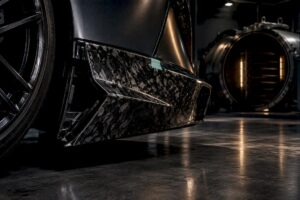
- Aero clearance: a front splitter or diffuser like the E6 Carbon Elite Kit for the Lexus LC500 changes front ride height and airflow around the wheel well, so wheel offset should be confirmed after aero components are selected, not before.
- Brake coordination: larger-diameter B20M wheels open clearance for bigger rotors and multi-piston calipers, but every caliper upgrade should be rechecked against the wheel’s barrel depth.
- Platform examples: an AMG GT63 staggered setup commonly runs a narrower front and wider rear width with offsets tuned to the factory fender line, while an LC500 build balances a similar stagger against its factory-forged brake package.
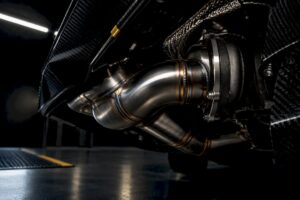
- Exhaust and finish matching: performance exhaust upgrades change nothing about wheel fitment directly, but we recommend finalizing wheel finish alongside aero and exhaust choices so the full build reads as one system rather than mismatched parts.
Ordering, lead times, and rim marking obligations
Custom B20M orders start with vehicle identification: VIN, hub and caliper photographs, and the desired diameter, width, and offset for each corner. Bespoke forging runs on a production queue rather than off-the-shelf stock, so lead times extend well beyond a cast-wheel purchase.
- What to submit: VIN, corner-by-corner hub and brake photos, and target specs for diameter, width, and offset.
- Lead time expectation: longer than stocked wheels, since each barrel is forged and machined to the submitted specification rather than pulled from inventory.
- Rim marking: under 49 CFR § 571.120, rims carry required markings for size designation and manufacturer source, and a party that substantially modifies a rim’s dimensions can become the rim manufacturer of record under NHTSA interpretation 77-442, which triggers its own marking responsibility.
- Install checklist: torque to spec, retorque after initial break-in mileage, and verify clearance at both static ride height and full suspension travel before track use.
A properly specified forged monoblock order documented with VIN and hub photos reduces the chance of a fitment revision after the wheel is already in production, a principle reflected in 49 CFR §571.120’s emphasis on accurate size and source documentation at the point of manufacture.
What Fitment First engineering means for monoblock builds
Fitment First is not a slogan applied after the fact. It is a sequence: measure the hub and brake envelope, model the stress path, machine the barrel, then validate clearance again before a wheel ships. Monoblock construction suits Mercedes-AMG, Lexus LC500, McLaren, and Lamborghini platforms because a single forged piece removes the joint lines and fasteners that add weight in a multi-piece assembly, which matters most on vehicles where every pound of rotating mass shows up in lap time.
— E6 Engineering
Get a custom B20M fitment consult
Forged monoblock wheels built to your hub, caliper, and offset numbers remove the guesswork a generic size chart leaves behind. Our E6 Forged Monoblock collection covers the full 18 to 22 inch range in custom widths from 8.0 to 13.0 inches, and a fitment consult starts with the same VIN and hub-photo package described above. Pair your wheel order with professional in-house installation and complementary dry carbon aero or exhaust upgrades for a complete build. Request your consult and send your vehicle specs to get started.

FAQ
What makes a monoblock wheel different from a multi-piece forged wheel?
A monoblock wheel is machined from a single forged piece, while a multi-piece wheel bolts a separate barrel to the face. The single-piece design removes joint hardware and seams, which typically reduces weight and the number of potential failure points compared to a multi-piece assembly.
Can B20M wheels clear big brake kits?
Yes, B20M diameters and widths are specified against the caliper envelope, including caliper width, bracket depth, and rotor diameter, before a design is finalized. Final clearance is confirmed at both static ride height and full suspension travel as part of the professional auto repair and installation best practices fitment check.
How long does a custom forged wheel order take?
Bespoke forged wheels take longer than stocked cast wheels because each barrel is forged and CNC-machined to the submitted vehicle specs rather than pulled from existing inventory. Submitting accurate VIN and hub photos up front helps avoid delays caused by a mid-production fitment revision.
Who is responsible for rim markings on a custom wheel?
Under 49 CFR §571.120, rims must carry specific size and source markings, and a party that substantially changes a rim’s dimensions can become the rim manufacturer of record. NHTSA interpretation 77-442 explains when that responsibility shifts to the modifier.
Does a larger wheel diameter hurt ride quality?
A larger diameter generally means a lower-profile tire, which reduces sidewall cushioning and can transmit more road feedback. Matching tire width to the wheel’s recommended section width, as outlined in the spec sheet above, keeps that tradeoff within a reasonable range for street and track use.
Sources
- An analysis of the forging processes for 6061 aluminum‑alloy wheels
- 49 CFR § 571.120 – Tire selection and rims (LII / Cornell)
- NHTSA interpretation 77‑442
- Wheel design and stress tradeoffs (HP Gavin paper)
Recommended
- Engineer Verified E6 RF20 Fitment for Luxury & Exotics, $3,500–$7,000
- Fitment First E6 Two Piece Forged Wheels With Carbon Aero for LC500
- Fitment First: E6 Forged 6061 T6 Wheels for C192 AMG GT63 5×112
- Fit 21–26in E6 HX5 Wheels Without Caliper Rub on AMG, LC500, Exotics
Pricing, custom fitment options, and surface finishes subject to availability. Please contact E6 Carbon or E6 Forged directly to confirm vehicle-specific offset parameters, brake clearances, and current lead times prior to placing your order.