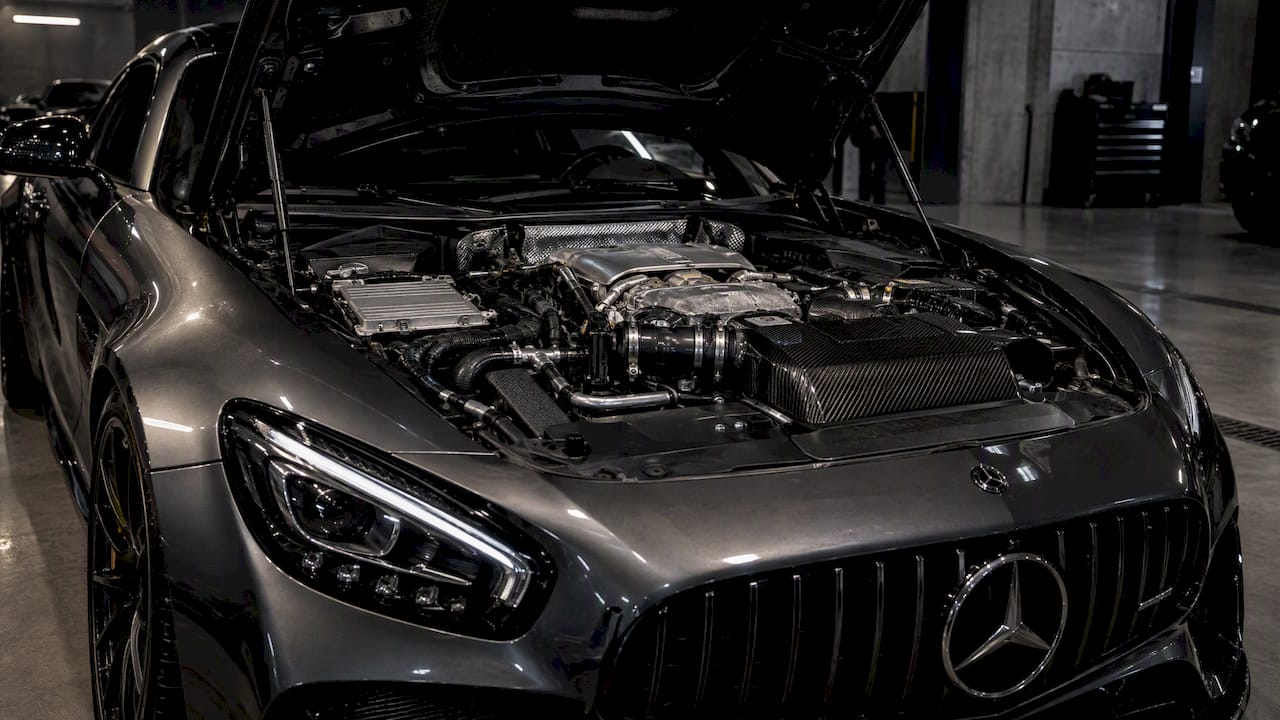
For AMG GT (C190/R190) owners running the dry-sump 4.0L biturbo M178, the E6 Motorsports M178 VTA adapter is the clear plug-and-play answer: it bolts directly onto the factory electronic diverter valve location, seals with precision O-rings, and uses CNC-machined 6061-T6 aluminum construction that needs no permanent ECU work. The result is the authentic vent-to-atmosphere sound your ECU already commands, released safely instead of trapped in the intake tract, with less heat soak under hard driving.
TL;DR:
- A CNC-machined aluminum VTA adapter with Viton seals reliably maintains boost and withstands heat cycling better than plastic spacers.
- Most twin-turbo AMG GT applications require two adapters, one for each bank, to ensure proper venting and sealing at both diverters.
- Proper installation involves torqueing mounting screws to 6-8 Nm and ensuring correct adapter orientation for a secure seal.
- The venting sound is ECU-controlled and occurs during factory commanded events, offering no benefit in noise for stock boost setups.
- Owners running above stock boost should prioritize seal quality and machining precision to prevent boost leaks and long-term seal failures.
Table of Contents
- Comparing VTA adapter approaches for the M178 platform
- What separates a well-engineered VTA adapter from a cheap one
- Installing the VTA adapter on your AMG GT
- What to expect: sound, heat management, and real tradeoffs
- Engineering standards behind the E6 Motorsports VTA adapter
- What actually matters when choosing a VTA adapter
- Where to get your VTA adapter and round out the build
- FAQ
- Sources
Comparing VTA adapter approaches for the M178 platform
Before you commit to hardware, it helps to understand what you’re actually choosing between. Three paths exist for M178 owners chasing the blowoff signature, and they are not equivalent in sealing quality or long-term reliability.
Factory recirculation keeps boost looping back through the intake with no audible event. Spacer-style sound adapters sit between the diverter and manifold and use thin plastic or basic gaskets to redirect a portion of pressure outward. Precision CNC VTA adapters like the E6 Motorsports M178 VTA adapter replace that interface entirely with a machined aluminum body and a proper seal system designed to hold pressure at the valve face.
- Factory diverter (stock): no vent sound, no added hardware, full OEM pressure retention.
- Spacer/sound-only adapters: inexpensive and easy to source, but thin plastic seals and loose tolerances often leak boost under sustained load.
- Precision CNC VTA adapters: metal piston and Viton O-ring sealing hold pressure more reliably than plastic OEM diverter components, which matters once you’re pushing the M178 past stock boost.
Material, seal type, and installation complexity separate these options as much as price does. A spacer-style unit is typically the cheapest buy-in and the simplest bolt-on, but it carries the least fit certainty and the thinnest support behind it. A precision VTA adapter costs more up front, uses a tighter O-ring interface, and generally comes with clearer installation documentation and manufacturer support. For a tuned M178 build where boost retention and long-term sealing matter, the precision route is the one worth the extra cost. Stock-boost cars chasing sound alone can get away with a simpler spacer, but they give up pressure-hold margin if boost is raised later.
What separates a well-engineered VTA adapter from a cheap one
Material choice and seal design decide whether a VTA adapter holds boost reliably or leaks under load. Quality units are machined from aircraft-grade 6061-T6 aluminum and finished with Type II or Type III anodizing, which resists corrosion in the engine bay’s heat and moisture cycles far better than bare or painted metal.
- Body material: CNC-machined 6061-T6 aluminum with anodized finish for corrosion resistance and dimensional stability under heat cycling.
- Seal system: Viton O-rings seated at the valve face, versus the OEM plastic seals that ship with the factory diverter.
- Piston and valve design: a precision metal piston bore holds pressure more consistently than a stamped spacer insert.
- Fitment detail: the mounting bolt pattern on the M178 diverter is not symmetrical, and twin-turbo configurations require two adapters, one per bank.
One documented performance distinction stands out: metal piston VTA kits with Viton seals hold pressure better than OEM plastic diverter components, a meaningful margin for anyone running the M178 above stock boost levels. That difference comes down to seal material and machining tolerance rather than marketing. A loose-tolerance plastic interface will creep and leak over heat cycles; a properly toleranced metal piston bore with Viton sealing does not. Connector and loom protection matter too: the factory electrical plug for the diverter solenoid needs to stay fully seated and shielded from abrasion once the adapter is in place, since that connection is what preserves normal ECU communication.
Installing the VTA adapter on your AMG GT
Installation follows a straightforward bolt-on sequence, and most owners with basic hand tools can complete it in under an hour per turbo.
- Disconnect the battery if your reference instructions call for it, then locate the factory diverter valve on the turbo housing.
- Unclip the OEM electrical connector from the diverter solenoid without forcing the locking tab.
- Remove the factory diverter using the correct Torx driver, noting that AMG submodels may use E-Torx or standard male Torx fasteners.
- Fit the new O-rings to the adapter body and seat them fully before mounting.
- Orient the adapter correctly, since the bolt pattern is not symmetrical and misalignment will compromise the seal.
- Tighten the three mounting screws to 6 to 8 Nm, then reconnect the plug-and-play adaptor loom and secure the wiring harness.
Twin-turbo M178 applications need one adapter per bank, so budget time accordingly if you’re doing both sides in one session. Intercooler piping or turbo shrouding can add disassembly steps depending on your specific GT, GTS, GTC, or GTR trim.
Pro Tip: Route the vent outlet away from painted body panels and keep the electrical loom clear of hot surfaces, since abrasion damage to the harness is the most common post-install complaint.

What to expect: sound, heat management, and real tradeoffs
The vent event itself is ECU-controlled, not adapter-controlled. Because the M178 diverter system is ECU-driven, a VTA adapter simply makes audible the vent events the ECU already commands rather than changing when or how often the valve opens. That means you’ll hear venting during lift-throttle shifts and occasionally during partial-throttle traction events, which is normal ECU logic and not an adapter malfunction.
- Acoustic result: the familiar blowoff chuff on lift-throttle, timed exactly to existing ECU commands.
- Thermal benefit: releasing excess boost to atmosphere instead of recirculating it through the intake reduces charge-air heat soak during aggressive street or track driving.
- Residue: light oily film at the outlet is normal, since crankcase and turbo oil vapor pass through the PCV system into the intake path.
- Local rules: check regional emissions requirements before installing on a vehicle subject to inspection.
A quality CNC-machined adapter with Viton sealing holds boost more consistently than a plastic spacer, which is the practical reason seal quality belongs at the top of your checklist for tuned builds.
Engineering standards behind the E6 Motorsports VTA adapter
We machine every E6 Motorsports VTA adapter from 6061-T6 aluminum stock and anodize it for corrosion resistance, applying the same fitment-first inspection discipline we use across our Mercedes-AMG hardware line, one of our priority engineering platforms alongside Lexus LC500 and expanding McLaren and Lamborghini applications.
- Each adapter is CNC-machined to hold tight tolerances at the mounting interface and valve bore.
- Viton O-ring sealing is fitted at assembly, not left to the installer to source separately.
- Fitment is verified against M178 diverter geometry before parts ship, reducing on-car surprises during install.
- A VTA adapter pairs naturally with lightweight E6 Forged wheels and dry carbon fiber parts for owners rounding out a full performance build.
What actually matters when choosing a VTA adapter
The conventional advice treats VTA adapters as interchangeable, judging them mostly on price and the promise of sound. That framing misses the point. The valve body and seal material determine whether the part survives heat cycling and holds boost two years from now, not whether it makes noise on day one. A $40 plastic spacer and a precision CNC unit will sound nearly identical in a parking lot demo, but only one of them is still sealing properly after a season of track days.
Prioritize seal material and machining tolerance first, fitment documentation second, and acoustic marketing claims last. If you’re running the M178 above stock boost, pressure retention at the valve interface stops being a nice-to-have and becomes the deciding factor. Owners who skip that step and chase the cheapest sound-only adapter often end up replacing it within a year. Buy once, buy for the seal.
— E6 Engineering
Where to get your VTA adapter and round out the build
Ordering the E6 Motorsports M178 VTA adapter starts with confirming fitment for your specific AMG GT, GTS, GTC, or GTR configuration, and we handle that confirmation directly before anything ships.
- Browse E6 Forged wheel collections to pair your VTA upgrade with lightweight 6061-T6 monoblock or multipiece wheels for real unsprung weight reduction.
- Add carbon fiber parts finished from autoclave-cured 2×2 twill for a build that looks as dialed as it sounds.
- Book our professional in-house installation services if you’d rather have the adapter, torque specs, and loom routing handled by hardware we built ourselves.
If you’re also evaluating supporting mods, our ECU and TCU tune page and performance downpipes cover the next steps most M178 owners take after the VTA install. Reach out through our catalog to confirm fitment and get your adapter and wheel set scheduled together.
FAQ
Do I need one or two VTA adapters for my AMG GT?
The M178 is a twin-turbo engine, so most C190 and R190 configurations need two adapters, one per turbo bank. Confirm your specific trim’s turbo layout before ordering to avoid a return.
Will a VTA adapter trigger a check engine light?
No, when properly installed, a VTA adapter does not require permanent ECU modifications, because it only redirects the physical vent path the ECU already commands. Standard bolt-on installation on a stock ECU map should not set a fault code.
What torque spec do I use for the mounting screws?
Vendor installation instructions specify tightening the three diverter mounting screws to 6 to 8 Nm. Overtightening can distort the O-ring seal, so a calibrated torque wrench is worth using here.
Is oily residue at the vent outlet normal?
Yes, light oily residue around the atmosphere outlet is a normal byproduct of crankcase oil vapor passing through the PCV system, not a sign of a failed seal. Routing the outlet away from painted panels keeps any residue from staining body surfaces.
Does a VTA adapter require a custom tune?
A standard VTA adapter installs on a stock ECU without custom tuning for typical street use. Owners running the M178 well above stock boost should verify pressure-hold capability with a metal piston, Viton-sealed adapter rather than a plastic spacer.
Sources
- T9488 Installation Instructions (GFB)
- GFB T9488 product/tech note
- GFB DV installation and explanation (ECSTuning blog)
Recommended
- Engineer Backed E6 Downpipes for AMG GT: Mandrel Bent 304, TIG Flanges
- Brake Upgrade | AMG GT (C190/R190)
- Track Focused Wheels for the AMG GT: Engineering Guide
- AMG GTS to AMG GTR Bumper Conversion Guide
Pricing, custom fitment options, and surface finishes subject to availability. Please contact E6 Carbon or E6 Forged directly to confirm vehicle-specific offset parameters, brake clearances, and current lead times prior to placing your order.