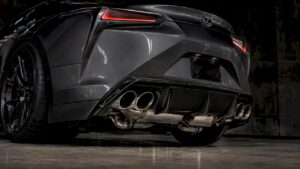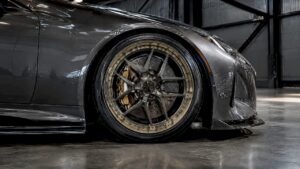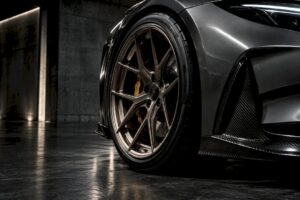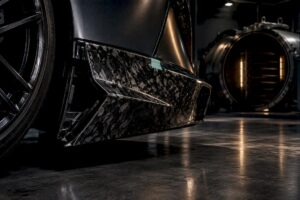
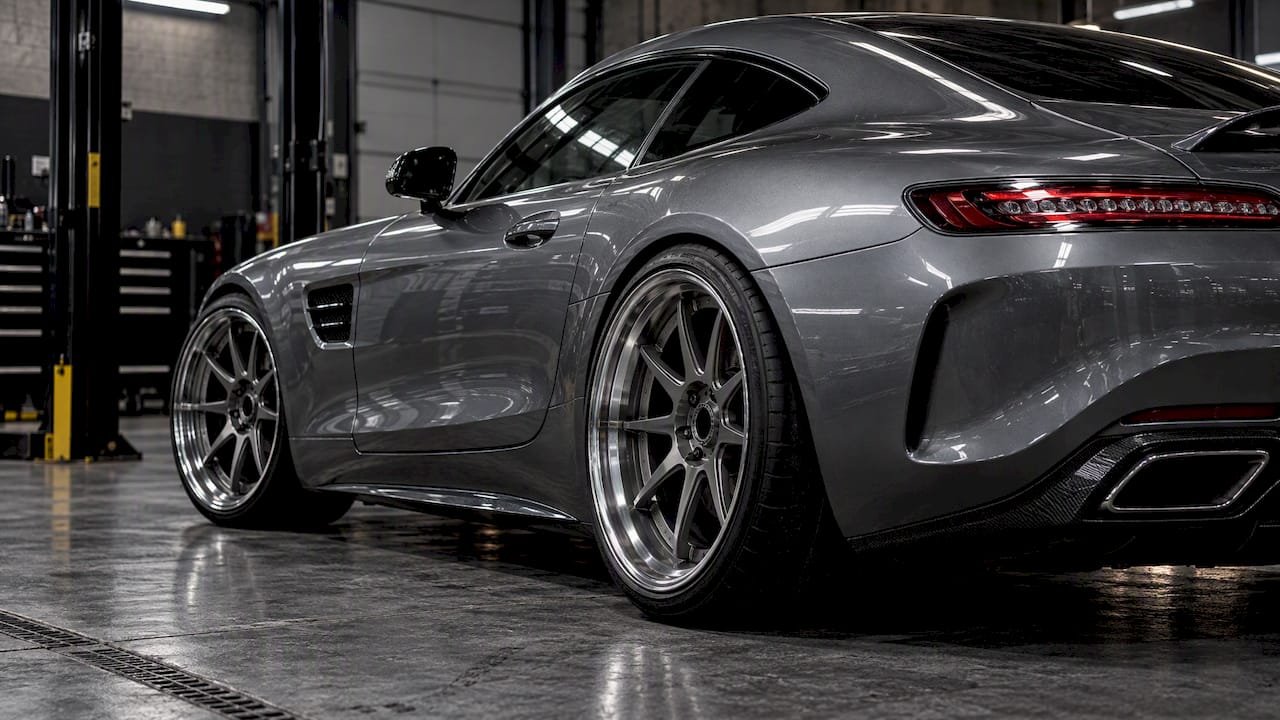
Direct answer: We recommend E6 Forged monoblock wheels in a staggered 20×10 front / 21×12 rear setup, 5×112 bolt pattern, for AMG GT C190 track builds. Expect meaningful rotating-mass reduction and clearance for most big brake kits.
For owners chasing lap times rather than show-stand looks, the wheel is the single highest-leverage change you can make on an M178-powered AMG GT. Every pound removed from the corner affects acceleration, braking, and how the dampers respond to track surfaces, and it does so four times over, once per wheel. The sections below walk through exact fitment specs, the engineering behind the gains, clearance math for big brake kits, and how a wheel order fits into a broader E6 Carbon and E6 Motorsports build.
TL;DR:
- Forged monoblock wheels offer the lowest weight and no seams, making them ideal for dedicated track builds focused on lap-time reduction.
- A 20×10 front and 21×12 rear staggered setup with 5×112 bolt pattern is recommended, with the wheel’s offset carefully aligned to the factory scrub radius.
- Removing one pound of rotational mass provides the equivalent benefit of 4 to 10 pounds of static weight savings, improving acceleration, braking, and handling response.
- Ensuring proper fitment involves checking brake clearance, offset, backspacing, hub bore size, and stud length before ordering, to avoid costly returns.
- Re-torque and regularly inspect wheels and runout post-track sessions to maintain safety and performance, especially when using lightweight forged wheels.
Table of Contents
- E6 wheel fitments and spec shortlist for the AMG GT C190
- Why cutting rotating mass sharpens acceleration, braking, and damper response
- Fitment checklist: offsets, stagger, and big brake kit clearance
- Forged construction, tolerances, and when beadlocks matter
- Mounting, balancing, and alignment for a track-prepped AMG GT
- How E6 Forged wheels complete a build with E6 Carbon aero and E6 Motorsports upgrades
- Warranty coverage and after-sales support
- Recommended tire pairings and sizes for track use
- Maintenance tips specific to forged lightweight track wheels
- Price range and total cost considerations including shipping and installation
- E6 Engineering viewpoint: choosing between monoblock, multipiece, and beadlock
- Order E6 Forged wheels and book your fitment consultation
- FAQ
- Sources
E6 wheel fitments and spec shortlist for the AMG GT C190
The C190 chassis responds well to an aggressive stagger, provided the offsets respect the factory scrub radius and the rear fender doesn’t need to be rolled. A common track-oriented starting point is 20×10 front and 21×12 rear, though owners running a more conservative street/track mix often land closer to 20×9.5 and 21×11.5.
Bolt pattern across the C190 lineup is 5×112, shared with much of the Mercedes-AMG range, so centerbore handling is the detail that actually varies between wheel suppliers. A quality hub-centric ring eliminates the vibration that comes from running a wheel bored to a larger diameter than the hub, and it’s worth confirming ring material (aluminum, not plastic) before ordering. Lug torque should follow Mercedes-AMG factory specification, checked with a calibrated torque wrench rather than an impact gun set to “feel right.”
Weight differences between wheel families are where the real decision gets made:
| Wheel family | Typical construction | Weight priority | Best suited for |
|---|---|---|---|
| E6 Forged Beadlock | Forged with mechanical bead lock | Moderate, traction-focused | Low tire pressure, dedicated race setups |
A few practical notes before specifying a set:
- Monoblock wheels carry the least rotating mass and no seams, which matters most when the goal is lap time.
- Multipiece wheels trade a small weight penalty for easier refinishing and the ability to swap barrel widths later.
- Beadlock wheels solve a problem most street/track owners don’t have: they matter when tire pressures drop low enough for the bead to walk off the rim under cornering load.
Matching the right family to the right use case avoids paying for traction hardware a street-driven car will never need.
Why cutting rotating mass sharpens acceleration, braking, and damper response
Rotating mass behaves differently from static weight because it has to be accelerated angularly as well as linearly. Every wheel, tire, and rotor spinning at the corner resists changes in speed the way a flywheel does, and that resistance shows up every time you get on the throttle, brake, or turn in. Industry engineers estimate that a pound removed from the rotating assembly can deliver the equivalent benefit of 4 to 10 pounds of static weight savings, which is why wheel weight gets disproportionate attention from teams chasing fractions of a second.
On the M178 transaxle platform, where the transmission sits at the rear and weight distribution is already tuned for balance, a lighter wheel and tire assembly pays off in a few specific ways:
- Acceleration rollout improves because less energy goes into spinning up the wheel and more goes into moving the car forward.
- Braking distance shortens slightly, since the brake system has less rotational inertia to arrest at each corner.
- Damper response sharpens because unsprung weight, everything the suspension has to control below the spring, drops, letting the damper react to the road rather than fighting wheel mass.
- Transient handling, turn-in sharpness and mid-corner corrections, becomes more immediate because the suspension isn’t working against extra rotating inertia.
The gains are real but they diminish past a certain point: dropping from a heavy OEM wheel to a forged monoblock is where most of the benefit lives, and further marginal weight savings matter less than tire compound choice or damper tuning. Ride comfort can also firm up slightly with a stiffer forged structure, which is a fair tradeoff for a track-focused build but worth knowing before ordering for a daily-driven GT.
Fitment checklist: offsets, stagger, and big brake kit clearance
Getting fitment right before you order saves a return shipment and a stripped lug stud. Work through these checks in order:
- Confirm your brake package. Measure caliper width and rotor diameter, including any big brake kit you’re running or planning, before locking in offset.
- Set offset around scrub radius, not just looks. An offset too far outward increases scrub radius and adds steering effort and tie rod stress; too far inward crowds the caliper and strut.
- Measure backspacing against caliper clearance. The inner barrel needs real clearance from the caliper body at full steering lock, not just static clearance.
- Confirm center bore and request hub-centric rings sized to your hub diameter so the wheel centers on the hub rather than the lug studs alone.
- Check stud length against your wheel’s mounting pad thickness, especially with spacers or multipiece wheels with deeper pads.
- Torque to Mercedes-AMG spec with a calibrated wrench, then plan a re-torque after the first heat cycle.
A few additional points matter once the wheels are mounted:
- Tire width should track wheel width: a 20×10 front typically pairs with a 275 width tire, and a 21×12 rear suits a 315 or wider, depending on the tire’s approved rim range.
- Going significantly wider than the wheel manufacturer’s recommended tire width distorts the sidewall profile and can throw off speedometer calibration.
- Confirm load rating on any track tire matches or exceeds the corner weight of the car, not just the tire size that physically fits.
Forged construction, tolerances, and when beadlocks matter
Not all “forged” wheels are built to the same standard, and the difference shows up under track loads rather than on a showroom floor. Genuine forged aluminum performance wheels typically start from a 6061-T6 billet, which outperforms cast or flow-formed construction in strength-to-weight ratio because the forging process aligns the metal’s grain structure rather than relying on a cast mold.
Monoblock versus multipiece is a genuine engineering tradeoff, not just a cosmetic choice:
- Monoblock wheels are stiffer and lighter because there’s no seam, bolt ring, or barrel joint, but a damaged monoblock usually means full replacement.
- Multipiece wheels carry a small weight penalty at the bolt ring but allow a damaged barrel to be replaced independently of the face, which matters for a wheel that sees curbing or track debris.
When evaluating a quoted wheel, the tolerance numbers that actually matter are radial runout, lateral runout, and concentricity, since these determine whether the wheel spins true at speed rather than inducing vibration through the steering wheel or seat. A reputable forged wheel will publish these tolerances rather than leaving them to assumption.
Knurled bead seats, a machined texture on the bead seat area, solve tire slippage under high torque for the vast majority of street and track AMG GT owners without the added complexity of a true beadlock. Beadlocks matter specifically for low tire-pressure race setups where the bead would otherwise walk under cornering load.

Pro Tip: Ask for the radial and lateral runout spec in writing before ordering. A wheel without a published tolerance number is a wheel you’re trusting blind.
Mounting, balancing, and alignment for a track-prepped AMG GT
Getting the wheel on the car correctly matters as much as the spec you chose. Follow this sequence for a track-prep install:
- Mount with care around the knurled bead seat, since the texture that prevents slippage also makes tire mounting slightly more aggressive on the bead; a shop experienced with performance wheels avoids bead damage here.
- Torque lugs in a star pattern to the Mercedes-AMG factory spec, then plan a re-torque check after the first 50 to 100 miles or after the first track session, since new wheels and tires seat slightly under initial load.
- Select valve stems rated for the speeds and pressures you’ll run, as standard rubber snap-in stems aren’t always rated for sustained track speeds.
- Balance with care on a lightweight wheel, since less rotating mass means smaller imbalances are more noticeable; a quality shop will use fine-increment weights rather than rounding to the nearest half ounce.
- Re-align after any wheel or tire change, checking camber and toe against track-oriented alignment targets rather than factory daily-driving specs; an experienced mobile alignment service can handle this without a shop visit for owners who prefer it.
Inspect runout periodically, especially after curb contact or a hard impact, since a wheel that has gone out of tolerance will transmit vibration through the chassis before it shows any visible damage.
Pro Tip: Keep a torque log after every track day. A sudden change in required torque to reach spec is often the first sign a wheel needs inspection.
How E6 Forged wheels complete a build with E6 Carbon aero and E6 Motorsports upgrades
A lightweight wheel doesn’t operate in isolation. Reducing rotational mass at all four corners amplifies what an aero package and an exhaust upgrade are already doing for the car’s transient behavior, since the suspension and chassis can respond to aerodynamic load changes faster when they’re not also fighting excess wheel inertia.
A few build-sequence notes worth knowing before you order:
- Brake clearance first. If you’re running or planning an AMG GT brake upgrade, confirm wheel offset and spoke design against caliper clearance before finalizing a wheel order.
- Aero and wheel choice interact at speed. Downforce-generating carbon components change the load the suspension sees at the corners, so a lighter wheel helps the suspension translate that load into grip rather than lag.
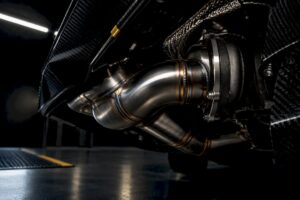
- Downpipes and weight savings share a goal. Both E6 Motorsports downpipes and E6 Forged wheels reduce parasitic mass and resistance, one in the exhaust path, one in the rotating assembly, and the combined effect compounds rather than simply adding up.
- Request an integrated fitment consultation when ordering wheels alongside brakes or aero, since offset, caliper clearance, and aero ride-height changes all interact.
Building wheels, brakes, and aero as one engineered package avoids the clearance surprises that come from ordering each piece independently.
Warranty coverage and after-sales support
A forged wheel is a structural part, and the warranty behind it should reflect that. When evaluating any track wheel purchase, ask specifically what’s covered: manufacturing defects, tolerance issues discovered after delivery, and finish coverage are typically separate warranty categories.
After-sales support matters for forged wheels because fitment questions often surface after the wheel arrives: a hub-centric ring that’s slightly undersized, a valve stem that doesn’t seal at track pressures, or a question about re-torque intervals after the first session. Direct engineering consultation shortens the time between a fitment question and a track-ready car.
After-sales support that integrates fitment questions for wheels, brakes, and aero parts together improves the process from buying parts to having a car that’s track-ready.
Recommended tire pairings and sizes for track use
Tire choice determines how much of a wheel’s weight savings actually reaches the pavement. For the staggered fitments discussed above, a 275-width front and 315 to 325-width rear is a common track-day pairing on a 20×10 / 21×12 setup, though exact sizing should follow the tire manufacturer’s approved rim-width range rather than a generic rule of thumb.
Compound choice matters as much as size. A dedicated track compound (often labeled as an R-compound or extreme-performance summer tire) extracts far more from a lightweight wheel’s reduced rotating mass than a street-oriented ultra-high-performance tire, since the softer compound translates suspension and damper improvements into actual grip rather than losing it to tire flex.
A few sizing notes worth confirming before ordering tires alongside new wheels:
- Match tire width to the wheel’s recommended rim-width range rather than maximizing width for appearance.
- Confirm load rating meets or exceeds the AMG GT’s corner weight, especially with a passenger and fuel load for a track day.
- Check speed rating against the car’s realistic top speed on track, not just the posted speed limit rating.
Getting the tire and wheel width matched correctly also protects the sidewall from the kind of flex that undoes the benefit of running a lighter forged wheel in the first place.
Maintenance tips specific to forged lightweight track wheels
Forged wheels are stronger than cast equivalents, but a lighter structure still needs attention a heavier OEM wheel might tolerate without complaint. Build a simple maintenance routine around these points:
- Re-torque after the first heat cycle. New wheel and tire assemblies seat slightly under initial load and track heat, so a re-torque check after the first session catches any lugs that have settled.
- Inspect for runout periodically, especially after curb contact, since a wheel that’s gone out of tolerance transmits vibration before any crack or deformation becomes visible.
- Clean brake dust regularly, particularly around the knurled bead seat area, since accumulated dust and grime can mask early signs of coating wear or surface corrosion.
- Store off-season sets properly, upright rather than stacked flat, to avoid stress on the barrel or finish over time.
- Check valve stems at every tire service, since a stem rated for street pressures can fail at sustained track pressures and speeds.
A forged wheel that’s properly maintained holds its tolerances for years of track use, but skipping the re-torque and runout checks is the most common way an otherwise excellent wheel develops a problem that didn’t need to happen.
Price range and total cost considerations including shipping and installation
Budgeting for a forged wheel set means looking past the per-wheel price to the full cost of a track-ready corner. E6 Forged Multipiece wheels start at $3,800 per set, while E6 Luxury Wheels start at $3,500 per set; E6 Forged Beadlock wheels start at $1,500 per pair for owners who need dedicated race hardware on two corners. Monoblock and AeroForm pricing is available on request given the degree of custom specification involved in each order.
Total cost beyond the wheel price includes tires sized correctly for the new fitment, hub-centric rings if not included, valve stems rated for track use, and professional mounting and balancing. Professional in-house installation is worth factoring into the budget from the start rather than treating it as an afterthought, since improper mounting on a lightweight forged wheel can undo much of the benefit the wheel was bought to deliver. Shipping costs for a full wheel set vary by destination and should be confirmed at the time of order given the size and weight of a staggered set packaged for freight.
E6 Engineering viewpoint: choosing between monoblock, multipiece, and beadlock
For a time-attack or track-day-focused AMG GT, monoblock is the right call: it carries the least rotating mass and no seams to maintain, and lap time is the only metric that matters. For a mixed street/track car, multipiece earns its keep through serviceability, since a curbed barrel can be replaced without losing the whole wheel. Beadlocks stay a specialist tool, reserved for low-pressure dedicated race setups rather than general track days. Whichever family fits your use case, review the monoblock wheel specs before ordering to confirm tolerances match what a track build actually demands.
— E6 Engineering
Order E6 Forged wheels and book your fitment consultation
We build every wheel order around the way you’ll actually use the car, not a generic size chart. Our E6 Forged Monoblock line suits dedicated track builds chasing the lowest possible corner weight, while E6 Forged Multipiece fits owners who want serviceability built in, and E6 Forged Beadlock wheels cover dedicated low-pressure race setups.
- Monoblock: lowest weight, track-day and time-attack focus
- Multipiece: serviceable barrel, street/track flexibility
- Beadlock: mechanical bead retention for dedicated race use
- AeroForm: aero-aware wheel design for speed-dependent loads
We match wheel spec to your brake kit and aero package as part of one fitment process, so clearance questions get solved before the wheels ship. Spec your set and start a fitment consultation on our E6 Forged wheels page.
FAQ
What bolt pattern do Mercedes-AMG GT C190 wheels use?
The AMG GT C190 uses a 5×112 bolt pattern, shared across much of the Mercedes-AMG lineup. Confirm center bore and request a hub-centric ring sized to your hub before ordering aftermarket wheels.
How much weight can forged wheels save versus OEM wheels?
The exact savings depend on the specific OEM wheel and the forged wheel chosen, since monoblock designs typically save more than multipiece. What matters more than the raw number is that rotational weight reductions carry an outsized benefit versus static weight, since removing a pound of rotating mass can equal 4 to 10 pounds of static savings in overall performance impact.
Do I need beadlock wheels for AMG GT track days?
Most AMG GT track-day owners don’t need true beadlocks; knurled bead seats handle tire retention at normal track tire pressures without the added complexity. Beadlocks become necessary only for dedicated, low-pressure race setups where the bead would otherwise walk under load.
Will a staggered track wheel setup clear a big brake kit?
Clearance depends on offset, backspacing, and spoke design relative to the caliper you’re running, so it should be confirmed before ordering rather than assumed. Requesting a fitment consultation alongside a brake upgrade order resolves this before the parts ship.
What’s the difference between monoblock and multipiece forged wheels?
Monoblock wheels are forged as a single piece, giving the lowest weight and no seams to maintain, but a damaged monoblock typically requires full replacement. Multipiece wheels carry a small weight penalty at the bolt ring but allow the barrel to be serviced or replaced independently of the face.
Recommended
- Fitment First: E6 Forged 6061 T6 Wheels for C192 AMG GT63 5×112
- Gain 0.1 mm Fit Advantage: E6 Carbon & Forged Wheels for C190 AMG GT
- Track Focused Wheels for the AMG GT: Engineering Guide
- How to Spec High-End Wheels for Performance Cars
Pricing, custom fitment options, and surface finishes subject to availability. Please contact E6 Carbon or E6 Forged directly to confirm vehicle-specific offset parameters, brake clearances, and current lead times prior to placing your order.