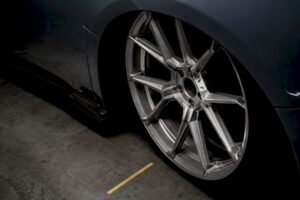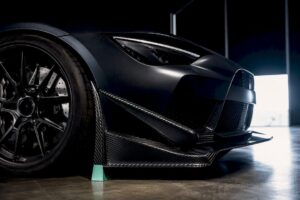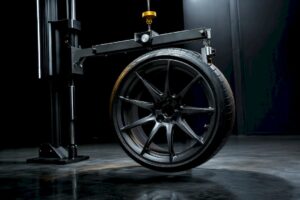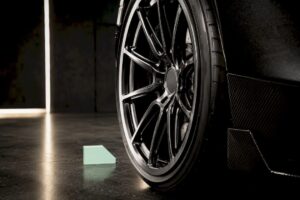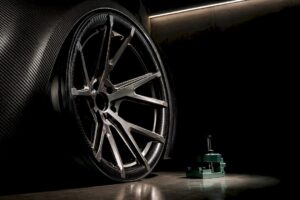
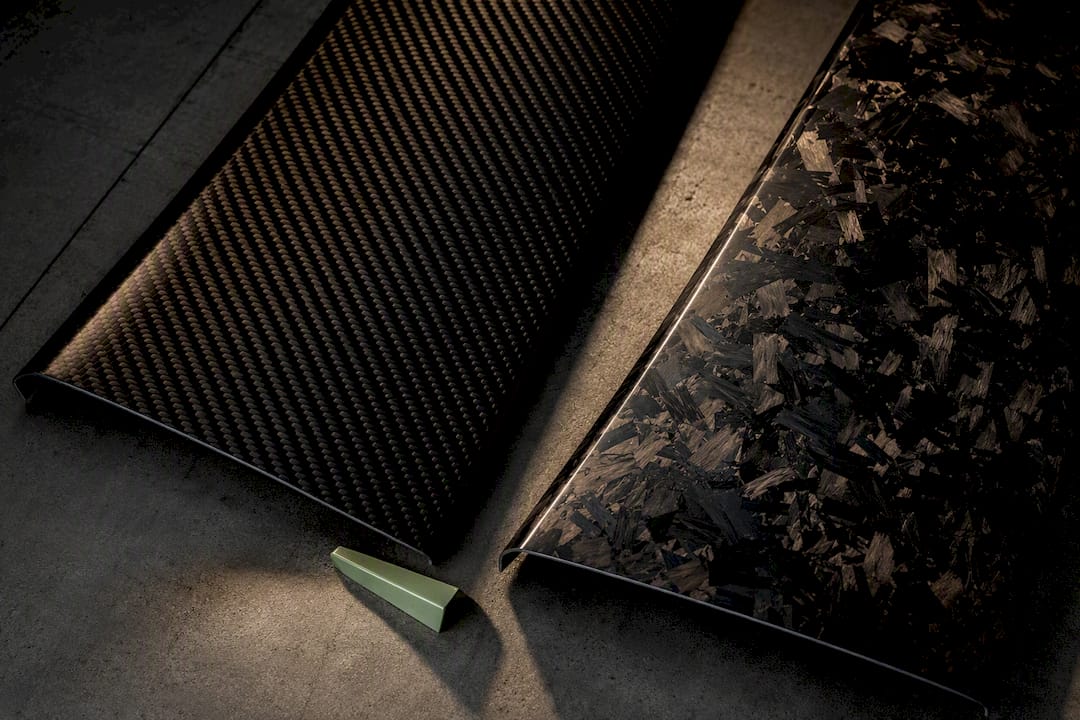
For most visible exterior panels on the C192 AMG GT63, autoclave-cured 2×2 twill dry carbon delivers the better balance of Class-A finish and directional stiffness, while forged carbon earns its place on complex, small-format trim where a marbled aesthetic or intricate mold geometry matters more than peak tensile strength. The prepreg autoclave process yields a tighter fiber fraction and a uniform weave under raking light. Forged carbon molds easier into tight radii and resists impact well but reads visually and structurally different at every panel.
TL;DR:
- Autoclave-cured 2×2 twill dry carbon provides superior directional stiffness and a high-quality Class-A finish, especially on load-bearing and aerodynamic panels.
- Forged carbon offers multi-directional impact resistance and unique marbled aesthetics, making it ideal for small complex trims like mirror caps and vent surrounds.
- Panel fitment quality heavily depends on precise digital mapping and quality assurance, with factory-style mounting points crucial for proper installation.
- Weight savings between forged and autoclaved panels are similar, but autoclaved laminates generally deliver more predictable stiffness for high-performance handling.
- Long-term durability relies on UV-resistant clearcoats and proper maintenance; forged carbon’s impact resistance can simplify cosmetic repairs over time.
Table of Contents
- Autoclaved Dry Carbon vs. Forged Carbon Finishes for the C192 AMG GT63 Platform: The Material Science
- What Does Class-A Autoclaved Weave Look Like Versus Forged Marbling?
- Will Aftermarket Carbon Panels Fit Factory Sensor Mounts?
- How Much Weight Do Carbon Panels Actually Save?
- How Do You Prevent Yellowing on Carbon Fiber Body Panels?
- Which Carbon Finish Suits Each Exterior Panel Best?
- E6 Engineering: What In-House Autoclave Capability Actually Delivers
- Is Autoclave Curing Better for the Environment Than Compression Molding?
- How Long Do Carbon Fiber Body Panels Last on a Daily-Driven GT63?
- Three Ways to Build Out Your GT63’s Carbon Program
- Commission Bespoke Carbon Engineering for Your C192 Build
- Sources
- FAQ
Autoclaved Dry Carbon vs. Forged Carbon Finishes for the C192 AMG GT63 Platform: The Material Science
Every debate about carbon finish quality on the GT63 eventually comes down to how the fiber gets there in the first place. Autoclave-cured 2×2 twill dry carbon starts as a pre-impregnated fabric, often called prepreg, where resin is already distributed through the fiber sheet at a controlled ratio before it ever touches a mold. Once laid up and bagged, the part cures under simultaneous heat and high pressure inside an autoclave chamber. That pressure forces out microscopic air pockets, which is why autoclave-cured prepreg processes achieve Class-A optical surface finish when paired with precision tooling. The result is a laminate with a genuinely continuous fiber path, which gives it directional strength: pull along the weave axis and it resists deformation far more than a chopped-fiber equivalent.
Forged carbon works from an entirely different starting point. Instead of woven sheets, manufacturers chop carbon tow into short random-length segments, mix it with resin, and compression mold the slurry into shape under heat. That randomness is the whole point. Forged carbon’s randomly oriented chopped fibers produce near-isotropic mechanical behavior, meaning it resists loads from multiple directions reasonably well rather than excelling in one. It also tends to handle impact better than a woven laminate loaded outside its fiber axis, since there’s no single weak plane for a crack to propagate along.
The numbers back this up. Independent lab testing on forged carbon specimens found a flexural modulus around 35.5 GPa, tensile strength near 192 MPa, and density close to 1.5 g/cm³ in compression-molded, non-autoclaved samples.
Statistic Callout: Forged carbon at roughly 192 MPa tensile strength comfortably outperforms cast aluminum in bending tests, but continuous 2×2 twill prepreg laminates still post higher peak directional stiffness and tensile yield when the load lines up with the weave.
What does that mean on your car? Three practical takeaways:
- A front splitter under aerodynamic downforce wants continuous fiber orientation, because it’s loaded predictably in one direction at speed.
- A mirror cap absorbing incidental impact from car washes or debris benefits from forged carbon’s multi-directional toughness.
- Panel-to-panel consistency in flex and deflection favors autoclaved laminates, since batch-to-batch fiber orientation is engineered, not randomized.
None of this makes forged carbon inferior. It makes it a different tool. Hybrid forged components that add oriented continuous fiber strands in critical zones can close some of that stiffness gap for owners who want the marbled look on a load-bearing panel, though a pure continuous laminate still wins on raw directional numbers.
What Does Class-A Autoclaved Weave Look Like Versus Forged Marbling?
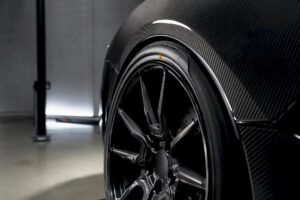
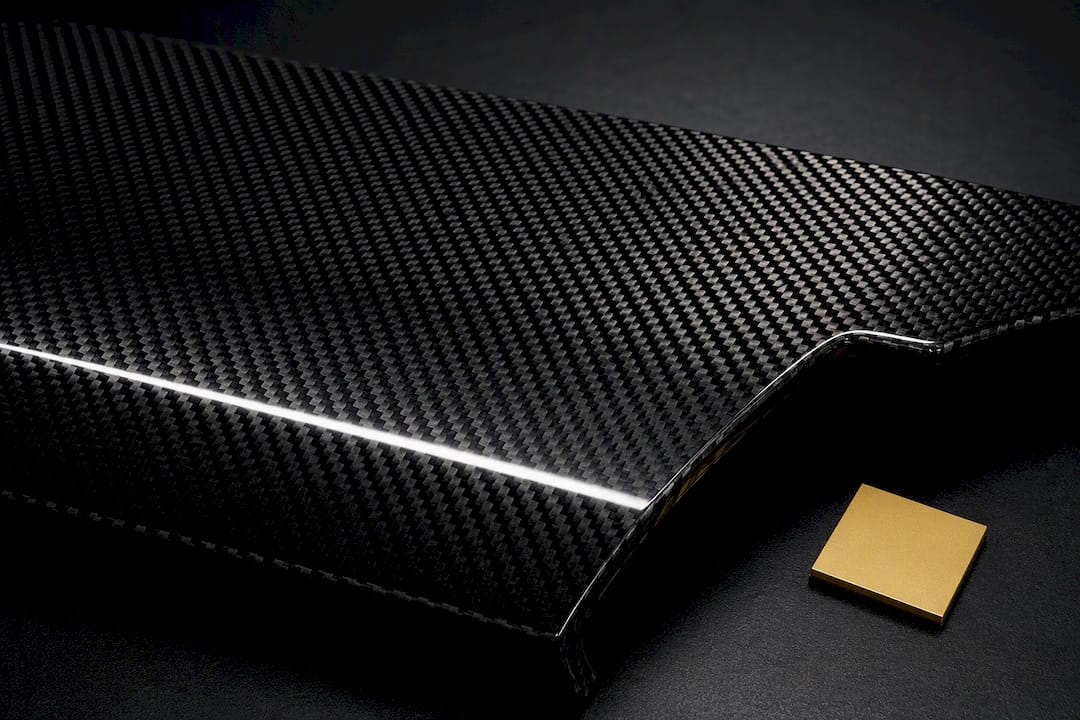
Hold a factory AMG panel and an aftermarket autoclaved 2×2 twill part side by side under a shop light, and the difference between good and mediocre carbon becomes obvious in about three seconds. Class-A surface grade means the weave pattern is perfectly aligned edge to edge, the clearcoat has zero orange peel, and there’s no visible print-through from the substrate underneath. Tilt the panel and rake a light source across it: a properly finished autoclaved panel shows uniform sheen across the entire weave with no dull patches or resin-rich pooling at the edges.
Forged carbon reads completely differently, and that’s the appeal for a lot of owners. Instead of a repeating twill pattern, you get organic, marbled swirls, no two panels identical, closer in feel to a natural stone countertop than a woven textile. Under raking light, forged carbon shows depth rather than directional sheen, since there’s no grain to catch the light uniformly. Some owners specifically commission forged mirror caps or vent surrounds because that one-of-one marbled look separates their car from every other GT63 with a generic weave kit at a cars-and-coffee meet.
Finish options change the outcome further:
- High gloss clearcoat amplifies both the twill pattern and forged marbling, but shows swirl marks faster if maintenance is neglected.
- Matte or satin clearcoat mutes reflections and hides minor surface imperfections, popular on splitters and diffusers that see more road debris.
- Painted edges on autoclaved panels can blend a carbon accent into factory body color for a subtler statement.
Pro Tip: Before you commission any panel, ask the supplier to show you a sample under a raking shop light, not a diffused showroom light. Diffused lighting hides weave misalignment and clearcoat inconsistency that raking light exposes instantly.
Owners should also press suppliers on clearcoat thickness and whether the panel underwent true autoclave curing or a lower-cost vacuum-bag process marketed under similar language. Verifying sample quality under raking light and confirming clearcoat specifications before committing to a full panel set saves owners from a mismatched finish once parts arrive.
Will Aftermarket Carbon Panels Fit Factory Sensor Mounts?
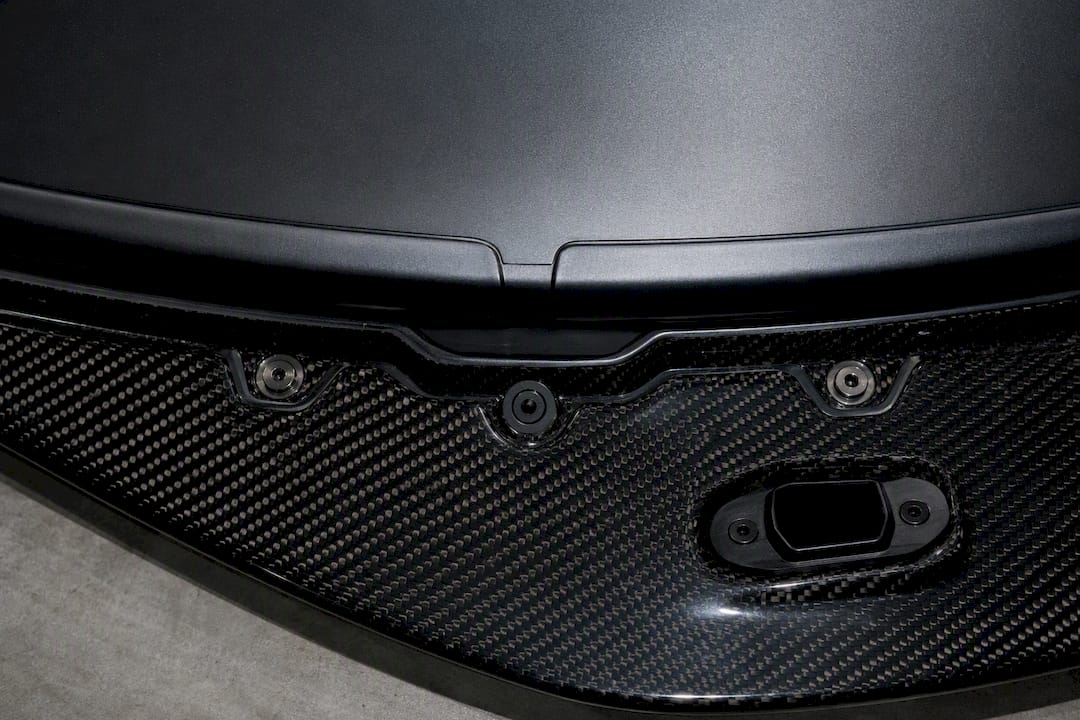
Fitment is where most generic aftermarket kits fall apart, and it’s the single biggest differentiator between a bespoke carbon program and a mail-order body kit. The C192 platform carries specific mounting bosses, parking sensor cutouts, and factory crash structure interfaces that a panel must respect exactly, not approximately. Mercedes-AMG’s own factory Exterior Carbon Fibre Package, which bundles the splitter, sills, diffuser, and rear wing, sets the engineering bar aftermarket parts should be measured against: every component integrates without disturbing sensor function or airflow-critical geometry.
A “Fitment First” approach means the panel is digitally mapped against the factory chassis before a single layer of carbon gets laid up. Good fit looks like this in practice:
- Mounting bosses land flush with zero play, and factory hardware threads in without re-tapping.
- Panel gaps run consistent within a millimeter or two across the entire seam, matching factory reveal lines.
- Sensor cutouts clear parking and radar sensors without contact or signal interference.
- Clip attachment points seat fully on the first attempt, with no forced flexing of the panel to make contact.
Installation should be a test-fit-then-final-fit process. Reputable suppliers supply their own fixings matched to the panel’s mounting geometry rather than expecting you to reuse worn factory clips designed for a different substrate thickness. Professional installation becomes non-negotiable when a panel interfaces with active aero elements or requires disassembly of factory trim to access mounting points.
The red flag every owner should watch for: any panel that requires trimming, drilling new holes, or forcing contact with structural crash elements to achieve fitment. That’s not a bespoke component. That’s a generic shape sold as a fit-specific part, and it usually means the supplier never test-fitted it against an actual C192 chassis.
How Much Weight Do Carbon Panels Actually Save?
Weight numbers get thrown around loosely in this category, so it helps to separate real component-level savings from marketing language. Forged carbon’s density runs close to 1.5 g/cm³ in independent lab testing, putting it in a similar range to well-consolidated autoclaved laminates, though wall thickness and resin content on any individual panel can shift that figure meaningfully.
Statistic Callout: A forged carbon panel at roughly 1.5 g/cm³ density sits close to autoclaved 2×2 twill in raw material weight, but the autoclave process typically achieves a higher fiber-to-resin ratio, which can shave additional grams per panel once void content is minimized.
Where the two diverge is stiffness under aerodynamic load, not just static weight. A front splitter or rear diffuser flexing at speed changes its angle of attack, which changes downforce, which changes how the car behaves entering a fast corner. Continuous 2×2 twill’s directional stiffness resists that deflection more predictably than forged carbon, making it the safer choice when the build priority is repeatable track behavior rather than static display weight.
For a show-focused build, either material’s weight savings over factory steel or ABS trim will be noticeable and satisfying. For a track-focused build, panel choice is one piece of a larger unsprung weight reduction strategy that includes wheel selection, brake hardware, and suspension components working together, not a single carbon splitter doing all the work.
How Do You Prevent Yellowing on Carbon Fiber Body Panels?
Yellowing is the number one long-term complaint from owners who bought carbon parts based on day-one looks alone. It happens when UV radiation breaks down the resin matrix and, separately, when the clearcoat itself lacks adequate UV inhibitors. Cheaper resin formulations, and clearcoats applied without proper UV stabilizers, degrade visibly within one to two years of daily sun exposure, while quality autoclaved laminates finished with automotive-grade UV-resistant clearcoat can hold their color for years longer under the same conditions.
Protective maintenance matters as much as the underlying material:
- A high-quality automotive clearcoat with UV inhibitors is the first line of defense, applied at correct thickness, not sprayed thin to save material cost.
- Ceramic coatings add a sacrificial layer that reduces UV exposure to the clearcoat itself and simplifies maintenance between details. Owners looking into longer-term protective options can review ceramic coating maintenance guidance for realistic reapplication intervals on matte and gloss carbon finishes alike.
- Garage storage or a quality car cover cuts cumulative UV exposure dramatically versus daily outdoor parking.
Repairability splits along the same lines as the manufacturing process. Autoclaved prepreg laminates, when damaged, typically require the affected panel section to be professionally re-laminated and recurred, since matching the original fiber tension and resin ratio by hand is difficult. Forged carbon panels, being compression molded, often tolerate localized surface repair and reclearing more forgivingly, since there’s no directional weave pattern to match perfectly at the repair boundary.
Pro Tip: Ask any supplier directly what UV inhibitor package their clearcoat uses and whether they offer a written finish warranty. A supplier confident in their resin and clearcoat formulation will answer this without hesitation.
Build an inspection habit: check clearcoat gloss retention every six months, watch for any amber tint developing at panel edges first, and address hairline clearcoat cracking immediately before moisture reaches the fiber underneath.
Which Carbon Finish Suits Each Exterior Panel Best?
Different panels on the GT63 face different load cases and different visual expectations, so the material decision should be made panel by panel rather than as a blanket choice for the entire car.
- Mirror caps. Small, geometrically complex, and exposed to incidental impact from car doors and wash equipment. Forged carbon’s molding flexibility and impact tolerance make it a strong fit here, and its marbled look reads beautifully at this scale where a full weave pattern would go largely unnoticed anyway.
- Front splitter and lip. This is the panel most exposed to sustained aerodynamic load and curb strikes. Insist on autoclaved 2×2 twill here. The directional stiffness resists deflection at speed, and Class-A finish quality is most visible on a panel this prominent and this close to the ground where light constantly changes angle.
- Fender vents. Evaluate the specific geometry before choosing. Simple, low-load vent surrounds can go either way aesthetically, but vents integrated into structural fender panels with complex curvature often favor forged carbon’s molding advantage, provided the load case doesn’t demand directional stiffness.
- Rear diffuser. Prefer autoclaved laminates without exception. Diffuser performance depends on repeatable geometry at speed, and any panel flex changes airflow behavior unpredictably. Modular autoclaved diffuser sections also simplify repair, since a damaged section can sometimes be replaced independently rather than recuring the entire assembly.
E6 Engineering: What In-House Autoclave Capability Actually Delivers
Generic aftermarket kits get sourced from whichever overseas mold happens to exist. A bespoke carbon program starts from the direction of engineering the panel around the specific chassis it’s going onto, emphasizing a “Fitment First” philosophy through a detailed quality assurance process.
- Digital mapping of the target chassis before layup begins, so mounting bosses and sensor clearances are confirmed against real geometry, not an assumed template.
- Prototype test-fitting on a representative platform, checking panel gap uniformity and clip engagement before a client’s part ever ships.
- Class-A optical inspection under raking light on every finished panel, verifying weave alignment and clearcoat consistency before it leaves the shop.
Engineering focus on priority platforms includes Mercedes-AMG, Lexus LC500, and expanding exotic programs, with autoclave-cured 2×2 twill capability applied consistently across relevant products. Owners considering forged carbon accents alongside autoclaved structural panels can browse real forged carbon fiber examples to see how the two materials pair on a finished build. For a C192 AMG GT63 commission, engineering consultation can identify which panels warrant specific carbon materials before fabrication begins.
Is Autoclave Curing Better for the Environment Than Compression Molding?
Neither process is what anyone would call low-impact manufacturing, but the two differ in meaningful ways. Autoclave curing consumes significant energy running large pressure vessels at sustained heat for hours per cure cycle, and prepreg material itself has a shelf life requiring refrigerated storage and transport, adding to its logistics footprint. The upside is precision: because autoclaved parts are engineered to exact fitment from digital chassis mapping, waste from ill-fitting panels that get scrapped and remade drops considerably compared to trial-and-error kit production.
Forged carbon’s compression molding process generally runs shorter cycle times at lower peak energy input per part, and it has an underappreciated advantage: it can incorporate chopped fiber offcuts and scrap material from other carbon manufacturing processes rather than sending that material to a landfill. That makes forged carbon a genuinely useful outlet for reducing composite waste industry-wide, even though the resin systems used in both processes remain petroleum-derived and are not yet recyclable at end-of-life through any mainstream process.
The honest comparison isn’t “one process is green and the other isn’t.” It’s that autoclave curing rewards precision and reduces waste through accuracy, while forged carbon rewards material reuse through its chopped-fiber input stream. Owners who care about this angle should ask suppliers directly about scrap rates and whether prepreg material batches are used before expiration, since wasted expired prepreg is a real cost in this industry that rarely gets discussed publicly.
How Long Do Carbon Fiber Body Panels Last on a Daily-Driven GT63?
Under normal daily driving and reasonable care, a well-manufactured autoclaved 2×2 twill panel with quality UV-resistant clearcoat should hold structural integrity and visual finish for well beyond a decade. The fiber itself doesn’t fatigue meaningfully under normal road loads. What actually limits lifespan is almost always the clearcoat and resin surface degrading from UV exposure and stone chip damage, not the underlying carbon structure failing.
Forged carbon holds up comparably well structurally, and its impact resistance advantage means it often survives incidental parking lot contact and door dings that would chip or crack a woven laminate’s surface layer. Real-world durability differences between the two materials show up more in cosmetic longevity than structural failure rates. A forged panel with a scuffed clearcoat is arguably easier to spot-repair than a woven panel where any repair needs to blend seamlessly into a visible twill pattern.
Climate matters more than most owners expect. A GT63 garaged in a moderate climate and detailed regularly will see both material types outlast one driven daily in intense UV exposure or repeated freeze-thaw cycles, where clearcoat micro-cracking accelerates regardless of the fiber underneath. Track use introduces its own wear pattern: splitters and diffusers absorb far more stone chip and curb strike exposure than mirror caps or fender trim, so those panels warrant more frequent inspection regardless of which material sits underneath the clearcoat.
Three Ways to Build Out Your GT63’s Carbon Program
A show-focused GT63 build should lean toward autoclaved 2×2 twill for every visible structural panel, splitter, sills, diffuser, reserving forged carbon specifically for mirror caps and small trim where the marbled aesthetic creates visual contrast against the twill weave elsewhere on the car. That contrast, done deliberately, reads as an intentional design choice rather than a mismatched parts bin.
A track-focused build should prioritize autoclaved laminates almost everywhere aerodynamic function matters, since predictable stiffness at speed outweighs any aesthetic preference once you’re chasing lap times. Forged carbon earns a spot only where its impact resistance genuinely protects against curb strikes and debris without compromising downforce-critical geometry.
A balanced hybrid build, which describes most GT63 owners, benefits from sequencing the investment: start with the front splitter and rear diffuser in autoclaved 2×2 twill since those carry the most functional weight, then add forged mirror caps and vent accents later as budget allows. That approach spreads cost over time without sacrificing the structural panels that actually affect how the car drives.
— E6 Engineering
Commission Bespoke Carbon Engineering for Your C192 Build
Generic body kits get you a shape. They rarely get you a fit, and they almost never get you Class-A finish quality that survives a raking light inspection five years later. E6 Carbon builds autoclave-cured 2×2 twill panels and engineered forged carbon accents around your specific chassis, not a generic mold pulled from a catalog. That’s the practical difference between a kit that requires trimming to install and one that bolts to factory mounting points on the first attempt.
Our engineering team maps fitment against your platform before layup begins, whether that’s a GT63 splitter, a Lexus LC500 aero program like the E6 Carbon Elite Kit, or a McLaren commission requiring custom geometry. If you’re weighing autoclaved versus forged carbon for your own build, the difference between engineered fitment and a generic import kit becomes obvious the moment parts arrive, and it’s worth understanding why cheap carbon fiber parts fail at high speeds before committing to a supplier. Start a consultation through E6 Carbon to scope your C192 AMG GT63 project and get panel-specific material recommendations before a single layer of carbon gets cut.
Sources
Technical claims in this guide draw on independent composite testing and manufacturer program documentation rather than marketing copy alone. Easy Composites’ mechanical property testing supplies the flexural modulus, tensile strength, and density figures cited for forged carbon. Managing Composites and Ant Composites explain forged carbon’s isotropic behavior and practical limits. Mercedes-AMG’s factory GT63 PRO page establishes the OEM fitment and aero benchmark referenced throughout.
- The Truth About Forged Carbon Fiber: What It Can (and Can’t) Do – Managing Composites
- Comparing the Mechanical Properties of Forged Carbon Fibre – Easy Composites
- The new Mercedes-AMG GT 63 PRO 4MATIC+ – Mercedes-AMG
FAQ
Which Is Faster, an M8 or a GT63?
The Mercedes-AMG GT63 generally accelerates more quickly from a standstill than a standard BMW M8, largely thanks to its AMG biturbo V8 and 4MATIC+ all-wheel-drive system putting power down more effectively off the line. Trim level matters enormously on both sides, so specific comparisons should always match equivalent performance variants.
Is the AMG GT63S a Supercar?
The AMG GT63S sits in the high-performance grand tourer category rather than the strict supercar class, blending four-door practicality with genuinely supercar-adjacent acceleration and top speed figures. Its four-passenger layout and daily usability separate it from two-seat exotic supercar competitors, even though its power output rivals many of them.
What’s Faster, an SL63 or a GT63?
The GT63, particularly in 4MATIC+ configuration, typically outpaces the SL63 in straight-line acceleration due to its all-wheel-drive traction advantage off the line, though the SL63 closes the gap at higher speeds depending on aerodynamic configuration. Both share AMG’s biturbo V8 architecture, so the practical difference comes down to chassis, drivetrain layout, and body weight distribution.
Which AMG GT63 Variant Is the Fastest?
Among production GT63 variants, the GT63 PRO 4MATIC+ represents the most track-focused configuration, incorporating the factory Exterior Carbon Fibre Package with functional aero elements tuned for sustained high-speed stability rather than pure straight-line numbers. Owners chasing outright acceleration and top speed should compare specific model-year output figures directly against dealer or manufacturer specifications.
Should I Choose Autoclaved Dry Carbon or Forged Carbon for My GT63?
For structural, high-visibility panels like the front splitter and rear diffuser, autoclave-cured 2×2 twill dry carbon delivers better directional stiffness and Class-A finish consistency. Forged carbon suits smaller, geometrically complex parts like mirror caps where its marbled aesthetic and impact resistance matter more than peak tensile strength, and E6 Carbon engineers both material types around exact C192 chassis fitment for commissioned projects.
Recommended
- E6 Backed Forged Wheel Strength: 43–60% Higher Yield
- Why Forged Aluminum Beats Cast and Flow Formed Wheels
Pricing, custom fitment options, and surface finishes subject to availability. Please contact E6 Carbon or E6 Forged directly to confirm vehicle-specific offset parameters, brake clearances, and current lead times prior to placing your order.