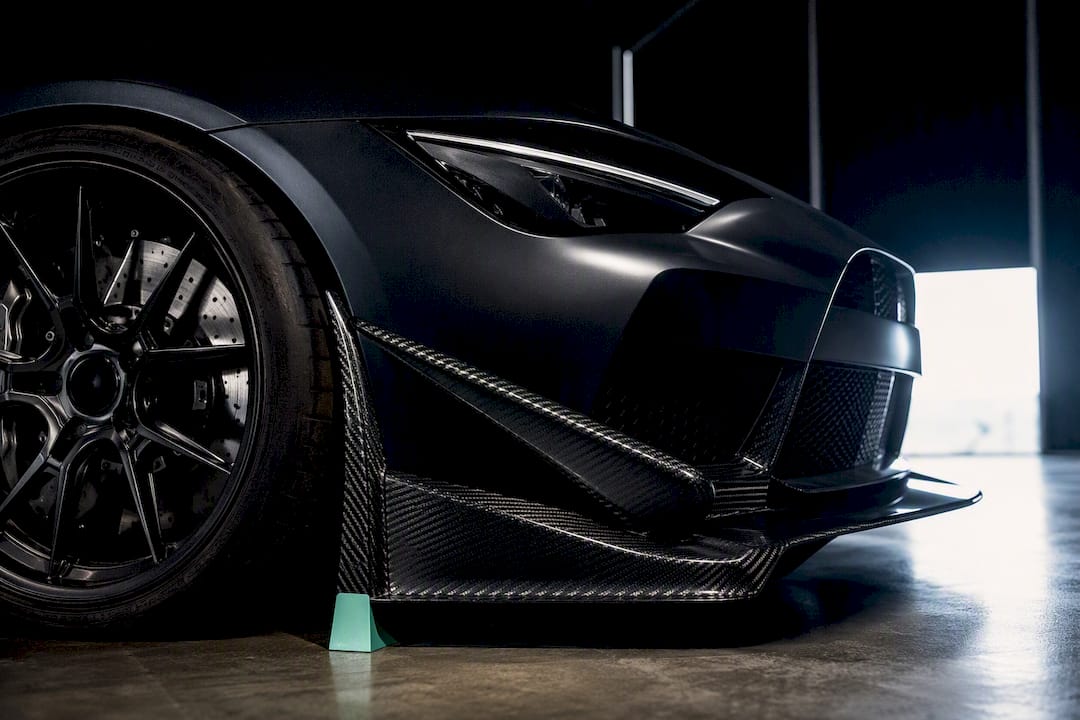
Dive planes exist to shift a car’s aerodynamic balance forward, cutting front-end lift and cleaning up turbulent air around the wheel wells. They matter most on track-focused or aero-tuned performance cars, where every degree of front grip changes how the chassis responds under braking and turn-in. E6 Engineering treats them as fine-tuning elements, not headline downforce generators, which is exactly how a coordinated aero package like the Lexus LC500 Elite Kit applies the concept.
TL;DR:
- Dive planes are most effective when mounted ahead of the front axle at moderate angles, maximizing leverage and the front pitching effect.
- Proper placement involves ensuring clearance from suspension travel and coordinating with other aero elements like splitters and rear wings for balanced downforce.
- Their main benefit is improving front-end balance and reducing understeer, but they introduce only minor drag increases and can cause inconsistent behavior if not matched with overall aero.
- Coordinated aero kits, like the E6 Carbon Elite System, integrate dive planes into a full design that matches factory pressure zones, maximizing effectiveness and minimizing weight.
- Street cars usually do not need dive planes unless already equipped with a well-tuned splitter and rear wing, and proven balance improvements are confirmed by testing front tire temperature and steering dynamics.
Table of Contents
- How Dive Planes Generate Force and Manipulate Airflow
- Where to Mount Dive Planes and Why Placement Changes Everything
- Performance Trade-Offs: Downforce, Drag, and Balance Sensitivity
- Practical Application on Mercedes-AMG, Lexus LC500, and McLaren Platforms
- E6 Engineering’s View on Coordinated Front Aero
- When Dive Planes Are the Right Upgrade, and When They Aren’t
- Complete the Aero Picture with a Matched Kit
- Sources
- FAQ
How Dive Planes Generate Force and Manipulate Airflow
A dive plane is a slender, low-aspect-ratio wing, usually mounted at a steep angle of attack that would stall a full-size rear wing almost immediately. That steep angle is deliberate. Instead of producing smooth, laminar lift the way a main wing does, dive planes are built to work in the messy, turbulent air that piles up ahead of the front wheels.
The pressure differential across the plane’s surface does two jobs at once. It generates a small amount of local downforce, and it sheds a vortex off each outboard tip. That vortex acts almost like a side curtain, keeping air attached to the bodywork longer and helping seal the wheel-well wake so it doesn’t spill turbulence into the underbody or side flow.
The more consequential effect happens around the car’s center of gravity, not at the plane itself. Because dive planes sit far forward, the force they produce acts through a long moment arm. A small load at the nose creates an outsized pitching moment, pulling weight onto the front axle the same way a canard on an aircraft trims pitch without needing a full elevator’s worth of surface area.
Three mechanisms explain most of what a dive plane does on a car:
- High-angle-of-attack geometry generates local pressure differential rather than sustained laminar lift.
- Tip vortices help seal wheel-well wake and reduce turbulent spillover into side flow.
- Forward placement converts small forces into a large nose-down moment about the center of gravity.
A typical dive plane runs at a lift-to-drag ratio lower than what a properly profiled rear wing achieves. That’s not a flaw. It confirms the part’s job is balance correction, not raw downforce production.
Where to Mount Dive Planes and Why Placement Changes Everything
Mounting location decides whether a dive plane does anything useful or just adds drag. Placing the surface at the forward-most point of the bumper, ahead of the front axle, maximizes the moment arm and produces a larger pitching effect for the same amount of physical force. Mount the same plane closer to the wheel and that leverage shrinks fast, even though the plane itself hasn’t changed.
Most functional setups run the plane at a moderate angle relative to the airflow, with enough clearance to avoid contact during suspension travel or steering lock. Bumper geometry and wheel articulation both constrain how far outboard and how low a plane can sit, especially on platforms like the Mercedes-AMG GT or Lexus LC500 where factory fascia contours already manage a specific pressure zone.
Dive planes don’t work in isolation. They need to complement the splitter, side blades, and any diffuser or rear wing already on the car. Adding a plane without matching rear aero just moves grip forward without a corresponding plan for the rear axle, which can introduce oversteer under trail-braking.
- Confirm splitter and front lip geometry before selecting plane angle.
- Check suspension travel and steering lock for clearance at full deflection.
- Set initial angle at 12 to 15 degrees and verify no contact with wheel arch liners.
- Cross-check rear aero balance before committing to a final mounting position.
Pro Tip: Weigh the front axle before and after installation with the car in ride height and a full tank. A 10 to 15 pound shift at speed-equivalent load tells you more about real-world balance than any spec sheet claim.
Performance Trade-Offs: Downforce, Drag, and Balance Sensitivity
Dive planes trade a small drag penalty for a disproportionate improvement in front-end balance. Because their lift-to-drag ratio sits well below that of a primary wing, they were never meant to carry the aero load. Their real contribution is the pitching moment discussed above, which changes how much load reaches the front contact patches during braking and initial turn-in.
That shift toward the front axle tends to reduce understeer entering a corner, at the cost of slightly quicker rotation that can tip into oversteer if the rear wing isn’t matched to compensate. Race-team testing shows dive-plane downforce contribution varies significantly with shape, angle, and mounting position, which is why generic claims about “X pounds of downforce” rarely hold up across different cars.
Drag increases modestly with plane size and angle, and flow sensitivity rises too. Cars running dive planes without a sealed underbody or matched diffuser sometimes see inconsistent behavior at speed, including a mild porpoising sensation on rough pavement.
Three checks tell you whether the change is working:
- Lap time delta on a repeatable section with heavy trail-braking.
- Front tire surface temperature spread across the tread.
- Steering effort and response consistency at turn-in versus mid-corner.
Practical Application on Mercedes-AMG, Lexus LC500, and McLaren Platforms
Dive planes only make sense once the splitter, diffuser, and any rear wing are already installed and tuned. Adding them first, before the rest of the aero package exists, wastes the moment-arm advantage they’re built to deliver. Street-driven cars rarely need them at all; the benefit shows up at speeds and cornering loads most public roads never demand.
On Mercedes-AMG platforms, common mounting zones sit just outboard of the front splitter corners, integrated with the factory front apron’s existing pressure recovery zone. Lexus LC500 owners typically pair dive planes with a matched splitter and side-rocker setup to keep the front and rear balance changes proportional. McLaren and Lamborghini platforms, with their mid-engine weight distribution, tend to need smaller planes since the front axle carries less static load to begin with.
A simple testing protocol works across all three platforms involving baseline balance measurements, angle adjustments of the planes, logging tire temperature and steering feedback, and locking in the setting that improves turn-in without inducing rear instability.

E6 Engineering’s View on Coordinated Front Aero
E6 Engineering builds every aero component around Fitment First principles, which means a dive-plane-style front element is never designed in isolation. Autoclave-cured 2×2 twill carbon fiber keeps added front-end weight minimal, so the pitching moment created by the part comes from geometry and angle, not mass, showcasing advanced CNC machining capabilities for automotive carbon fiber parts.
A properly coordinated kit ties small front elements to the splitter and rear wing so the car’s balance shifts as one system, not three disconnected parts fighting each other. That’s the difference between a dive plane that helps and one that just adds drag without a payoff.
Core proof points behind that approach:
- Fitment First engineering validated against factory tolerances for BMW M, Mercedes-AMG, and Lexus platforms.
- Autoclave-cured carbon fiber construction for consistent weight and structural integrity.
- Bespoke aero geometry matched to each platform’s existing pressure zones rather than a generic bolt-on shape.
When Dive Planes Are the Right Upgrade, and When They Aren’t
Street-driven exotic owners rarely need dive planes; the speeds where they matter almost never happen on public roads. Track-focused drivers with a splitter and rear wing already dialed in are the real audience.
Before adding them, check three things: is your rear aero already matched, do you have a way to log front and rear balance, and does your driving actually reach speeds where turn-in stability matters? Test changes one variable at a time, log the data, and resist the urge to trust feel alone.
— E6 Engineering
Complete the Aero Picture with a Matched Kit
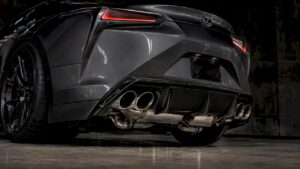
Bolting on isolated dive planes without matching splitter, side blades, and rear wing geometry is exactly the mismatch problem discussed above. The E6 Carbon Elite Kit for the Lexus LC500 solves that by building front aero elements, splitter geometry, and rear wing support into one coordinated system, engineered around the LC500’s factory pressure zones rather than added as an afterthought.

Every panel is autoclave-cured 2×2 twill carbon fiber, verified against Fitment First tolerances before it ships, so the balance shift you get is the one you designed for, not a guess. If you’re pairing front aero with a rear wing, the Carbon-Elite Wing for the LC500 is built to match. Check current fitment specs and availability on the Elite Kit product page before your next track session.
FAQ
What are bow planes?
Bow planes are forward-mounted control surfaces on submarines used to manage pitch and depth, operating on the same control-surface principle as automotive dive planes but through hydraulic actuation rather than fixed mounting.
What is the purpose of canards on a car?
Canards, another name for dive planes, shift aerodynamic balance toward the front axle by generating a pitching moment and cleaning turbulent airflow around the wheel wells, rather than producing large amounts of standalone downforce.
Do dive planes actually work, or are they mostly cosmetic?
They work when matched to a car’s existing splitter and rear aero. A coordinated setup with correct angle and placement measurably improves front-end grip; an unmatched, oversized plane on a street car mostly adds drag.
What are canards for on a car versus an aircraft?
On aircraft, canards provide pitch trim and sometimes primary lift. On cars, dive planes serve the same pitch-moment function but target front-axle grip and wheel-well airflow instead of vertical lift.
Can you dive into water from a plane?
That question refers to aviation, not automotive dive planes, and falls outside the scope of aerodynamic vehicle components covered here.