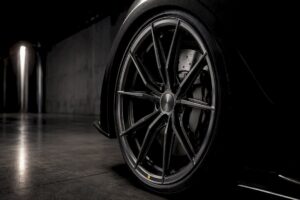
The McLaren 720S runs a 5×112 bolt pattern with a 57.1 mm center bore across virtually every 2017 through 2023 model year, and factory staggered fitments split between roughly 19×9 up front and 20×11 out back. Offsets fall in the ET39 to ET43 range up front and ET22 to ET26 in the rear, tightening the window for aftermarket wheel selection considerably. Before ordering anything, confirm your exact trim and year against a fitment placard, since carbon-ceramic brake clearance and hub-centricity vary enough between production runs to turn a “close enough” wheel into a return shipment.
TL;DR:
- Always verify the exact trim and production year before purchasing wheels, as small clearance differences can cause fitment issues.
- Factory wheels are 19×9 front and 20×11 rear with offsets between ET39 and ET43 front and ET22 to ET26 rear, limiting aftermarket options.
- Recommended aftermarket sizes are typically 19×9 ET32 front and 20×11.5 ET24 rear, with careful attention to offset changes that affect clearance and handling.
- Carbon-ceramic brakes reduce inner clearance, making it essential to measure rotor-to-barrel space and use hub-centric rings for safe spacer installation.
- Proper fitment starts with precise measurements, hub-specific rings, and test-fitting to avoid costly returns or clearance failures.
Table of Contents
- McLaren 720S Wheel Fitment Specs You Need Before You Buy
- Aftermarket Wheel Sizes and Offset Ranges That Actually Work
- Brake Clearance, Hub Rings, and Spacer Sizing Done Right
- Fitment-First Checklist Before You Order
- How E6 Engineering Approaches Wheel Fitment on Exotics
- What We See Go Wrong on 720S Fitments
- Get a 720S-Specific Fitment Consultation From E6 Forged
- Sources
- FAQ
McLaren 720S Wheel Fitment Specs You Need Before You Buy
Every 720S built from 2017 through 2023 shares the same 5×112 PCD and 57.1 mm center bore, a spec confirmed independently by Wheel-fitment.html) and cross-checked against Wheel-size. If you’re cross-shopping a used set from another McLaren model, don’t assume the bore carries over. The Artura uses a 66.6 mm center bore, which means a wheel that fits perfectly on an Artura will wobble on a hub ring the moment you try to mount it on a 720S.
Factory staggered sizing runs 9Jx19 front and 11Jx20 rear, with OEM offsets landing between ET39 and ET43 up front and ET22 and ET26 at the rear axle. Some upgraded trims and model years widen that window further, with rear width climbing as high as 12 inches on certain configurations documented by Limitless Tire’s fitment guide.
| Spec | Front | Rear |
|---|---|---|
| Bolt pattern | 5×112 | 5×112 |
| Center bore | 57.1 mm | 57.1 mm |
| OEM wheel diameter | 19" | 20" |
| OEM wheel width | 9.5 | 9.5–12" |
| OEM offset range | ET39–43 | ET22–26 |
| OEM tire size | 245/35-19 | 305/30-20 |
Lug hardware runs M14 x 1.5 wheel bolts, torqued to a commonly specified 130 Nm, roughly 96 ft-lb, according to fitment data compiled by wheel-fitment.com. A few quick reference points worth bookmarking:
- Tire sizing: 245/35-19 front and 305/30-20 rear covers the vast majority of stock and OEM+ builds.
- Alternative widths in the 235 to 255 front and 295 to 315 rear range are common on aftermarket setups, provided offset compensates correctly.
- Always torque wheel bolts in sequence, then recheck after the first 50 to 100 miles of driving.
Aftermarket Wheel Sizes and Offset Ranges That Actually Work
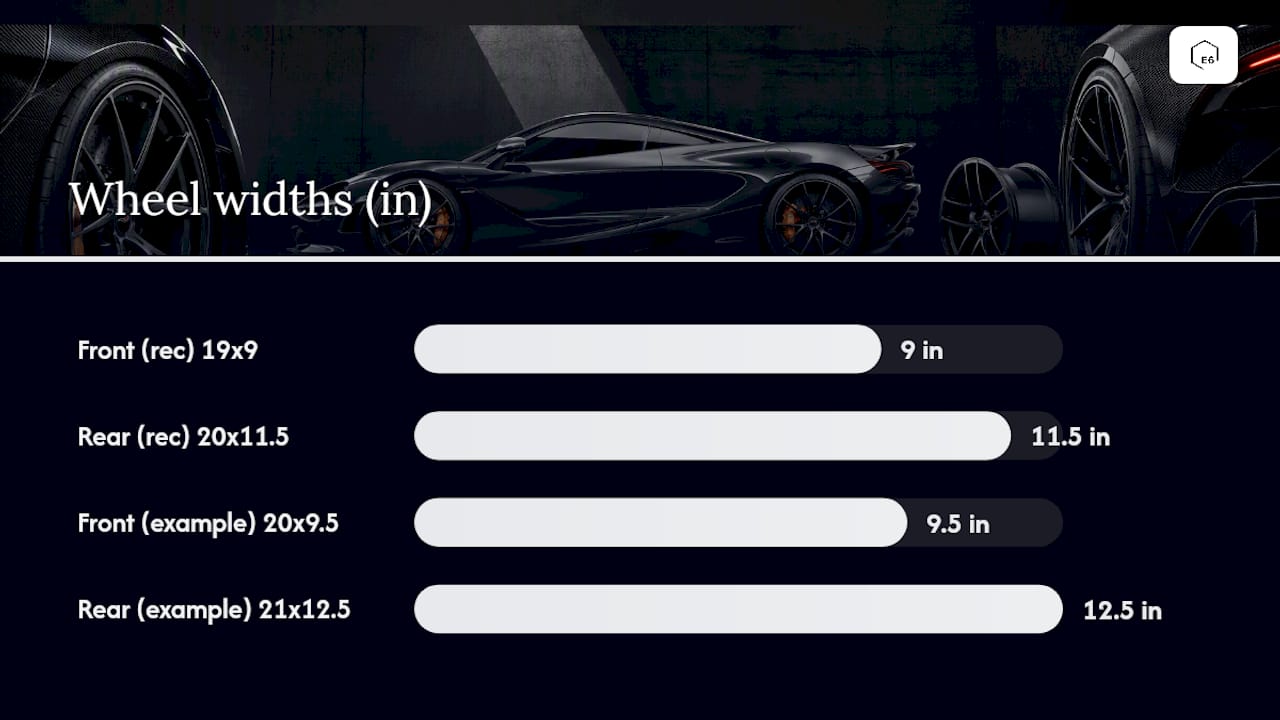
Owners building a street-focused wheel package tend to land on 19×9 ET32 front and 20×11.5 ET24 rear, a fitment that shows up repeatedly across vendor guides and forum builds documented in APEX Wheels’ 720S fitment guide. That combination keeps the wheel face close enough to stock geometry that suspension travel and steering feel stay predictable, while opening up slightly more visual width than the factory setup.
Offset controls how far the wheel’s mounting face sits relative to the hub centerline, and on a car this low, small changes have outsized consequences. Drop the offset number and the wheel pushes outward, widening the track and increasing the odds of contact with fender liners or, at the extreme end, the rear diffuser. Push the offset higher and the wheel tucks inward, which can bring the barrel dangerously close to caliper bodies on the carbon-ceramic setup.
A few guardrails worth following on any 720S build:
- Stay within roughly 5 mm of factory offset unless you’ve confirmed clearance with a CAD file or physical test fit.
- Avoid stacking an aggressive offset with a wider-than-stock tire. The two compound each other fast.
- Lowered cars need extra scrutiny at full steering lock and full compression. What clears at ride height can rub the moment the suspension loads up.
Real-world fitment galleries showing setups like 20×9.5 front and 21×12.5 rear with 255/30/20 and 325/25/21 tires prove wider builds are achievable, but they also show why arch clearance checks aren’t optional at that scale, per examples cataloged by Fitment Industries.
Pro Tip: Print your intended offset and width on paper, tape it to the fender at the wheel centerline, and physically sight down the arch before you place an order. It sounds low-tech, but it catches diffuser interference issues that a spec sheet alone won’t reveal.
Brake Clearance, Hub Rings, and Spacer Sizing Done Right
Carbon-ceramic brake packages leave less room in the wheel barrel than steel rotors, which makes inner clearance the first thing to check on any non-OEM wheel, and you can find practical guidance on how to protect alloy wheels with ceramic coatings to keep your rims in top condition here. Measure from the caliper’s outermost point to the wheel’s inner barrel wall with the wheel test-fitted, not estimated from a spec sheet, since rotor diameter and caliper casting shape vary enough between the standard and upgraded brake packages to matter.
Community and vendor practice on McLaren platforms commonly starts spacer sizing at 15 mm front and 20 mm rear to dial in an OEM+ stance without pushing the wheel face dangerously close to fender edges, a range confirmed by Brightstone Engineering’s spacer buyer’s guide. Those numbers work as a starting point, not a guarantee, since arch and tire clearance still need physical confirmation.
Follow this sequence before finalizing any spacer:
- Confirm the wheel’s own offset first. A correctly offset wheel often needs no spacer at all.
- Test-fit without the spacer, checking rotor-to-barrel and caliper-to-barrel clearance by hand.
- Add the spacer only after confirming hub-centric rings match your 57.1 mm bore precisely, since a loose-fitting ring transfers load unevenly onto the lug bolts.
- Recheck full-lock steering and full-compression suspension travel with the spacer installed.
Spacers change how the wheel bears load. A hub-centric ring properly seated against a 57.1 mm bore lets the hub carry the wheel’s weight, the way McLaren engineered it. Skip that ring, or use an undersized one, and the lug bolts alone end up bearing shear loads they weren’t designed to carry long-term. For track use specifically, professional confirmation of torque values and spacer load ratings matters more than it does on a car that only sees street miles.
Fitment-First Checklist Before You Order
Skipping any one of these steps is how owners end up shipping wheels back. Work through them in order:
- Confirm your exact year and trim against the fitment placard, since production changes across 2017 through 2023 can shift small dimensional details.
- Cross-check PCD and center bore against the vendor’s own datasheet, not just their marketing copy. A mismatch here is the single most common return reason.
- Verify width and offset fall within acceptable ranges for your intended tire size, and confirm the tire itself matches a size the wheel manufacturer has tested.
- Request CAD clearance data or 3D brake scans from the wheel maker whenever the car runs carbon-ceramic brakes, since a generic fitment chart won’t catch caliper-specific interference.
- Confirm hub-centric status. A hub-centric wheel needs no additional ring; a lug-centric design needs the correct ring to distribute load properly.
- Plan your lug bolt length and torque spec (M14 x 1.5, roughly 130 Nm) before the wheels arrive, not after.
- Decide on spacers last, only once you’ve physically measured clearance rather than assumed it from a spec chart.
Pro Tip: Keep a written record of every measurement you take during test-fitting. If a wheel maker asks for clearance confirmation later, you’ll already have the numbers instead of pulling the wheel back off to remeasure.
How E6 Engineering Approaches Wheel Fitment on Exotics
Fitment First isn’t a slogan for a car like the 720S. Every gram of rotating mass at the wheel affects unsprung weight reduction, and unsprung mass has an outsized effect on how quickly a suspension can respond to a bump compared to the same weight added anywhere else on the chassis, a principle that applies just as directly to platforms like the McLaren 750S.
For track-focused 720S builds, a one-piece monoblock forged wheel typically offers the best strength-to-weight ratio and the tightest tolerance control. Multi-piece forged construction earns its place on street-focused builds where custom width, offset, and finish flexibility matter more than shaving the last few grams. A thorough verification process for platforms like this includes:
- 3D brake scans to confirm inner barrel clearance against caliper geometry before a wheel design goes to production
- Hub-centric bore verification against documented OEM tolerances, not assumed averages
- Torque and load testing on finished wheels before they ship
Readers building a similar fitment case around Lamborghini or brake-clearance-sensitive platforms can review the Huracán offset and carbon ceramic brake clearance breakdown for a comparable engineering approach, and the monoblock forged wheel technical page for construction detail.
What We See Go Wrong on 720S Fitments
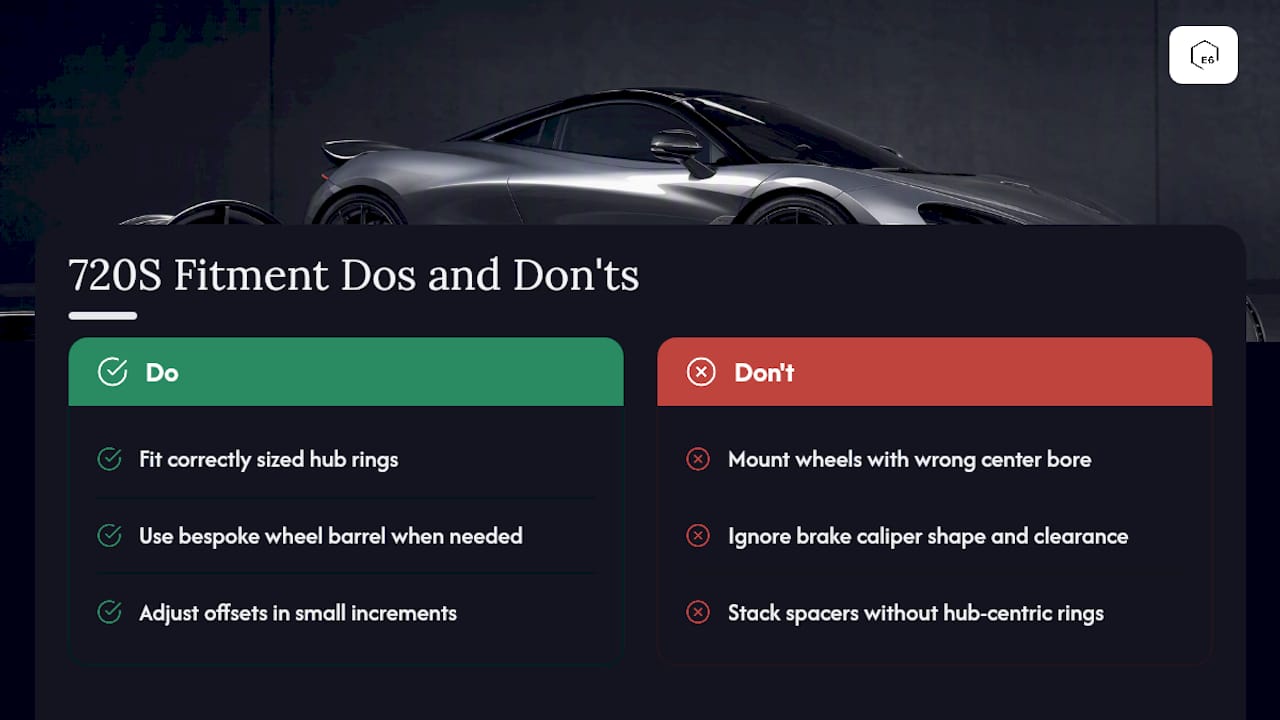
Center bore confusion tops the list. Owners mount a wheel sized for another McLaren model without checking whether it’s the 57.1 mm or 66.6 mm bore, and it never sits right on the hub. Ignoring caliper shape is a close second. Unsafe spacer stacking without hub-centric rings finishes the trio.
The fix is almost always the same: correctly sized hub rings, a bespoke wheel barrel profile when the stock offset won’t clear the brake package, and offsets adjusted in small increments rather than guessed at. For the full numeric reference, the spec guide above covers the ranges that matter.
— E6 Engineering
Get a 720S-Specific Fitment Consultation From E6 Forged
E6 Carbon builds forged wheels the way this article just described fitment should be checked: bore-first, brake-clearance-first, offset second. That’s the entire premise behind E6 Forged wheels, where every monoblock or multi-piece order for a platform like the 720S starts with the same verification steps outlined above, not a generic size chart pulled from a catalog. If you’ve been stalled trying to reconcile vendor spec sheets with your car’s actual measurements, that’s precisely the gap a bespoke fitment consultation closes. Compare forged aluminum against cast and flow-formed construction to see why the extra engineering step matters for a car this sensitive to unsprung weight, then request a fitment consultation through the E6 Forged wheels collection to get your exact year and trim confirmed before you commit to an order.
Sources
- Wheel-size
- McLaren Wheel Spacers Buyer’s Guide | Brightstone Engineering
- 2021 McLaren 720S Wheel & Tire Sizes, Bolt Pattern, Offset & Fitment Guide | Limitless Tire
FAQ
What is the bolt pattern on a McLaren 720S wheel?
The 720S uses a 5×112 bolt pattern across all 2017 through 2023 model years, confirmed by both wheel-fitment.com and wheel-size.com.
What bolt pattern are McLaren wheels generally?
Most McLaren models, including the 720S, share the 5×112 pattern, though center bore can differ. The Artura, for example, uses a 66.6 mm bore instead of the 57.1 mm common to the 720S.
How do I tell if a rim is 5×120?
Measure the distance between bolt holes directly or check the wheel’s stamped markings against a fitment database rather than eyeballing it.
What vehicles use a 5×139.7 bolt pattern?
That pattern is common on full-size trucks and SUVs, not exotic platforms like the 720S. It has no crossover application with McLaren’s 5×112 fitment.
What torque spec should I use on 720S wheel bolts?
McLaren’s M14 x 1.5 wheel bolts are commonly torqued to 130 Nm, roughly 96 ft-lb, according to fitment data from wheel-fitment.com.
Do I need spacers on a McLaren 720S?
Not necessarily. Many correctly offset aftermarket wheels need no spacer at all. When owners do add one, 15 mm front and 20 mm rear is a common starting point, but only after confirming clearance and using proper hub-centric rings.