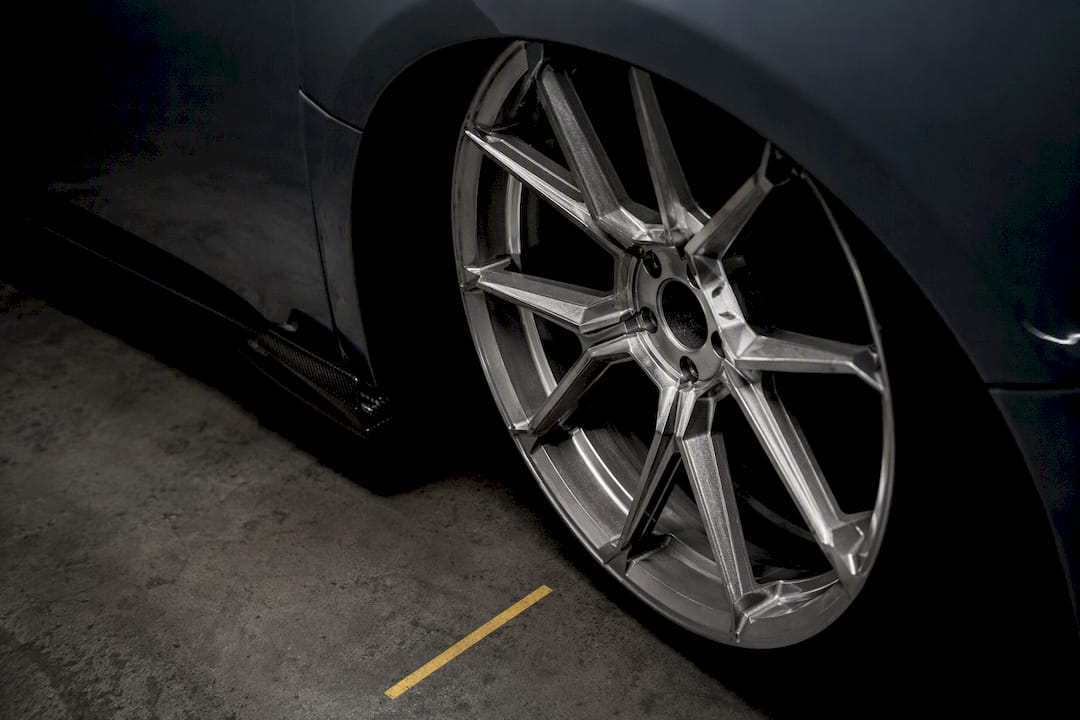
Forged wheels are measurably stronger than typical cast wheels in yield strength, fatigue life, and impact toughness, thanks to refined, aligned grain flow and near-zero internal porosity. In practice, that means a forged wheel is far more likely to bend under a severe impact than to crack or shatter, and the material savings let engineers cut real weight off the unsprung mass. The trade-off is cost: forging is a more expensive process, and it only pays off if you actually load the wheel hard enough to feel the difference.
TL;DR:
- Forged wheels have an 18 to 30% higher tensile strength and a 43 to 60% advantage in yield strength compared to cast wheels.
- They typically weigh 15 to 25% less than cast wheels, improving handling, braking, and fatigue life, especially under hard driving conditions.
- Forging eliminates internal porosity and aligns grain flow, significantly enhancing impact toughness and resistance to crack propagation.
- Their higher cost stems from complex manufacturing, tighter tolerances, and longer lead times, making them less ideal for low-stress daily use.
- Prioritize fatigue and impact toughness data over tensile strength when evaluating wheel quality, especially for applications involving repeated impacts or high loads.
Table of Contents
- How Much Stronger Is Forged Wheel Strength Compared to Cast?
- What Makes Forged Aluminum Stronger at the Grain Level?
- Does Forged Wheel Strength Matter for Daily Driving or Only Track Use?
- Where Does Forged Wheel Strength Stop Being Worth the Premium?
- How E6 Engineering Approaches Forged Wheel Strength
- What Should You Check Before Buying Forged Wheels?
- The Gap Between Spec Sheets and Real-World Wheel Failure
- Get Forged Wheel Strength Built Around Your Exact Platform
- Sources
- FAQ
How Much Stronger Is Forged Wheel Strength Compared to Cast?
The numbers aren’t subtle. Forged aluminum alloys post a tensile strength advantage of 18 to 30% over cast A356-T6, but the gap widens dramatically once you look at yield strength and fatigue performance, where forging shows a 43 to 60% advantage in yield.
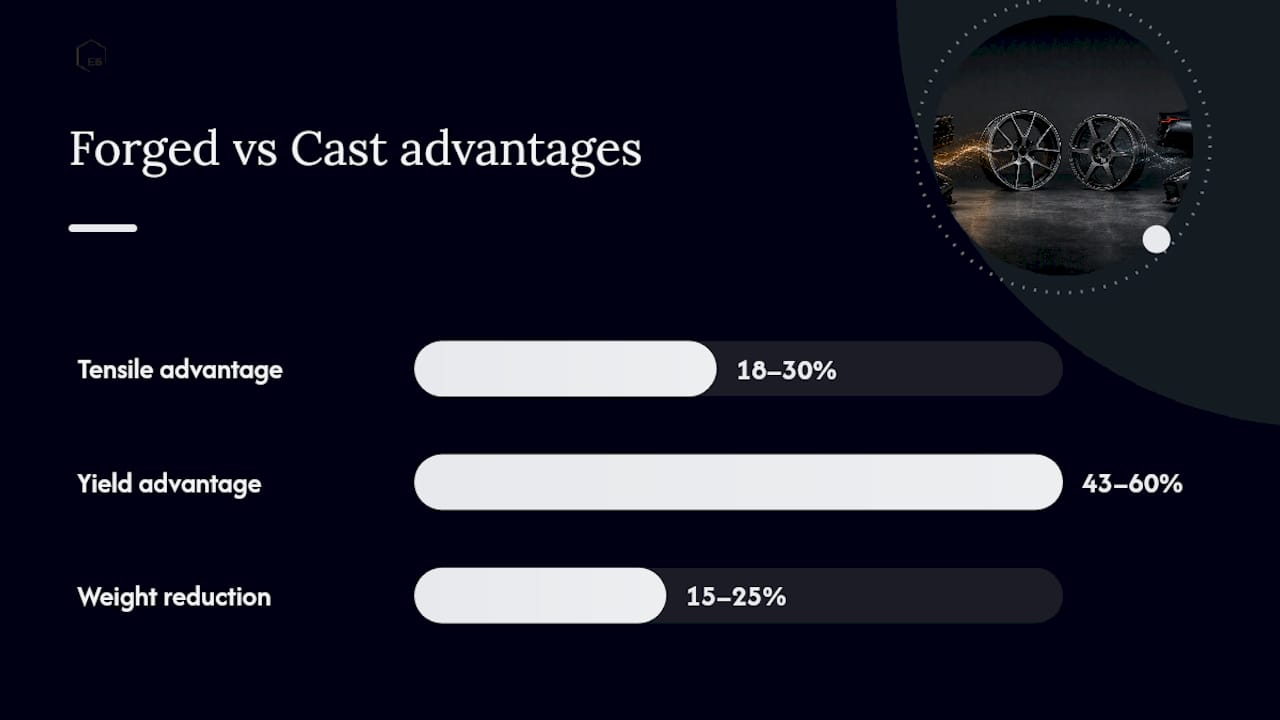
That last figure matters more than any other spec on the sheet. Most wheels never see loads anywhere near their yield strength during normal driving. What they do see is millions of small-amplitude stress cycles from every seam, expansion joint, and cornering load, which is why fatigue strength (not tensile strength) is the number that actually predicts long-term reliability.
Weight tells a parallel story. Forged wheels typically shed 15 to 25% of the mass of an equivalent cast wheel, because the stronger material lets engineers use thinner sections and more aggressive spoke geometry without giving up structural margin. That savings lands entirely in unsprung mass, and unsprung mass is disproportionately valuable: cutting 1 kg there produces a handling response roughly equivalent to trimming 4 to 5 kg from the chassis itself, according to industry comparisons from Kaizen Wheels.
What this buys you on the road:
- Sharper turn-in response because the suspension spends less energy accelerating wheel mass
- Better braking response, since lighter rotational mass means less inertia to overcome
- Longer fatigue life under repeated hard cornering or track abuse
- A wheel that resists cracking even after years of curb strikes and pothole hits
What Makes Forged Aluminum Stronger at the Grain Level?
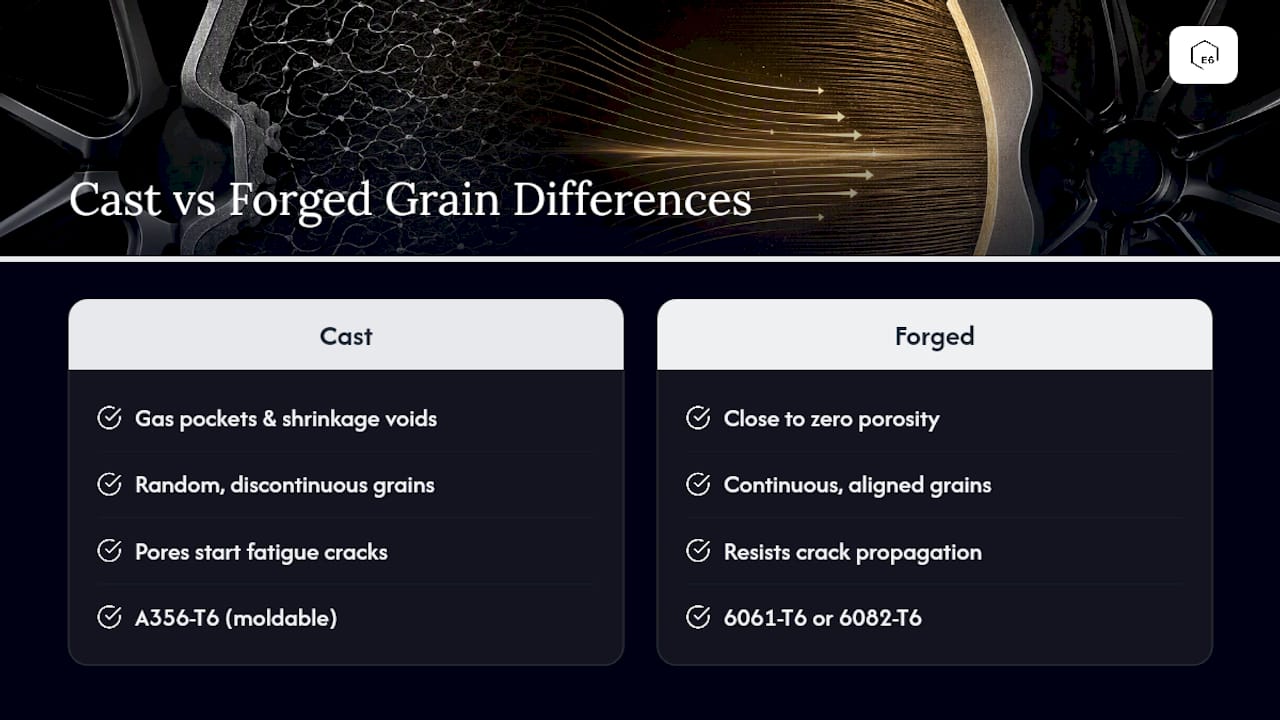
Strength differences trace back to what happens inside the metal, not just what alloy is stamped on the spec sheet. Casting pours molten aluminum into a mold and lets it solidify, a process that leaves microscopic gas pockets and shrinkage voids scattered through the structure. Those voids are stress concentrators. Under repeated loading, cracks start at a pore and propagate outward, which is exactly the failure mode that shows up in fatigue testing of cast wheels.
Forging works the metal in its solid state. A hot aluminum billet gets pressed under enormous compressive force, which collapses those internal voids and forces the grain structure to flow along the contours of the wheel, rim to spoke to barrel. The result is a continuous, aligned grain structure with close to zero porosity. That grain alignment is why a forged wheel resists crack propagation so much better than a cast one under the same fatigue load.
There’s a well-established metallurgical principle behind part of this gain called the Hall-Petch relationship: refine the grain size and you raise the yield strength, because smaller grains create more boundaries that block dislocation movement through the metal.
Alloy choice compounds the effect. Cast wheels commonly use A356-T6, an alloy chosen partly because it flows well into molds. Forged wheels typically use 6061-T6 or 6082-T6, alloys selected specifically for their response to the forging process and their fatigue behavior after heat treatment. You can read more about how that grain structure develops through the process and why it matters for long-term durability.
Pro Tip: Don’t judge a wheel by tensile strength alone. Ask for fatigue and impact toughness figures. A wheel with modest tensile numbers but strong fatigue data will usually outlast one with an impressive tensile spec and no fatigue testing behind it.
Does Forged Wheel Strength Matter for Daily Driving or Only Track Use?
Context decides whether that strength advantage is worth paying for. Here’s how the trade-off plays out across common use cases:
- Track driving and high horsepower builds. Sticky tires generate cornering loads that cast wheels weren’t designed to absorb repeatedly. Forged wheels’ fatigue advantage becomes the deciding factor here, not a bonus.
- Daily commuting on stock power. A quality cast or flow-formed wheel handles normal potholes and expansion joints without issue. Paying a forged premium here is more about weight and aesthetics than necessity.
- Flow-formed as the middle ground. These start as a cast center with a spun, heat-treated barrel, which tightens the grain structure in the barrel and trims roughly 10 to 15% of the weight versus a standard cast wheel, without the full forged price tag.
- Severe impact events. This is where failure mode matters most. A forged wheel tends to bend under a hard curb strike or pothole hit; a cast wheel is more prone to cracking outright. A bent wheel can sometimes be reconditioned. A cracked one gets replaced, full stop.
Longevity comes down to maintenance basics regardless of material: correct tire profile for the rim width, torque specs checked after the first hundred miles on new wheels, and a runout check any time you hit something hard enough to worry about. None of that changes with wheel material, but skipping it erodes even a forged wheel’s fatigue margin over time.
Where Does Forged Wheel Strength Stop Being Worth the Premium?
Forged wheels cost more, and the reasons aren’t arbitrary. The forging press, the billet pre-forming, and the tighter machining tolerances required to hit spec all add labor and equipment cost that casting simply doesn’t carry. Complex multi-spoke designs or deep concave profiles push that premium even higher, since intricate geometry is harder to forge cleanly than a simple five-spoke pattern.
A few realities worth weighing before you commit to forged:
- Lead times run longer on custom forged wheels than off-the-shelf cast options, especially for bespoke fitments.
- Multi-piece forged wheels add assembly complexity and cost versus a monoblock design, though they offer more finish and width flexibility.
- On a low-power commuter, the fatigue and impact advantages of forging rarely get exercised enough to justify the price gap versus a well-designed cast or flow-formed wheel.
- A poorly engineered forged wheel with weak geometry can still underperform a well-designed cast wheel in certain load cases, so the manufacturing process alone doesn’t guarantee the outcome.
Resale value tends to favor forged wheels in the performance segment, but that only holds when the wheel carries a recognized brand and documented spec sheet. An unbranded forged wheel with no fatigue data behind it is a harder sell than a well-known cast wheel with a track record.
How E6 Engineering Approaches Forged Wheel Strength
Custom wheel programs should prioritize fitment: strength numbers are irrelevant if the wheel doesn’t clear the caliper, match the offset, or fit inside the fender with correct scrub radius. This discipline shapes every monoblock versus multi-piece decision made for a given platform.
Engineering priorities on a forged wheel program include:
- Targeting yield and fatigue performance during the design phase, not as an afterthought during quality control
- Holding tight machining tolerances on bolt circle, offset, and barrel width to ensure proper fitment for the exact platform
- Choosing monoblock construction where a single-piece structure serves the load case best, and multi-piece where width or finish flexibility matters more
- Verifying tolerance stacks before a wheel shipment
If you want the full breakdown of how tolerance control affects both safety margin and performance, our page on forged wheel tolerances walks through it in more depth, and our precision machining overview covers how QC catches issues before delivery.
What Should You Check Before Buying Forged Wheels?
Most enthusiasts overspend on brand reputation and underspend on verification. Here’s the short version of what actually matters:
- Confirm the load rating matches your vehicle’s gross axle weight, not just the bolt pattern.
- Ask which alloy the wheel uses. 6061-T6 and 6082-T6 are the common forged standards; know which one you’re getting and why.
- Request fatigue and impact test data, ideally referencing a recognized standard like SAE J2530, rather than taking “forged” as a strength guarantee on its own.
- Verify fitment tolerances for offset, bolt circle, and hub bore against your exact chassis, not a generic platform listing.
- Check the warranty and repair policy. A bent forged wheel is often repairable; know whether your manufacturer supports that before you need it.
The premium is worth paying when your driving actually stresses fatigue life and impact toughness. It’s harder to justify on a wheel that will spend its life on smooth pavement at moderate speed.
The Gap Between Spec Sheets and Real-World Wheel Failure
Most buying guides treat “forged” as a synonym for “indestructible,” and that’s where the conventional advice goes wrong. Forging raises the ceiling on yield, fatigue, and impact toughness, but geometry and alloy selection still decide how much of that ceiling a given wheel actually uses. A poorly designed forged wheel can lose to a well-engineered cast one in specific load cases, even though the forging process itself is superior on paper.
What gets underestimated is fatigue strength, not tensile strength. Enthusiasts fixate on tensile numbers because they’re the easiest spec to find, but a wheel almost never fails from a single overload event reaching its tensile limit. It fails from millions of smaller cycles finding a weak point, usually a pore or a grain boundary the casting process left behind. That’s the mechanism forging actually fixes.
If you’re shopping on strength alone, prioritize documented fatigue and impact data over marketing language. Then match the wheel to how you actually drive; a track car and a weekend cruiser have different real answers here, even if both get badged “performance.”
Get Forged Wheel Strength Built Around Your Exact Platform
Wheel design and manufacturing should focus on fatigue and impact performance, not just aesthetics. Every program should start with exact offset, bolt pattern, and clearance data for the specific chassis. This is the difference between buying a wheel that’s strong on paper and one that’s verified strong on the vehicle.
If your build calls for aero as much as strength, the E6 Carbon Elite Kit for the Lexus LC500 pairs autoclave-cured carbon components with the same fitment discipline. For wheels specifically, start with our forged wheel program and get a fitment consultation before you commit to a spec.
Sources
- What Are Forged Wheels? — Motor1
- What are the differences between forging and casting in manufacturing? — ChengEnCasting
- The Production Process of Forging Car Wheel Hub — PDH Press
FAQ
How much stronger are forged wheels than cast wheels?
Forged aluminum shows 43 to 60% higher yield strength, 37 to 43% higher fatigue strength, and 150 to 300% greater impact toughness compared to common cast A356-T6 alloy.
What are the disadvantages of forged wheels?
The main drawback is cost, driven by the forging press, tighter machining tolerances, and longer lead times, especially for custom or multi-piece designs; complex spoke geometry adds further expense.
Are forged wheels good for daily driving?
Yes, but the fatigue and impact advantages that justify the price are most valuable under track loads, sticky tires, or repeated hard cornering; a low-power commuter often does fine on a quality cast or flow-formed wheel instead.
Are forged wheels less likely to crack?
Forged wheels are far less porous and have aligned grain flow, which typically causes them to bend rather than crack under a severe impact, while cast wheels are more prone to outright cracking at the same load.