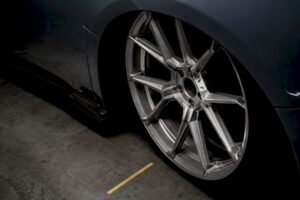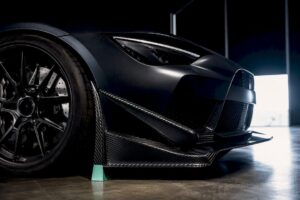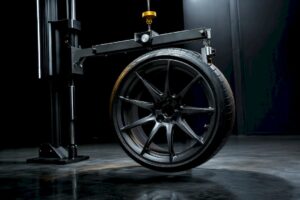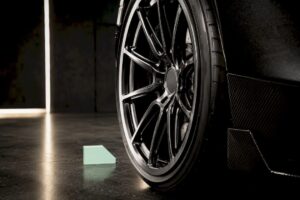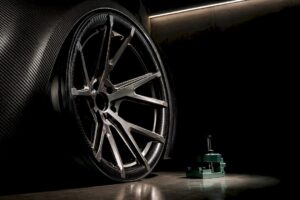
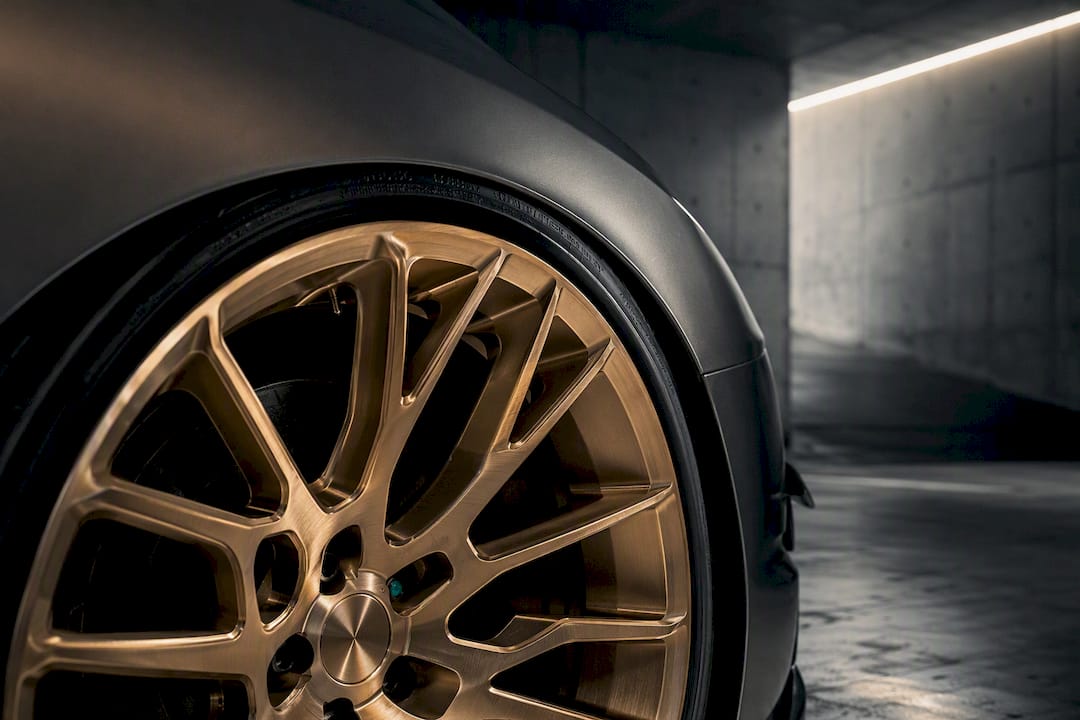
RF20 wheels are in production now, offered in 21" to 26" diameters with widths from 8.0" to 14.0", priced from starting tier to the highest tier per set shipped. Before ordering, confirm three things: bolt pattern, center bore, and offset. Get those wrong on a 26" wheel and you will not just scuff a fender, you will bind a caliper.
TL;DR:
- Confirm factory bolt pattern, center bore, and offset with precise measurements before ordering to avoid binding or clearance issues at larger diameters.
- For diameters above 22 inches, forged construction from 6061-T6 aluminum is essential for strength, weight savings, and durability at large sizes.
- Test-fit one wheel with dynamic suspension compression and full steering lock to identify potential brake caliper clearance issues before mounting full sets.
- Keep rolling diameter within 3 percent of factory specifications to prevent speedometer and ABS calibration drift; adjust tire aspect ratio accordingly for larger wheels.
- Provide your VIN, brake caliper photos, and exact specifications to the manufacturer to ensure a verified, accurate fitment from the start.
Table of Contents
- E6 Forged RF20 Luxury Wheels Large Diameter Fitment Guide: Specs and Sizing
- Which Vehicles Fit the RF20: Mercedes-AMG, Lexus LC500, and Exotic Platforms
- Do Big Wheels Cause Brake Rubbing? Clearance and Suspension Checks
- How to Choose Tire Sizes for Large-Diameter Wheels
- Ordering and Test-Fitting Your RF20 Wheels: A Step-by-Step Checklist
- Why 6061-T6 Forging Matters for RF20 Fitment Precision
- RF20 Wheels: Diameter Choice and Next Steps
- Ready to Order Your RF20 Wheel Set?
- Fitment Tools and Additional Resources
- Sources
- FAQ
E6 Forged RF20 Luxury Wheels Large Diameter Fitment Guide: Specs and Sizing
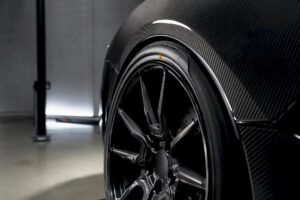
The RF20 is built as a full-face turbine and disc design, with radial outer cooling vents cut into a sunken dish center face and finished in brushed champagne gold. It reads as a show wheel from ten feet away, but the specification sheet behind it is what actually determines whether it bolts onto your car without drama.
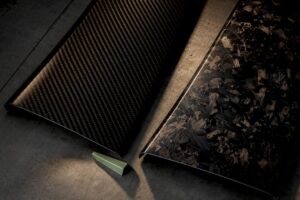
Every RF20 is machined from 6061-T6 forged aluminum billet, not cast or flow-formed. That distinction matters more as diameter climbs. Casting introduces porosity that becomes a structural liability once you push past 22 inches; forging compresses the aluminum’s grain structure, which is why forged construction outperforms cast and flow-formed wheels on strength-to-weight ratio at the sizes exotic and luxury platforms actually run.
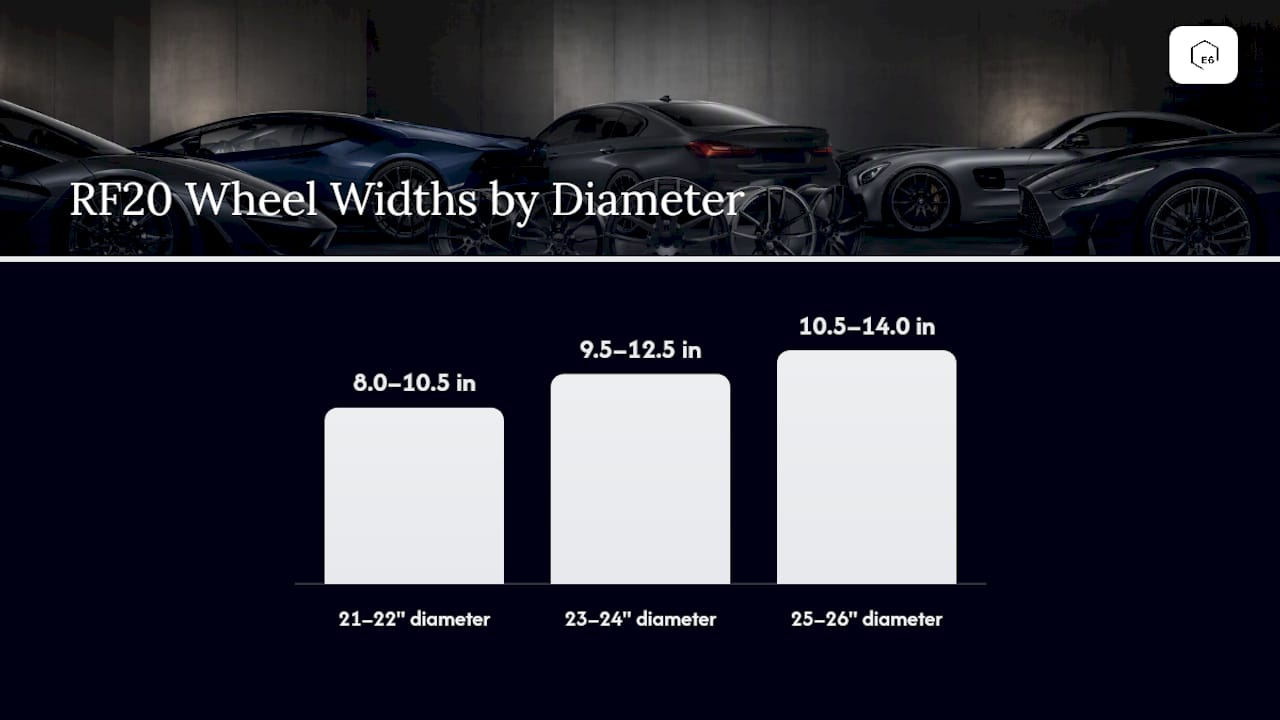
Widths scale with diameter in a fairly predictable band. Smaller diameters in the 21" to 22" range typically run 8.5" to 10.5" for sedans and coupes, while stance builds and wider exotic applications push into the 11" to 14" range at 24" to 26" diameters. Here’s how the sizing matrix breaks down:
- 21" to 22" diameter: widths from 8.0" to 10.5", suited to Mercedes-AMG sedans, Lexus LC500 coupes, and daily-driven luxury flagships.
- 23" to 24" diameter: widths from 9.5" to 12.5", common on exotic SUVs and wider sport coupes needing more contact patch.
- 25" to 26" diameter: widths from 10.5" to 14.0", built for stance applications and show-focused builds where fitment is pushed to its outer limit.
Bolt pattern and center bore are non-negotiable data points, and they vary by platform. E6 Carbon has engineer-verified a 57.1 mm center bore paired with a 5×112 bolt pattern for the McLaren 720S, which is the kind of specific, checkable fitment data that separates a bespoke forged program from a generic aftermarket catalog. If your platform’s factory bore does not match the wheel’s design bore, you need a hub-centric bore sleeve, not a wheel that simply “should fit.”
Offset and backspacing shift as width increases, and this is where a lot of buyers underestimate the math. Add width to the outboard side of a wheel without adjusting offset, and the tire shoulder walks toward the fender lip; add it to the inboard side, and you are suddenly negotiating with a control arm or a caliper you didn’t plan for. For anything wider than 12 inches, request custom offset machining rather than accepting a stock offset chart, and if your factory hub bore doesn’t match, ask for a bore sleeve rather than forcing a wheel that’s technically “close enough.”
Which Vehicles Fit the RF20: Mercedes-AMG, Lexus LC500, and Exotic Platforms
Mercedes-AMG chassis dominate the RF20’s fitment requests, and for good reason. Most current AMG sedans and coupes run a 5×112 bolt pattern with a 66.5 mm factory center bore, which means an RF20 built to that spec drops on cleanly with the correct hub-centric ring. Typical AMG builds land in the 21" to 24" range with offsets between +32 and +40 millimeters, depending on whether the car is running staggered widths front to rear. AMG owners chasing a flush stance often request a slightly more aggressive offset on the rear axle, which is exactly the kind of custom machining request E6 Carbon’s engineering team handles before a wheel ever ships.
Lexus LC500 fitment follows a different pattern entirely, and it’s worth its own explanation because the platform is popular enough to be one of E6 Carbon’s priority applications. The LC500 runs a 5×114.3 bolt pattern, and its low, wide fascia rewards a wheel with a deep dish profile rather than a flush face. The RF20’s sunken center face was designed with exactly this kind of application in mind. Buyers finishing an LC500 build often pair the RF20 with the E6 Carbon Elite Kit for Lexus LC500, since the kit’s carbon front lip and rear diffuser are proportioned to sit correctly with 22" to 24" wheels rather than looking undersized against a stock fascia.
McLaren and Lamborghini platforms make up a smaller share of RF20 orders, but they carry the tightest fitment tolerances of any application E6 Carbon supports. The McLaren 720S example is instructive: a 57.1 mm bore and 5×112 pattern, verified against the factory hub rather than assumed from a generic fitment chart. Lamborghini platforms, particularly Huracán and Urus variants, often run different bore specifications between front and rear axles, which means a single “one bore fits all” wheel order is a mistake waiting to surface at install. For any exotic platform:
- Always request the manufacturer’s exact hub bore measurement, not a published spec sheet number, since running production tolerances can shift bore by a fraction of a millimeter.
- Confirm whether front and rear bolt patterns and bores match, especially on Lamborghini Urus and Huracán chassis.
- Ask for hub-centric bore sleeves rather than lug-centric mounting on any platform with a factory bore under 60 mm.
Whichever platform you’re working with, treat the published bolt pattern and bore numbers as a starting point for the conversation with E6 Carbon’s engineering team, not a final answer you place an order against.
Do Big Wheels Cause Brake Rubbing? Clearance and Suspension Checks
Yes, and it’s almost never the diameter itself that causes it. It’s the barrel profile and internal spoke geometry sitting closer to the caliper than the nominal offset number suggests. A wheel can carry the “correct” offset on paper and still clip a big-brake kit caliper because the inner barrel curves inward at a point the spec sheet doesn’t capture. This is the single most underestimated failure point in large-diameter fitment, and it catches experienced installers as often as first-timers.
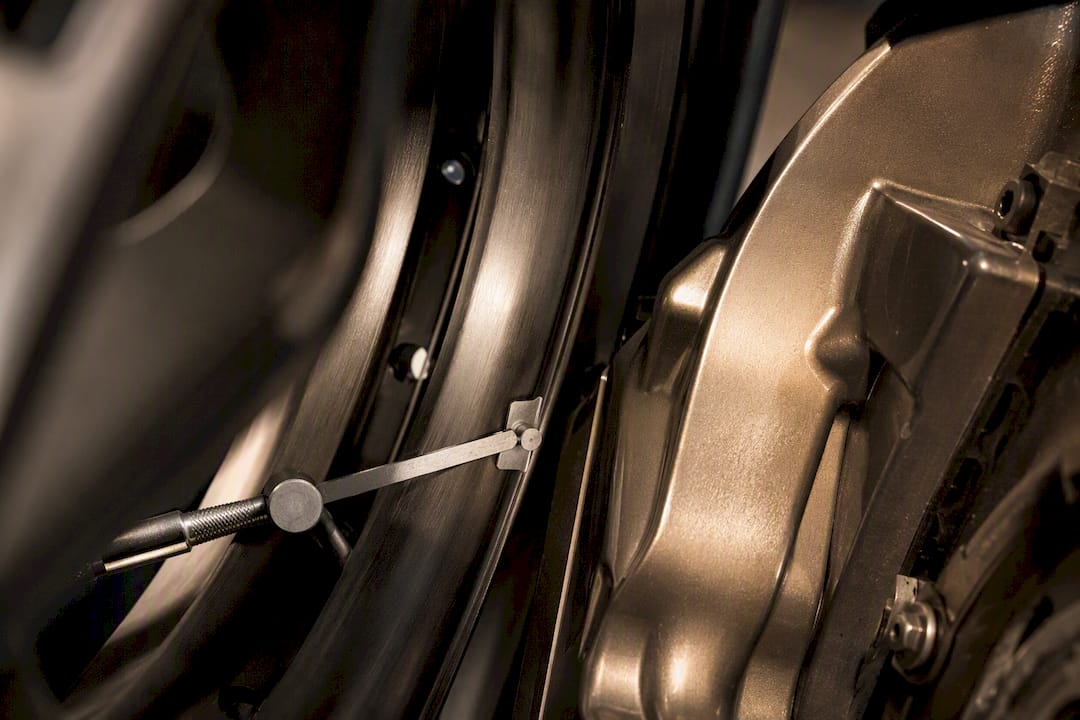
The fix is procedural, not guesswork. Always request the wheel manufacturer’s brake template and mock-fit it directly against your actual caliper measurements before committing to an order, particularly if you’re running a big-brake kit upgrade. A template check takes twenty minutes and costs nothing; a wheel that arrives and doesn’t clear costs you a shipping delay and a machining bill.
Static clearance checks, meaning simply bolting the wheel on with the car sitting still, are not enough on their own. Repeatable dynamic testing that simulates suspension compression while turning the wheel to full steering lock reveals interference that a static check simply cannot show, because the geometry between tire, fender, and control arm changes constantly as the suspension travels. Follow this sequence on a single test wheel before committing to a full set:
- Mount one wheel and torque it to spec at the corner you suspect will be tightest, usually the front driver’s side on a car with a big-brake kit.
- Compress the suspension fully using a floor jack under the control arm or subframe, simulating hard braking or a pothole hit.
- Turn the steering to full lock in both directions while the suspension stays compressed.
- Check for contact at the inner fender liner, tie rod, sway bar end link, and brake line at every point in that steering sweep.
- Repeat the same sequence with the suspension at ride height and again at full droop to cover the full range of travel.
Larger wheels also change rotational mass and unsprung weight enough to shift how the car behaves under load, which is why wheel sizing has to be treated as a suspension and brake decision, not just a cosmetic one. A jump from a factory 20" wheel to a 25" or 26" RF20 is rarely a drop-in swap.
Pro Tip: Keep a printed copy of your brake caliper’s outer diameter and mounting bracket depth in your phone before ordering. E6 Carbon’s engineering team can cross-reference it against the wheel’s barrel profile in minutes, and it saves a round of back-and-forth once your set is already in production.
If the mock-fit reveals interference, you have three real options: shift to a wheel with more offset (moving the barrel outward), upgrade to a big-brake kit with a smaller caliper profile, or, in more extreme stance builds, modify the fender lip or roll it for clearance. Wheel spacers can solve a marginal clearance issue, but they’re a compromise, not a fix. A spacer pushes the wheel outward without changing the wheel’s actual design offset, which increases leverage on the wheel bearing and can reintroduce fender clearance problems you just solved on the brake side. Where possible, order the correct offset directly rather than relying on a spacer to bridge the gap.
How to Choose Tire Sizes for Large-Diameter Wheels
Your car’s ABS, traction control, and speedometer calibration all assume a specific rolling diameter. Change that diameter too much and the systems start making decisions based on bad data.
The industry guideline is to keep your new rolling diameter within about 3% of the factory setup, and that 3% figure comes up consistently in professional wheel-swap guidance for exactly this reason. Push past that window and speedometer error, ABS trigger points, and stability control thresholds all start drifting from what the factory calibrated.
Here’s a worked example. Say your factory tire is a 245/40R20, which works out to a rolling diameter of roughly 27 inches. Moving to a 24" RF20 means you need a tire with a shorter sidewall to compensate, something like a 275/30R24, to land back in that same rolling diameter window. The math isn’t intuitive because width, aspect ratio, and diameter all interact, which is exactly why running the numbers through a tire size and fitment calculator before ordering rubber is worth the five minutes it takes.
A three percent rolling diameter shift is roughly the threshold where speedometer error and ABS calibration drift become noticeable, according to guidance widely used in professional wheel swaps.
As a general rule for the RF20 range:
- 21" to 22" wheels pair best with tires in the 30 to 35 aspect ratio range to preserve enough sidewall for ride quality and load rating.
- 23" to 24" wheels typically need a 25 to 30 aspect ratio to stay within the rolling diameter window.
- 25" to 26" wheels often require a 20 to 25 aspect ratio, and at this range, sidewall height gets thin enough that ride quality and load rating both need a second look before you commit.
TPMS sensors and ABS wheel-speed sensors don’t care what your wheel looks like, but they do care about the tire’s actual rolling circumference. Any change large enough to shift rolling diameter outside that 3% window should prompt a conversation with your installer about ABS recalibration, and in some cases a TPMS relearn procedure. Retailers offering fitment guarantees, Discount Tire’s process is a good example, build in expert confirmation at the point of installation for exactly this reason: it catches a mismatch before it becomes your problem on the highway.
Ordering and Test-Fitting Your RF20 Wheels: A Step-by-Step Checklist
Getting a bespoke forged wheel right on the first shipment comes down to what information you hand over before the wheel goes into production, not what you do after it arrives. Work through this sequence in order.
- Gather your VIN and OEM wheel specs. Your VIN lets E6 Carbon’s engineering team pull exact factory bolt pattern, bore, and offset data rather than working from a generic trim-level guess.
- Photograph your brake calipers. Include a straight-on shot and an angled shot showing caliper depth, especially if you’re running a big-brake kit.
- Confirm suspension modifications already installed. Lowering springs, coilovers, or lift kits all change the fender-to-tire relationship the wheel has to clear.
- Request the manufacturer’s brake template and mock-fit it against your actual caliper before finalizing width and offset.
- Place your order with exact diameter, width, offset, and finish specified, along with any custom bore machining requirements.
- Test-fit a single wheel on arrival before mounting the full set, torquing to manufacturer spec at the corner most likely to show interference.
- Run the dynamic clearance test, compressing the suspension and turning to full steering lock in both directions, checking for contact at every point of travel.
- Mount the full set and perform a four-wheel alignment immediately, since the new wheel and tire package changes scrub radius and can shift camber and toe readings.
- Re-torque all lug fasteners after 100 to 200 miles of driving, once the wheels have had a chance to seat fully against the hub.
- Schedule a follow-up inspection at your next service interval to check for any finish wear, lug torque drift, or early signs of clearance contact you may have missed during the initial test-fit.
Skipping the single-wheel test-fit step is the most common mistake buyers make, mainly because it feels like an unnecessary delay when a full set has just arrived. It isn’t. Finding an issue on one wheel before you’ve mounted four is the difference between a quick offset adjustment and a return shipment on an entire set.
Why 6061-T6 Forging Matters for RF20 Fitment Precision
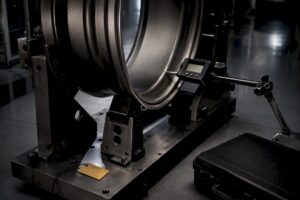
Large-diameter wheels put more stress on the material than most buyers realize, and this is where the manufacturing process stops being a marketing detail and starts being a structural one. 6061-T6 forged aluminum is compressed under extreme pressure during production, which aligns the metal’s grain structure and eliminates the porosity that cast wheels are prone to at larger diameters. That density difference is what allows the RF20 to hold tight tolerances and higher load ratings at 24", 25", and 26" diameters, sizes where a cast or flow-formed wheel would need considerably more material, and therefore more weight, to match the same strength.
That weight difference isn’t cosmetic. Every pound removed from a wheel is a pound of unsprung weight the suspension no longer has to control, which improves how quickly the tire responds to road surface changes and how consistently the brakes bite under repeated hard stops. E6 Carbon’s precision machining process holds the tolerances that make this weight savings possible without sacrificing the structural margin large-diameter wheels need.
Fitment verification isn’t an afterthought bolted onto the end of production, it’s built into the process from the start. The McLaren 720S example, a confirmed 57.1 mm bore paired with a 5×112 bolt pattern, reflects the same engineer-verified approach applied across every platform E6 Carbon supports, including AeroDisc configurations that trace their design language back to motorsport wheel programs.
The RF20 ships in three structural configurations depending on the application:
- Monoblock construction for the cleanest weight profile, best suited to street-driven luxury and exotic builds.
- Multi-piece forged assembly for buyers who want finish flexibility or need to fine-tune width and offset without a full remachining.
- AeroDisc options for platforms where aerodynamic drag reduction matters as much as the visual statement.
Finish options extend beyond the signature brushed champagne gold, with satin and gloss variants available depending on the platform and the buyer’s overall build direction.
RF20 Wheels: Diameter Choice and Next Steps
Bigger isn’t automatically better here. A 26" wheel looks dramatic in photos, but every inch past 22" trades a little ride compliance and a little suspension margin for visual impact, and on a car that still needs to handle a pothole or a track day, that trade needs to be a deliberate one, not a default choice.
Our advice: pick your diameter based on how the car actually gets driven, not just how it photographs. A daily-driven Mercedes-AMG or Lexus LC500 usually looks and drives best in the 21" to 23" range. Reserve 24" through 26" for builds where street presence is the primary goal and the suspension has already been upgraded to match.
Before contacting our engineering team, gather three things: your VIN, your OEM wheel specs, and photos of your brake calipers. That’s the fastest path to an accurate fitment template and a quote that doesn’t need revision later.
— E6 Engineering
Ready to Order Your RF20 Wheel Set?
Off-the-shelf wheel brands make you choose from whatever offset happens to be in stock. E6 Carbon builds every RF20 set to your car’s actual measurements, which is the difference between a wheel that “should fit” and one an engineer has already verified against your bolt pattern, bore, and brake caliper before it ships.
Start by browsing the full E6 Forged wheels catalog to see the diameter and finish options available for your platform. If you’re building out a Lexus LC500, pair your RF20 order with the Elite Kit aero package for a matched look front to rear.
When you’re ready to request a quote, have this on hand: your VIN, current wheel specs, clear photos of your brake calipers, your desired diameter, width, and offset, and any finish preference. Our engineering team will follow up with a fitment template request, deposit details, and a realistic lead-time estimate for your specific build.
Fitment Tools and Additional Resources
A few outside tools are worth bookmarking before you place any order. Discount Tire’s sizing calculator lets you cross-check tire width, aspect ratio, and rim diameter combinations against your factory rolling diameter. For ongoing wheel care once your set is mounted, Diamondbrite’s brake dust removal guidance covers safe cleaning intervals that protect a brushed finish from long-term brake dust etching. If you’re still deciding on overall wheel dimensions for your platform, this guide to matching wheels to your car walks through the same width and offset logic covered here in more general terms.
Sources
- How wheel size affects car performance — expert testing results (PerformancePlusTire)
- Preparing your car for a big wheel swap: suspension, brakes and alignment (Azara Wheels)
- Discount Tire — Tire size and fitment tools
- Repeatable dynamic testing (technical whitepaper)
FAQ
What Sizes Does the RF20 Come In?
The RF20 is available in 21", 22", 23", 24", 25", and 26" diameters, with widths ranging from 8.0" to 14.0" depending on the diameter chosen. Pricing starts at $3,500 per set for 21" and scales up to $7,000 per set for 26", shipped.
How Do I Know if RF20 Wheels Fit My Car?
Confirm your bolt pattern, center bore, and offset against your vehicle’s factory specs, ideally by providing your VIN so E6 Carbon’s engineering team can pull exact fitment data. For reference, McLaren 720S fitment has been engineer-verified at a 57.1 mm bore and 5×112 bolt pattern.
Do I Need Bigger Brakes for 24-Inch or Larger Wheels?
Not necessarily, but you do need to confirm brake caliper clearance against the wheel’s barrel profile before ordering, especially if you’re running a big-brake kit. Requesting the manufacturer’s brake template and mock-fitting it against your actual calipers catches interference issues that a static check alone can miss.
How Long Does a Custom RF20 Order Take?
Lead times vary by diameter, finish, and any custom offset or bore machining requested, so current estimates are provided directly during your engineering consultation. Submitting your VIN, wheel specs, and brake photos upfront is the fastest way to get an accurate timeline.
Can RF20 Wheels Be Paired With Carbon Fiber Body Kits?
Yes, RF20 wheels are commonly paired with dry carbon aero components like the E6 Carbon Elite Kit for Lexus LC500, since the wheel’s deep dish profile is designed to complement a lowered, widened aero package rather than compete with it visually.
Recommended
- E6 Forged AeroDisc Wheels: Motorsport Heritage Meets Luxury
- AeroTech Carbon Fiber Hood | Lexus LC500
- E6 Motorsports LFA Style Valved Exhaust for LC500 V8
- Acoustic Engineering of the E6 Motorsports LC500 Exhaust
Pricing, custom fitment options, and surface finishes subject to availability. Please contact E6 Carbon or E6 Forged directly to confirm vehicle-specific offset parameters, brake clearances, and current lead times prior to placing your order.