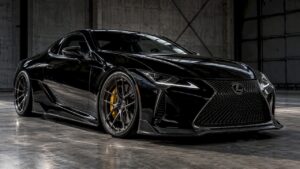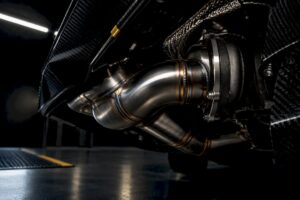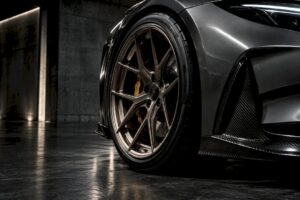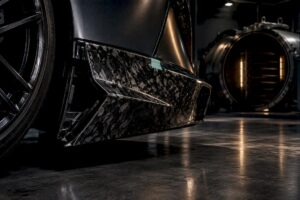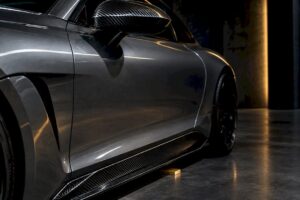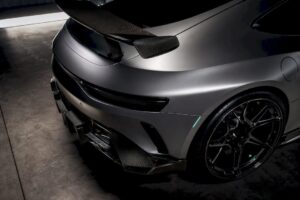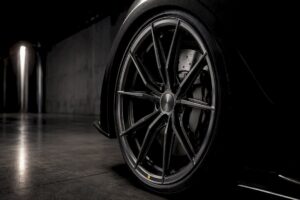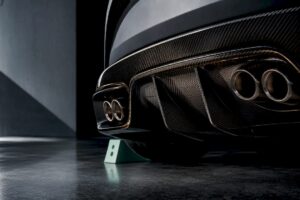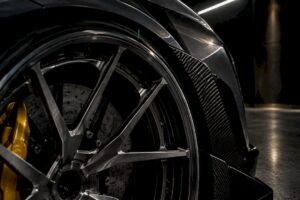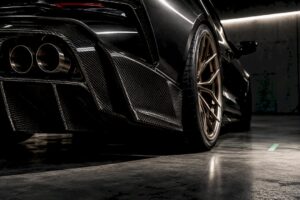
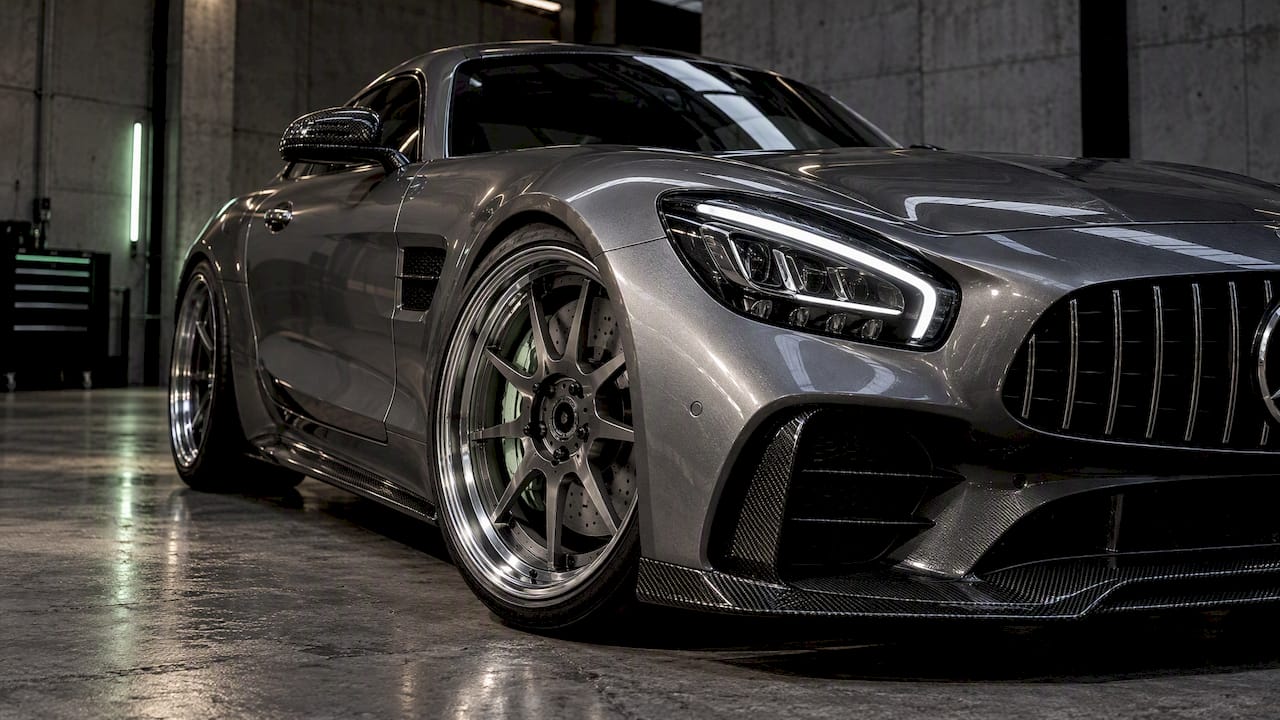
E6 Carbon’s autoclave-cured dry carbon components and E6 Forged wheelsets offer a practical path to restoring the AMG GT C190’s factory lines while modernizing its presence. The combination addresses faded trim, generic aftermarket fitment gaps, and flat factory wheel designs in one pass. Owners get a route to factory-correct aesthetics plus a meaningful stance upgrade, covered in the parts and fitment sections below.
TL;DR:
- Autoclave-cured dry carbon panels offer the best fitment and durability, reducing panel gaps and UV degradation over cheaper wet-layup or generic alternatives.
- Chassis-specific tooling ensures that parts like lips and diffusers install without modification, minimizing misalignment issues during the restoration.
- Forged wheels can lower unsprung weight, improving suspension response and allowing for wider, more aggressive designs without compromising factory proportions.
- Finish options, including painted or exposed weave, enable owners to customize the look while maintaining value and avoiding resale pitfalls associated with poor-quality aftermarket parts.
- A professional mock fit and detailed consultation before installation are essential to prevent costly alignment and finish mismatches on the highly precise AMG GT C190 body.
Table of Contents
- Which E6 Carbon parts fit the AMG GT C190
- E6 Forged wheel options and how they change the C190’s stance
- Fitment, finish, and installation: what to expect
- Why high-quality carbon parts protect vehicle value
- Engineering proof: autoclave process and material data
- How E6 Carbon compares with other aftermarket carbon brands
- Visual customization and finish options
- What a C190 aesthetic upgrade costs
- Common challenges during a C190 restoration
- E6 Engineering’s view on restoration versus aggressive upgrade paths
- How to buy E6 Carbon parts and E6 Forged wheels
- Recommended reading and source pages
- FAQ
Which E6 Carbon parts fit the AMG GT C190
Restoring a C190’s factory lines starts with identifying which trim pieces have aged out or never matched the car’s proportions to begin with. The primary candidates are the ones drivers touch, see, or stare at from behind the wheel every day.
- Carbon steering wheel: replaces a worn factory wheel with a tactile, grip-focused upgrade that also lightens the hub assembly.
- Front lip: sharpens the nose profile and improves front-end aero balance at speed.
- Side skirt splitters: visually lower the car’s stance and clean up the production side sill line.
- Mirror caps: a low-cost swap that modernizes the greenhouse without touching bodywork.
- Rear diffuser: restores an aggressive rear valence profile and supports rear-end aero balance.
- Optional aero accents: canards and trim pieces for owners building toward a show-oriented look.
Each piece serves a distinct function. The steering wheel is a cabin upgrade, the lip and diffuser are aero-functional, and the side skirts and mirror caps are primarily visual. Finish choice matters as much as the part itself: painted-to-match works for owners prioritizing a factory-plus look, while exposed 2×2 twill suits those who want the upgrade to read clearly as carbon fiber.
Autoclave-cured 2×2 twill is the preferred route for C190 trim because the curing process produces a denser, more dimensionally stable panel than wet-layup or vacuum-bagged alternatives. On the related C192 AMG GT63 platform, autoclaved dry carbon delivers a measurable fit advantage over forged carbon, which translates directly into tighter panel gaps and less on-car trimming during install on the C190’s similar body architecture.
E6 Forged wheel options and how they change the C190’s stance
Wheel choice does more to transform a C190’s silhouette than any single body panel. E6 Forged produces several distinct families, and each delivers a different visual and mechanical outcome.
- Monoblock: a single-piece forged construction favored for a clean, understated profile and minimal unsprung mass.
- Multi-piece forged: separate barrel and face sections, allowing custom width, offset, and finish combinations for a more tailored fitment.
- Beadlock: a motorsport-style lip detail suited to owners building a track-focused or show-aggressive look.
- AeroForm Series: aerodynamic-oriented wheel faces designed with airflow management in mind.
- Luxury Wheels: finish-forward designs aimed at street presence over motorsport cues.
Concavity and lip depth are the two levers that change how wide a wheel reads from the curb. Deeper concave faces push visual width outward even on a moderate physical width, while a slimmer lip keeps the factory silhouette closer to stock. For owners restoring a factory-correct look, a shallower lip with correct offset keeps the C190’s proportions intact. For owners chasing a more aggressive, deep-concave presence, a wider multi-piece setup with generous offset delivers that without altering the chassis.
Forged construction’s strength-to-weight ratio is the mechanical argument underneath the visual one. A forged wheel typically weighs less than a cast equivalent at the same strength rating, and that savings is concentrated at the wheel itself, which is unsprung mass. Reducing unsprung weight improves how quickly the suspension can respond to road inputs, a benefit that compounds with the C190’s double wishbone setup front and rear. Monoblock and multi-piece construction differ mainly in how that weight is distributed and how finely the fitment can be customized, not in raw strength.

Fitment, finish, and installation: what to expect
Replacing factory trim on a C190 is not a bolt-and-forget job. The chassis has tight production tolerances, and a few millimeters of misalignment at the bumper-to-fender seam is immediately visible.
- Inspection: the installer documents existing panel gaps and any prior bodywork before touching the new parts.
- Mock fit: the carbon piece is dry-fitted without adhesive or fasteners to confirm alignment against the bumper, fender, and sill lines.
- Paint or match prep: if the owner chose a painted finish, color matching happens before final fitment, not after.
- Final install: fasteners are torqued to spec and any adhesive-bonded sections are given full cure time before the car is driven.
A full front lip, side skirt, and diffuser install typically spans inspection through final fitment over several working days once the mock fit stage confirms a clean match, with painted finishes adding time for color matching and cure. The most common pitfalls are uneven gaps at the lip-to-bumper seam, hood-to-bumper misalignment carried over from prior repairs, and under-torqued fasteners on diffuser mounting points.
Pro Tip: Ask any installer for fitment photos from a prior C190 install before committing, since chassis-specific experience shortens mock-fit time considerably.
Before booking an install, ask what torque specifications they use on diffuser hardware, whether they offer a dry mock fit before any adhesive is applied, and what documentation they provide if a panel needs adjustment later.
Why high-quality carbon parts protect vehicle value
A C190 is a collector-adjacent platform, and that changes the math on aftermarket parts. Cheap carbon trim that cracks, lifts, or mismatches the factory paint does more than look bad: it can depress resale value and raise questions about the car’s history.
- Poor fitment often requires drilling or trimming factory bodywork, damage that’s difficult to reverse and that a future buyer will notice.
- Properly matched clearcoat and gel coat on quality carbon parts avoid the yellowing and UV fade that cheap resin finishes show within a year or two.
- Tasteful, factory-aligned upgrades signal careful ownership, which matters more to a C190 buyer than aggressive, ill-fitting aero.
- Precision-cut parts that install without modifying the body keep the car’s maintenance history clean for future inspection.
The durability gap shows up over years, not weeks. Autoclave-cured parts resist UV-driven surface degradation better than wet-layup alternatives, and that holds the car’s appearance steady through the ownership window where most resale decisions get made.
Engineering proof: autoclave process and material data
The autoclave process cures carbon fiber under heat and pressure inside a sealed chamber, which compacts the resin and fabric layers more evenly than open-mold methods. That evenness is what produces a flatter, more dimensionally consistent panel.
Autoclaved 2×2 twill carbon fiber delivers a 0.1 millimeter fit advantage over forged carbon on fitment-critical panels.
That half-millimeter-scale tolerance difference sounds small until it’s applied to a body panel seam, where even a fraction of a millimeter shows up as a visible gap or a panel that needs force to seat. E6’s measured fitment data on the C192 AMG GT63 platform reflects that advantage, and the same autoclave process applies to the C190’s trim geometry.
Material strength is a separate question from fitment. Forged carbon is cited at roughly 192 MPa of tensile strength, a figure positioned against autoclaved 2×2 twill in comparative material data. In practice, this means the two materials serve different jobs: forged carbon suits structural, load-bearing applications, while autoclaved 2×2 twill is the better choice for exterior trim where surface finish and panel-to-panel fit matter most. Neither material is a universal upgrade over the other; the right choice depends on whether the part is cosmetic or load-bearing.
How E6 Carbon compares with other aftermarket carbon brands
Most aftermarket carbon fiber for the C190 falls into one of three categories: wet-layup kits sold through generic tuning catalogs, dry carbon from brands that don’t specialize in a given chassis, and chassis-specific dry carbon built around measured fitment data.
Wet-layup kits are the cheapest entry point and the most prone to panel gaps, since the process doesn’t compact the fiber as evenly as autoclave curing. Generic dry carbon brands improve on that but often rely on universal molds adapted across multiple chassis rather than tooling built specifically for the C190’s production tolerances.
E6 Carbon’s approach centers on chassis-specific tooling and the autoclave-cured 2×2 twill process described above, which is where the fitment advantage over looser aftermarket competitors comes from. For owners who’ve already dealt with a poor-fitting lip kit or a diffuser that never sat flush, the difference between generic and chassis-specific tooling is usually the entire explanation for why the first attempt failed. It’s worth weighing that fitment history against price when comparing quotes, since a cheaper kit that needs rework often costs more by the time it’s actually installed correctly.
Visual customization and finish options
Beyond the raw carbon weave, finish choice is where owners put their personal stamp on a restoration. Exposed 2×2 twill left in a gloss or matte clear coat is the most common finish, and it reads unmistakably as carbon fiber under any light.
Painted-to-match options let the front lip, side skirts, or mirror caps disappear into the factory body color, which suits owners restoring a subtle, OEM-plus look rather than announcing the upgrade. Some owners split the difference, keeping the diffuser and splitters in exposed weave for visual contrast while painting the mirror caps to match.
Wheel finish follows a parallel logic. E6 Forged offers finishes ranging from brushed and polished metallics to matte and gloss powder coats, and the wheel finish is often the element that ties the whole build together once the carbon trim is installed. A painted-to-match lip paired with a matte bronze or gunmetal wheel finish is a common combination on builds aiming for a cohesive, factory-plus aesthetic rather than a loud, contrast-heavy look.
What a C190 aesthetic upgrade costs
Parts and installation are priced separately, and the total depends heavily on which pieces an owner selects and whether they choose exposed weave or painted finishes. Carbon Fiber Parts pricing for individual pieces like the front lip, side skirts, mirror caps, and diffuser is available on request through E6’s carbon parts catalog, since pricing varies by part and finish.
Wheels carry published starting prices. E6 Forged Multipiece sets start from $3,800 per set, E6 Forged Beadlock wheels start from $1,500 per pair, and E6 Luxury Wheels sets start from $3,500. E6 Forged Monoblock and the AeroForm Series don’t carry published pricing and are quoted per project.

Professional in-house installation is priced on request as well, scaled to the scope of the job. A full exterior trim replacement with painted finishes naturally costs more in labor than a bolt-on exposed-weave kit, since color matching and cure time add to the installer’s schedule. Getting an itemized quote covering parts, finish, and installation before committing is the only way to compare the true cost of a build against a cheaper, lower-tolerance alternative.
Common challenges during a C190 restoration
The most frequent issue owners run into isn’t the carbon part itself, it’s a body that’s already slightly out of factory alignment from prior repair work. A front lip that should sit flush against a stock bumper will reveal that misalignment immediately, since the new part has far tighter tolerances than a dented or previously repaired panel.
The fix is the mock fit stage described earlier: catching alignment problems before adhesive or fasteners go on, rather than after. A second common issue is finish mismatch on painted parts, usually from skipping a proper color sample step before full production paint. Requesting a physical paint chip matched against the car in daylight, not under shop lighting, avoids most of these mismatches.
Diffuser fitment on the rear valence occasionally requires trimming factory clips or brackets, particularly on cars that have had prior exhaust or suspension work. An installer familiar with the C190’s rear subframe layout will flag this during inspection rather than discovering it mid-install. The common thread across all of these issues is the same: problems caught during inspection and mock fit are cheap to fix, and problems caught after final install are not.
E6 Engineering’s view on restoration versus aggressive upgrade paths
Fitment First engineering exists because a C190 owner’s goals vary more than the parts catalog suggests. A collector-minded owner wants trim that looks like it could have left the factory this way, which argues for shallower wheel lips, painted-match finishes, and conservative aero. A show-oriented owner wants the opposite: deep concave wheels, exposed weave, and an aggressive diffuser.
Neither path is wrong, but they call for different parts and different installer conversations from day one. The honest approach is choosing a direction before ordering parts, then building a consultation and mock-fit plan around that direction rather than mixing conservative and aggressive choices piecemeal.
— E6 Engineering
How to buy E6 Carbon parts and E6 Forged wheels
Restoring a C190’s lines starts with a fitment consultation, not a cart checkout. E6 Carbon builds every exterior kit and wheel set around chassis-specific tolerances rather than a universal mold, which is the practical difference between a part that seats on the first try and one that needs rework.
For owners focused on wheels, concavity, and forged construction, the E6 Forged Wheels collection is the place to start comparing monoblock, multi-piece, and beadlock options side by side.
- Review the Carbon Fiber Parts catalog for front lips, side skirts, diffusers, and mirror caps.
- Request a fitment consultation before ordering to confirm finish, lead time, and whether in-house installation services fit your timeline.
Lead times vary by part and finish, and every order includes fitment verification before parts ship to you or your installer.
Recommended reading and source pages
For a deeper look at the engineering behind these upgrades, review E6’s autoclave fitment data and the downforce and thermal management page for AMG GT63. For platform context, FrenzyCars covers the AMG GT63 S E Performance lineage relevant to C190 owners tracking the model line’s evolution.
FAQ
Will E6 Carbon parts fit my C190 without modification?
Chassis-specific tooling built around the C190’s factory tolerances is designed to seat without cutting or drilling factory bodywork. A professional mock fit before final installation is still the recommended step to confirm alignment on any individual car, since prior repair work can shift factory tolerances slightly.
How long does a full exterior carbon upgrade take?
A typical front lip, side skirt, and diffuser install runs from inspection through final fitment over several working days, with painted finishes adding time for color matching and cure. Exposed weave finishes without paint matching generally move faster through that same process.
Does autoclaved dry carbon look different from painted or forged carbon?
Autoclaved 2×2 twill has a tighter, more uniform weave pattern than wet-layup carbon, and it can be left exposed under clear coat or painted to match factory color. Forged carbon has a distinct, marbled visual texture and is generally reserved for structural rather than cosmetic parts.
Do forged wheels actually reduce unsprung weight?
Forged construction typically produces a lighter wheel than a cast equivalent at the same strength rating, and that weight sits directly in the unsprung mass at each corner. Lower unsprung weight lets the suspension respond faster to road inputs, a benefit that applies whether the wheel is monoblock or multi-piece.
Does upgrading trim and wheels affect my C190’s resale value?
Precise, factory-aligned carbon upgrades generally support resale confidence because they avoid the panel damage and finish mismatch that cheap aftermarket kits can leave behind. A documented, well-fitted upgrade tends to read as careful ownership rather than a liability to a future buyer.
Recommended
- E6 Forged AeroDisc Wheels: Motorsport Heritage Meets Luxury
- Track Focused Wheels for the AMG GT: Engineering Guide
- How to Spec High-End Wheels for Performance Cars
- Carbon fiber wheels: performance benefits and myths 2026
Pricing, custom fitment options, and surface finishes subject to availability. Please contact E6 Carbon or E6 Forged directly to confirm vehicle-specific offset parameters, brake clearances, and current lead times prior to placing your order.