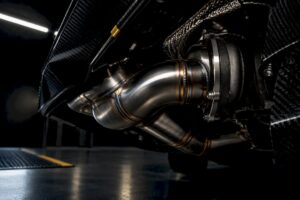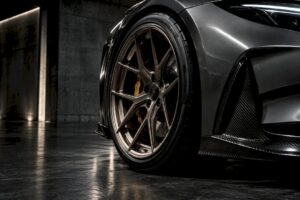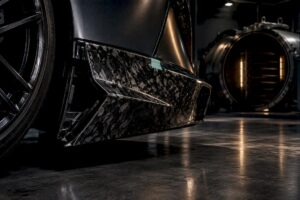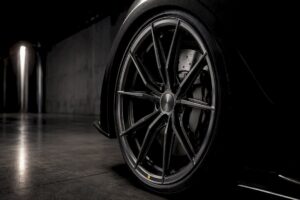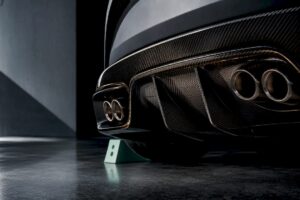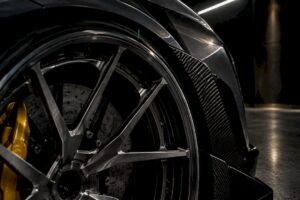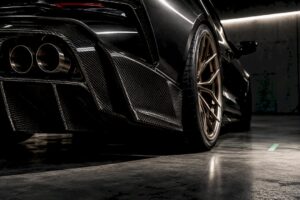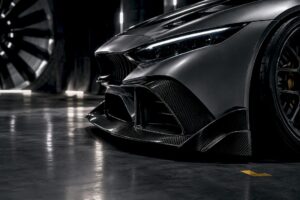
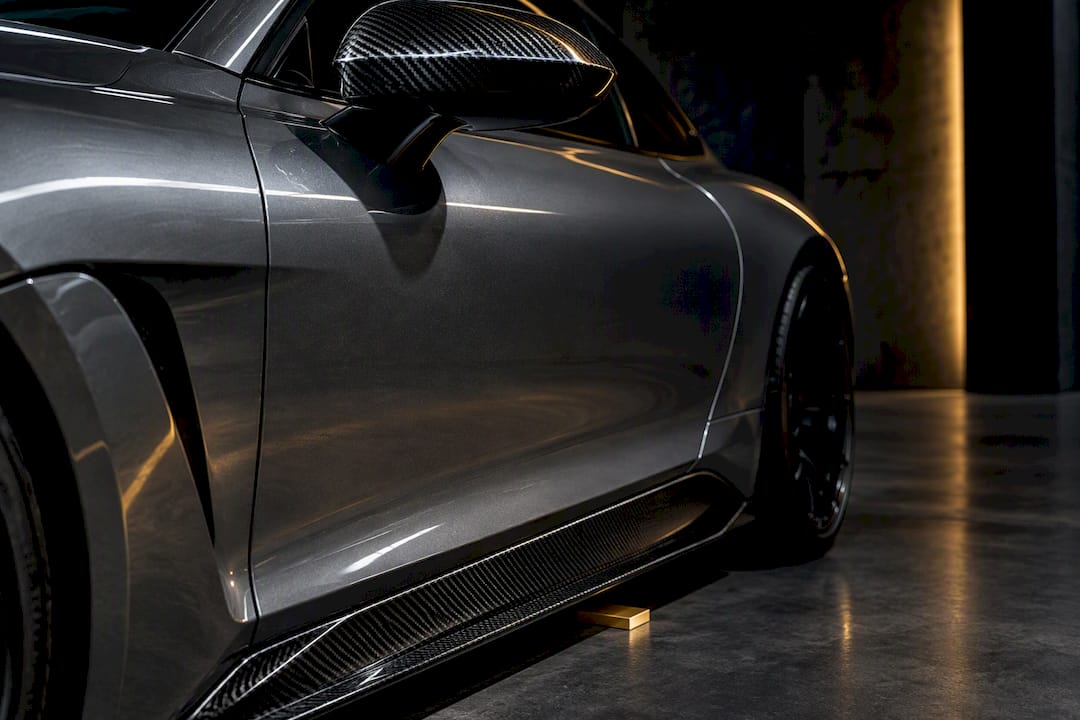
For a C192 AMG GT63 owner who wants presence without altering the car’s factory identity, the answer is accent pieces over full conversion. Precision mirror caps, rocker inserts, intake trim and diffuser fins in autoclave-cured dry carbon, paired with a subdued E6 Forged monoblock finish, sharpen the car’s read at eye level while leaving every factory body line and resale argument intact.
TL;DR:
- Accent pieces in dry carbon, such as mirror caps and rocker inserts, are designed to trace existing factory lines for a subtle upgrade without altering body shape.
- Autoclave-cured twill dry carbon offers tighter fitment tolerances and a more consistent weave pattern, which is ideal for factory-fitted overlays.
- Matte finishes on carbon parts provide a more subdued look that blends into the vehicle, while gloss polish enhances visual impact under direct light.
- Factory-tolerant design and professional installation minimize the risk of misfit, panel stress, or moisture intrusion, ensuring lasting visual and structural quality.
- Matching wheels in satin or brushed finishes support a cohesive OEM-plus aesthetic, with forged monoblock options reducing unsprung weight and improving handling.
Table of Contents
- Which accent pieces deliver subtle OEM-plus changes
- How dry carbon and forged carbon finishes compare
- Fitment-first installation from dry-fit to final finish
- Pairing E6 Forged monoblock finishes with carbon accents
- What accent pieces and matched wheels actually cost
- Keeping the finish right after installation
- What to expect from an E6 engineering-led build
- How carbon accents are manufactured and quality-checked
- What owners say about living with subtle carbon builds
- Compatibility across C192 model years and trims
- Warranty coverage and return terms for accent parts
- Handling, weight, and the trade-offs worth knowing
- Why subtlety usually beats a full conversion
- Getting started with an E6 accent build for your GT63
- Sources for OEM fitment and material claims
- FAQ
Which accent pieces deliver subtle OEM-plus changes
The C192 AMG GT63’s body was drawn with tight, deliberate lines, so the accent pieces that work best are the ones that trace those lines rather than compete with them. Each of the four core pieces does a distinct job, and the right combination depends on how much visual change the owner actually wants.
Mirror covers are the easiest entry point and the one most owners choose first. A high-gloss dry carbon cap reads almost identically to factory paint from a distance, picking up light the same way a painted cap would, while a matte cap sits quieter and reads more like a factory carbon-fiber package option than an aftermarket add-on. Owners chasing a stealth aesthetic tend toward matte; those wanting the accent to catch the eye at a car meet lean gloss.
Front bumper intake trim works differently. These are overlay pieces that follow the factory intake opening rather than reshape it, which means they add visual depth to the lower fascia without changing the bumper’s silhouette. The effect is subtle: a slightly more sculpted front end that photographs with more shadow definition, not a different-looking car.
Side rocker panel inserts do the most work per square inch. Because rocker panels sit at eye level for anyone standing next to the car, a well-fitted dry carbon insert reads immediately, tracing the factory rocker line rather than replacing it. This is the piece most likely to make a passerby notice the car is not stock, without making them question whether it still is one.
Rear diffuser fins round out the set. Low-profile fins that integrate into the factory diffuser opening add depth and shadow to the rear fascia without the large cutaways or vertical blades associated with full aero conversions. On a GT63, where the factory diffuser is already fairly aggressive, subtlety here matters more than on a less sculpted platform.
For owners building toward a coherent, resale-friendly look rather than buying pieces piecemeal, a few combinations consistently work:
- Mirror caps and rocker inserts in matching gloss or matte finish, the lowest-risk starting combination.
- Mirror caps, rocker inserts, and intake trim together for a fuller but still low-contrast package.
- All four pieces in matte finish for an executive, understated build.
- All four pieces in gloss finish for a build that photographs well without crossing into loud territory.
None of these combinations require touching the bumper structure or altering panel gaps, which is the entire point of an OEM-plus approach.
How dry carbon and forged carbon finishes compare
Two manufacturing paths dominate the exterior carbon market, and they produce noticeably different results on a car this precise. Autoclave-cured 2×2 twill is laid up in sheets and cured under heat and pressure in an autoclave, which produces a uniform weave pattern and a consistent resin distribution across the part. Forged carbon, by contrast, uses chopped fiber compressed into a mold, producing the marbled, speckled look that reads as more aggressive and less traditionally “OEM.”
For an owner chasing factory-plus subtlety, that distinction matters directly. Autoclave-cured 2×2 twill produces tighter, more repeatable fitment tolerances than some forged finishes, which is the reason it tends to be the default recommendation for panels that sit against factory-tight gaps, like rocker inserts and mirror caps.
Finish choice on top of the material changes the visual outcome again. A high-gloss clear coat amplifies the twill pattern and makes the part read as a deliberate styling statement, closer to a factory carbon package than an aftermarket bolt-on. A matte clear coat mutes the weave and lets the part recede into the car’s overall shape, which is the finish most executive-focused owners gravitate toward.
- Gloss dry carbon: highest visual pop, closest match to factory clear-coated paint under direct light.
- Matte dry carbon: lowest visual footprint, best for owners prioritizing subtlety over statement.
- Forged carbon in either finish: more aggressive fiber pattern, better suited to owners building a more overt aesthetic.
Autoclave-cured 2×2 twill can achieve fitment tolerances as tight as 0.1 millimeters against factory panel gaps, which is the margin that keeps a rocker insert or mirror cap looking factory-installed rather than bolted on.
Durability trade-offs run in a predictable direction. Matte finishes hide light stone-chip marks and swirl marks better than gloss but require more careful product selection during washing, since some polishes and degreasers will burnish a matte surface into an unwanted sheen. Gloss finishes show chips and scratches more readily but are easier to spot-repair and re-clear. For resale, a carbon accent that has aged well and still sits flush against factory paint supports the car’s value story far better than a mismatched or lifting panel, regardless of which finish was chosen.
Fitment-first installation from dry-fit to final finish
E6 Carbon’s engineering process for the C192 platform follows what the brand calls Fitment First design, which means every panel is checked against factory gap and edge-seating tolerances before it ships, rather than adjusted on the car during install. That distinction matters because a part designed to factory tolerance installs faster and with fewer surprises than a part designed to a generic aftermarket template.
A proper install for accent-level parts like mirror caps, rocker inserts, and diffuser fins follows a consistent sequence:
- Dry-fit the part against the factory panel without adhesive or fasteners, checking gap consistency along every edge.
- Mark alignment points and confirm the part seats flush at both ends and along the seam.
- Prepare the factory surface, applying primer or adhesion promoter where the panel requires bonding.
- Apply the specified adhesive or fastener system according to the part’s engineering spec.
- Allow the part to cure and seat, then restore or blend clear coat where the install intersected factory paint.
Some pieces, particularly rocker inserts and intake trim that require partial factory trim removal, are better handled through professional in-house installation. A shop familiar with the C192’s trim clips and panel fasteners can remove and reinstall factory hardware without stress-cracking mounting points, something that is harder to guarantee on a first-time DIY attempt.
Pro Tip: Never trust a single dry-fit check performed at room temperature: panel materials expand slightly with heat, so verify edge gaps again after the car has sat in direct sun or a warm garage for an hour.
The most common DIY pitfalls are avoidable but expensive when missed: skipping the dry-fit step and forcing a part into place, which stresses factory clips; using the wrong adhesive chemistry against factory clear coat, which can lift paint on removal; and failing to reseal seams properly, which lets moisture track behind a rocker insert or mirror cap over a wet season. Each of these is a paint or water-intrusion risk, not just an aesthetic one, which is why fitment-first parts and professional installation both exist to reduce that risk rather than eliminate the owner’s involvement entirely.
Pairing E6 Forged monoblock finishes with carbon accents
Wheels carry more visual weight than any single carbon accent, so getting the finish right is what makes a subtle carbon package look intentional rather than incomplete. The goal on an OEM-plus build is a wheel finish that supports the carbon accents rather than competing with them for attention.
Satin and brushed finishes on E6 Forged Monoblock wheels read as an extension of a matte carbon package, both finishes absorbing light rather than throwing it. A stealth or smoked finish pushes the look further toward understated, appropriate for an owner who wants the carbon accents to be the only element that draws a second look. High-polish or mirror finishes, by contrast, tend to pull attention toward the wheel itself, which can visually fight with a matte carbon build even when the two are otherwise well matched.
- Matte carbon accents pair best with satin or stealth monoblock finishes for a unified, quiet build.
- Gloss carbon accents pair well with brushed or satin finishes, which balance the shine without a mismatch.
- High-polish wheel finishes suit owners running gloss carbon across the full accent set, since both elements are already built to catch light.
Monoblock construction also carries a functional argument beyond finish. A monoblock wheel is forged from a single piece of aluminum, which typically achieves lower unsprung weight than a comparable multi-piece forged wheel of the same diameter, since there are no bolted barrel sections adding mass. Lower unsprung weight improves suspension response, letting the dampers react to road surface changes with less rotating mass to control. Wheel diameter and profile also affect how the body reads: a slightly larger diameter with a lower-profile tire tightens the visual gap between fender and wheel, which can make the factory body lines look more taut without changing a single panel.
What accent pieces and matched wheels actually cost
Budgeting for an OEM-plus build depends heavily on how many pieces are included and how much bespoke fitment work each one requires. A single accent part, such as a pair of mirror caps, sits at the lower end of the spending range, since the part count and labor are minimal. A small accent package covering three to four pieces, for example mirror caps, rocker inserts, and intake trim together, moves up from there, both in part cost and in installation time. A full aero conversion, which reshapes rather than overlays the bumper and adds larger diffuser and splitter components, represents the top of the range and the most labor-intensive install.
Several factors push cost upward regardless of piece count:
- Bespoke fitment work for panels that require factory trim removal or custom bonding.
- Specialty finishes, particularly forged carbon in custom colorways rather than standard gloss or matte dry carbon.
- Matched wheel builds, since a custom E6 Forged Multipiece set adds significantly more engineering time than a standard monoblock design.
Lead time follows a similar pattern. Autoclave-cured carbon parts require mold preparation, layup, and cure cycles that run on the order of weeks rather than days, and custom forged wheels add their own production queue on top of that. Owners planning an install around a specific event, a car show or a delivery date, should build in buffer time for both the carbon parts and the wheels to arrive before scheduling the installation appointment, since rushing either production run tends to be the point where fitment quality suffers.
Keeping the finish right after installation
A carbon accent build only stays looking factory-fresh if it is maintained like one. The cleaning routine matters more than most owners expect, since the wrong products can dull a matte finish or haze a gloss clear coat within a single wash season.
A pH-neutral car wash product and a dedicated microfiber towel, used with straight-line motion rather than circular scrubbing, is the safest baseline for both dry carbon and painted panels. Matte surfaces in particular should avoid any product marketed as a “shine enhancer,” since those tend to leave a slight gloss residue that ruins the intended flat finish.
- Wash weekly with a pH-neutral shampoo and a soft microfiber towel, drying immediately to avoid water spotting.
- Inspect panel edges and fasteners monthly for early signs of lifting, moisture ingress, or loosened hardware.
- Apply a UV-protective sealant or ceramic coating to gloss carbon roughly twice a year to slow clear-coat yellowing.
- Use matte-specific ceramic products on matte panels, since standard ceramic coatings can add unwanted gloss.
Pro Tip: Check seam edges after the first heavy rain following installation. A properly sealed rocker insert or diffuser fin will show no water tracking behind the panel; any dampness at the seam means the seal needs attention before it becomes a paint problem.
What to expect from an E6 engineering-led build
E6 Carbon’s manufacturing approach for platforms like the C192 AMG GT63 centers on autoclave-cured carbon components and bespoke forged wheels built to the same fitment-first standard across every accent piece, from mirror caps to diffuser fins. That approach exists specifically to serve owners who want the visual upgrade without the fitment guesswork that comes with generic aftermarket templates.
The Fitment First process itself is a verification step built into production, not an afterthought applied at install. Panels are checked against factory gap and edge tolerances before they ship, which is the reason a fitment-first mirror cap or rocker insert tends to require little to no on-car adjustment compared with parts designed to a one-size-fits-all mold.
For owners evaluating a C192 build, the practical expectation is straightforward: parts arrive engineered to the platform’s actual panel geometry, finish options are specified up front rather than discovered during install, and the installation itself, whether performed professionally or by an experienced technician, follows a dry-fit-first workflow rather than a force-and-hope approach. That consistency is what allows a set of accent pieces to look like they belong on the car rather than like they were added to it.
How carbon accents are manufactured and quality-checked
Producing a dry carbon accent panel starts with laying autoclave-grade 2×2 twill fabric into a tooled mold that matches the factory panel’s geometry. The layup is vacuum-bagged to remove trapped air, then cured inside an autoclave under controlled heat and pressure, a process that produces a denser, more uniform part than open-mold or vacuum-only curing methods.
Once cured, each panel goes through trimming to its final edge profile, followed by a fitment check against a reference panel or fixture built to the platform’s factory tolerances. This is where fitment-first quality control happens: edges are measured for gap consistency, mounting points are verified against the factory attachment locations, and the surface is inspected for weave uniformity before any clear coat is applied. Parts that fail tolerance checks at this stage are reworked or scrapped rather than shipped and adjusted on the car.

Clear coating is the final step, applied in either gloss or matte formulation depending on the ordered finish, then cured before packaging. The entire sequence, from layup to final inspection, is designed to catch fitment problems before a part ever reaches an installer’s bench, which is the difference between a panel that drops into place and one that requires trimming or forcing on the car.
What owners say about living with subtle carbon builds
Owners who choose the accent-piece route over a full conversion consistently describe the same outcome: a car that reads as noticeably sharper in person without prompting the “what did you do to it” question from people unfamiliar with the platform. That reaction is largely the point of an OEM-plus build, and it is the reason mirror caps and rocker inserts remain the most frequently ordered starting combination rather than more dramatic pieces.
Feedback on gloss versus matte tends to split along a predictable line: owners who show their cars or attend meets more often lean gloss, since it photographs with more contrast, while daily drivers who want the upgrade to blend into normal traffic lean matte. Either way, the pieces that get the most repeat praise are the ones that required no visible modification to install, mirror caps and rocker inserts chief among them, since they preserve the option to return the car to fully stock condition if a future owner or a lease-end inspection requires it.
Compatibility across C192 model years and trims
The C192 platform covers the AMG GT63 across multiple production years with only minor running changes to bumper and rocker geometry, which means most accent pieces engineered for the platform’s core body lines fit consistently across the range. Owners should still confirm their specific model year and trim when ordering, since even small mid-cycle revisions to bumper intake shapes or rocker contours can affect how tightly an overlay panel seats.
Trim level matters less for fitment than it does for finish matching. A base AMG GT63 and a Pro-spec variant share the same underlying body structure, but the Pro trim’s more aggressive factory aero elements mean accent pieces designed for a base car’s cleaner lines may look proportionally different once mounted next to Pro-spec components. Confirming trim-specific fitment before ordering, rather than assuming universal compatibility across the GT63 range, is the safest way to avoid a panel that technically bolts on but does not sit flush with adjacent factory components.
Warranty coverage and return terms for accent parts
Warranty and return terms for exterior carbon accent parts are specific to the piece and finish ordered, since a custom-fit panel carries different considerations than a stock catalog item. Owners should confirm coverage details and any return conditions directly during the quote process, since bespoke fitment work is generally treated differently from off-the-shelf parts once a part has been cut, finished, or installed.
The safest practice for any owner ordering accent pieces is to request warranty terms and return conditions in writing before placing a deposit, particularly for finish-specific orders like matte dry carbon, where color and sheen matching against existing panels can vary slightly between production runs. Confirming these terms up front avoids disputes later, especially on parts that require professional installation to fit correctly.
Handling, weight, and the trade-offs worth knowing
Exterior accent pieces like mirror caps, rocker inserts, and diffuser fins carry negligible weight compared with the vehicle’s overall mass, so their effect on handling is essentially cosmetic rather than dynamic. The real handling conversation on a C192 build centers on wheels, not carbon panels.
Monoblock forged wheels typically weigh less than comparable cast or multi-piece forged wheels at the same diameter, and that difference shows up specifically as reduced unsprung weight, the mass that moves with the wheel and tire rather than being supported by the springs. Lower unsprung weight lets the suspension respond to bumps and surface changes with less inertia to overcome, which owners often notice as sharper turn-in and a more settled ride over rough pavement.
The trade-off worth understanding is that a full aero conversion, unlike accent-level carbon pieces, can add measurable weight if it includes larger structural components rather than lightweight overlay panels, and it can also alter airflow patterns around the factory-tuned front and rear fascias. For an owner focused on subtle styling rather than track performance, staying within the accent-piece category avoids that trade-off entirely, since none of the four core accent pieces alter the car’s aerodynamic balance in any meaningful way.
Why subtlety usually beats a full conversion
Full conversions promise a bigger visual jump, but they also carry more risk to the thing that makes a C192 GT63 valuable in the first place: its factory-correct body. Every panel a full kit replaces is a panel a future buyer or appraiser has to evaluate as non-original, and that evaluation rarely works in the seller’s favor.
Accent pieces carry almost none of that risk. They overlay rather than replace, they can typically be removed without a trace, and they deliver most of the visual upgrade an owner actually wants: a sharper read at eye level, more shadow definition at the front and rear, and wheels that finish the look instead of fighting it.
Full conversions still make sense for a narrower group: owners building toward a specific show-car aesthetic, or those who have already committed to a more aggressive aerodynamic direction and want the parts to match. In consultations, we walk owners through both paths honestly, and more often than not, the accent-piece route is the one that fits what they actually wanted when they started asking about carbon in the first place.
— E6 Engineering
Getting started with an E6 accent build for your GT63
E6 Carbon builds precision autoclave-cured accents for the C192 AMG GT63, and E6 Forged supplies the monoblock wheels that complete the look, both engineered under the same fitment-first standard rather than sold as separate, unmatched products. That combination means an owner can order mirror caps, rocker inserts, and a matched wheel finish from one engineering process instead of piecing together parts from unrelated vendors and hoping they align.
Starting the process begins with a consultation to confirm your exact GT63 model year and trim, followed by measurement and quote steps for the specific accent pieces.
- Browse Carbon Fiber Parts for the current accent piece catalog and finish options.
- Review E6 Forged Monoblock for finish pairings that complement dry carbon accents.
- Check Professional in-house installation services if your build includes pieces requiring factory trim removal.
From there, a deposit locks in production once fitment and finish are confirmed, and the parts move into the autoclave and wheel production queue on the timeline outlined earlier in this guide.
Sources for OEM fitment and material claims
The technical claims in this guide draw on the C192 AMG GT technical archive for platform context, Mercedes-AMG’s own GT 63 Pro page and the Mercedes-Benz For Sale in Fort Lauderdale, FL – Auto Vendors Inc build configurator for factory OEM carbon precedent, and E6 Carbon’s own project and autoclave versus forged finish pages for manufacturing and tolerance specifics. Each source ties directly to a fitment, material, or OEM-precedent claim made above.
FAQ
Will carbon accent pieces affect my GT63’s resale value?
Overlay accent pieces like mirror caps and rocker inserts generally support resale value rather than hurt it, since they can be removed without altering factory panels or trim. A full aero conversion carries more resale risk because it replaces rather than overlays factory components.
Should I choose gloss or matte dry carbon for my mirror covers?
Matte suits owners who want the upgrade to stay understated in daily driving, while gloss suits owners who want the accent to stand out under direct light. Both use the same autoclave-cured 2×2 twill construction, so the choice is purely visual, not a durability trade-off.
Do I need professional installation for rocker panel inserts?
Rocker inserts often require partial factory trim removal, which makes professional in-house installation the safer route to avoid stress-cracking factory mounting clips. A dry test-fit should always happen before any adhesive or fastener is applied, regardless of who performs the install.
How do monoblock wheels compare to multi-piece forged wheels for this build?
Monoblock wheels are forged from a single piece of aluminum and typically run lighter than a comparable multi-piece forged wheel, which reduces unsprung weight and can sharpen suspension response. Multi-piece forged wheels offer more finish and width customization but usually carry more mass at the same diameter.
What does a small carbon accent package typically include?
A typical starting package covers three to four pieces, most often mirror caps, side rocker inserts, and front intake trim, chosen because they overlay factory lines without requiring structural changes. Pricing and lead time scale with part count and finish complexity, so a quote confirms exact costs for your specific model year and trim.
Recommended
- Brake Upgrade | AMG GT (C190/R190)
- GT63 Owners: 192 MPa Forged Carbon or Autoclaved 2×2 Twill?
- Track Focused Wheels for the AMG GT: Engineering Guide
Pricing, custom fitment options, and surface finishes subject to availability. Please contact E6 Carbon or E6 Forged directly to confirm vehicle-specific offset parameters, brake clearances, and current lead times prior to placing your order.