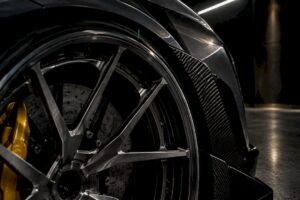
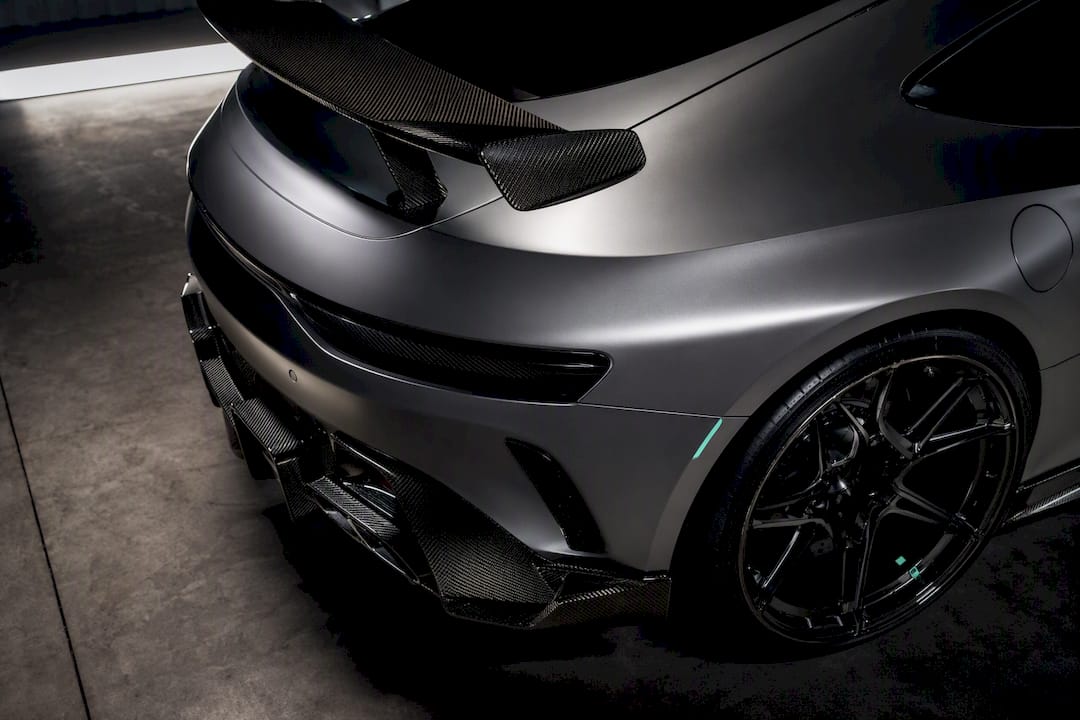
E6 Carbon’s fixed autoclave-cured rear wing is the recommended solution for sustained high-speed stability on the C192 GT63, but only when it is installed as part of a matched aero system rather than a standalone panel. The wing works with a tuned diffuser and the factory front aero to hold consistent rear downforce at speed. The trade-off is a measurable increase in drag against a predictable, repeatable handling balance that a reactive factory spoiler cannot always match.
TL;DR:
- The matched aero system with a fixed autoclave-cured carbon wing and diffuser provides consistent downforce but increases drag compared to factory active spoilers.
- Proper fitment of the wing, diffuser, and wheel offset is crucial; mismatched components can reduce stability and negate aerodynamics gains.
- Widening rear track through validated wheel offset improves diffuser inlet flow and high-speed stability more effectively than adding larger wings alone.
- Mounting points must be reinforced and engineered to handle aerodynamic loads, avoiding structural failures from concentrated high loads on the trunk lid.
- Prioritizing diffuser and wheel specifications over wing size optimizes aerodynamic efficiency and handling, especially on the track.
Table of Contents
- What the E6 autoclave-cured carbon kit includes for the GT63
- How the rear wing, diffuser, and wheel wake interact on the GT63
- Fixed E6 wing vs factory active spoiler: when to choose which
- How E6 Forged wheels and rear track widening improve stability
- Mounting, trunk load distribution, and structural integrity for large wings
- Material weave, finish matching, and durability across components
- Driver-facing outcomes: stability, lap times, and top speed trade-offs
- Deciding between a full E6 conversion and individual accent pieces
- E6 Engineering proof points for the C192
- An engineering-first case against the bolt-on wing
- How to order E6 Carbon components and request an engineering consultation
- Sources
- FAQ
What the E6 autoclave-cured carbon kit includes for the GT63
The approach treats the rear of the car as one aerodynamic assembly rather than a collection of separate parts. The core kit typically pairs a fixed rear wing with a matched rear diffuser, an optional decklid lip or ducktail element, and a front splitter designed to work with the factory front lip rather than against it. Wheel packages in monoblock, multi-piece, and AeroDisc configurations complement the system, depending on the owner’s weight and stiffness priorities.
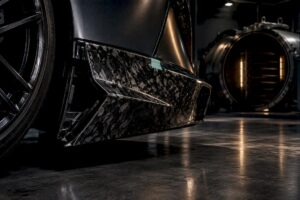
Every carbon panel in the kit is produced from autoclave-cured 2×2 twill, a process that applies heat and pressure inside a pressurized vessel to compress the resin and fiber layers far more evenly than an open-mold or vacuum-only process achieves. That consistency matters structurally: a wing endplate or a diffuser strake under sustained aerodynamic load needs uniform fiber orientation, not a panel where resin pooled unevenly during cure.
The kit-level logic comes down to three points:
- A rear wing generates downforce, but its efficiency depends on the pressure field the diffuser creates underneath it, so the two are engineered together rather than sold separately.
- Fastener interfaces (wing risers, diffuser tabs, splitter brackets) are dimensioned to E6’s own tolerances, so components from the same kit share bolt patterns and load paths.
- Wheel offset and rear track width, addressed later in this article, are treated as an aero variable, not just a fitment or styling choice.
That is the practical argument against buying a single bolt-on wing from a catalog and calling the job done. A wing sized for a different diffuser angle, or bolted onto a deck lid that was never reinforced for the new load path, can generate lift-side inconsistencies that a driver only discovers at speed. Fitment focus is critical: a component that looks correct on a parts diagram but does not match the underbody geometry of the specific GT63 trim can create more instability than it removes. Owners considering a full carbon program for a different platform, such as the E6 Carbon Elite Kit for the Lexus LC500, will see the same system logic applied: wing, diffuser, and splitter specified as one geometry set rather than three independent purchases.
For owners weighing forged wheels within that same kit logic, E6’s monoblock wheel engineering guide covers the strength and stiffness reasoning behind the wheel side of the equation.
How the rear wing, diffuser, and wheel wake interact on the GT63
A rear wing does not generate downforce in isolation. Its effective angle of attack, and the drag penalty that comes with it, depends heavily on the pressure field building up behind the car from the diffuser and from the wake shed by the rear wheels. Research into rear wheel, wing, and diffuser interaction on sports car-type vehicles found a measurable relationship between diffuser angle, ground clearance, and base pressure, all of which change how much net downforce a given wing profile actually produces, as documented in SAE’s wheel and diffuser interaction study. A wing that looks correctly sized on paper can underperform badly if the diffuser behind it is not extracting air at a compatible rate.
Wing geometry itself carries its own trade-offs. Multi-element wing research shows that optimizing chord spacing, gap, and relative element angle can raise the lift coefficient while simultaneously cutting drag, but the gains are specific to the underbody and diffuser configuration the wing is paired with, according to SAE’s multi-element rear wing optimization paper. There is no universal “bigger wing” answer: a wing tuned for a car with a shallow diffuser angle behaves differently once bolted to a car running a steeper, more aggressive diffuser.
Wheel wake adds a third variable that is easy to overlook. Turbulent air shed off the rear tires disturbs the diffuser’s inlet flow, and the same interaction research found that shifting the rear wheels outward changes that inflow condition in ways that can improve net downforce when the wake is shaped correctly.
Diffuser angle, ground clearance, and base pressure significantly influence downforce generation, and rear wheel wake interacts directly with diffuser inlet performance.
That is the mechanical reason a wider rear track, delivered through E6 Forged wheel offsets, is not just a stance decision on the GT63. It is a variable in the same aero equation as the wing and diffuser.
Mercedes-AMG’s own PRO 4MATIC+ aero package reduces front-axle lift by more than 30 kilograms through coordinated front deflectors, active underbody panels, AIRPANEL shutters, and a fixed rear wing, according to Mercedes-AMG’s official GT 63 PRO release. That figure matters here because it establishes the scale of front-end downforce a serious rear aero package needs to balance. Add front lip downforce without a rear system engineered to match it and the car’s front-to-rear aero balance shifts toward oversteer at speed, particularly through fast, sustained corners.

Fixed E6 wing vs factory active spoiler: when to choose which
The factory rear spoiler on the GT63 is an active element that adjusts its angle in response to speed and driving mode, giving Mercedes-AMG flexibility to trade downforce for lower drag at cruising speed and add it back under hard driving. A fixed E6 carbon wing gives up that adaptability in exchange for a downforce number that never varies, never lags behind a sensor input, and never depends on an actuator staying in calibration after years of use.
The right choice depends on how the car is actually driven:
- Sustained track use with long, high-speed corners favors the fixed wing, because downforce stays constant through the entire corner rather than adjusting mid-apex.
- Mixed street and occasional track use often favors keeping the factory active spoiler, since most driving happens at speeds where lower drag and better fuel efficiency matter more than peak downforce.
- Owners chasing a specific lap-time target benefit from the fixed wing’s repeatability, since a driver can trust the car’s balance to be identical on lap one and lap twenty.
The engineering process recognizes that the GT63’s rear deck is not a blank surface. AIRPANEL shutters and cooling ducts route air through specific channels, and a wing mount that blocks or redirects that airflow can raise underhood or brake temperatures over a long track session. Wing risers and base plates are positioned and vented to preserve those factory air paths rather than sealing over them, which is one reason a generic universal wing mount is a poor substitute for a kit engineered to the specific chassis.
How E6 Forged wheels and rear track widening improve stability
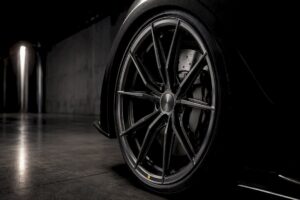
Wheel choice affects the GT63’s high-speed behavior on two separate fronts: mechanical response and aerodynamic performance. Forged monoblock wheels cut unsprung weight compared to a cast or flow-formed equivalent, and less unsprung mass means the suspension can react faster to road inputs, improving transient handling during quick direction changes at speed. That benefit compounds with the aero case: the interaction research cited earlier found that rear wheel position changes diffuser inlet conditions, meaning a wider rear track achieved through calculated offset can improve the air feeding the diffuser rather than just widening the car’s stance for looks.
Practical considerations for GT63 owners specifying wheels alongside E6 rear aero:
- Offset changes that widen the rear track should be validated against fender clearance and suspension travel before finalizing a spec.
- Monoblock construction suits owners prioritizing minimum unsprung weight and track use.
- Multi-piece construction gives more flexibility in width and offset combinations for a custom rear track target.
- Any offset change should be reviewed against the diffuser’s design width to keep the wheel wake and diffuser inlet working together rather than in conflict.
Pro Tip: Have your wheel offset and rear track spec reviewed against your specific rear diffuser width before ordering, since a mismatch between the two undermines the airflow gains either component is designed to deliver on its own.
For a deeper technical comparison of monoblock and multi-piece construction as it applies to track-oriented builds, E6’s guide to wheel selection for the AMG GT covers the strength and weight trade-offs in more detail.
Mounting, trunk load distribution, and structural integrity for large wings
A structural dry-carbon wing generating real downforce places real loads back into the trunk lid and its surrounding sheet metal, and that load path has to be engineered, not assumed. E6 approaches mounting on the GT63 with a few consistent principles:
- Load is spread across reinforced backing plates rather than concentrated at a single riser point, reducing the chance of the trunk lid deforming under sustained aero load.
- Through-bolt interfaces are preferred over adhesive-only bonding at high-load points, since a bolted joint can be inspected and re-torqued while a bonded joint cannot.
- Fastener grade and diameter are selected to handle shear loading at the mount, not just the static bearing load of the wing sitting still.
- Adhesive used at secondary bond lines is matched to the autoclaved resin system so thermal expansion rates stay compatible over repeated heat cycles.
- Owners should schedule a periodic visual inspection of mounting points, checking for hairline cracking around fasteners, sealant breakdown at bonded seams, and any sign of water ingress into the trunk structure.
Skipping reinforcement at the trunk lid is the most common failure point industry-wide for owners who bolt a large wing onto a factory deck lid never designed to carry aerodynamic load, and it is why E6’s kits include the backing hardware rather than treating the wing as a standalone accessory.
Material weave, finish matching, and durability across components
Autoclave-cured 2×2 twill is the material standard across E6’s GT63 kit, and the reasoning is mechanical, not cosmetic. The autoclave process applies even pressure and heat during cure, which compacts the resin more uniformly than a wet-lay or vacuum-bagged panel and reduces the microvoids that become fatigue starting points under repeated aero load.
- Consistent resin content across every panel keeps stiffness and weight predictable from one component to the next.
- Matched weave orientation between the wing, diffuser, and splitter keeps the visual pattern aligned when the parts sit next to each other on the finished car.
- A UV-stable clear coat is recommended for any exposed dry-carbon surface, since raw resin will yellow and become brittle under prolonged sun exposure without it.
Owners comparing autoclave-cured dry carbon against forged carbon composite finishes, which use chopped fiber under pressure rather than a woven cloth layup, can review the mechanical and cosmetic trade-offs in E6’s dry carbon versus forged carbon comparison.
Driver-facing outcomes: stability, lap times, and top speed trade-offs
The practical result of a matched wing and diffuser system is more consistent grip through fast corners and steadier lap-to-lap times, since the car’s rear-end balance no longer depends on how quickly an active spoiler reacts to a sensor. The trade-off is straightforward aerodynamics: more rear downforce means more drag, which typically costs some amount of peak top speed on long straights.
Owners validating the change should record a consistent baseline before and after installation: lap times at the same track and conditions, tire temperatures across the tread width, and, where telemetry allows, yaw and pitch rate through the same corners. Suppressing lateral load fluctuations with flow-control devices such as vortex generators has been shown to reduce yawing and rolling vibration and improve overall vehicle motion performance in large-eddy simulation and wind-tunnel testing, according to SAE research on aerodynamic load fluctuation suppression. That same principle applies at the system level: a well-matched wing and diffuser should reduce the small yaw and pitch disturbances a driver feels through fast, bumpy corners, not just add a static downforce number.
If tire temperatures come back uneven across the tread or yaw rates through a corner become less consistent rather than more, that points to a wing and diffuser mismatch rather than a correctly functioning system, and it is worth revisiting the fitment before assuming the parts themselves are at fault.
Deciding between a full E6 conversion and individual accent pieces
The right starting point depends on how the GT63 is used and how much of the factory system the owner wants to keep.
- Define primary use first: a car doing regular track days benefits most from the full wing, diffuser, and wheel conversion; a mostly street-driven car may only need one element addressed.
- Set budget and installation time expectations: a full kit involves more labor for backing plate reinforcement and calibration than a single accent piece.
- Decide whether factory active systems stay: if keeping AIRPANEL and the active spoiler’s adaptability matters, discuss that priority with E6 before selecting wing geometry.
Before ordering, confirm mounting hardware scope, whether the diffuser and wing are sold as a matched pair, and what the warranty covers on structural components versus cosmetic panels. A red flag on any third-party part: no clear diffuser angle specification, since that number is what determines whether a wing will actually work with the rest of the car.
E6 Engineering proof points for the C192
E6’s Fitment First engineering process is built on internally developed case studies covering downforce behavior and thermal management across the platforms it supports, including the GT3-derived wing geometry demonstrated on the Corvette C8 carbon wing project. That geometry work directly informs how wing and diffuser angles are specified for the GT63 kit.
- Case-study analysis of downforce and thermal behavior shapes the wing and diffuser angles offered for each supported chassis.
- Autoclave-cured 2×2 twill is standardized across the catalog so structural and cosmetic panels share the same material baseline.
- Vehicle-specific fitment notes, including current wheel and aero specifications, may be requested ahead of a purchase.
An engineering-first case against the bolt-on wing
The most common mistake in rear-aero shopping is treating the wing as the product and the diffuser as an afterthought. It is the reverse: the diffuser sets the pressure field the wing operates in, and a wing chosen for its silhouette rather than its match to that pressure field can add drag without adding real stability. That is the gap between what a rear wing promises on a spec sheet and what it delivers on a fast, bumpy corner.
The second underrated point is wheel offset. Owners spend heavily on wing carbon and comparatively little thought on rear track width, even though wheel wake measurably changes diffuser inflow. A wing and diffuser specified together but paired with a wheel offset nobody validated against that diffuser width is a system working against itself.
If there is one place to start, it is the diffuser and wheel spec, not the wing. Get those two right first, and the wing’s job becomes straightforward.
— E6 Engineering
How to order E6 Carbon components and request an engineering consultation
Getting the wing, diffuser, splitter, and wheel offset right at the same time is exactly the coordination problem E6’s kit-based approach is built to solve, rather than leaving an owner to source four separate parts from four separate catalogs and hope they align. Before requesting a fitment consultation, have your GT63’s VIN, current wheel specification, and any existing aftermarket aero on hand so E6’s engineering team can confirm compatibility before manufacturing begins.
Owners exploring full carbon programs on other supported chassis can see the same system approach applied on the E6 Carbon Elite Kit for the Lexus LC500, where wing, diffuser, and splitter are likewise engineered as one geometry set.
Sources
FAQ
Why is the AMG GT 63 so heavy?
The GT63’s curb weight reflects its 4MATIC+ all-wheel-drive hardware, a twin-turbo V8, and the reinforced structure needed to support active aero and suspension systems. That mass is one reason coordinated rear downforce matters: more weight at speed means more benefit from a stable, predictable aero balance.
Which is faster, M8 or GT63?
Outright speed between the two depends on the specific trim, transmission, and testing conditions being compared, and neither manufacturer publishes a direct head-to-head figure. Owners cross-shopping the two should compare the exact model-year specifications each brand publishes for their own vehicles.
Which AMG GT63 is the fastest?
Mercedes-AMG’s own GT 63 PRO 4MATIC+ variant is built specifically for track agility, using coordinated front and rear aero to cut front-axle lift by more than 30 kilograms. Exact top-speed figures vary by trim and should be confirmed against the current model-year specification.
How much is a GT63s E performance?
Pricing for the GT63 S E Performance trim is set by Mercedes-AMG and varies by market, options, and model year, so it is not publicly listed here. Check the current Mercedes-AMG GT Coupe 63 specification page or a local dealer for the current figure.
Recommended
- E6 Fitment First: Downforce & Thermal Management for C192 AMG GT63
- Fitment First Autoclave Prepreg: E6 Carbon Aerodynamics for McLaren
- Carbon GT3 Wing | Corvette (C8)
- AMG GTS to GTR Front Bumper Conversion Aero Blueprint
Pricing, custom fitment options, and surface finishes subject to availability. Please contact E6 Carbon or E6 Forged directly to confirm vehicle-specific offset parameters, brake clearances, and current lead times prior to placing your order.