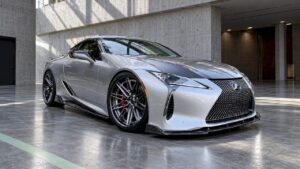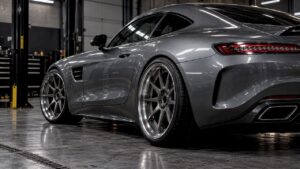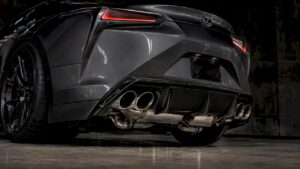
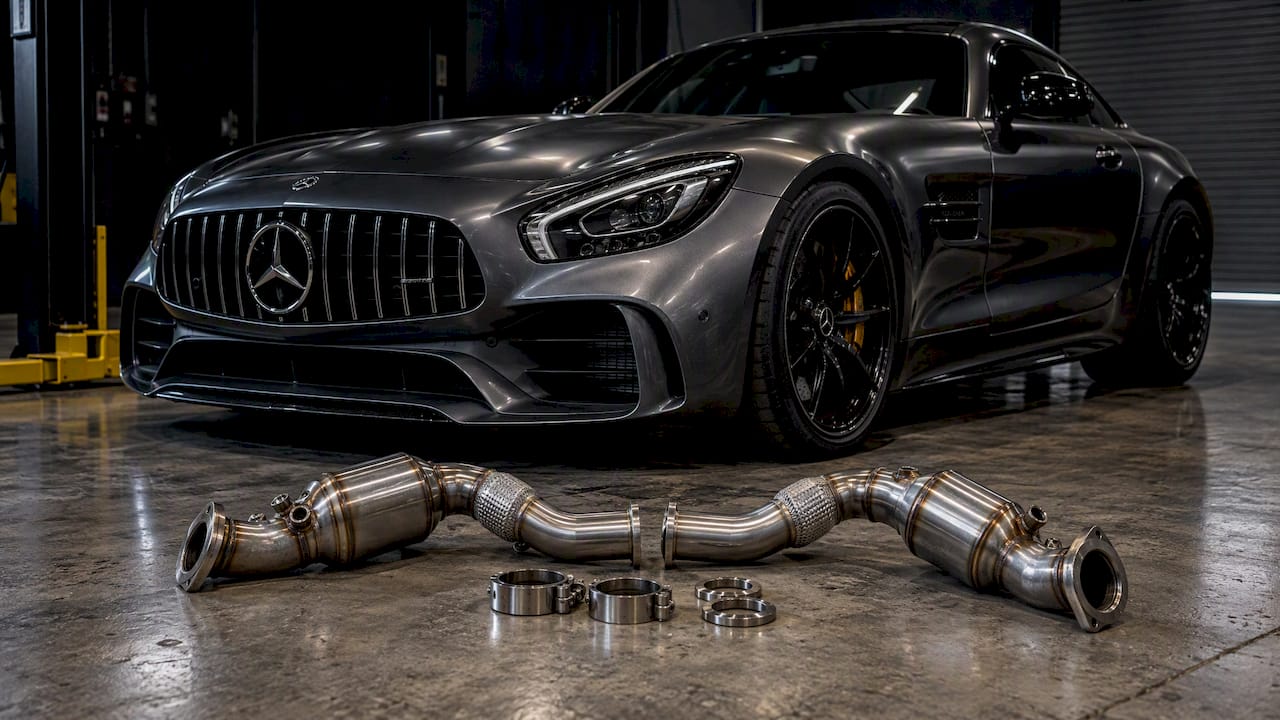
For M178 AMG GT C190 owners, E6 Motorsports engineered downpipes with the 200-cell sport cat option are the recommended plug-in upgrade path: reduced backpressure, lower EGTs, sharper throttle response, and real horsepower gains once paired with a proper ECU calibration.
The M178 twin-turbo V8 sits inside a hot-inside-V configuration, which means the turbochargers and their downstream plumbing run hotter and under more thermal stress than a conventional layout. Anything that restricts flow immediately after the turbos compounds that heat load, and the factory downpipes are built to a compliance target, not a performance one. Swapping in a mandrel-bent, TIG-welded exhaust section changes that equation immediately: exhaust gases evacuate faster, turbine backpressure drops, and the turbos themselves spend less time working against their own exhaust. The result is a car that spools quicker, breathes easier at the top of the rev range, and runs cooler through the sections of pipe that take the most abuse. None of that is theoretical. It is the direct, predictable outcome of reducing restriction in a forced-induction system, and it is why downpipes remain one of the first modifications serious M178 owners make. The remainder of this guide walks through construction, fitment, tuning requirements, and how the exhaust upgrade fits into a broader AMG GT build.
TL;DR:
- Choose the 200 cell metal matrix sport catalyst for street use; catless pipes suit track only, and local emissions rules determine legality.
- A supporting ECU calibration adjusts boost, fueling, and catalyst thresholds; without it, downstream oxygen sensor readings can trigger persistent warning lights.
- Confirm your model year and trim before ordering, because turbo placement and clearance vary; listed fitment details prevent surprises during installation.
- A shop familiar with the M178 typically needs three to five hours for the swap; corroded fasteners or tight clearances can extend work.
- After tuning, log exhaust temperatures and verify oxygen sensor readings during a dyno pull to confirm the calibration matches the new catalyst.
Table of Contents
- E6 Motorsports downpipes and sport-cat kit: what’s in the box
- How less backpressure changes EGTs, spool, and horsepower
- Fitment specifications for the M178-equipped C190
- Installing the kit and the ECU tune it requires
- Comparing E6 downpipes against the factory exhaust
- Pairing downpipes with turbos, tunes, and other exhaust components
- How long installation takes and what adds complexity
- Choosing an ECU tuning option for the new exhaust
- Warranty coverage and support for E6 exhaust hardware
- Why we specify 200-cell sport cats over catless or OEM
- Get your M178 downpipe kit and tuning scheduled
- FAQ
- Sources
E6 Motorsports downpipes and sport-cat kit: what’s in the box
Every E6 Motorsports downpipe for the AMG GT C190 starts as mandrel-bent 304 stainless steel, TIG-welded at every flange and joint for a consistent weld bead and no pipe collapse through the bends. That construction matters more on a hot-inside-V engine than almost anywhere else in the exhaust system, because the downpipes sit closest to the turbo outlets and see the highest thermal cycling in the car.
Buyers choose between three catalyst configurations depending on how the car is used:
- 200-cell metal matrix sport cats: the street-and-track compromise, cutting backpressure sharply while retaining enough catalytic surface area to manage emissions and downstream O2 behavior.
- High-flow catted pipes: a less aggressive step up from OEM cell density, useful for owners who want quieter operation and a smaller tuning adjustment.
- Catless race pipes: the lowest-restriction option, intended for track-only cars where emissions compliance is not a factor.
Kits ship with new flange gaskets, hardware, and O2 sensor bosses positioned to match factory sensor locations. The piping typically runs 3.5 inches in diameter, sized to the M178’s turbo outlet flow without creating the drone or flow separation that an oversized pipe can introduce. Every kit is built around fitment-first engineering rather than a universal fit profile.
How less backpressure changes EGTs, spool, and horsepower
Backpressure immediately downstream of the turbos forces exhaust gas to linger longer inside the turbine housing and the pipe itself, and that lingering gas stays hot. Cutting that restriction with a mandrel-bent downpipe gives the exhaust gas a straighter, larger path out of the car, which lowers exhaust gas temperatures across the pipe and reduces the heat soak that builds up during hard driving inside the M178’s hot-inside-V layout.
The same flow improvement affects turbo response. A turbine that empties faster has less resistance to spin against, so boost builds sooner off idle and the car feels more responsive to small throttle inputs, not just at full load.
Independent dyno testing of M178 downpipe upgrades consistently shows measurable rear-wheel horsepower gains when paired with a supporting ECU calibration, though exact figures vary by vehicle condition and tune quality.
A few practical points shape what an owner should expect:
- Gains are tune-dependent: hardware alone rarely unlocks the full benefit without a Stage 2 calibration.
- Results vary with ambient conditions, fuel quality, and the car’s existing mileage and turbo health.
- 200-cell metal matrix catalysts preserve most of the flow benefit of a catless pipe while keeping catalytic conversion in place, which is why they are the default choice for street-driven cars.
Fitment specifications for the M178-equipped C190
E6 downpipes are engineered for the Mercedes-AMG GT and GT S/C/R variants built on the C190 chassis with the M178 4.0-liter twin-turbo V8, matching OEM flange geometry so the swap bolts to the factory turbo outlets without pipe modification.
Before ordering, confirm the following:
- Flange type: downpipes mate directly to the factory turbo flanges; no adapter plates are required on correctly specified kits.
- O2 sensor placement: pre-cat and post-cat sensor bosses are positioned to match factory wiring harness length, avoiding the need for extension harnesses in most installs.
- Clearance to carbon aero: cars fitted with aftermarket rear diffusers or valances should confirm heat shielding is adequate, since lower-restriction pipes can shift heat distribution slightly toward the rear subframe area.
- Material lifecycle: 304 stainless resists the oxidation and cracking that mild steel OEM pipes eventually show, and TIG-welded joints hold up to repeated heat cycling far better than stamped or clamped factory seams.
Trim-level differences across GT, GT S, GT C, and GT R mean turbo placement and clearance can vary slightly, so confirming the exact production year against the kit’s listed fitment range avoids surprises at install.
Installing the kit and the ECU tune it requires
A typical install follows a consistent sequence regardless of shop:
- Lift the car and remove factory heat shielding around the turbo outlets.
- Disconnect and label O2 sensor harnesses before unbolting the OEM downpipes.
- Remove the factory downpipes and inspect turbo outlet flanges for gasket residue or damage.
- Fit the new E6 downpipes with fresh gaskets, torquing flange bolts to factory spec in a star pattern.
- Reconnect O2 sensors, reinstall heat shielding, and clear any stored fault codes before starting the car.
The hardware swap alone is only half the job. Running high-flow or sport-cat pipes without a supporting calibration commonly triggers persistent check-engine lights, because the ECU reads downstream O2 behavior against a factory catalyst efficiency map that no longer matches the new catalyst’s flow characteristics. A Stage 2 or bespoke ECU and TCU calibration remaps fueling and boost targets to the new exhaust flow and recalibrates the catalyst efficiency thresholds so the car doesn’t flag false faults.
Pro Tip: Log EGTs and verify O2 sensor readings on a dyno pull immediately after the tune, not just after the hardware install, to confirm the calibration is reading the new catalyst correctly.
Comparing E6 downpipes against the factory exhaust
The factory M178 downpipes are built to meet global emissions certification across every market the GT C190 was sold into, which means their catalyst density and pipe diameter are set conservatively rather than for flow. That conservatism shows up as measurable backpressure, more heat retention under load, and a flatter power curve above the midrange than the engine is otherwise capable of producing.
Swapping to mandrel-bent 304 stainless with a 200-cell sport cat addresses each of those limits directly. The larger, smoother-bent piping removes the flow restriction without removing catalytic function entirely, and the lighter-gauge stainless construction sheds weight versus the factory pipe’s heavier shielding and bulkier catalyst housing. Factory pipes also use stamped seams and clamped joints in places that E6 kits TIG-weld solid, which means the aftermarket pipe holds up to repeated heat cycling with less risk of cracking at the seams over time.

The tradeoff owners should understand clearly: factory pipes are quieter and require no tuning, because they’re matched to the stock ECU map from the factory. An E6 downpipe upgrade trades that plug-and-play simplicity for real flow and thermal gains, provided the supporting tune is done correctly.
Pairing downpipes with turbos, tunes, and other exhaust components
E6 downpipes are engineered to work as a standalone upgrade or as part of a larger exhaust package, and they integrate cleanly with most aftermarket cat-back and axle-back systems built for the C190, since the downpipe’s outlet flange follows the same factory dimensions downstream components already expect.
Owners running upgraded turbos or a built M178 should treat the downpipe as a prerequisite rather than an optional add-on: larger turbos push more exhaust volume, and a factory downpipe becomes an even tighter bottleneck as turbo output increases, undercutting the hardware investment upstream. The same logic applies to supporting fueling and intake upgrades, which only pay off fully when the exhaust side of the engine can keep pace.
Because the downpipe sits at the start of the exhaust system, every downstream component, from mid-pipe to muffler to valved exhaust controller, inherits the flow characteristics it sets. A sport 200-cell downpipe from a specialist like Valve Control Exhaust pairs well with electronically valved cat-back systems, since both are designed around the same flow and sound targets for the M178 platform.
How long installation takes and what adds complexity
A straightforward downpipe swap on a lift, performed by a shop familiar with the M178’s turbo packaging, typically runs in the range of three to five hours for both sides, factoring in heat shield removal, flange access, and sensor reconnection. Cars with aftermarket heat shielding, tight turbo-to-chassis clearances, or corroded factory fasteners can push toward the longer end of that window.

Complexity increases when the install is bundled with other work. Doing the downpipe swap at the same time as a clutch, turbo service, or subframe work makes sense labor-wise, since much of the underbody access overlaps. Attempting the swap without lift access or without removing the factory heat shields first is the most common source of extended shop time, since the turbo outlet flanges on the M178 sit in a tight space inside the engine V.
Budgeting for the ECU calibration separately is worth factoring into total project time. A dyno-based Stage 2 tune typically adds another block of shop time beyond the physical install, since proper calibration involves multiple logged pulls and fine-tuning of fueling and boost targets rather than a single flash.
Choosing an ECU tuning option for the new exhaust
Hardware gains on the M178 are capped by whatever the factory ECU map allows, so the tuning step is not optional for owners chasing real output from a downpipe or sport-cat upgrade. A bespoke calibration adjusts fueling, boost targets, and catalyst efficiency thresholds to match the new exhaust’s flow characteristics, which is the difference between a car that simply sounds different and one that actually performs differently.
Our ECU and TCU tune for the AMG GT C190 is built specifically around hardware changes like downpipe and sport-cat installs, so the calibration accounts for the new catalyst’s oxygen storage behavior rather than flagging it against a factory efficiency map. That distinction matters most with 200-cell sport cats, where downstream O2 sensor readings shift enough from stock that a generic tune can misread catalyst health and trigger unnecessary fault codes.
Owners should treat the tune as part of the same purchase decision as the downpipes themselves, not a follow-up step to schedule later. A car running new hardware on an old map rarely shows its full potential, and in some cases runs worse than stock until the calibration catches up to the new flow.
Warranty coverage and support for E6 exhaust hardware
E6 downpipes and sport-cat kits are built from 304 stainless with TIG-welded joints specifically because that construction holds up to the heat cycling the M178’s hot-inside-V layout puts on exhaust hardware, and that durability is the backbone of the support we stand behind. Fitment questions, whether about flange alignment, O2 sensor placement, or clearance to aftermarket aero components, are handled directly through our engineering team rather than a generic support queue.
Buyers pairing the downpipe install with our ECU and TCU tuning service get calibration support tied to the exact hardware installed, so questions about fault codes or logged O2 behavior after the install go to the team that built both the pipe and the map. That combination, matched hardware and matched calibration, is why we recommend ordering both together rather than sourcing a tune separately.
Why we specify 200-cell sport cats over catless or OEM
A catless pipe makes the most power and the least sense for a street-driven car, since it strips out catalytic function entirely and often fails local emissions requirements outright. OEM catalysts protect compliance but cost real flow. The 200-cell metal matrix sits in the middle deliberately, giving up a small amount of the catless pipe’s peak flow in exchange for catalytic function that holds up under real driving.
Mandrel bend geometry and TIG-welded flanges aren’t cosmetic choices. They’re what keeps that balance consistent pipe after pipe, car after car.
— E6 Engineering
Get your M178 downpipe kit and tuning scheduled
Start with the E6 Motorsports downpipe and sport-cat kit built for the AMG GT C190’s M178 engine, confirm your model year and trim against the listed fitment range, and decide between the 200-cell sport cat, high-flow catted, or catless configuration based on how the car is actually driven.
Pair the hardware with our ECU and TCU calibration at the same time rather than after the fact, and schedule a dyno pull once the tune is loaded to confirm EGTs, boost targets, and O2 sensor behavior are all reading correctly. If the install coincides with other underbody work, our installation services can handle the downpipe swap, heat shield fitment, and calibration in a single visit.
FAQ
Do E6 downpipes require an ECU tune to work properly?
Yes. Running a 200-cell sport cat or catless downpipe without a supporting calibration commonly triggers check-engine lights, because the factory map reads downstream O2 behavior against a catalyst efficiency threshold the new hardware no longer matches.
Are 200-cell sport cats legal for street use?
Legality depends on local emissions rules, and California Proposition 65 requires warnings about certain chemical exposures on many aftermarket exhaust parts sold in the US. Owners should confirm their local emissions requirements before installing any catalyst configuration other than OEM.
How much horsepower do M178 downpipes actually add?
Gains vary by vehicle condition and tune quality, but reduced backpressure consistently lowers EGTs and improves throttle response, with measurable rear-wheel horsepower gains showing up once a supporting ECU calibration is installed alongside the hardware.
Can I install downpipes myself or do I need a shop?
The physical swap follows a defined sequence (flange removal, gasket replacement, sensor reconnection) that an experienced home mechanic with lift access can complete, but the required ECU calibration needs dyno access and tuning software that most driveways don’t have.
Will E6 downpipes fit my AMG GT trim?
Fitment covers the M178-equipped C190 chassis across GT, GT S, GT C, and GT R variants, though flange and clearance details can shift slightly by model year, so confirming your exact production year against the kit’s listed fitment range is worth doing before ordering.
Recommended
- Faster Spool, Engineered Fit for C192 AMG GT63: E6 Downpipes
- Engineer Backed E6 Downpipes for AMG GT: Mandrel Bent 304, TIG Flanges
- 0.1 mm Fit: E6 Autoclaved Carbon Aero & Ti Exhaust for AMG GT C190
- Gain 0.1 mm Fit Advantage: E6 Carbon & Forged Wheels for C190 AMG GT
Pricing, custom fitment options, and surface finishes subject to availability. Please contact E6 Carbon or E6 Forged directly to confirm vehicle-specific offset parameters, brake clearances, and current lead times prior to placing your order.