Choose 18 inch BF2X beadlocks for heavier sidewall drag tires and street-driven launch builds, and move to 20 or 21 inch for low-profile fitments on exotic platforms. BF2X uses forged 6061-T6 aluminum rated for high-torque launches, so sizing comes down to tire profile, brake clearance, and offset, not strength. Take three measurements before you order: inner barrel ID, caliper envelope, and desired backspacing.
TL;DR:
- BF2X beadlocks come in 18 to 21 inch diameters, with widths up to 13 inches for drag radial and slick tire setups, depending on application.
- Proper fitment requires measuring the caliper envelope, rotor size, hub-to-control arm distance, and backspacing to ensure clearance and correct offset before ordering.
- Torque specifications for beadlock hardware vary, and a star pattern tightening followed by re-torquing after 50 to 100 miles is essential for safety and performance.
- Forged 6061-T6 construction reduces weight compared to cast wheels, but beadlock wheels are typically heavier due to the added hardware, balanced by carbon fiber options.
- Beadlocks are mainly recommended for high-torque launches and track use, with daily street cars generally benefiting from standard forged wheels and correct tire pressure.
Table of Contents
- BF2X specifications and sizing matrix
- How do you check backspacing and brake clearance before ordering?
- Installation and torque schedule for beadlock assemblies
- Pairing BF2X beadlocks with carbon aero and high-flow exhaust hardware
- Ordering, bespoke options, and lead times
- Engineering validation behind BF2X fitment
- Warranty and after-sales support
- When do you actually need a beadlock instead of a reinforced bead seat?
- View the BF2X beadlock catalog and request a fitment check
- FAQ
- Sources
BF2X specifications and sizing matrix
We machine BF2X beadlocks from forged 6061-T6 aluminum billet, the same aerospace-grade alloy family used where strength-to-weight ratio determines whether a part survives repeated shock loading. That matters on a drag launch, where the tire bead wants to spin independently of the wheel the instant torque multiplies through a low gear. The forged structure resists the bead ring bolts working loose under that load far better than a cast or flow-formed shell would.
Diameter choices run from 18 to 21 inches, and width goes up to 13 inches on the wider fitments built for drag radials and slicks. The right width depends on the tire you are mounting: tire manufacturers generally recommend a wheel 2 to 3 inches narrower than the tire’s overall width, which keeps the sidewall properly tensioned and helps the bead stay seated when you drop air pressure for traction. Go too narrow for the tire and you accelerate center tread wear; go too wide and the sidewall loses the stiffness that helps the bead hold at low PSI.
Offset is available from minus 40 to plus 60, which covers everything from deep-dish aesthetic fitments to the tucked, reversed-lip geometry drag builds use to clear wide rear tires without altering track width excessively. Offset and backspacing describe the same geometry from different reference points: shallower backspacing reads as more negative offset, deeper backspacing reads as more positive offset, and both numbers shift together as you change wheel width or bolt pattern placement.
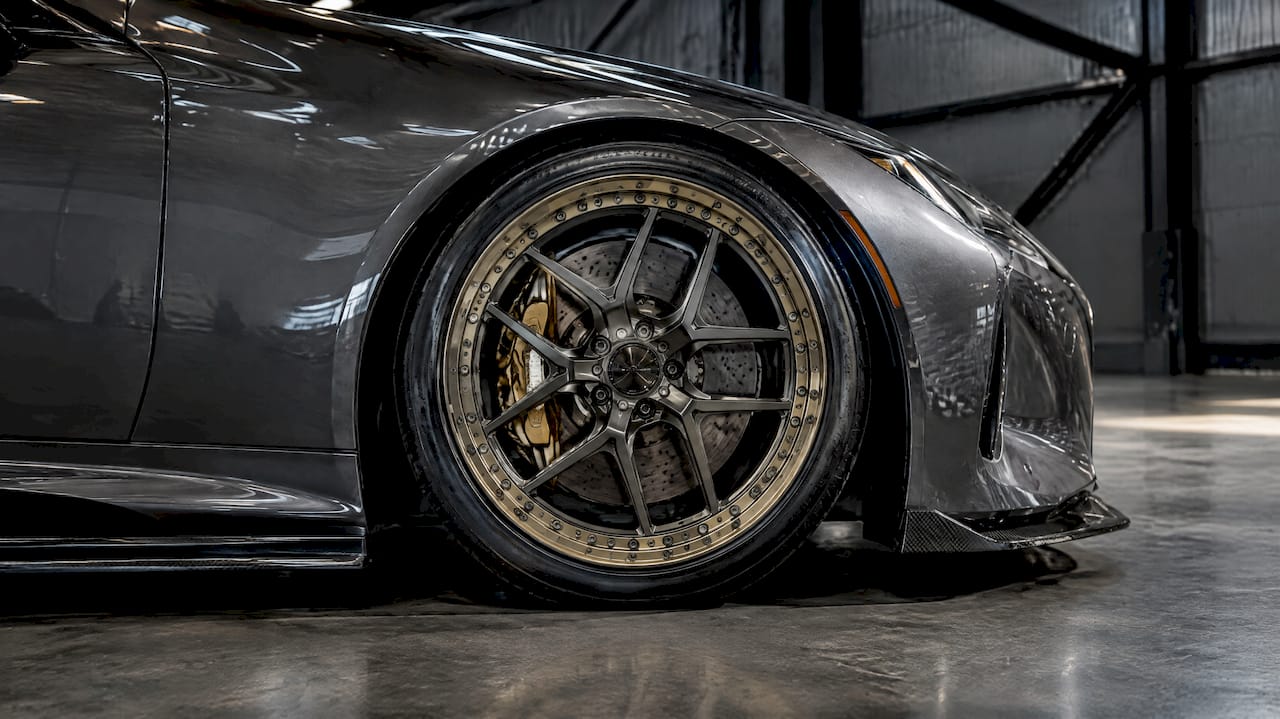
Beadlock hardware options include an anti-slip knurled bead seat, which adds mechanical grip between the tire bead and the ring surface beyond what clamping force alone provides. We also offer a carbon fiber centercap for builds where unsprung weight reduction and show-quality finish both matter, along with corrosion-resistant finish options for cars that see track days year-round.

How do you check backspacing and brake clearance before ordering?
Backspacing is the distance from the wheel’s mounting surface to the inner edge of the rim, and it is not the same measurement as offset even though the two move together. Most wheel shells carry a wide “bell” near the outer lip that tapers to a narrower inner diameter close to the mounting face, and that narrower section is what actually determines whether the wheel clears your brake package. Measuring only the outer lip diameter and assuming the whole barrel is that wide is the single most common fitment mistake on exotic platforms with large multi-piston front calipers.
Confirm clearance in this order:
- Measure the caliper’s outer diameter and depth at its widest point, including any mounting ears.
- Record rotor diameter and thickness.
- Measure hub face to knuckle or control arm, so you know how much the wheel can move inward before contacting suspension components.
- Check hub bore diameter against the wheel’s center bore.
- Decide your target track width change, then back-calculate the offset that achieves it without exceeding the inner barrel clearance you measured in step one.
Pro Tip: Measure the inner ID at its narrowest point, not the outer lip. If you reverse a wheel’s bell orientation to gain positive offset, pushing the tire assembly inward by more than about a quarter inch beyond the shell’s design clearance can create bead seating issues on certain barrel profiles.
On Mercedes-AMG platforms with the larger AMG-spec brake package, the caliper’s mounting ears often sit closer to the barrel than the rotor diameter alone suggests, so measure the full caliper envelope rather than estimating from rotor size. On the Lexus LC500, the factory Brembo caliper fits comfortably inside most 19 and 20 inch BF2X configurations, but backspacing and load rating both narrow as bolt pattern and wheel width increase, so wider 20 inch and 21 inch builds still warrant a clearance check against the factory caliper before finalizing offset. For either platform, reviewing beadlock ring spacers against your measured caliper envelope is worth doing before you lock in a final width.
Installation and torque schedule for beadlock assemblies
Bead ring bolts and wheel lug fasteners each have their own torque specification, and the two should never be treated as interchangeable. We recommend verifying torque values against the specific BF2X configuration documentation before final assembly, since bolt diameter and thread pitch vary across diameters.
- Inspect the bead ring for machining burrs or debris before seating the tire, since either can prevent even clamping force around the circumference.
- Verify bead seat orientation and confirm the tire bead sits flush against the knurled surface before you begin torquing bolts.
- Torque bead ring bolts in a star pattern, working in stages rather than fully tightening one bolt before moving to the next.
- Re-torque all bead ring and lug fasteners after the first 50 to 100 miles of driving, since initial seating can slightly relax clamping force.
- Inspect fasteners periodically for corrosion, especially on cars that see salted roads or frequent track wash downs.
For launch events where you intentionally run low or near-zero PSI, the beadlock ring is what keeps the tire seated against the wheel rather than spinning loose on the bead, but it does not substitute for correct torque. Skipping the re-torque interval after initial seating is the most common cause of bead ring bolt failure on otherwise correctly specified assemblies.
Pairing BF2X beadlocks with carbon aero and high-flow exhaust hardware
A beadlock ring does one specific job under launch load: it clamps the tire bead mechanically against the wheel so the tire cannot spin independently of the rim when torque multiplication tries to twist it loose at low tire pressure. That is the failure mode beadlocks exist to prevent, and it is most relevant exactly at the moment a high-horsepower car leaves the line.
Beadlocks solve traction consistency, but the rest of a straight-line build benefits from shedding mass everywhere else in the rotating and unsprung assembly. Pairing forged BF2X wheels with autoclave-cured 2×2 twill carbon fiber aero components reduces both rotational inertia and unsprung weight, which helps the suspension respond faster to the load transfer a hard launch creates.
- Forged 6061-T6 construction keeps wheel weight down relative to cast alternatives at the same load rating, supporting unsprung weight reduction across the corner.
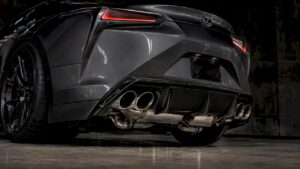
- Lightweight carbon fiber aero components, including the E6 Carbon Elite Kit for Lexus LC500, reduce overall curb weight without compromising structural mounting points.
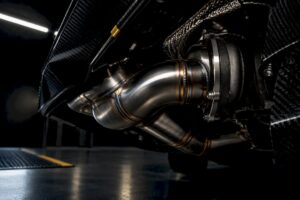
- High-flow downpipes from E6 Motorsports reduce exhaust backpressure, letting a high-horsepower engine make more of its rated power available at the exact RPM range a launch uses.
- On Mercedes-AMG twin-turbo platforms and the Lexus LC500’s naturally aspirated V8, the combination of reduced rotating mass and improved exhaust flow compounds rather than simply adding up.
McLaren and Lamborghini platforms benefit from the same approach, though wider factory fender clearances on those cars often permit the 20 and 21 inch BF2X widths without the fender modifications a tighter chassis would require. The tradeoff across all platforms is maintenance: beadlock assemblies need the re-torque discipline covered above, and running a wheel setup this specialized is generally a track and strip configuration rather than a daily-driver one in jurisdictions where low-pressure beadlock operation on public roads is restricted.
Ordering, bespoke options, and lead times
Ordering starts with a size and finish selection, though we recommend an engineering consultation for any build running serious horsepower through a launch, since bolt pattern, offset, and caliper clearance interact differently on every chassis. Bespoke options include finish color, the carbon fiber centercap, bell orientation (standard or reversed for additional positive offset), the anti-slip knurled bead seat, and custom backspacing outside the standard matrix.
- BF2X beadlock pricing starts from $1,500 per pair for 18 inch configurations, with larger diameters and wider widths priced above that baseline.
- Bespoke finish and bolt pattern combinations extend lead time beyond standard stocked configurations, so confirm timeline at the point of order for time-sensitive builds.
- Before shipping, we verify fitment against your submitted caliper and suspension measurements as part of the standard order flow.
- Full warranty and care requirements apply once the wheels are installed, and following the re-torque schedule is part of maintaining that coverage.
Engineering validation behind BF2X fitment
Fitment accuracy on a beadlock wheel matters more than on a standard wheel, because the bead ring geometry adds a second clamping interface that has to clear the same brake and suspension envelope as the barrel itself. We verify BF2X fitment against documented caliper and suspension geometry for each supported platform rather than relying on generic bolt pattern charts, an approach reflected in our Engineer Verified RF20 fitment documentation for luxury and exotic platforms.
Precision machining on the bead ring and barrel interface is what keeps the bead seated evenly around the full circumference under load, rather than clamping unevenly and creating a weak point where the bead can walk under torque.
Fitment-first engineering means every bolt pattern, offset, and barrel dimension gets verified against the actual brake and suspension envelope before a wheel ships, not after a customer discovers a clearance problem on install day.
Warranty and after-sales support
Every BF2X beadlock assembly is covered under our standard forged wheel warranty, with coverage terms and care requirements for beadlock-specific hardware detailed in our fitment and care guidelines. Following the documented re-torque schedule and inspection intervals is a condition of that coverage, since bead ring bolts loosening from a skipped re-torque is treated as a maintenance issue rather than a manufacturing defect.
After-sales support includes fitment verification before your order ships, so any discrepancy between your submitted measurements and the ordered configuration gets caught before the wheels reach your shop. If a clearance question comes up after installation, our engineering team is available to review your measurements against the documented fitment data for your platform. Professional in-house installation is also available for buyers who prefer to have the full assembly, torque sequence, and initial bead seating handled under our own process rather than through a third-party shop, which removes one common source of warranty disputes tied to incorrect initial torque.

When do you actually need a beadlock instead of a reinforced bead seat?
Beadlocks earn their complexity for drag launches, repeated low-pressure track events, and any build where torque multiplication regularly tries to spin the tire on the rim. Daily-driven cars and street-only performance builds rarely need the added weight, maintenance, and re-torque discipline beadlocks demand. For Mercedes-AMG launch builds, a beadlock is justified; for a street-driven Lexus LC500, a standard forged wheel with correct tire pressure usually covers the job.
— E6 Engineering
View the BF2X beadlock catalog and request a fitment check
We build every BF2X beadlock to the offset, width, and bead ring configuration your specific launch build requires, backed by fitment verification before the wheels ever leave our shop. Pair that with professional in-house installation and our documented warranty care requirements, and the sizing decisions covered above turn into a wheel that actually clears your brakes on day one.
Browse the full E6 Forged Beadlock wheels collection and request an engineering fitment check for your platform before you order.
FAQ
Is 29 pounds heavy for a wheel?
Weight depends heavily on diameter, width, and construction method, so there is no single universal benchmark for what counts as heavy. A forged 6061-T6 wheel typically weighs less than a cast wheel of the same size and load rating, which is part of why forged construction is preferred for unsprung weight reduction on performance builds.
Are beadlock wheels heavier?
Beadlock wheels generally weigh more than an equivalent non-beadlock wheel of the same diameter and width, since the bead ring and its bolt hardware add mass the standard wheel design does not carry. Forged construction and a carbon fiber centercap option can offset part of that added weight on platforms where every pound of unsprung mass matters.
What is the recommended torque for beadlock bolts?
Torque specifications vary by bolt diameter and thread pitch across different beadlock configurations, so the correct value should always be verified against the specific product’s own torque documentation rather than a generic figure. A star-pattern tightening sequence in stages, followed by a re-torque after the first 50 to 100 miles, is the standard approach across beadlock assemblies.
Are Method 305 real beadlocks?
That question concerns a specific third-party wheel model and its bead ring design, which falls outside what we can verify here. As a general rule, a true functional beadlock clamps the tire bead mechanically with a bolted ring, which is distinct from a wheel that simply uses beadlock-style aesthetics without functional clamping hardware.
Can BF2X beadlocks fit Mercedes-AMG and Lexus LC500 platforms?
Yes, BF2X beadlocks are available in diameters and widths that fit common Mercedes-AMG and Lexus LC500 brake and suspension packages, though inner barrel clearance against the factory caliper should be verified for wider 20 and 21 inch configurations. We verify this fitment data against documented caliper and suspension geometry before any bespoke order ships.
Sources
- Beadlock Wheels FAQ
- Wheel offset, backspacing, bolt pattern and beadlock basics
- What are beadlock ring spacers and do I need them
Recommended
- Engineer Verified E6 RF20 Fitment for Luxury & Exotics, $3,500–$7,000
- How to Spec High-End Wheels for Performance Cars
- Track Focused Wheels for the AMG GT: Engineering Guide
- When Does Your Car Need E6 Forged Beadlock Wheels?
Pricing, custom fitment options, and surface finishes subject to availability. Please contact E6 Carbon or E6 Forged directly to confirm vehicle-specific offset parameters, brake clearances, and current lead times prior to placing your order.