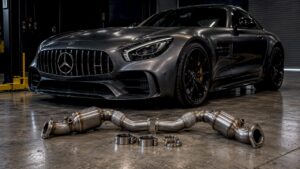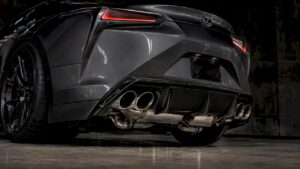
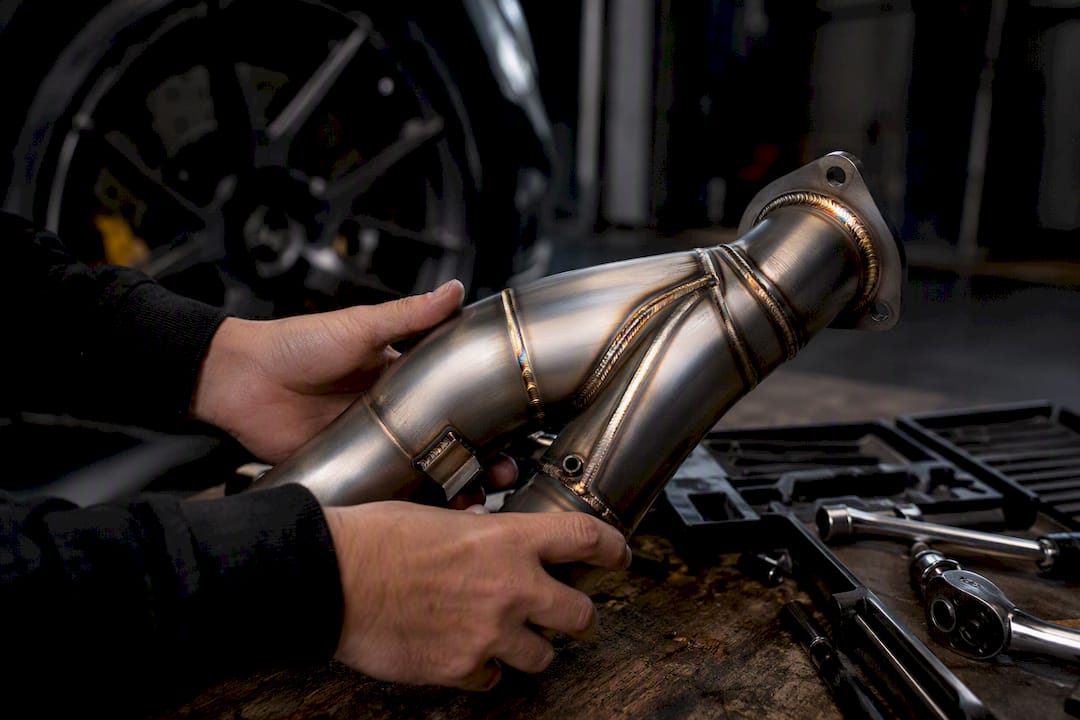
E6 Motorsports downpipes for the Mercedes-AMG GT (C190/R190) cut exhaust backpressure at the turbo outlets, which speeds spool and sharpens throttle response on the M178 biturbo V8. Built from mandrel-bent 304 stainless with TIG-welded, CNC-machined flanges, they bolt into factory or E6 valved exhaust setups. Realizing the gains requires a Stage 2 ECU tune, and installation belongs with an experienced technician, since improper fitment falls outside E6’s liability.
TL;DR:
- E6 Motorsports downpipes replace the factory turbo-to-midpipe section with mandrel-bent tubing, reducing exhaust backpressure and enabling quicker spool and sharper throttle response.
- Gains in horsepower and torque are highly dependent on the base model, tune level, and whether the pipe is catted or catless, with significant improvements seen when paired with a Stage 2 ECU tune.
- Installation requires about 2 to 3 hours per side, must be performed by an experienced technician, and includes a baseline dyno test before and after tuning to verify actual gains.
- The downpipes are designed to fit the full AMG GT lineup, including GTS, GTC, GTR, and GTR Pro, with specific considerations for OPF-equipped vehicles and prior modifications.
- Proper ECU tuning is essential after installing a catless or high-flow catted pipe to prevent running lean and to fully realize power, throttle response, and thermal benefits.
Table of Contents
- What Are E6 Motorsports Performance Downpipes for the Mercedes-AMG GT Platform?
- How Much Horsepower Does a Downpipe Add on the M178?
- Which AMG GT Variants Fit E6 Motorsports Downpipes?
- What Does Installation and ECU Tuning Involve?
- Why Mandrel Bending and TIG Welding Matter for Durability
- What’s Covered Under Warranty, and What Voids It?
- How E6 Engineering Approaches Downpipe Design
- Where to Buy E6 Motorsports Downpipes for Your AMG GT
- Sources
- FAQ
What Are E6 Motorsports Performance Downpipes for the Mercedes-AMG GT Platform?
An E6 Motorsports downpipe replaces the factory turbo-to-midpipe section on the M178 4.0L biturbo V8 with a smoother, larger-diameter path that lets exhaust gas exit the turbine housings with less resistance. That single change is the foundation of most bolt-on power gains on this platform, because the M178’s twin-scroll turbos are backpressure-sensitive by design.
The core build uses mandrel-bent tubing, which keeps the internal diameter constant through every bend instead of the pinched, oval cross-section you get from cheaper crush-bending. Sector norms on this platform run a larger upper section near the turbo outlets that steps down to a tighter diameter lower in the pipe to clear the chassis tunnel, a compromise common among M178 downpipe builders.
Configuration options include:
- Catless race pipes for maximum flow, intended for closed-course or off-road use
- High-flow catted pipes using 200-cell substrate cores that retain meaningful emissions control while flowing far better than the factory OPF-equipped units
- Heat-shield variants with wrapped or ceramic-coated sections to protect adjacent wiring, sensors, and turbo housings
- Finish options including brushed and black ceramic-coated stainless
Every kit ships with the necessary gaskets, hardware, and OEM-style mounting points, so the pipe seats against the factory turbo flange and midpipe interface without cutting or re-fabricating brackets. The design also integrates with the E6 Motorsports valved exhaust line, letting an owner combine a catless or catted downpipe with a valved catback for one coherent, drivable system rather than mismatched aftermarket parts fighting each other’s flow characteristics.
How Much Horsepower Does a Downpipe Add on the M178?
The physics is simple: less backpressure at the turbine outlet means the turbo spins up faster on light throttle and holds boost more efficiently at higher RPM. Factory downpipes, built around a dense OPF (particulate filter) substrate, choke exhaust velocity right where the M178 needs it least, during the transition from idle to full boost. Open that path and the turbos spool measurably quicker, which shows up as a snappier pedal response before the dyno numbers even come into play.
Gains vary widely by base model, tune level, and whether the pipe is catted or catless. Vendors across the M178 aftermarket report meaningful horsepower increases when downpipes are paired with a matching ECU calibration, though the spread between a mild catted setup and a full catless race pipe on a Stage 3 tune is significant.
Realistic expectations with a Stage 2 tune:
- Sharper low-to-mid RPM throttle response from faster spool, felt before any dyno pull confirms it
- A tangible bump in peak horsepower and torque, with the exact figure depending on the base GT, GTS, GTC, or GTR platform and the tuner’s calibration
- Lower measured exhaust gas temperatures under sustained boost, since less trapped heat means less thermal stress on the turbo housings
- A noticeably deeper exhaust note with more pronounced burble and pop on decel, especially with a catless pipe and a tune that allows overrun fueling
Pro Tip: Don’t chase the biggest number on a forum thread. Book a baseline dyno pull before the install, then a second pull after tuning. That’s the only way to know what your specific car actually gained, and it protects you if a warranty question ever comes up.
Secondary benefits matter as much as the peak numbers. Reduced backpressure means the turbos work less hard to push spent gas out, which translates to lower sustained EGTs and less thermal fatigue on the turbine wheels over years of track use. That’s a durability argument as much as a power one.
Which AMG GT Variants Fit E6 Motorsports Downpipes?
E6 Motorsports downpipes are engineered for the full C190/R190 family running the M178 4.0L biturbo V8: the AMG GT, GTS, GTC, GTR, and GTR Pro. Because these variants share the same core turbo and midpipe architecture, the downpipe geometry carries across the lineup, though flange orientation and heat-shield clearance can shift slightly between the coupe and roadster (GTC) chassis.
A few fitment details are worth checking before you order:
- Pre- and post-catalyst O2 sensor bungs are pre-located to match factory wiring harness length, so no splicing is needed on either catted or catless configurations
- OPF-equipped cars need a catted pipe or a tune that accounts for the missing filter to avoid emissions-monitor fault codes
- The factory midpipe interface is retained on E6 kits, so no custom fabrication is needed at the rear of the pipe
- Cars with prior aftermarket turbo work, a different midpipe, or a non-factory exhaust may need a fitment review, since modified turbo outlets don’t always match stock flange spacing
If your GT has any history of exhaust or turbo modification, confirm VIN-specific compatibility with E6 before ordering. It’s a five-minute conversation that avoids a return shipment.
What Does Installation and ECU Tuning Involve?
A downpipe swap on the M178 is a moderate-complexity job, not a driveway task for most owners. Shop time typically runs 2 to 3 hours per side pair, and the car needs to be on a lift with enough clearance to access the turbo flanges and heat shielding without disturbing the factory undertray more than necessary.
- Remove and inspect. The technician removes the factory downpipes, checks turbo outlet gaskets, and inspects for oil seepage or cracked factory hardware before the new pipes go in.
- Install and torque. E6’s CNC-machined flanges seat against the OEM-style mounting points, and every fastener gets torqued to spec, since an under-torqued flange is the most common source of post-install exhaust leaks and ticking noises.
- Reconnect sensors. O2 sensor bungs line up with factory wiring, and the technician confirms every connector clicks home before the car comes off the lift.
- Baseline dyno pull. Before any tune changes, a baseline run documents where the car sits with the new hardware and stock software.
- Stage 2 calibration. A tuner adjusts fueling and boost targets to match the new flow characteristics. This step isn’t optional on catless or high-flow catted setups. Without it, the ECU sees more airflow than its stock tables expect, and running lean under load is a real risk on the M178’s dry-sump architecture if the fuel map isn’t corrected.
- Incremental mapping and EGT monitoring. Reputable tuners move up in small steps, watching EGTs and knock data rather than pushing straight to a maximum map on the first pull.
- Post-dyno validation. A final run confirms the car holds targeted boost and AFR cleanly across the RPM band, and this run is what you want on file for warranty and resale purposes.
If your build target pushes toward the upper end of what the factory clutch packs and driveshaft can handle, loop in a TCU tune and a driveline inspection at the same time rather than treating the exhaust as an isolated upgrade. A remote or in-person session with a shop offering ECU remapping services covers the calibration side once the hardware is installed.
Why Mandrel Bending and TIG Welding Matter for Durability
The manufacturing choices behind a downpipe determine whether it lasts one season or ten. Mandrel bending supports the tube from the inside during the bend, which keeps the cross-section round and the internal diameter consistent. Crush-bent alternatives pinch down at every bend, creating turbulence exactly where smooth flow matters most.
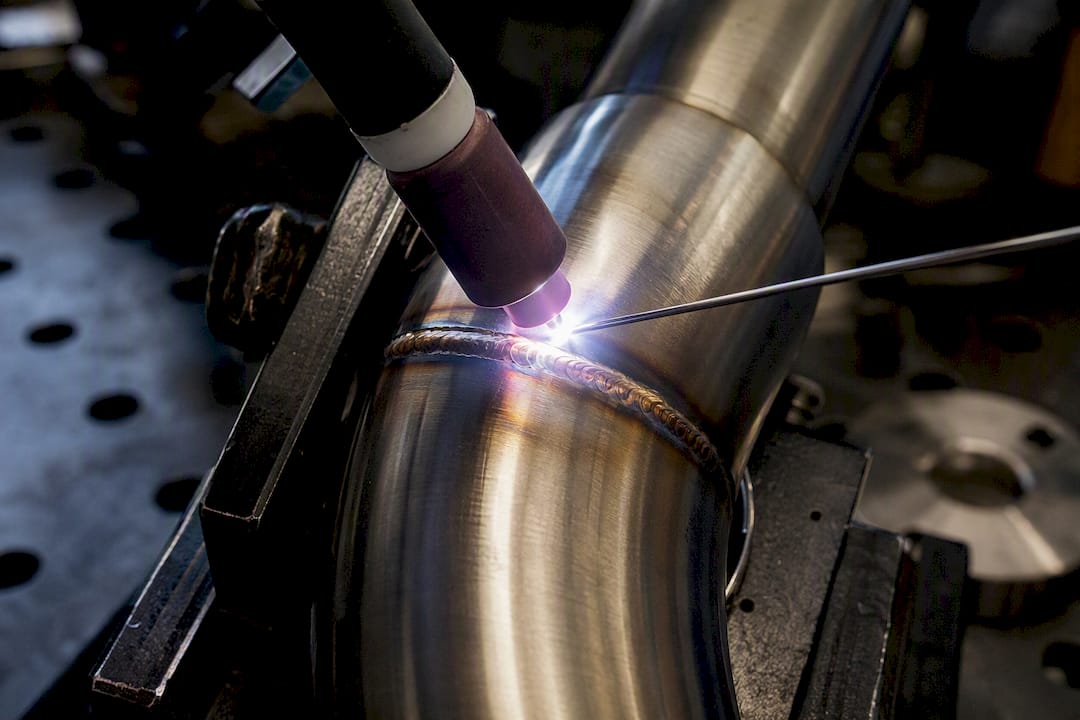
- TIG welding with back-purge shielding produces cleaner, fully-penetrated joints that resist cracking under the M178’s high-temperature cycling
- CNC-machined flanges hold tighter tolerances than stamped units, which means a repeatable, leak-free seal against the turbo outlet every time
- 304 low-carbon stainless resists corrosion better than mild steel while staying weldable without the brittleness issues of higher-carbon grades
- Heat-shield wrapping on select sections protects nearby wiring harnesses and turbo oil lines from radiant heat buildup
Pro Tip: Ask any shop quoting a downpipe whether the flanges are cast or CNC-machined. Cast flanges warp slightly under repeated heat cycles, and that’s usually where a “mystery leak” three track days later actually starts.
Heat management is one of the more underrated factors in downpipe longevity, since a pipe that flows well but cooks the wiring harness above it creates a different problem six months down the road.
What’s Covered Under Warranty, and What Voids It?
E6 backs its downpipes against manufacturing defects in materials and welds. Improper installation, torque errors, or damage from a subsequent aftermarket modification typically fall outside that coverage, which is why documentation matters.
- Keep the install invoice and torque specs on file in case a warranty question comes up later
- Save the baseline and post-tune dyno sheets. They prove the car was calibrated correctly after the install
- Catless configurations are generally intended for closed-course or off-road use. Check your local and state emissions requirements before choosing a catless pipe for a car you drive on public roads. Some vendors mark catless downpipes explicitly for off-road use for exactly this reason
- Professional installation by an experienced technician is required. E6 holds zero liability for improper fitment or installation errors
How E6 Engineering Approaches Downpipe Design
Fitment First isn’t a slogan we apply loosely. On a platform like the AMG GT, a downpipe that’s a few millimeters off at the flange, or that doesn’t account for the GTC’s slightly different heat shield clearance, turns into a leak, a check-engine light, or a rattle against the tunnel at speed. We engineer to OEM mounting geometry first, then optimize flow within that boundary, not the other way around.
That sequencing matters because a downpipe rarely lives in isolation. Ours is built to work with the E6 valved exhaust system, so an owner building toward a full turbo-back setup isn’t stacking parts that were never tested together. If you’re weighing a catless race pipe against a catted street option, or wondering how a downpipe interacts with a planned ECU and TCU tune, reach out to E6 Engineering directly. Fitment questions on a car with any exhaust history deserve a real answer, not a guess.
— E6 Engineering
Where to Buy E6 Motorsports Downpipes for Your AMG GT
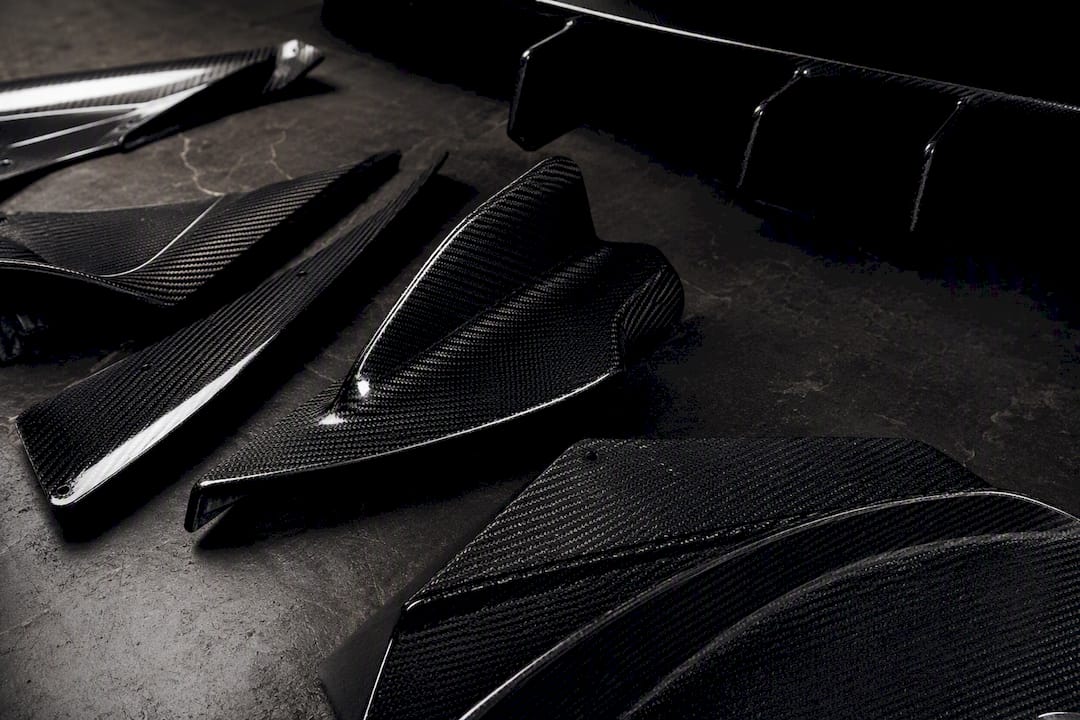
Ordering starts on the E6 Carbon catalog, where you confirm your exact GT, GTS, GTC, GTR, or GTR Pro variant and choose between catless, catted, and heat-shield finish options before checkout. If your build already includes carbon aero components, the E6 Carbon Elite Kit for the Lexus LC500 shows the same autoclave-cured 2×2 twill engineering standard E6 applies across every platform it supports, from Mercedes-AMG to Lexus.
Most owners pair the downpipe order with a Stage 2 ECU and TCU tune and, if daily drivability matters, a valved exhaust for quiet cold starts and an aggressive mode at the push of a button. For fitment confirmation on a VIN with prior exhaust or turbo work, or for a custom heat-shield configuration, contact E6 Engineering directly rather than guessing at compatibility. Installation partners can coordinate lift time and dyno tuning in the same visit, which keeps the car off the road for one appointment instead of three. Start at the E6 Carbon homepage to browse the full AMG GT catalog and request an engineering consultation.
FAQ
How Much Horsepower Will a Downpipe Add?
It depends heavily on the base GT model, whether the pipe is catted or catless, and the tune level applied, but vendors across the M178 aftermarket report meaningful gains when a downpipe is paired with a matching Stage 2 calibration rather than run on stock software.
What Is the Best Exhaust Upgrade for an AMG GT?
A high-flow downpipe built from mandrel-bent 304 stainless with TIG-welded, CNC-machined flanges, paired with a matching ECU tune, delivers the most measurable gain in spool and throttle response, and integrating it with a valved catback exhaust adds daily drivability without sacrificing the upgrade.
Which Is Faster, the BMW M8 or the AMG GT63?
Straight-line performance between these two depends on trim, options, and driver skill, and neither vehicle is covered by the fitment data in this guide. This article focuses specifically on downpipe engineering for the Mercedes-AMG GT (C190/R190) platform.
Which AMG GT Is the Fastest?
Among the C190/R190 lineup, the GTR Pro sits at the top of the factory hierarchy, with the GTR just behind it, though the horsepower gap narrows considerably once GT and GTS models are fitted with high-flow downpipes and a Stage 2 tune.
Do I Need a Tune After Installing a Catless Downpipe?
Yes. Running a catless or high-flow catted downpipe without a corresponding ECU calibration risks lean air-fuel conditions under load on the M178’s dry-sump architecture, since the stock fuel and boost tables aren’t built for the increased flow.