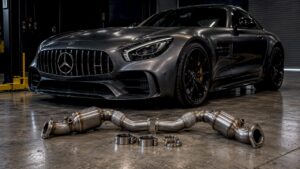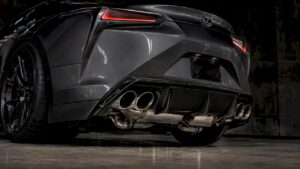

E6 Carbon dry carbon splitters, vented hoods, and diffusers, when matched to E6 Motorsports downpipes and validated by temperature logging, improve aerodynamic balance and provide targeted heat extraction on the C192 AMG GT63. That improvement only holds when the parts preserve the factory cooling flow paths rather than fighting them. No responsible shop should quote you a downforce or temperature-drop number without clearance checks, heat shielding, and logged data behind it. Treat that verification step as part of the install, not an afterthought.
TL;DR:
- Proper sealing and alignment of splitters, hoods, and diffusers are essential to optimize both aerodynamics and thermal management.
- High-flow downpipes significantly increase exhaust heat near aero components, requiring additional heat shielding and clearance review.
- Prepreg carbon fiber parts outperform plastic trim by tolerating higher temperatures, but only if their resin systems support those limits.
- Temperature logging at key points like the turbo outlet and brake ducts is crucial before and after installation to verify cooling and handling improvement.
- A matched, system-level approach based on tailored fitment and validation ensures that aero parts enhance performance without disrupting factory cooling architecture.
Table of Contents
- What Does E6 Carbon Aero Change on the C192 GT63?
- How Does Carbon Aero Affect the GT63’s Cooling System?
- How Do Splitters, Hoods, and Diffusers Work on the GT63?
- What Happens When You Add High-Flow Downpipes?
- Does Prepreg Carbon Hold Up Better Than Plastic Trim?
- What’s the Validation Process for Aero and Cooling Changes?
- Why Fitment-First Engineering Matters More Than a Spec Sheet
- Building a Balanced Aero and Cooling Package With E6 Carbon
- Sources
- FAQ
What Does E6 Carbon Aero Change on the C192 GT63?
Downforce isn’t a front-splitter problem or a rear-diffuser problem. It’s a balance problem. Push more front-axle load into a C192 without a matching increase at the rear, and you get a car that turns in sharper than it exits, especially loaded mid-corner at speed. The GT63’s factory PRO package understands this: Mercedes-AMG built the front carbon-fiber air deflectors, an active underbody, AIRPANEL shutters, and a fixed rear wing as one coordinated system, not four separate add-ons.
Aftermarket carbon aero has to respect that architecture. E6 Carbon’s approach to the GT63 platform starts with what we call Fitment First engineering, meaning:
- Splitter geometry is matched to rear wing angle and diffuser exit before either component ships.
- Mounting hardware controls ride-height rake within factory tolerance, since even a few millimeters of unplanned rake shifts the whole aero balance.
- Underbody sealing at the splitter-to-undertray junction is treated as a functional surface, not a cosmetic gap.
A splitter that dumps front-axle load without a rear counterpart doesn’t add grip. It adds a handling problem you’ll find at 120 mph on a front straight, not in a parking lot.
How Does Carbon Aero Affect the GT63’s Cooling System?
The GT63 PRO variant runs reinforced high and low-temperature cooling circuits, extra intake paths, and wheel-arch mounted radiators specifically to sustain thermal load under repeated hard driving, not just to survive a single quarter mile. Any aftermarket aero component that alters airflow around the nose, hood, or underbody is operating inside that thermal architecture whether it’s designed to or not.
Done right, carbon aero helps this system. A vented hood or a properly profiled diffuser can pull trapped heat out of the engine bay and brake area if it maintains the pressure gradients the factory ducting depends on. Three things determine whether a part helps or hurts:
- Inlet obstruction. A splitter lip or canard that blocks a factory air inlet starves a radiator circuit that was sized to need every bit of that flow.
- Brake duct disruption. Front splitter geometry that redirects air away from brake ducting drops pad and rotor temperature margin exactly when you need it most, mid-session.
- Discharge placement. A hood vent or diffuser exit that dumps hot air onto a wiring harness, a coolant line, or a composite bracket creates a localized hotspot even while the dash gauges read normal.
That last point matters more than most owners assume. Bulk coolant temperature can look perfectly fine while a bracket six inches from a turbo outlet is quietly cooking. Sensor placement during validation has to account for that, not just watch the main coolant readout.
How Do Splitters, Hoods, and Diffusers Work on the GT63?
Each component does a distinct aerodynamic job, and conflating them is where a lot of aftermarket kits go wrong.
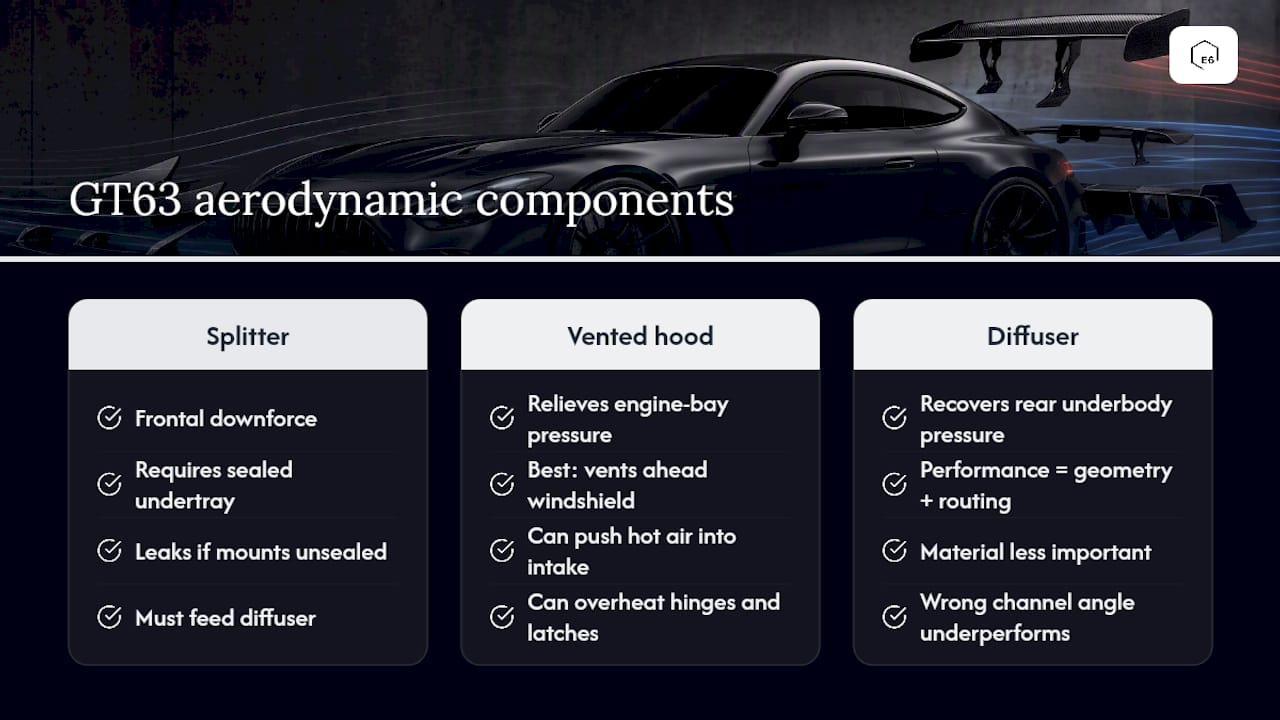
Front splitters create frontal downforce by generating a high-pressure zone above the splitter lip and a lower-pressure zone beneath it, but that only works cleanly if the undertray behind it seals properly and feeds air toward the diffuser rather than letting it escape sideways. A splitter that’s structurally strong but poorly sealed at the mounting points leaks the pressure differential it was designed to create.
Vented hoods exist to relieve engine bay pressure buildup, and discharge location decides whether that relief helps or hurts. Vents placed ahead of the windshield in a low-pressure zone at speed evacuate heat efficiently. Vents placed carelessly can push hot air back into the cabin’s fresh-air intake or, worse, onto hinge and latch hardware that wasn’t designed for sustained heat cycling.
Diffusers recover pressure at the rear of the underbody and accelerate air out from beneath the car. Diffuser effectiveness comes down to geometry and integration with exhaust routing, not the material it’s molded from; a carbon diffuser with the wrong channel angle underperforms a well-designed one in aluminum.
Pro Tip: Before ordering a hood or splitter, ask for the discharge and inlet drawings, not just a render. Hinge and latch alignment gets overlooked constantly, and a vent that doesn’t drain water properly will corrode fasteners long before it causes a heat problem.
What Happens When You Add High-Flow Downpipes?
Pairing carbon aero with E6 Motorsports downpipes changes the thermal equation again. High-flow downpipes raise local exhaust gas velocity and temperature near the turbo outlet and flange. They are exhaust hardware, not a cooling upgrade, and treating them as one is a mistake that shows up as heat-damaged composite brackets six months later.
Running carbon aero and high-flow downpipes together on the same GT63 calls for a few specific mitigations:
- Rigid heat shielding at any point where a downpipe or manifold sits within a few inches of a carbon splitter mount, undertray panel, or diffuser strake.
- Thermal barrier layers or standoff spacers at composite-to-metal fastener points, since bare metal fasteners conduct heat directly into resin.
- A routing review confirming the downpipe’s new path doesn’t close clearance gaps that were fine with the factory exhaust.
E6 Motorsports downpipes for the GT platform use mandrel-bent 304 stainless with TIG-welded flanges, which holds up well structurally, but that doesn’t eliminate the need for a calibration check. An AFR and ECU review after installation, followed by staged dyno or track validation, catches issues before they become a heat-soak problem at lap eight.
Does Prepreg Carbon Hold Up Better Than Plastic Trim?
Standard injection-molded plastic trim starts softening and warping well below the temperatures a GT63 engine bay or wheel well reaches under sustained track load. Autoclave-cured prepreg carbon fiber handles that environment differently, but the reason isn’t the carbon itself.
The limiting factor in a composite part is almost never the carbon fiber. It’s the resin matrix, the adhesive bond lines, and the clear coat. Fiber reinforcement tolerates far higher temperatures than the polymer system holding it together, which means two carbon parts that look identical can have very different real-world heat limits depending on the resin used.
Prepreg systems with a glass transition temperature (Tg) above 150°C exist in the industry, but that figure only applies when the specific resin, cure cycle, and laminate schedule support it. Before installing carbon near a downpipe, manifold, or turbo, ask for three things: the resin Tg on the datasheet, confirmation that the bake cycle used for paint or clear coat is compatible with that resin, and whether metallic inserts or heat-blocking layers are specified anywhere the part sits close to an exhaust component.
What’s the Validation Process for Aero and Cooling Changes?
A responsible install follows a sequence, and skipping steps is how owners end up with a warped hood or a scorched bracket at 4,000 feet of elevation on a hot track day.
- Confirm the exact spec. Model year, trim, whether the car has active AIRPANEL control, and undertray geometry all affect fitment before a single part is ordered.
- Dry-fit at ride height. Measure clearances around the splitter, diffuser, and any downpipe routing changes, and confirm mounting loads and seal continuity match the design intent.
- Instrument before you drive it hard. Thermocouples at the turbo outlet, manifold, radiator inlet, brake caliper area, and diffuser exit give you real data instead of a guess.
- Test in stages. Street driving first, then a measured track session with pre- and post-run temperature logs and a handling assessment, then iterate on hardware or ECU calibration based on what the sensors actually show.
Pro Tip: Log ambient temperature alongside your thermocouple data. A 15-degree difference in outside air temperature between two track days can make an identical setup look like it’s overheating when it isn’t, or hide a real problem on a cooler day.
Independent CFD, wind tunnel, or dyno validation becomes necessary the moment anyone wants to publish a specific downforce figure or a cooling delta rather than describe the engineering intent behind a part.
Why Fitment-First Engineering Matters More Than a Spec Sheet
Every claim in this piece has a caveat attached, and that’s deliberate. We’d rather tell a GT63 owner what a part is engineered to do, and what needs to be measured before anyone believes a number, than hand out a downforce figure that sounds good on a product page and falls apart at the track.
E6 Carbon documents fitment blueprints for the C192 platform and offers direct engineering consultation for owners building a matched aero and cooling package. If you already have proprietary track logs from a build, that data belongs in the conversation before you order the next part, not after.
— E6 Engineering
Building a Balanced Aero and Cooling Package With E6 Carbon
Most aftermarket aero kits are sold as isolated parts. A splitter here, a hood there, whatever looks aggressive in a photo. E6 Carbon builds the GT63 package as a system instead, autoclave-cured 2×2 twill components engineered around the factory cooling architecture and matched to E6 Motorsports downpipes, so the parts work together rather than fighting each other under load.
If you’re planning a build, the next step is a fitment consultation, not a checkout cart. Tell us your trim, your active-aero status, and what you’re actually doing with the car (street, track days, or both), and we’ll spec a matched front-to-rear package instead of a single part that unbalances the rest of the car. For owners cross-shopping platforms, our Elite Kit for the Lexus LC500 follows the same fitment-first logic. Start a build conversation through E6carbon and get a spec sheet built around your car, not a generic one.
Sources
- Mercedes-AMG official site
- Mercedes-AMG media materials / MBUSA
- Society of Plastics Engineers automotive resources
FAQ
Does a carbon splitter actually add downforce on a GT63?
A properly sealed splitter creates a front-axle pressure differential that adds load, but the gain depends entirely on undertray sealing and matching it to the rear wing and diffuser. Without independent tunnel or track validation, treat any specific downforce figure with skepticism.
Can carbon aero parts help cool the engine bay?
Vented hoods and diffusers can extract trapped heat if they preserve the factory cooling circuits and inlet paths that Mercedes-AMG built into the GT63 PRO package. A part that blocks an intake or disrupts brake duct airflow can make thermal conditions worse instead of better.
Is prepreg carbon fiber more heat-resistant than plastic trim?
Prepreg carbon generally tolerates far more heat than injection-molded plastic trim, but the real limit comes from the resin system, not the fiber. Ask for the resin’s glass transition temperature before assuming a part is track-ready.
Do E6 Motorsports downpipes require special aero considerations?
Yes. High-flow downpipes raise local exhaust temperatures and change pressure behavior near the turbo, so any carbon part mounted nearby needs heat shielding and a clearance review. E6 Motorsports downpipes are engineered with this integration in mind, but installation still calls for a fitment check.
How much does an E6 Carbon aero package for the GT63 cost?
Pricing depends on which components and finish level you select for your specific build. Current pricing is listed on the E6 Carbon site, and a consultation will confirm the exact configuration and cost for your GT63.
Recommended
- Brake Upgrade | AMG GT (C190/R190)
- AMG GTS to GTR Front Bumper Conversion Aero Blueprint
- AMG GTS to AMG GTR Bumper Conversion Guide
Pricing, custom fitment options, and surface finishes subject to availability. Please contact E6 Carbon or E6 Forged directly to confirm vehicle-specific offset parameters, brake clearances, and current lead times prior to placing your order.