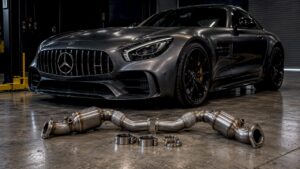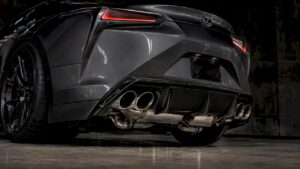
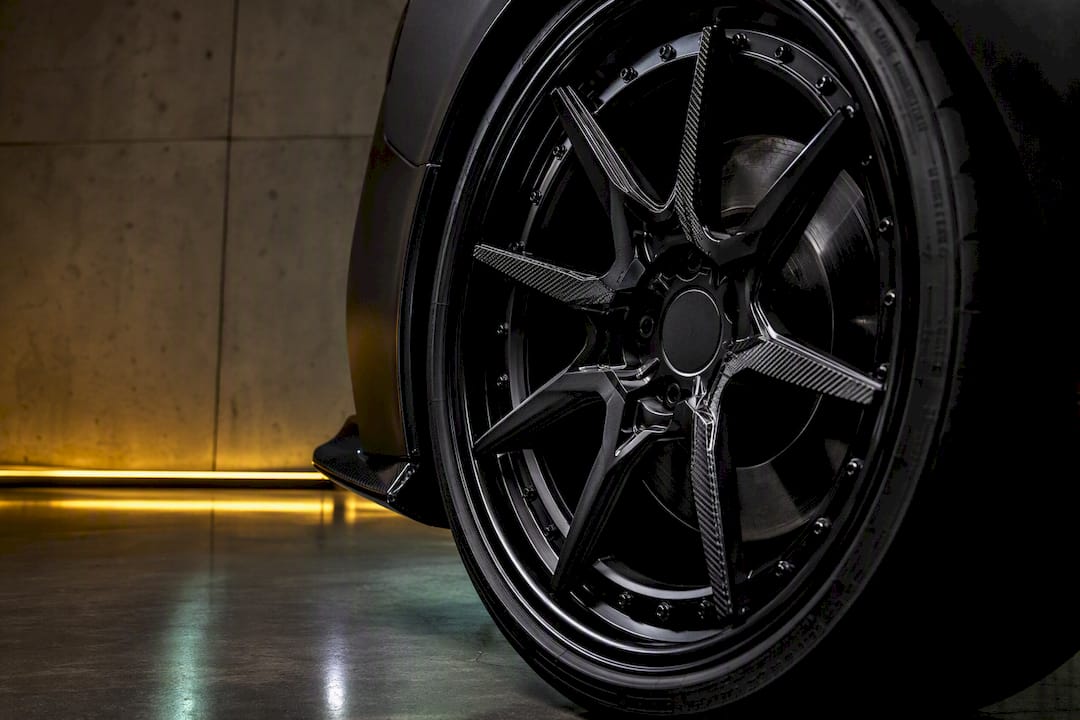
The modular design flexibility of E6 Forged two-piece wheels comes down to one engineering decision: separating the center from the barrel. That split lets you dial in fitment for a Mercedes-AMG or Lexus LC500 without touching the wheel’s structural core, and it lets you pair a brushed liquid bronze face with a polished outer barrel instead of settling for a single factory finish. Forged 6061-T6 centers and aerospace titanium hardware keep that flexibility from costing you strength.
TL;DR:
- Precision fitment depends on full dynamic clearance checks of brakes, suspension, and fender geometry, not just static measurements at ride height.
- Bolted two-piece wheels offer modularity by allowing easy barrel swaps and finish customization, but require maintenance of hardware, sealants, and torque rechecks over time.
- Forged 6061-T6 centers ensure dimensional accuracy and fatigue resistance, while aerospace titanium hardware reduces rotational mass for better steering response.
- Wider rear barrels enable staggered setups with common center designs, but depend on brake clearance, tire profile, and steering geometry to prevent interference.
- Proper fitment and engineering validation are essential before selecting finishes or widths, as clearance constraints limit options regardless of modular design.
Table of Contents
- How Do Clearance Zones Affect Two-Piece Wheel Fitment?
- Welded Vs. Bolted Two-Piece Wheels: Which Is Better?
- Can You Get a Wider Stance Without New Wheel Centers?
- Why Does 6061-T6 Forging Matter for Fitment Precision?
- What Maintenance Do Two-Piece Modular Wheels Need?
- What Finish Combinations Are Possible With Modular Wheels?
- How Does E6 Engineering Build and Validate Its Two-Piece Wheels?
- Key Takeaways for Choosing a Two-Piece Modular Wheel
- The Fitment-First Take on Modular Wheel Design
- Ready to Build a Bespoke Two-Piece Wheel Set?
- Sources
- FAQ
How Do Clearance Zones Affect Two-Piece Wheel Fitment?
Every custom wheel build lives or dies at four physical boundaries: the caliper, the suspension, the fender, and the hub face. Get any one of them wrong and a beautifully finished modular wheel turns into an expensive paperweight.
Brake caliper clearance is the first checkpoint, and it’s not a static measurement. A caliper that clears comfortably at rest can kiss the inner barrel the moment you turn the wheel to full lock, especially on a Mercedes-AMG with big front calipers or a McLaren with carbon-ceramic packages. E6 Engineering checks dynamic clearance through the full steering sweep, not just a single static gap, because that’s where fitment failures actually happen.
Suspension compression is the second variable, and it moves. A wheel that clears at ride height can contact a control arm or strut housing under compression, which is why bump travel gets measured before a barrel width gets finalized. Fender roll and inner-arch geometry come next: an unrolled lip or aggressive arch lip can interfere with the outer barrel even when the caliper and suspension numbers check out.
Hub-centric fit and bolt pattern matching round out the picture. A wheel that’s centered on the lug bolts instead of the hub bore can introduce vibration that no amount of finish work will fix.
What this means practically for modular builds:
- Caliper sweep gets checked at full lock in both directions, not just straight ahead.
- Suspension travel is measured under compression, not just static ride height.
- Fender roll and inner lip geometry are inspected before barrel width is finalized.
- Hub bore and PCD (pitch circle diameter) must match the platform exactly, with no adapter shortcuts.
- These constraints narrow the safe range of barrel widths well before finish or style enters the conversation.
Modularity gives you options at the barrel level, but it doesn’t override physics. The centers and barrels still have to respect the same clearance envelope a one-piece wheel would.
Welded Vs. Bolted Two-Piece Wheels: Which Is Better?
Two-piece wheels join their center and barrel one of two ways, and the method you choose shapes what the wheel can and can’t do later.
Welded two-piece wheels fuse the center to the barrel into a single structure, which gets you stiffness that approaches a true monoblock forged wheel. The trade-off is permanence. Once welded, you can’t swap barrels for a different width or finish. It’s a one-and-done decision.
Bolted assemblies keep the center and barrel as separate, serviceable components, joined through a ring of hardware around the wheel’s circumference. This is where real modularity lives, because it means:
- Barrels can be swapped for a different width or offset without replacing the entire wheel.
- Finishes can be mixed and matched, since the center and barrel are fabricated and finished independently.
- Individual components can be repaired or replaced if one section suffers curb damage, rather than scrapping the whole assembly.
Every joint interface, though, is a spot that needs attention over the wheel’s service life. Kipardo Racing’s comparison of two-piece and monoblock construction notes that bolted assemblies trade some rigidity for that flexibility, and require proper sealing and periodic hardware checks to stay reliable. Bolt fatigue, gasket sealing, and scheduled re-torque intervals aren’t optional maintenance items on a bolted two-piece wheel; they’re part of the design contract.
Pro Tip: Ask any two-piece wheel manufacturer what re-torque interval they recommend after initial installation. If they don’t have a clear answer, that’s a signal their bolted-joint engineering hasn’t been fully validated under real-world loads.
E6 Engineering leans toward bolted two-piece architecture for AMG, Lexus LC500, and McLaren builds specifically because these platforms attract owners who want to revisit their fitment or finish down the road, not lock in a single configuration for the wheel’s lifespan.
Can You Get a Wider Stance Without New Wheel Centers?
Modular barrels solve a problem that plagues one-piece wheel shopping: wanting a different width on the front axle than the rear without ordering two completely different wheels. Because the center design stays constant, E6 Engineering can pair the same forged face with barrels of different widths to build a staggered setup, front and rear, from a single design.
That matters more on a Lexus LC500 or Mercedes-AMG than most owners realize. Wide rear fitment for improved tire contact patch is a common goal on these platforms, and building it around modular barrels means the front and rear wheels share identical center geometry and finish, so the car doesn’t look like it’s wearing mismatched wheels.
A few sizing realities worth understanding before you spec a build:
- Barrel width interacts directly with brake caliper clearance and steering geometry, so wider isn’t automatically better.
- Tire sidewall height and profile affect both the visual contact patch and how much clearance margin you actually have at full compression and full lock.
- A lower-profile tire on a wider barrel changes the load path through the wheel assembly, which is factored into how E6 validates each width and center pairing.
- Custom barrel widths carry longer manufacturing lead times than standard catalog widths, since each is machined to order rather than pulled from stock.
None of this replaces a proper fitment consultation. What it does is explain why modular architecture is the practical path to staggered, tailored stance work on an exotic platform: you’re changing one component, not redesigning the entire wheel.
Why Does 6061-T6 Forging Matter for Fitment Precision?
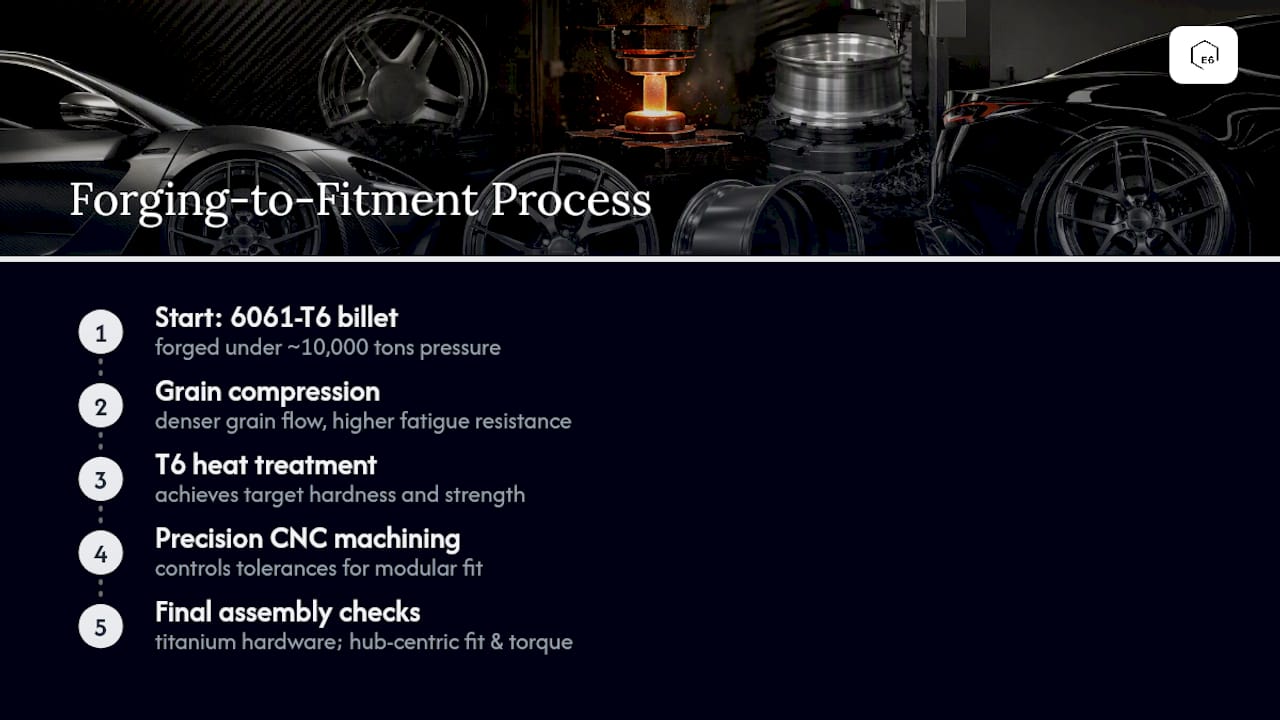
Modular flexibility only works if the parts you’re mixing and matching are dimensionally consistent, and that starts with the material. E6 Forged centers begin as solid 6061-T6 aluminum billets, forged under roughly 10,000 tons of pressure rather than cast into shape.
The forging advantage: forging compresses the aluminum’s internal grain structure instead of letting it solidify loosely, and that denser grain flow is what gives forged wheels their fatigue resistance over cast alternatives. T6 heat treatment then brings the alloy to its target hardness and strength, a standard step across the aluminum forging industry.
Precision CNC machining is what turns that forged blank into a wheel that actually mates correctly with its barrel. The machining stage of wheel production controls dimensional accuracy down to tolerances tight enough that a center machined this month and a barrel machined next month will still assemble without stack-up error. That precision is what makes true modularity possible instead of theoretical. Industry sources on multi-piece wheel engineering are consistent on this point: mixing barrels and centers only works reliably when both sides are held to matched tolerance standards.
Every bolted joint also gets lightweight aerospace-grade titanium hardware rather than standard steel fasteners, cutting rotational mass at the wheel’s outer diameter, which is the location where weight reduction has the largest effect on unsprung mass and steering response. Before any wheel ships, E6 Engineering runs assembly checks confirming hub-centric fit, torque specifications, and seal integrity, echoing the dimensional-control checkpoints standard to forged wheel production.
What Maintenance Do Two-Piece Modular Wheels Need?
Owning a bolted two-piece wheel is different from owning a monoblock, and it pays to know the differences going in.
- Torque faces and seal areas at the center-to-barrel joint are the primary inspection points over the wheel’s service life.
- A damaged barrel or curbed lip can often be replaced independently instead of forcing a full wheel replacement, which is the practical payoff of modular repairability.
- Finish longevity varies by process, brushed and polished surfaces age differently under road exposure, and that’s a factor to weigh at the design stage rather than after the fact.
- Ask for documented quality-control records and warranty terms covering both the forged center and the barrel hardware, since a wheel is only as reliable as its weakest joint.
None of this makes bolted two-piece wheels high-maintenance. It makes them serviceable in a way monoblock wheels simply aren’t, which is the trade you’re making when you choose modularity.
What Finish Combinations Are Possible With Modular Wheels?
This is where two-piece architecture stops being an engineering conversation and becomes a design one. Because the center and barrel are separate forgings, each can be finished independently before final assembly.
The signature example E6 Engineering builds around is a brushed liquid bronze center paired with a polished outer barrel, a combination that would be nearly impossible to execute consistently on a one-piece casting. Two-piece construction is popular in exactly this space, where bespoke aesthetics and show-quality fitment matter as much as raw performance.
Modularity also changes the production math for shops and owners alike:
- A single center design can support multiple finish combinations without new tooling for each variation.
- Barrel finish and center finish can be updated independently later, letting an owner refresh a look without replacing the whole wheel.
- Show builds and track cars can share the same center geometry while wearing completely different finish treatments.
Pro Tip: If you’re planning a finish combination you haven’t seen before, ask whether the center and barrel finishes are cured or coated using processes compatible with each other. Mismatched coating chemistries at the joint interface are a common source of long-term corrosion issues.
For Lexus LC500 owners chasing a specific aesthetic, this same logic extends beyond the wheel itself. Complementary finish work through detailing specialists like PPF Pros’ Lexus detailing services can round out a build that started with a custom wheel finish.
How Does E6 Engineering Build and Validate Its Two-Piece Wheels?
E6 Engineering builds every two-piece wheel around the same core discipline: forged 6061-T6 centers, precision CNC machining, and aerospace-grade titanium hardware at every bolted joint. That combination is what allows the modular architecture described throughout this article to function as a system rather than a collection of parts.
Platform focus runs deep on Mercedes-AMG and Lexus LC500 fitments, where E6 Engineering has concentrated the majority of its bespoke two-piece development, with selective expansion into McLaren and Lamborghini applications for owners seeking the same fitment-first approach on exotic platforms.
What that engineering discipline delivers in practice:
- Forged 6061-T6 centers for grain density and fatigue resistance over cast alternatives.
- Autoclave-cured carbon fiber components available across the broader E6 catalog for owners building a complete aesthetic package.
- Aerospace titanium hardware at every bolted interface to cut rotational mass without sacrificing joint integrity.
- Pre-shipment quality checkpoints validating hub-centric fit, torque specification, and seal condition.
Lexus LC500 owners looking to pair a custom two-piece wheel with a matching aerodynamic package should look at the E6 Carbon Elite Kit for the Lexus LC500, engineered around the same fitment-first philosophy. For wheel-specific consultations, E6 Forged’s two-piece wheel collection is the starting point for a bespoke fitment conversation.
Key Takeaways for Choosing a Two-Piece Modular Wheel
Two-piece modular construction earns its place on an exotic platform when you want fitment precision and finish freedom that a one-piece wheel can’t offer. The trade-off is a joint interface that needs proper hardware, sealing, and periodic inspection, work E6 Engineering builds into the wheel’s design from the forging stage forward.
Choose bolted two-piece architecture when you want the option to revisit barrel width or finish later. Choose a welded two-piece or monoblock design when maximum stiffness matters more than future flexibility, particularly for dedicated track applications.
If you’re weighing a bespoke build for a Mercedes-AMG, Lexus LC500, or select McLaren or Lamborghini platform, a fitment-first consultation is the right next step before any barrel width or finish gets finalized. Start that conversation through E6 Forged’s wheel collection.
The Fitment-First Take on Modular Wheel Design
Most wheel marketing sells modularity as a style feature. That undersells what’s actually happening structurally. The real value of a bolted two-piece wheel isn’t that you can change the finish later, it’s that the fitment conversation and the aesthetic conversation get decoupled entirely. You solve clearance and strength first, with the forged center and its CNC tolerances, then solve finish and stance second, with the barrel. Collapse those two decisions into one part, which is what a one-piece wheel forces you to do, and you inevitably compromise one to serve the other.
The conventional advice to “just pick your favorite finish and check if it fits” has that order backwards. Clearance zones, caliper sweep, and suspension travel should narrow your options before finish ever enters the discussion. Owners who prioritize the engineering sequence get better-looking wheels in the end, not worse, because nothing about the build gets rushed to accommodate a finish decision made too early.
— E6 Engineering
Ready to Build a Bespoke Two-Piece Wheel Set?
E6 Carbon builds forged two-piece wheels the way a race engineer would spec them: fitment constraints solved first, aesthetics layered on second, never the other way around. That sequencing is what separates a wheel that looks right in photos from one that clears the caliper at full lock and holds torque after a track day. For a Mercedes-AMG, Lexus LC500, or McLaren build, that means you get a forged 6061-T6 center matched to your platform’s actual clearance envelope, then the freedom to spec a brushed liquid bronze face against a polished barrel, or any finish pairing you can picture.
Lexus LC500 owners rounding out a full aesthetic package should also look at the Elite Aero Kit built for the LC500, engineered under the same fitment-first standard. To start a bespoke wheel consultation, visit E6 Forged’s two-piece wheel lineup and get your platform’s clearance specs reviewed before you commit to a configuration.
Sources
- How forged wheels are made — Hagerty
- T6 heat treatment for aluminum forgings — Southwest Aluminum
- The production process of forging car wheel hub — PDH Press
- Two-Piece Forged Wheels vs. Monoblock Forged Wheels — Kipardo Racing
FAQ
Are Forged Wheels Actually Forged?
Yes, genuine forged wheels start as a solid billet of aluminum compressed under thousands of tons of pressure, which is fundamentally different from cast wheels poured from molten metal. E6 Forged centers use this process with 6061-T6 aluminum, giving them denser grain structure than cast alternatives.
What Is the Best Brand of Forged Wheels?
The best forged wheel brand for you depends on your platform and priorities, but for owners building bespoke fitment on Mercedes-AMG, Lexus LC500, or McLaren platforms, E6 Forged’s fitment-first engineering and modular two-piece architecture directly address the clearance and customization concerns those builds demand.
Are Forged Wheels Worth It Over Flow-Formed Wheels?
Forged wheels generally offer better fatigue resistance and lower weight at equivalent strength compared with flow-formed wheels, because the forging process produces denser grain flow throughout the material. For performance-focused or bespoke fitment builds, that strength-to-weight advantage typically justifies the higher cost.
Why Are High-End Forged Wheels So Expensive?
Premium forged wheel pricing reflects the cost of the forging process itself, precision CNC machining to tight tolerances, and in the case of two-piece designs, aerospace-grade hardware and separate finishing work on centers and barrels. Custom barrel widths and bespoke finish combinations add manufacturing time that standard catalog wheels don’t require.
What’s the Difference Between Welded and Bolted Two-Piece Wheels?
Welded two-piece wheels fuse the center and barrel permanently for near-monoblock stiffness, while bolted assemblies keep them separate for serviceability and finish flexibility. Bolted construction trades some rigidity for the ability to swap barrels or repair individual components later.