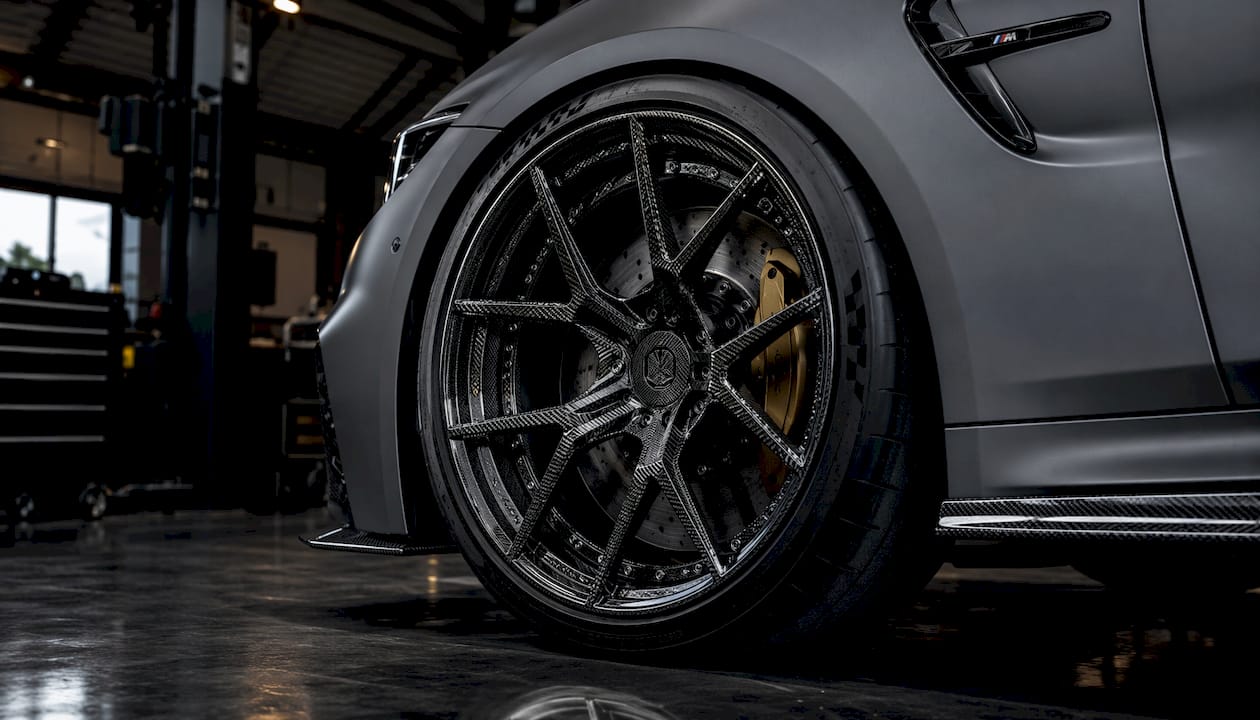
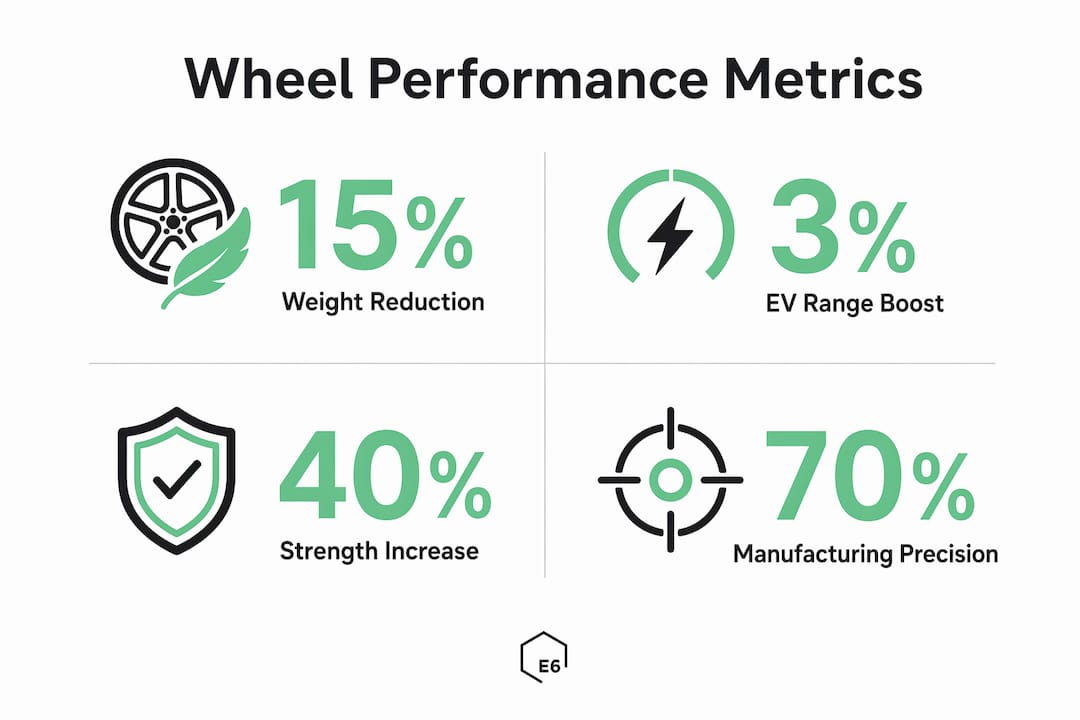
Advanced manufacturing transforms wheels from stamped or gravity-cast hardware into precision-engineered structural and aerodynamic components. The role of advanced manufacturing in wheels is straightforward: it reduces unsprung mass, raises stiffness-to-weight ratios, extends fatigue life, and cuts aerodynamic drag enough to measurably improve EV range. Every one of those outcomes is now achievable in production volumes, not just motorsport prototypes.
The practical effects are immediate. Forged and flow-formed wheels carry denser, more uniform grain structures than cast equivalents, which translates directly to higher fatigue resistance at the same or lower mass. Aerodynamic optimization of wheel geometry can improve EV range by up to 3% by reducing drag around the wheel and wheel well. Digital twin workflows, generative design, and FEA-driven topology optimization let engineers eliminate defects and validate structural performance before a single part is produced. Standards like JWL/VIA and SAE fatigue test methods set the minimum bar; advanced manufacturing is what clears it with margin to spare.
E6 Carbon and E6 Engineering apply these methods across Mercedes-AMG, Lexus LC500, McLaren, and Lamborghini platforms, where the engineering stakes are highest and the tolerance for compromise is zero.
Table of Contents
- What advanced manufacturing actually means for automotive wheels
- How specific manufacturing processes change wheel structure and capability
- Material systems and hybrid constructions enabled by advanced manufacturing
- How generative design, FEA, digital twins, and CFD produce manufacturable wheel designs
- Quantified effects on vehicle dynamics and EV performance
- Manufacturing controls, defect mitigation, inspection methods, and production scaling
- Regulatory and industry tests wheels must pass for the U.S. market
- Real-world examples where advanced manufacturing changed wheel outcomes
- E6 Engineering perspective: applying advanced manufacturing to performance platforms
- Key Takeaways
- The engineering case for getting this right
- Useful sources and further reading
- E6 Carbon forged wheels: built for platforms that demand the most
- FAQ
What advanced manufacturing actually means for automotive wheels
“Advanced manufacturing” in the wheel context is not a marketing label. It refers specifically to simulation-driven design, precision forming, additive production, and integrated quality assurance working as a connected system rather than isolated steps.
Three engineering goals define the discipline. First, lightweighting: reducing unsprung and rotating mass to improve acceleration, braking, and suspension response. Second, structural optimization: maximizing stiffness-to-weight and fatigue life so wheels survive high-torque BEV powertrains and track loads without adding material. Third, aerodynamic optimization: shaping spoke geometry, disc profiles, and aero covers to reduce wheel-well drag, which directly affects EV range.
Battery-electric vehicles have sharpened all three priorities simultaneously. Higher curb mass, instant torque delivery, and range sensitivity to drag mean that a wheel designed for a 2015 combustion platform is not an adequate starting point for a 2026 BEV. Digital workflows and new materials shift what is manufacturable at scale, and supercomputing-scale simulation lets engineers evaluate thousands of configurations before committing to tooling.
Pro Tip: When scoping a wheel program for a BEV platform, define your unsprung mass target and aerodynamic drag coefficient goal before selecting a manufacturing process. The process choice follows from those targets, not the other way around.
How specific manufacturing processes change wheel structure and capability
Process selection is the single biggest lever in wheel engineering. Each method produces a different microstructure, and microstructure determines strength, fatigue behavior, and the mass you can remove safely.
Gravity and low-pressure casting remain the cost baseline. Low-pressure casting improves fill consistency over gravity methods, but both leave porosity and dendrite structures that limit how aggressively you can thin spokes or reduce section thickness. Counter-pressure casting tightens that further by applying pressure during solidification, reducing gas entrapment.
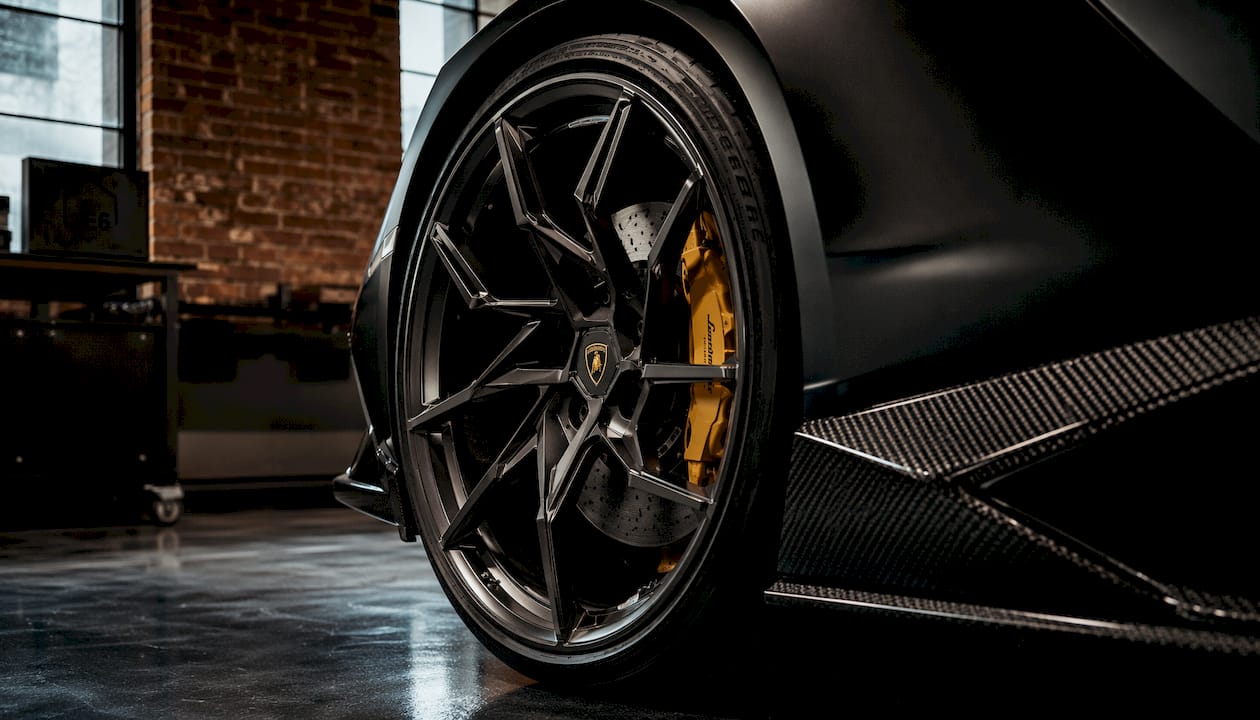
Dual squeeze casting applies mechanical pressure during solidification to collapse porosity and refine grain structure locally. Research using thermal-fluid-solid coupling FEM shows that optimized squeeze parameters eliminate predicted defect locations and improve mechanical properties in aluminum wheel hubs. It is the most capable casting variant for high-stress spoke roots and hub flanges.
Flow forming takes a cast or forged preform and rolls the barrel section under high pressure, elongating grains axially and increasing rim strength significantly compared to a simple cast barrel. Flow-formed barrels approach forged properties at lower per-unit cost, making them a strong choice for mid-volume performance programs.
Monoblock forging produces the densest grain structure and the highest stiffness-to-weight of any single-piece process. Forged wheels are denser and stronger than cast equivalents because the forging process consolidates grain flow along load paths. CNC machining then removes material precisely where FEA shows it is not load-bearing, leaving a wheel that is both lighter and structurally superior.
Additive manufacturing (SLM for metals, large-format autoclave or out-of-autoclave processes for CFRP) enables lattice geometries and organic internal structures that no die can produce. AI-assisted generative design combined with 3D printing produces structurally competent wheel concepts for EVs, but current process economics and certification constraints keep additive best suited to low-volume, high-value, or prototyping applications.
| Process | Grain/Density | Strength-to-Weight | Cost per Unit | Scalability |
|---|---|---|---|---|
| Gravity casting | Coarse dendrite | Low | Lowest | High |
| Low-pressure casting | Moderate | Moderate | Low | High |
| Dual squeeze casting | Refined, low porosity | Moderate-high | Moderate | Medium-high |
| Flow forming | Elongated axial grain | High (barrel) | Moderate | Medium-high |
| Monoblock forging | Dense, directional | Highest | High | Medium |
| Additive (SLM/CFRP) | Isotropic or tailored | Variable | Very high | Low |
Pro Tip: For high-torque platforms (AMG GT, McLaren 750S), choose a forged monoblock or flow-formed barrel over any cast variant. The grain consolidation in forging is not recoverable by heat treatment in a cast wheel. If production volume exceeds a few thousand units annually, flow-formed barrels with forged centers offer the best cost-performance balance. See E6 Carbon’s breakdown of forged vs. cast advantages for platform-specific guidance.
Material systems and hybrid constructions enabled by advanced manufacturing
Process and material are inseparable. The same forging press produces very different outcomes depending on whether the billet is 6061-T6, 7075-T6, or a high-strength 7000-series alloy.
| Material | Density (g/cm³) | Specific Stiffness | Fatigue Behavior | Manufacturing Fit |
|---|---|---|---|---|
| 6061-T6 aluminum | — | Moderate | Good, predictable | Casting, forging, flow forming |
| 7075-T6 aluminum | — | High | Excellent | Forging, CNC |
| High-strength steel | — | Moderate | Very high cycle life | Stamping, EAF rolling |
| Titanium alloy | — | High | Excellent, corrosion-resistant | Additive, precision forging |
| CFRP (autoclave) | — | Very high | Excellent in tension | Autoclave layup, RTM |
Hybrid constructions are where advanced manufacturing opens territory that single-material wheels cannot reach. An aluminum forged center paired with a carbon-fiber aero disc delivers the structural stiffness of forged aluminum at the hub while the CFRP disc manages aerodynamic drag and adds minimal mass. Multi-piece assemblies, where a forged center bolts to a flow-formed or carbon barrel, allow custom offsets and modular repair without scrapping the entire wheel after a curb strike. The trade-off is a small mass penalty versus a monoblock, and slightly more assembly complexity. For platforms where fitment flexibility matters as much as outright weight, that trade is often worth making.
On lifecycle and emissions: primary aluminum carries a cradle-to-gate CO2 footprint of 3.5–16 kg CO2/kg depending on the energy source for smelting. Conventional primary steel runs roughly 2–2.5 kg CO2/kg, and electric arc furnace production with renewable energy pushes that toward near-zero. For programs with sustainability mandates, the material and energy source combination matters as much as the alloy grade.
How generative design, FEA, digital twins, and CFD produce manufacturable wheel designs
The digital workflow is where modern wheel engineering separates from traditional trial-and-error development. A well-run program moves through these stages in sequence:
- Design brief: Define target mass, stiffness, fatigue life, resonant frequency windows, and aerodynamic drag targets before any geometry is drawn.
- Generative/topology optimization: AI-driven solvers remove material from low-stress regions and redistribute it along principal load paths, producing organic spoke geometries that no human designer would sketch by hand.
- FEA validation: Finite element analysis checks stiffness, stress concentrations, and modal frequencies against the brief. Spoke root radii, hub bore geometry, and barrel thickness are iterated here.
- CFD for aerodynamics: Computational fluid dynamics evaluates wheel-well airflow, spoke wake interactions, and the effect of aero disc profiles on drag. For BEV programs, this step is non-negotiable.
- Manufacturability filtering: Generative outputs are constrained by the chosen process. A topology-optimized design for additive manufacturing looks different from one constrained for forging die draft angles or casting fill paths.
- Digital twin and process simulation: Thermal-fluid-solid coupling simulations predict solidification behavior, shrinkage, and defect locations for casting programs. For forging, FEM predicts grain flow and forming force requirements.
The aerodynamic payoff is concrete: optimized wheel geometry can improve EV range by up to 3% by reducing drag around the wheel and wheel well. On a 300-mile range vehicle, that is roughly 9 miles recovered without adding a single battery cell.
Supercomputing-scale simulation lets engineers evaluate thousands of wheel configurations for weight, stiffness, and resonant frequency targets before any tooling is cut. The digital twin then carries those validated parameters into production monitoring, flagging process drift before it produces a defective part.
Quantified effects on vehicle dynamics and EV performance
Unsprung mass reduction is the most direct performance dividend. Every kilogram removed from a rotating wheel reduces the inertia the suspension must control, improving transient response, reducing wheel hop tendency, and lowering the energy cost of acceleration and braking. For a high-torque BEV like the Mercedes-AMG EQS 53, where instantaneous torque delivery amplifies any suspension compliance issue, this is a safety and dynamics argument, not just a performance one.
Stiffness-to-weight governs resonant frequency behavior. A wheel that is too compliant shifts its first bending or torsional mode into the frequency range where road inputs and tire excitation overlap, producing vibration and potential fatigue damage. Forged monoblock wheels, with their dense grain structure and CNC-optimized sections, maintain high stiffness at lower mass than cast equivalents, pushing resonant modes to higher, less problematic frequencies.
The aerodynamic range benefit of up to 3% from optimized wheel geometry, cited above, compounds with other lightweighting gains. A McLaren 750S running forged monoblock wheels versus a cast alternative might recover 4–6 kg of unsprung mass per corner. The unsprung mass and rotating weight effects on a mid-engine platform that sensitive are measurable in lap time and driver feedback, not just on a dynamometer.
Pro Tip: Before finalizing spoke geometry, run a modal analysis and compare predicted resonant frequencies against your suspension’s natural frequency range and typical road input spectra. A wheel that passes static and fatigue tests can still introduce NVH problems if its first mode sits at 18–22 Hz. Validate with physical modal testing and correlate back to FEA before sign-off.
Manufacturing controls, defect mitigation, inspection methods, and production scaling
Advanced process capability means nothing without the controls to sustain it across production runs. The failure modes in wheel manufacturing are well-documented: porosity in cast sections, inclusions from contaminated melt, and fatigue crack initiation at spoke roots or hub bore transitions.
QA checklist for wheel production:
- Melt cleanliness: degassing, flux treatment, and hydrogen content measurement before pour
- Mold and billet traceability: heat number tracking from raw material through finished wheel
- Thermal profiling: thermocouple monitoring of die and mold temperatures throughout the cycle
- Controlled forging pressures: load-cell feedback on press force to detect billet temperature variation
- Secondary forging timing: for dual squeeze casting, the delay between primary fill and secondary pressure application must be held within a narrow window to achieve the targeted grain refinement
- Post-process heat treatment verification: hardness testing and tensile coupon sampling per heat lot
Inspection methods:
- CT or X-ray scanning for internal porosity and inclusion mapping in cast sections
- Ultrasonic testing for subsurface crack detection in forged billets and finished wheels
- Dye-penetrant inspection for surface-breaking cracks at spoke roots and hub flanges
- In-line dimensional metrology (CMM or laser scanning) for bore diameter, offset, and runout
- Post-process fatigue sampling: destructive testing of production samples at defined intervals
Simulation-guided parameter optimization verified through microstructure and mechanical property tests is the current best practice for establishing process windows. The investment in upfront simulation pays back in reduced scrap and warranty costs at volume.
Pro Tip: As production volume grows, shift from 100% inspection to statistically designed sampling plans. Use process capability indices (Cpk) on critical dimensions to set inspection frequency. A process running Cpk above 1.67 on bore diameter and runout can support reduced-frequency sampling without increasing escape risk.
Regulatory and industry tests wheels must pass for the U.S. market
The U.S. aftermarket and OEM supply chain both reference a consistent set of standards. Knowing which test validates which failure mode is the starting point for aligning your design and simulation plan with regulatory readiness.
| Standard / Test | What It Validates | Key Pass Criteria |
|---|---|---|
| JWL (Japanese Wheel Standard) | Dimensional and structural baseline for alloy wheels | Defined load and cycle thresholds for each test |
| VIA (Vehicle Inspection Association) | Third-party verification of JWL compliance | Independent lab confirmation of JWL test results |
| SAE J328 | Static load and fatigue for passenger car wheels | No fracture or visible crack after specified cycles |
| SAE J1204 | Impact test (simulates pothole/curb strike) | No fracture; controlled deformation only |
| Dynamic cornering fatigue | Simulates lateral cornering loads over life cycle | No crack initiation at spoke roots or hub flange |
| Radial fatigue | Simulates vertical road load cycling | No structural failure over defined cycle count |
| Modal/resonant testing | Identifies natural frequencies and mode shapes | No resonant mode within specified suspension frequency range |
Digital twin and FEA correlation directly accelerates test readiness. When simulation predicts stress concentrations and fatigue life with high fidelity, physical tests become confirmation events rather than discovery exercises. Programs that skip simulation and go straight to physical testing typically run two to three more iteration cycles before passing, at significant cost and schedule impact.
Real-world examples where advanced manufacturing changed wheel outcomes
The clearest evidence for how modern wheel manufacturing techniques deliver measurable gains comes from production programs, not laboratory papers.
Aerodynamic aluminum wheel designs: Several OEM programs have replaced traditional spoke-and-air-gap designs with near-closed-face aluminum wheels that eliminate aero covers entirely. By integrating the aerodynamic surface into the forged or cast structure, engineers removed the cover’s mass while retaining the drag reduction. The result is a lighter wheel with equivalent or better aerodynamic performance.
Dual squeeze casting for spoke defect reduction: Published research on aluminum wheel hub production demonstrates that optimized dual squeeze casting parameters, identified through thermal-fluid-solid FEM, eliminate predicted defect locations in spoke roots and hub transitions. Microstructure verification confirmed the simulation predictions, validating the process window before production commitment.
AI-assisted generative design for 3D-printed prototypes: Research demonstrates that AI-assisted generative design combined with additive manufacturing produces lightweight, structurally competent wheel concepts for EVs, with lattice and organic internal geometries that reduce mass while maintaining strength. These are currently most applicable to low-volume specialty or concept applications, not mass production.
For Mercedes-AMG track applications, a forged monoblock on the AMG GT platform illustrates the method: FEA-optimized spoke geometry, CNC-machined to final section, validated against SAE J328 and dynamic cornering fatigue before fitment. For the Lexus LC500, an autoclave-cured carbon aero disc paired with a forged center delivers the aerodynamic profile the platform’s long hood and wide rear stance demand. McLaren and Lamborghini applications, where packaging constraints are extreme and mass targets are aggressive, are where generative-design lattice structures and multi-piece forged assemblies earn their cost premium.
E6 Engineering perspective: applying advanced manufacturing to performance platforms
At E6 Engineering, process selection follows platform requirements, not catalog availability. For Mercedes-AMG applications, which represent the largest share of our program work, monoblock forged wheels are the default recommendation. The AMG GT and AMG E-class platforms combine high cornering loads with aggressive brake torque, and the grain consolidation from forging is not replicated by any cast process. The monoblock forging approach also eliminates the fastener interfaces that multi-piece wheels introduce, which matters for track use where thermal cycling is severe.
For Lexus LC500 programs, the priority shifts toward aerodynamic integration. The LC500’s platform geometry and relatively lower unsprung mass sensitivity compared to a mid-engine car means the aero disc configuration, autoclave-cured 2×2 twill carbon over a forged aluminum center, delivers the best combined outcome. The carbon component is not decorative; it is a structural aero surface that changes the wheel’s drag contribution measurably.
McLaren and Lamborghini applications demand the most from both process and material. Packaging constraints, extreme mass targets, and high-torque powertrains push us toward multi-piece forged assemblies where custom offsets are required, or monoblock where the fitment envelope allows. The monoblock vs. multi-piece trade-off for these platforms is a genuine engineering decision, not a preference.
Engineering checklist for program launch:
- Define unsprung mass target per corner and stiffness-to-weight minimum
- Set resonant frequency window (avoid 18–25 Hz range for most suspension configurations)
- Run topology optimization with process constraints applied (forging draft, casting fill, additive build direction)
- Validate with FEA: stress, fatigue life, and modal analysis
- Run CFD if the program is BEV or aero-sensitive
- Establish process parameter windows using simulation before first tooling
- Define inspection plan: NDT methods, dimensional metrology, fatigue sampling frequency
- Correlate physical test results back to simulation model before production sign-off
Pro Tip: For McLaren and Lamborghini fitments, always verify hub bore, PCD, and offset against the OEM specification before finalizing the forging die. These platforms have tighter fitment tolerances than most, and a 0.5 mm offset error at the hub translates to measurable bearing load asymmetry at track speeds.
Key Takeaways
Advanced manufacturing is the mechanism that converts wheel design intent into measurable structural, aerodynamic, and fatigue performance, with forging and simulation-driven workflows delivering the highest stiffness-to-weight and the lowest defect rates across high-torque platforms.
| Point | Details |
|---|---|
| Aero optimization recovers EV range | Aerodynamic wheel design can improve EV range by up to 3% by reducing wheel-well drag. |
| Forging leads on stiffness-to-weight | Forged monoblock wheels produce denser grain structures and higher fatigue resistance than any cast process. |
| Digital twins cut iteration cycles | Thermal-fluid-solid coupling simulation eliminates casting defects in the virtual model before production begins. |
| Dual squeeze casting reduces spoke defects | Optimized squeeze parameters, validated by FEM and microstructure testing, eliminate predicted defect locations in hub and spoke roots. |
| E6 Carbon applies these methods by platform | E6 Engineering specifies monoblock forged for AMG, carbon-aero hybrid for Lexus LC500, and multi-piece forged for McLaren/Lamborghini fitments. |
The engineering case for getting this right
The conventional wisdom in aftermarket wheel selection is that forged means premium and cast means budget, and that the difference is mostly cosmetic or marginal in real-world use. That framing is wrong, and it is wrong in ways that matter more as vehicles get heavier and more powerful.
A BEV platform with 600 lb-ft of instantaneous torque does not give a cast wheel the same loading profile as a 300 hp combustion car. The fatigue cycles accumulate differently, the thermal environment at the hub is more severe, and the aerodynamic contribution of the wheel to total vehicle drag is larger because BEV range sensitivity amplifies every drag source. The gap between a properly forged, simulation-validated wheel and a gravity-cast alternative is not a luxury gap. On these platforms, it is a durability and safety gap.
What the industry underestimates is how much of that gap is closed in the design and simulation phase, before any metal is formed. A forged wheel designed with outdated spoke geometry and no CFD input will underperform a well-simulated cast wheel on aerodynamics. The process matters, but the digital workflow that precedes it matters just as much. Programs that invest in generative design, FEA, and digital twin validation before cutting tooling consistently arrive at better outcomes with fewer physical iterations. The engineering is not in the material alone. It is in the system.
Useful sources and further reading
These are the primary technical sources and standards references used throughout this article, organized by topic area.
Manufacturing methods and process comparison: Wheel Manufacturing Techniques — American Racing covers casting, flow forming, and forging families with practical cost/performance context. Single-piece wheel manufacturing — Wikipedia provides a useful overview of process-to-property relationships.
Dual squeeze casting and defect simulation: Study of Dual Squeeze Casting Process of Aluminum Alloy Wheel Hubs — International Journal of Metalcasting is the primary source for FEM-guided parameter optimization and microstructure validation in squeeze casting.
Additive manufacturing and generative design: AI-assisted design of lightweight and strong 3D-printed wheels for electric vehicles — PMC covers the current state of additive wheel concepts for EVs, including geometric capabilities and adoption constraints.
EV aerodynamics, lifecycle emissions, and digital simulation: The influence of wheels in the electric vehicle era — ETAuto (Iochpe-Maxion interview) is the source for the 3% range improvement figure, the CO2 footprint data for aluminum and steel, and the supercomputing simulation context.
Intelligent manufacturing and digital twin frameworks: Intelligent Manufacturing of Automotive Wheel Rims — Clausius Press presents the digital twin-based process modeling framework and optimization results for aluminum alloy wheel rim production.
Standards: JWL and VIA standards are administered through the Japan Light Alloy Wheel Testing Council and verified by VIA-accredited laboratories. SAE J328 and SAE J1204 are available through SAE International. These are the primary references for U.S. market structural and impact test compliance.
E6 Carbon forged wheels: built for platforms that demand the most
If you have read this far, you already know that the process behind a wheel matters as much as the material. E6 Carbon’s forged wheel catalog is built on exactly the engineering principles covered here: monoblock forged construction for Mercedes-AMG platforms, carbon-aero hybrid configurations for the Lexus LC500, and precision multi-piece forged assemblies for McLaren and Lamborghini fitments where packaging demands custom offsets.
Every wheel goes through FEA-validated spoke geometry, dimensional metrology to OEM bore and offset specifications, and fatigue testing aligned with Proven SEO strategies for manufacturing: examples that work for consistent industry content promotion. The “Fitment First” standard is not a tagline; it is the reason E6 Carbon wheels clear OEM tolerances on the first fitment rather than requiring shims or spacers.
For engineers and technical buyers who want to move from evaluation to specification, the E6 Forged wheel catalog is the starting point. If you want the full engineering case for why forged aluminum outperforms cast and flow-formed alternatives on high-torque platforms, the forged vs. cast breakdown covers the structural and fatigue arguments in detail. Request a fitment-specific consultation directly through the E6 Carbon website.
FAQ
What is the role of advanced manufacturing in wheels?
Advanced manufacturing converts wheel design intent into measurable structural and aerodynamic performance by using precision forming, simulation-driven design, and integrated quality controls. The result is lower unsprung mass, higher stiffness-to-weight, longer fatigue life, and reduced aerodynamic drag compared to conventionally cast wheels.
How does advanced manufacturing differ from standard wheel manufacturing?
Standard manufacturing relies on gravity or low-pressure casting with limited simulation input, producing wheels with coarser grain structures and higher porosity. Advanced manufacturing adds forging, flow forming, dual squeeze casting, generative design, FEA, and digital twin validation to achieve tighter tolerances, better material properties, and predictable fatigue behavior.
What can advanced manufacturing do for EV wheel performance?
Aerodynamic optimization of wheel geometry can improve EV range by up to 3% by reducing drag around the wheel and wheel well. Combined with unsprung mass reduction from forged or flow-formed construction, advanced manufacturing addresses both the range sensitivity and high-torque durability demands of BEV platforms.
What standards do U.S. market wheels need to meet?
The primary structural standards are JWL (Japanese Wheel Standard) and VIA third-party verification, along with SAE J328 for static and fatigue loads and SAE J1204 for impact resistance. Dynamic cornering fatigue and radial fatigue tests validate real-world load cycling, and modal testing confirms resonant frequencies stay outside problematic ranges.
When does a monoblock forged wheel make more sense than a multi-piece design?
Monoblock forged wheels deliver maximum stiffness and minimum mass with no fastener interfaces, making them the preferred choice for track use and high-torque platforms like the Mercedes-AMG GT and McLaren 750S. Multi-piece forged assemblies are better suited when custom offsets are required or when modular repairability after curb or track damage is a program priority.