TL;DR:
- A forged inner lip is the load-bearing inner barrel of a multi-piece wheel, made from high-grade aluminum and meticulously machined for strength. It offers benefits like reduced weight, improved fatigue resistance, and the ability to repair or customize fitment for high-performance applications. Regular inspection for cracks, deformation, and corrosion is essential to maintain safety and performance.
What is a forged inner lip in multi-piece wheels?
The forged inner lip is the inner barrel component of a multi-piece wheel, forged from high-grade aluminum alloy and responsible for the primary load-bearing function of the entire assembly. While buyers typically fixate on the visual outer lip, the inner barrel is what actually keeps the wheel round, sealed, and structurally sound under dynamic stress. Engineering teams consistently identify it as the most critical component in any multi-piece wheel build.
In a three-piece wheel, the assembly breaks into three separately manufactured parts:
- Inner barrel (forged inner lip): The load-bearing section that maintains roundness and structural integrity under cornering, braking, and acceleration forces.
- Outer lip: Defines visual depth and contributes lateral strength; typically polished, anodized, or brushed for aesthetics.
- Center disc: Connects the barrel to the hub; can be made from aluminum or carbon fiber depending on the build.
The forged inner lip sits inboard, interfacing directly with the tire bead and the hub mounting surface. On platforms like BMW M, Mercedes-AMG, Lexus LC500, McLaren, and Lamborghini, where cornering loads and track duty cycles are severe, the inner barrel’s integrity is non-negotiable. A barrel that is not perfectly round or properly balanced will cause vibration and air leaks at speed.
How the forging and machining process creates a superior inner lip
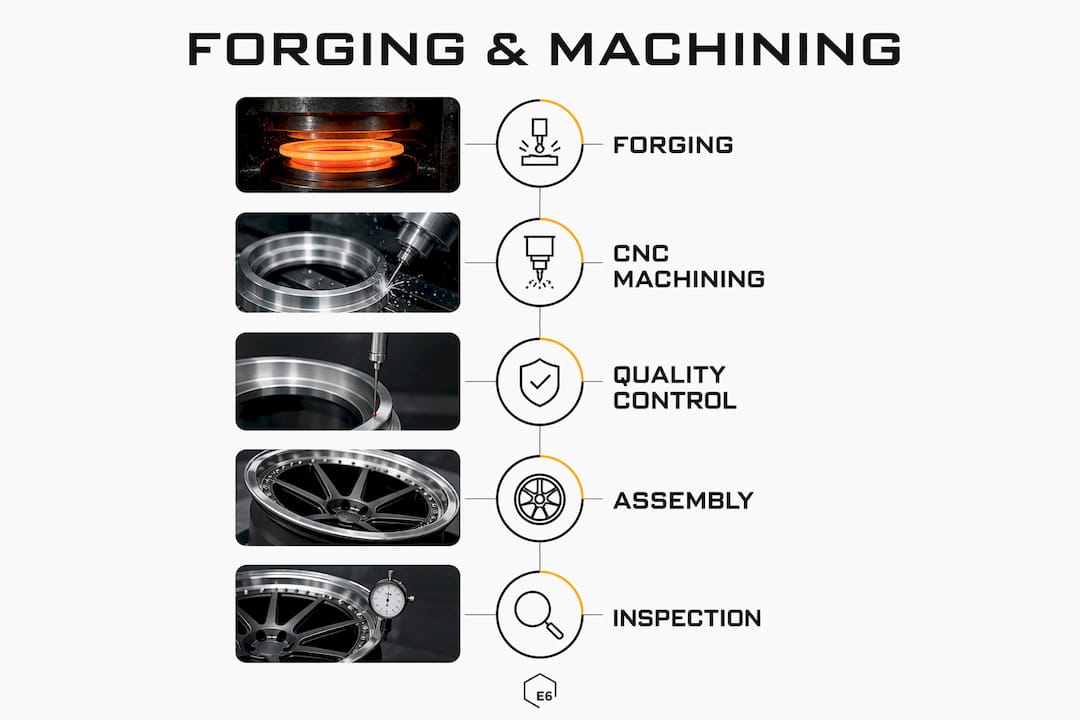
The manufacturing process separates a forged inner lip from every cheaper alternative. It starts with a solid billet of 6061-T6 aluminum alloy, heated and compressed under 8,000 to 12,000+ tons of press force. That extreme pressure eliminates the internal voids and micro-porosity that casting leaves behind, and it realigns the aluminum’s grain structure radially, which is what gives forged barrels their fatigue resistance under cyclic loading.
The forging process, step by step:
- Billet preparation: A pre-cut 6061-T6 aluminum billet is heated to forging temperature.
- Press forging: The billet is compressed under thousands of tons, reshaping grain structure and eliminating internal voids.
- Spinning (flow forming): Some manufacturers spin-forge the barrel to further refine wall thickness and radial grain alignment.
- Aerospace heat treatment: The forged blank undergoes a two-stage heat treatment process to reach full T6 temper, maximizing tensile strength.
- CNC machining: Turning, milling, and drilling carve the final bore diameter, bead seat, and hardware mounting holes to tight circular tolerances.
That last step is where safety lives. Precision CNC machining of forged inner barrels ensures exact circular tolerances, preventing air leaks and the imbalances that cause high-speed wobble. A barrel that is even slightly out of round will fight your tire pressure and your balancing weights every time you hit the highway.
Pro Tip: When spec’ing a multi-piece wheel, always ask the manufacturer to confirm the alloy grade (6061-T6 minimum) and the machining tolerance on the bead seat diameter. A reputable builder will have that data on hand.
Cast and spun alternatives skip the billet forging step entirely. Cast barrels have random grain orientation and residual porosity. Spun barrels improve on casting but still lack the density and fatigue resistance of a fully forged piece. For a deeper look at why the forging process matters at the material level, E6 Carbon’s breakdown of forged vs. cast aluminum covers the metallurgical differences in detail.
Why a forged inner lip improves performance and repairability
The performance case for forged inner lips comes down to three things: unsprung weight, fatigue life, and the ability to repair rather than replace.
Key benefits:
- Unsprung weight reduction: A forged 6061-T6 barrel is lighter than a cast equivalent at the same structural rating, reducing the unsprung mass that the suspension must control. Less unsprung weight means faster wheel response to road inputs and better tire contact patch consistency.
- Superior strength-to-weight ratio: The radially aligned grain structure from forging handles cyclic bending loads far better than cast metal, which matters on track where cornering forces repeat thousands of times per session.
- Repairability: With a multi-piece forged wheel, a damaged inner barrel can be replaced independently without scrapping the center disc or outer lip. A monoblock wheel with a cracked barrel is a total loss.
- Custom fitment: Multi-piece construction allows builders to specify exact widths, offsets, and lip depths that a monoblock cannot offer, which is critical for aggressive fitment on wide-body builds.
- Rotational inertia: A lighter barrel reduces the rotational inertia the drivetrain must overcome during acceleration, with measurable gains in throttle response on high-power platforms.
The repairability point deserves emphasis. Track drivers who regularly encounter curb strikes or debris know that a bent forged barrel can often be straightened or swapped at a fraction of the cost of a new wheel. That is a structural and financial advantage that monoblock cast wheels simply cannot match.
How forged inner lips perform on Mercedes-AMG, Lexus LC500, McLaren, and Lamborghini
High-performance platforms demand more from their wheel components than street cars, and the forged inner lip is where that demand shows up most clearly.
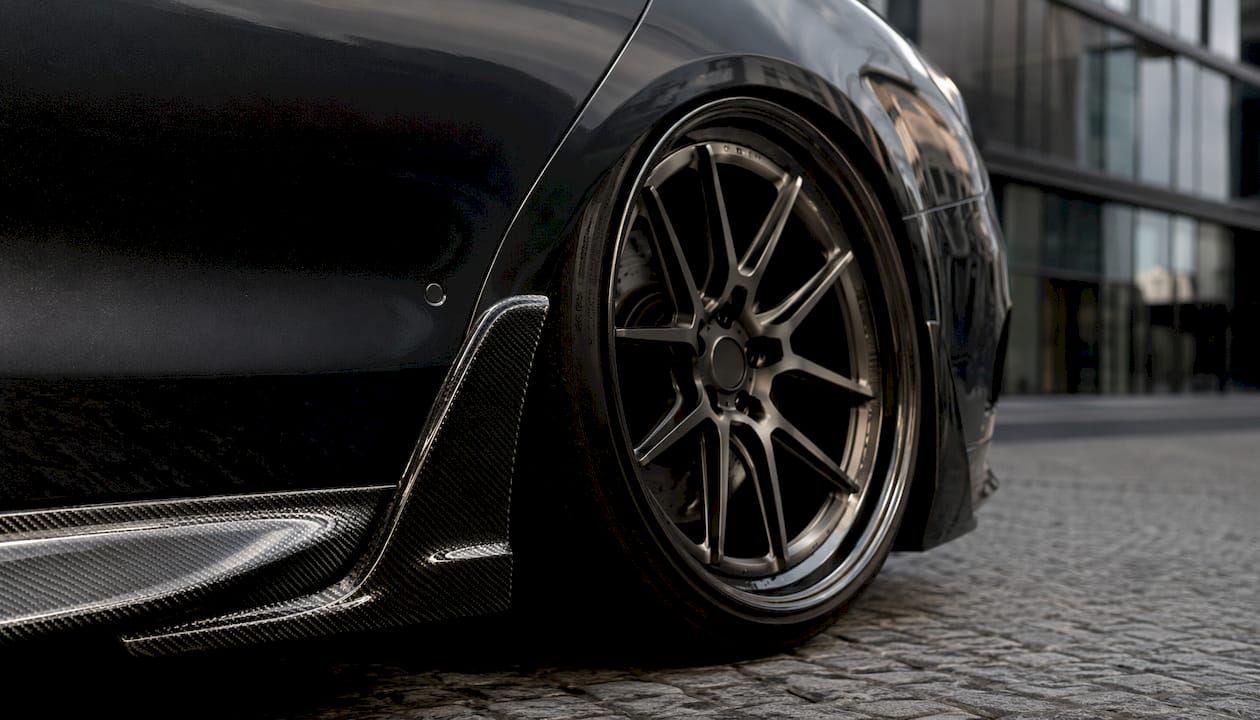
Mercedes-AMG (40% platform focus): AMG models like the E63 and GT series generate cornering loads that stress the inner barrel repeatedly under track conditions. The priority on these builds is offset customization and verified alloy certification. AMG fitment often requires specific hub-centric bore diameters and load ratings, and the inner barrel must be machined to tolerances that maintain hub-centric contact without play. E6 Carbon’s E6 Forged wheels are engineered to meet these exacting AMG fitment standards.
Lexus LC500 (30% platform focus): The LC500’s combination of a naturally aspirated V8 and a grand touring chassis makes it a candidate for precision fitment over outright track aggression. Forged inner barrels on the LC500 prioritize repairability and exact bead seat tolerances for the wide, low-profile tires the platform runs. A barrel that is even slightly out of spec on bead seat diameter will cause chronic slow leaks with low-profile rubber.
McLaren and Lamborghini (30% platform focus): These platforms push unsprung weight reduction to the extreme. McLaren’s carbon fiber monocoque chassis is extraordinarily sensitive to unsprung mass changes, and Lamborghini’s all-wheel-drive systems amplify any rotational inertia differences between corners. Forged inner barrels on these builds are typically machined to the tightest tolerances in the industry, with alloy certification required by the manufacturer. Custom offsets and widths are common, particularly on widebody Huracán and Aventador builds where aggressive fitment is part of the engineering brief.
Application benefits by platform:
- Mercedes-AMG: Track durability, offset customization, hub-centric precision
- Lexus LC500: Repairability, bead seat accuracy, luxury fitment standards
- McLaren: Minimum unsprung weight, extreme machining tolerances
- Lamborghini: Custom width and offset for widebody fitment, alloy certification
For performance wheel assembly guidance relevant to these platforms, Underground Dynamics offers expert consultation on custom wheel engineering and fitment.
Common defects in forged inner lips and how to detect them
Even a well-forged barrel can develop problems, particularly on track-driven vehicles. Knowing what to look for keeps a damaged wheel from becoming a dangerous one.
Cracks and stress fractures are the most serious defect. They typically originate at the bead seat radius or at hardware bolt holes, where stress concentrates. Visual inspection catches surface cracks, but subsurface fractures require dye penetrant testing or ultrasonic inspection. Any crack in the barrel is a replacement, not a repair.
Out-of-round deformation happens after a hard curb strike or pothole impact. The barrel may look intact but measure oval when checked with a dial indicator. An out-of-round barrel causes persistent vibration that balancing weights cannot fix, because the problem is geometric, not mass-related. Improperly machined inner barrels produce the same symptom from the factory, which is why sourcing from a verified manufacturer matters.
Bead seat corrosion develops when the polished or raw aluminum surface is exposed to road salt or moisture over time. Corrosion on the bead seat prevents a proper tire seal, leading to slow leaks. Wire brushing and resealing with bead sealer addresses minor cases; severe pitting requires barrel replacement.
Hardware thread damage at the barrel’s bolt circle can compromise the clamping force holding the three-piece assembly together. Inspect threads annually on track-driven wheels and replace any barrel with stripped or cross-threaded holes.
Inspection schedule: On street-driven performance vehicles, inspect the inner barrel visually every six months. On track-driven platforms like AMG GT, McLaren 720S, or Lamborghini Huracán, inspect after every track day, paying particular attention to the bead seat and bolt holes.
E6 Carbon builds E6 Forged multi-piece wheels engineered specifically for platforms like Mercedes-AMG, Lexus LC500, McLaren, and Lamborghini. Every barrel is forged from certified 6061-T6 aluminum and CNC-machined to hub-centric tolerances. Explore the full E6 Forged catalog and configure your fitment.
Key Takeaways
A forged inner lip is the structural core of any multi-piece wheel, and its alloy grade, forging quality, and machining precision determine both safety and long-term performance.
| Point | Details |
|---|---|
| Forged inner lip definition | The inner barrel of a multi-piece wheel, forged from 6061-T6 aluminum, bearing the primary structural load. |
| Manufacturing standard | Forged under 8,000 to 12,000+ tons of pressure, then CNC-machined to exact circular tolerances for balance and air sealing. |
| Performance advantage | Reduces unsprung weight and rotational inertia while delivering superior fatigue resistance compared to cast alternatives. |
| Repairability | Damaged barrels can be replaced independently on multi-piece wheels, avoiding full wheel replacement. |
| Platform relevance | Mercedes-AMG, Lexus LC500, McLaren, and Lamborghini all prioritize forged inner barrels for offset customization and extreme load tolerances. |
FAQ
What exactly is a forged inner lip on a wheel?
The forged inner lip is the inner barrel component of a multi-piece wheel, separately forged from 6061-T6 aluminum alloy and responsible for load-bearing, roundness, and structural integrity under dynamic stress.
How does a forged inner lip differ from a cast inner barrel?
Forging under 8,000 to 12,000+ tons of pressure aligns the aluminum’s grain structure radially, eliminating internal voids and producing superior fatigue resistance and a better strength-to-weight ratio than a cast barrel.
Can a damaged forged inner lip be repaired?
On a multi-piece wheel, a damaged inner barrel can be replaced independently without scrapping the center disc or outer lip, which is a key advantage over monoblock construction where barrel damage means a total wheel loss.
How often should I inspect my forged inner barrel?
On street-driven performance vehicles, a visual inspection every six months is adequate. Track-driven platforms like McLaren, Mercedes-AMG, and Lamborghini warrant inspection after every track day, focusing on the bead seat, bolt holes, and any area that contacted a curb or debris.
Why do Mercedes-AMG and McLaren prioritize forged inner lips?
Both platforms generate severe cyclic cornering loads and require hub-centric machining precision that only a forged and CNC-machined barrel can reliably deliver, along with the custom offset and width options that multi-piece construction enables.