
TL;DR:
- A wheel load rating indicates the maximum weight a wheel can safely support during real-world driving conditions. The rating must meet or exceed half of the vehicle’s highest GAWR, with additional margin for heavier use or modifications, to ensure safety and durability. Confirming size-specific, fatigue-tested load ratings for both wheels and tires is essential for high-demand applications like towing, off-road driving, or performance use.
A wheel load rating is the maximum weight one wheel is engineered to carry safely under dynamic, real-world conditions. The core rule is to choose wheels whose per-wheel rating meets or exceeds your vehicle’s highest Gross Axle Weight Rating (GAWR) divided by two, then add a margin appropriate for your use case, with tougher conditions requiring higher margins and documented fatigue testing.
The minimum wheel load requirement is always calculated from GAWR, not curb weight and not GVWR. Get that number right first, then worry about margin.
Table of Contents
- What a wheel load rating actually means
- How to calculate the minimum wheel load rating you need
- Where to find a wheel’s load rating before you buy
- Why load rating matters: fatigue, forging, and testing standards
- Choosing the right margin for street, towing, off-road, and track
- How wheel load rating differs from tire load index
- Common mistakes and red flags when sourcing wheels
- Key Takeaways
- The engineering case for fatigue-first wheel design
- E6 Forged wheels built for your load requirements
- Useful sources
- FAQ
What a wheel load rating actually means
A wheel load rating is the per-wheel maximum load, in pounds, that the wheel’s structure is engineered to sustain across its full service life under dynamic conditions. That means it accounts for the combined weight of the vehicle, occupants, cargo, and accessories acting on that corner, not just the bare vehicle sitting still in a parking lot.
The rating is expressed in pounds (lbs) in the U.S. market, though you’ll also see kilograms on imported wheels and spec sheets. Passenger car wheels typically carry moderate load ratings, with light truck and SUV wheels generally higher than passenger cars. Severe-duty aftermarket wheels for 4×4 and touring applications are rated higher to meet heavier use demands.
The critical word in that definition is dynamic. A wheel doesn’t just hold a static load. Every corner, pothole, and hard braking event multiplies the load on the outside or leading wheel by a significant factor. That’s why the rating reflects fatigue performance across thousands of load cycles, not a single static proof test.
Pro Tip: If a vendor quotes a load rating without specifying whether it’s static or dynamic-fatigue rated, ask for the test standard behind the number. A static rating and a fatigue-validated rating are not the same thing, and only the latter tells you how the wheel will behave over years of real driving.
How to calculate the minimum wheel load rating you need
This is a five-minute job that most owners skip, and it’s the most common reason people end up with wheels that are technically undersized for their vehicle.
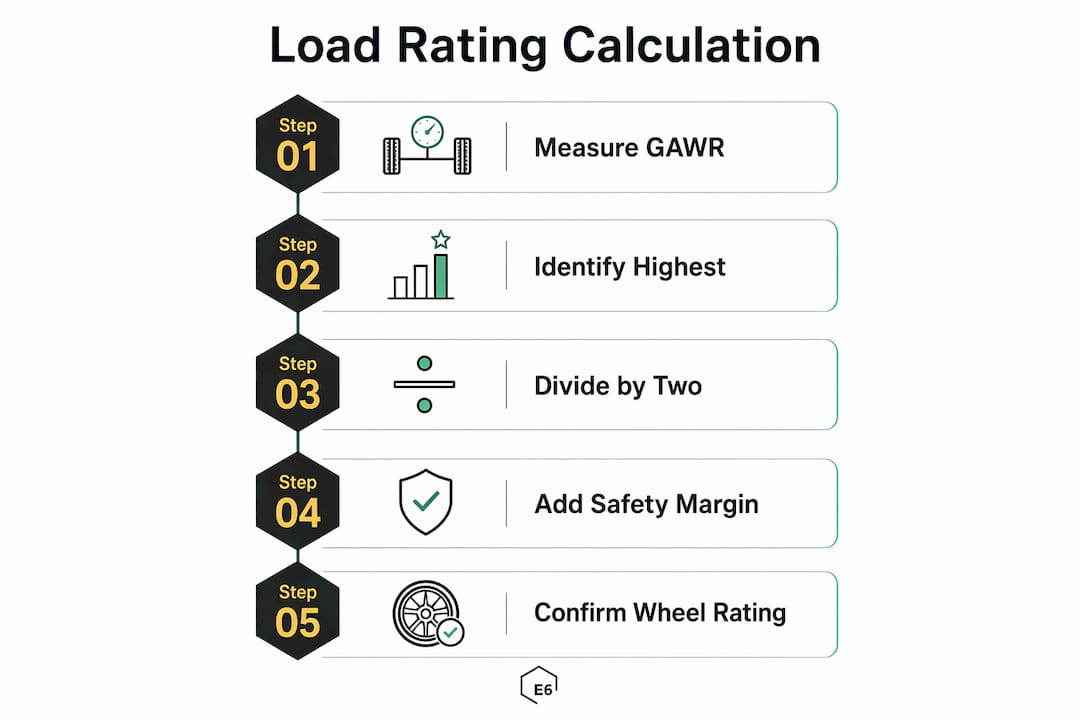
Step 1: Find your GAWR values. Open the driver’s door and look at the certification label on the door jamb. You’ll see two GAWR figures: one for the front axle and one for the rear. If the label is missing or illegible, the owner’s manual lists the same values, and the NHTSA vehicle database is a reliable backup for most U.S.-market vehicles.
Step 2: Identify the higher GAWR. On most trucks and SUVs, the rear GAWR is higher. On some performance cars, the front and rear are close. Take whichever number is larger.
Step 3: Divide by two. That result is your minimum per-wheel load rating. Every wheel on the vehicle must meet or exceed this number before you add any margin.
Worked example: A Mercedes-AMG GLE 63 S has a rear GAWR higher than typical values. Dividing that number by two gives a hard floor minimum per-wheel load rating, to which owners should add an appropriate margin for street or heavier use. If you’re adding a roof rack, a full tank of fuel, and four passengers, that per-corner load climbs further, and a 15–20% margin becomes the responsible choice.
Larger tires compound this fast. Upgrading to 35"–37" tires can add roughly 30–50 lbs per corner before you’ve added a single accessory. Factor that into your margin calculation, not as an afterthought.
Pro Tip: If your vehicle has been modified with a lift kit, larger tires, or a heavier bumper, the door-jamb GAWR no longer reflects actual per-corner loads. In that case, weigh the vehicle at a truck scale with a full tank, typical cargo, and all accessories installed, then use the measured axle weights as your baseline instead.
Where to find a wheel’s load rating before you buy
Knowing your minimum required rating is only half the job. You also need to confirm what the wheel you’re considering is actually rated for, and where that number comes from.
On the wheel itself:
- The load rating is stamped or cast into the back face of the wheel, typically on the inner barrel near the valve stem hole or on the back of the spoke roots
- Look for text reading “Max Load: XXXX lbs” or “Load Rating: XXXX kg”
- The stamp should also include the manufacturer’s identification code, a date-of-manufacture code, and a DOT symbol for U.S.-market wheels
- On multi-piece forged wheels, the rating may appear on the center section rather than the outer barrel
On spec sheets and vendor listings:
- Reputable vendors list load rating as a standalone field, not buried in a general description
- Confirm the rating is size-specific. A wheel rated at 2,200 lbs in a 19×8.5 configuration may carry a different rating in a 20×10.5 fitment. The geometry changes, and so does the structural capacity
- Wheels should carry permanent, legible markings including load rating, date of manufacture, manufacturer code, and DOT symbol; request J2530 documentation where available
What to request from a vendor:
- Size-specific test certificates (SAE J2530 or JWL-T) for the exact diameter and width you’re ordering
- A written confirmation that the stated load rating applies to your specific fitment, not a generic family rating
- For off-road or towing applications, ask whether the wheel has been tested to JWL-T, which uses higher cycle counts and impact multipliers than the standard JWL protocol
Why load rating matters: fatigue, forging, and testing standards
This is where understanding wheel ratings goes beyond a single number on a label.
Wheel failures are most often caused by cumulative fatigue from repeated dynamic loading, not a single catastrophic overload. A wheel can survive a hard pothole hit and still be accumulating microscopic crack propagation in the spoke roots or barrel that will eventually cause failure. That’s why fatigue life, not peak static strength, is the engineering metric that actually matters.
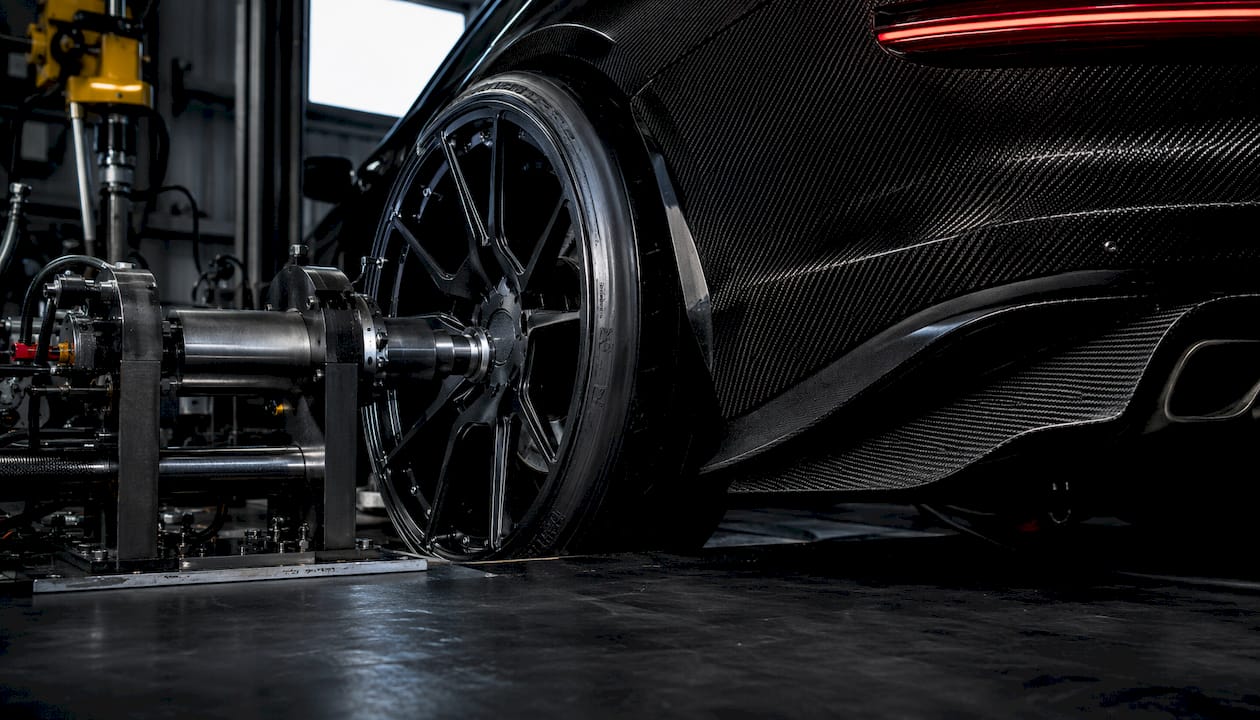
Dynamic events like cornering and hard braking can multiply the static load on the outside wheel by approximately 1.35× or more during sustained cornering, with impact events producing multi-g spikes. Standards like SAE J2530 and JWL-T are built around these multipliers, running thousands of load cycles at elevated forces to simulate years of real-world service.
How manufacturing method affects fatigue life
Forging compresses a billet under extreme pressure to align the grain structure of the aluminum, producing a wheel that achieves a superior strength-to-weight ratio versus a cast wheel of the same mass. Cast wheels, by contrast, have a random grain structure with potential micro-voids that become crack initiation sites under cyclic loading. Flow-forming improves on basic casting by stretching the barrel section, but the center section remains cast. For high-cornering, high-braking platforms, the forging advantage in fatigue resistance is the reason engineers specify it, not aesthetics.
Stiffness and strength are also distinct properties, a point worth stating plainly. A wheel can be laterally stiff and still fail in fatigue if the material selection and design don’t prioritize endurance. Monoblock forged or purpose-designed multi-piece forged constructions typically outperform cast alternatives in high-load, high-cycle applications precisely because the manufacturing process controls both properties simultaneously.
Voluntary testing standards at a glance
| Standard | Primary tests | What a passing result tells you |
|---|---|---|
| SAE J2530 | Dynamic cornering fatigue, radial fatigue, impact | Wheel meets U.S. aftermarket load and impact criteria |
| JWL | Rotational bending fatigue, radial endurance, impact | Wheel meets Japanese light-alloy quality baseline |
| JWL-T | Higher-cycle rotational bending, radial endurance, drop impact | Wheel validated for truck/4×4 severe-duty loads |
| VIA | Third-party verification of JWL compliance | Independent confirmation of JWL test results |
DOT does not mandate strength testing for aftermarket wheels; SAE J2530 and JWL-T are voluntary. That means a wheel can legally carry a load rating stamp without any fatigue testing behind it. A published load number without a test certificate is a marketing claim, not a validated engineering specification.
Platform notes:
- Mercedes-AMG (GLE 63, GT, C63): AMG platforms generate high lateral g-forces and sustained braking loads. The rear axle GAWR on full-size AMG SUVs frequently exceeds 4,000 lbs, putting the per-wheel minimum above 2,000 lbs before any margin. Fatigue-rated forged wheels with J2530 documentation are the appropriate choice, not flow-formed alternatives.
- Lexus LC500: The LC500’s front-heavy weight distribution and wide-body fitments (up to 21×10.5 rear) create geometry-specific load paths that standard ratings don’t always capture. Size-specific testing for the exact fitment is non-negotiable on this platform.
- McLaren and Lamborghini: Both platforms run extreme cornering loads and low-profile tires that transmit impact energy directly to the wheel. The combination of high dynamic loads and minimal tire sidewall compliance means fatigue life is the dominant design constraint. Monoblock vs. multi-piece forged construction choices matter here more than on any street-only application.
Choosing the right margin for street, towing, off-road, and track
The minimum rating from your GAWR calculation is a floor, not a target. Here’s how to set the right margin for each use case.
| Use case | Recommended margin above minimum | Fatigue testing required? |
|---|---|---|
| Street only | +5–10% | Recommended; ask for J2530 |
| Towing / heavy cargo | +15–30% | Yes — J2530 or JWL-T |
| Off-road (mild to moderate) | +25–35% | Yes — JWL-T preferred |
| Off-road (severe / rock crawl) | +40–50% | Yes — JWL-T with impact cycles |
| Track / performance driving | +10–25% | Yes — J2530 cornering fatigue |
A few practical points that don’t fit neatly into a table:
- Larger tires increase per-corner load directly. If you’re running 35" tires and a steel front bumper on a truck, your actual per-corner load can be 200–300 lbs above what the door-jamb GAWR implies. Build that into your margin before you order.
- Towing shifts weight rearward under load. The rear axle can approach or reach its GAWR with a loaded trailer, which means the rear wheels need to be rated for that full dynamic load, not a comfortable average.
- Track use introduces sustained high-g cornering that pushes the outside wheel well above its static share of vehicle weight. The 1.35× cornering factor used in J2530 testing is a baseline; aggressive track sessions can exceed it.
Pro Tip: For any build involving towing, severe off-road, or track use, request the actual J2530 or JWL-T test report for your specific wheel size, not just a generic family certificate. A certificate issued for a 17×8 wheel does not validate a 20×10 fitment of the same model. Size-specific documentation is the only documentation that counts.
How wheel load rating differs from tire load index
These two numbers measure different things, and confusing them is one of the most common mistakes owners make when sourcing aftermarket setups.
Wheel load rating is a structural property of the wheel itself. It describes how much load the aluminum, steel, or carbon structure can sustain across its fatigue life.
Tire load index is a standardized code on the tire sidewall that indicates the maximum load the tire can carry at its maximum rated inflation pressure. A load index of 100 corresponds to 1,764 lbs; 110 corresponds to 2,337 lbs. The full conversion table is published by the Tire and Rim Association and is available on most major tire retailer sites.
Tire speed rating is a separate letter code (H, V, W, Y) indicating the maximum sustained speed the tire is designed for. It has no direct relationship to load capacity.
The key points owners miss:
- A tire with a high load index does not compensate for an undersized wheel. Both must independently meet or exceed the expected per-wheel dynamic load.
- Matching tire load index to wheel load rating is not the goal. Both must independently meet or exceed the expected per-wheel dynamic load.
- Running a tire with a higher load index than the wheel’s rating creates a false sense of security. The tire may be capable; the wheel may not be.
- Speed rating and load rating are independent. An H-rated tire is not necessarily a high-load tire.
The actionable rule: confirm that both the wheel’s load rating and the tire’s load index, converted to pounds, meet or exceed your calculated per-wheel minimum, including your use-case margin. One without the other is incomplete.
Common mistakes and red flags when sourcing wheels
Mistakes owners make in the calculation
Using GVWR instead of GAWR. GVWR is the total vehicle maximum weight. Dividing it by four gives you an average that ignores the actual axle-by-axle distribution. The rear axle on a truck can carry significantly more than the front, and the wheel rating must reflect that, not a mathematical average.
Dividing curb weight by four. Curb weight is the vehicle empty. It ignores passengers, cargo, fuel, and accessories, all of which add real load at each corner.
Assuming the tire’s load index covers the wheel. It doesn’t. The tire and wheel are separate structural components with separate ratings.
Ignoring size-specific ratings. A wheel model rated at 2,400 lbs in one size may be rated lower in a wider or larger-diameter fitment. Always confirm the rating for your exact size.
Red flags on used or budget aftermarket wheels
- Missing or illegible Max Load stamps on the back face or inner barrel
- No manufacturer identification code or date-of-manufacture marking
- Evidence of welding, crack repair, or straightening, even if cosmetically clean
- Mismatched offset or size from the original certification without re-rating documentation
- A vendor who cannot produce a test certificate when asked
Handling failures on heavy-duty trucks, including the kind of instability described in guides on death wobble, can sometimes trace back to wheel fitment issues, undersized ratings, or structural fatigue that went undetected. Verifying wheel ratings before installation is a straightforward step that eliminates one of those variables entirely.
Pro Tip: Before installing any used wheel, run the manufacturer code and date stamp through the manufacturer’s verification process if available. A wheel that’s ten years old and has been on a work truck may have accumulated enough fatigue cycles to be near end-of-life even if it looks undamaged. When in doubt, the cost of a new wheel is always less than the cost of a failure.
Key Takeaways
The single most important rule in wheel selection: your per-wheel load rating must meet or exceed your vehicle’s highest GAWR divided by two, plus a use-case margin that reflects how you actually drive.
| Point | Details |
|---|---|
| Use GAWR, not GVWR | Divide the highest axle GAWR by two to find your true per-wheel minimum rating. |
| Add use-case margin | Street needs +5–10%; towing needs +15–30%; off-road needs +25–50%; track needs +10–25%. |
| Demand size-specific testing | A J2530 or JWL-T certificate for a different size does not validate your fitment. |
| Wheel and tire ratings are independent | Both must independently meet or exceed your calculated per-wheel dynamic load. |
| E6 Carbon forged wheels | E6 Forged wheels are engineered with size-specific fatigue validation for AMG, Lexus LC500, and McLaren/Lamborghini platforms. |
The engineering case for fatigue-first wheel design
Most buyers focus on load rating as a single number. The engineers who design wheels think about it differently: the number is only as credible as the test protocol behind it, and the test protocol is only as relevant as the manufacturing process that produced the wheel.
Forging is not a premium feature. It’s the process that makes a stated load rating defensible. When a billet is compressed under tens of thousands of pounds of force, the aluminum grain structure aligns along the load paths of the finished wheel. That alignment is what gives a forged monoblock wheel its fatigue resistance, not the alloy grade alone and not the wall thickness. A cast wheel of the same weight, tested to the same standard, will typically show earlier crack initiation under cyclic loading because the grain structure is random and the micro-voids are present from the pour.
At E6 Carbon, the engineering priority for every forged wheel program is fatigue life first, unsprung weight second, and aesthetics third. For Mercedes-AMG platforms, that means validating each size against the rear GAWR loads that AMG SUVs and coupes actually generate under hard driving, not against a generic passenger-car standard. For the Lexus LC500, it means accounting for the platform’s specific offset requirements and the load paths created by its wide rear fitment. For McLaren and Lamborghini builds, where low-profile tires transmit impact energy almost directly to the wheel structure, it means specifying forged monoblock or precision multi-piece constructions that keep the fatigue margin well above what the minimum rating implies.
The forged wheel tolerances that govern E6’s manufacturing process exist for the same reason: a wheel that doesn’t run true introduces cyclic bending loads that the fatigue calculation never accounted for. Tight tolerances and documented testing are two sides of the same engineering commitment.
E6 Forged wheels built for your load requirements
If your GAWR calculation puts you above 2,000 lbs per wheel, or if your build involves towing, severe off-road, or sustained track use, a generic aftermarket wheel with an unverified load rating is the wrong answer.

E6 Forged wheels are engineered from the axle load up. Every configuration, monoblock, multi-piece, beadlock, and AeroDisc, is developed with size-specific fatigue validation and platform-matched fitment engineering for Mercedes-AMG, Lexus LC500, McLaren, and Lamborghini. The load rating on an E6 Forged wheel reflects actual test data for your exact size, not a family average.
For technically demanding builds, E6 Carbon provides full engineering documentation and fitment consultation. If you’re replacing wheels on a platform where the load margin actually matters, start with the E6 Forged wheel catalog and request size-specific certification for your fitment.
Useful sources
- What is Load Rating? — American Racing: Primary source for the GAWR-based minimum calculation method used throughout this article.
- Understanding Load Rating — Fuel Off-Road Wheels: Practical guidance on how tire and accessory upgrades increase per-corner load; source for the 30–50 lb per-corner figure for large tire upgrades.
- Are Your Aftermarket Wheels Safe? — Performance Plus Tire: Covers SAE J2530 testing scope, DOT marking requirements, and what documentation to request from vendors.
- The Hidden Math: What Your Wheel’s Load Rating Really Needs to Handle — Osmond Forged: Technical explanation of fatigue failure modes, dynamic load multipliers, JWL-T test cycles, and severe-duty rating ranges.
- Wheel Design and Strength Explained — The Tundra Drums: Covers forging vs. casting grain structure and the strength-to-weight implications for high-performance platforms.
- Wheel Ratings Explained: SAE, JWL, VIA — Element Wheels: Overview of the three major voluntary wheel rating standards and what each certification confirms.
FAQ
What should my wheel load rating be?
Your per-wheel rating must meet or exceed your vehicle’s highest GAWR divided by two, plus a margin based on use: add 5–10% for street, 15–30% for towing, and 25–50% for off-road. Never use GVWR or curb weight as your baseline.
What is the 105% rule for rims?
A common vendor guideline is that a wheel’s load rating should have a conservative minimum margin above the per-wheel load it will carry in service for street use; towing and off-road applications warrant a larger buffer of 15–50% above the calculated minimum.
What’s better, load range D or E?
Load range applies to tires, not wheels. A load range E tire carries a higher maximum load than a load range D tire at its rated inflation pressure. For heavy trucks and towing, load range E is the standard choice, but the wheel must be independently rated to match or exceed the same per-wheel load the tire is designed to carry.
What is better, H or V rating on tires?
H and V are speed ratings, not load ratings. These letters indicate maximum sustained speeds, with H and V representing different speed thresholds. Neither designation indicates higher load capacity. Check the tire’s load index separately to confirm it meets your per-wheel load requirement.
Can a high tire load index substitute for a higher wheel rating?
No. The tire load index and the wheel load rating are independent structural specifications. A tire with a high load index does not compensate for an undersized wheel. Both must independently meet or exceed your calculated per-wheel dynamic load, including your use-case margin.