TL;DR:
- Track-spec wheels reduce unsprung weight, improve rigidity, and better manage brake heat, essential for safety and performance on the track. Proper manufacturing processes and precise fitment are critical, especially for high-performance platforms like Mercedes-AMG, Lexus LC500, McLaren, and Lamborghini, which require verified engineering specifications. Selecting wheels based on fitment accuracy and platform-specific design features guarantees optimal handling and durability during intense circuit use.
Track-spec wheels improve repeatable lap times, reduce the risk of catastrophic wheel failure, and manage brake and tire heat better than standard road wheels. If you’re running more than a few track days per year, or if your brake package has grown beyond stock, the wheel choice stops being cosmetic and starts being a safety and performance variable.
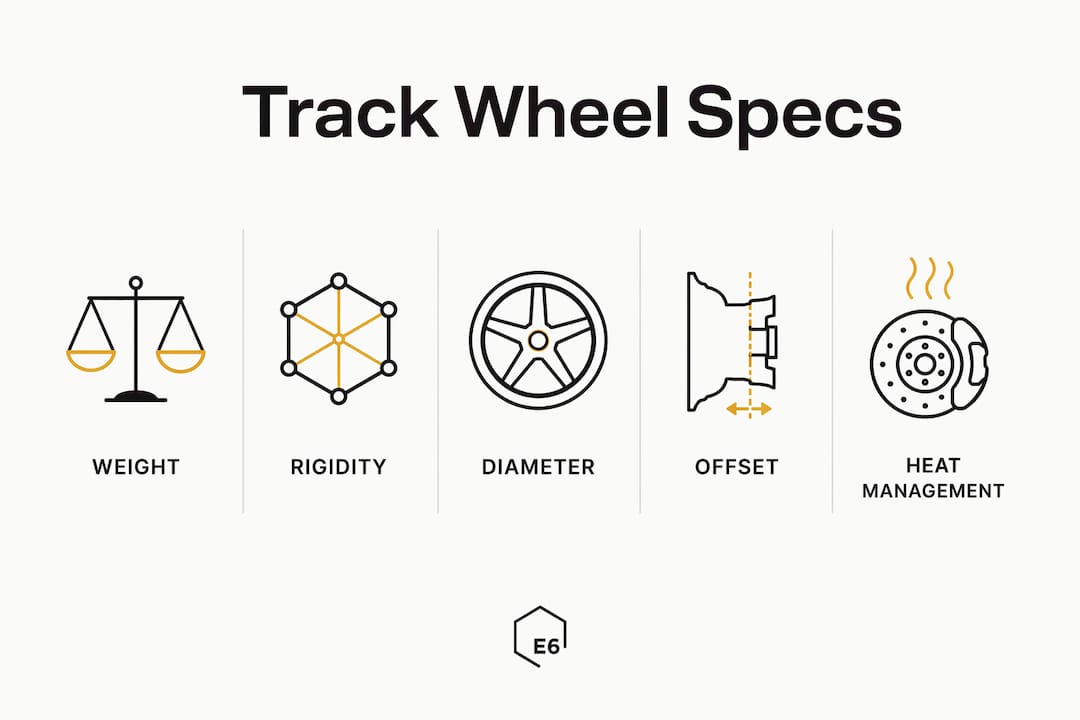
The core engineering reasons come down to five things:
- Reduced unsprung and rotational mass — less weight at the corner means faster suspension response and shorter braking distances
- Higher structural rigidity — stiffer barrels and spokes keep the contact patch stable under lateral load
- Superior thermal conduction — dense forged metal pulls heat away from the hub and brake rotor instead of trapping it
- Predictable failure mode — forged wheels bend under impact; certain cast wheels crack or shatter, which is a very different problem at speed
- Correct fitment geometry — offset, backspacing, and center bore matched to your suspension and brake package, not just your bolt pattern
Pro Tip: If you’re doing more than six track days per year on a car with upgraded brakes, treat wheel selection the same way you treat brake fluid selection: it’s part of the thermal management system, not an afterthought.
When to prioritize track wheels: high-frequency track use (six or more days per year), cars with big-brake kits that demand specific caliper clearance, and platforms like the Mercedes-AMG GT, Lexus LC500, and McLaren 720S where factory wheel weights and offsets are already a compromise between road comfort and circuit performance.
Table of Contents
- What “track-spec” actually means in engineering terms
- How track-spec wheels change what happens on the car
- Wheel specs that matter on track: what each number actually does
- Track-specific design features worth understanding
- How to choose the right track wheel for your car
- Tradeoffs, failure modes, and maintenance
- How E6 Forged engineers true track-spec wheels
- Key Takeaways
- The part most buyers get wrong
- E6 Forged wheels: built for the track, fitted to your platform
- Further reading and useful sources
- FAQ
What “track-spec” actually means in engineering terms
The phrase gets applied loosely. A wheel marketed as “track-spec” might be nothing more than a lightweight cast wheel with an aggressive spoke design. What the term should mean, and what it means when applied correctly, is application-specific engineering: the manufacturing process, material properties, tolerances, and fitment geometry are all chosen for the mechanical demands of circuit driving, not street compliance.
Manufacturing categories that actually matter
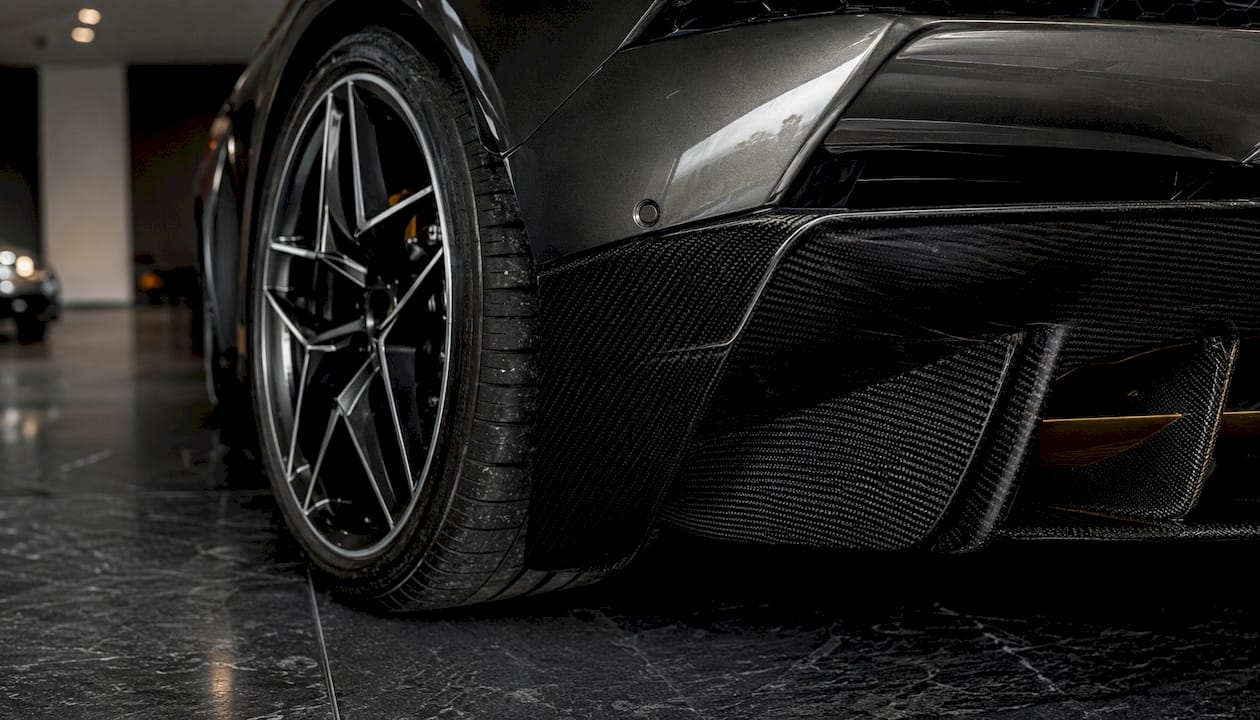
Gravity cast wheels are poured into molds. The process is inexpensive, but it produces a porous microstructure with inconsistent grain density. That porosity insulates heat and creates stress concentration points. For occasional street use, fine. For repeated hard braking zones, it’s a liability.
Flow-formed (sometimes called rotary-forged) wheels start as a cast blank, then the barrel is stretched under heat and pressure. The barrel gets meaningfully stronger and lighter than a pure cast equivalent, but the face and spokes remain cast, leaving a structural gap that matters under sustained cornering loads.
Fully forged wheels — monoblock or multi-piece — are pressed from a solid billet under thousands of tons of force. The grain structure aligns continuously through the entire cross-section. The result is a denser, more uniform material that conducts heat, resists fatigue, and tolerates impact in a fundamentally different way. For track use, this is the manufacturing standard that the label “track-spec” should imply.
Monoblock vs. multi-piece: a monoblock forged wheel is machined from a single forging, which maximizes stiffness and eliminates the barrel-to-face joint. Multi-piece designs (two- or three-piece) allow width and offset customization without a new forging, which is useful for unusual fitments, but the bolted or welded joint introduces a potential flex point under extreme cornering loads. For pure track performance, monoblock wins on rigidity. For fitment flexibility on exotic platforms, multi-piece has a legitimate role.
Pro Tip: Ask any wheel vendor for their load test data and manufacturing traceability documentation. A vendor who can’t produce either is selling you marketing, not engineering.
How track-spec wheels change what happens on the car
Unsprung weight and rotational inertia
Every pound removed from an unsprung corner has an outsized effect compared with removing the same pound from the chassis. The suspension doesn’t have to work as hard to keep the tire in contact with the road surface over bumps and curbs. Braking distances shorten because the rotating assembly decelerates faster. Turn-in response sharpens because the wheel follows the steering input instead of lagging behind it. A forged wheel can be 20–30% lighter than a cast wheel of the same dimensions, and that reduction shows up in every braking zone and every direction change.
Structural rigidity and contact patch stability
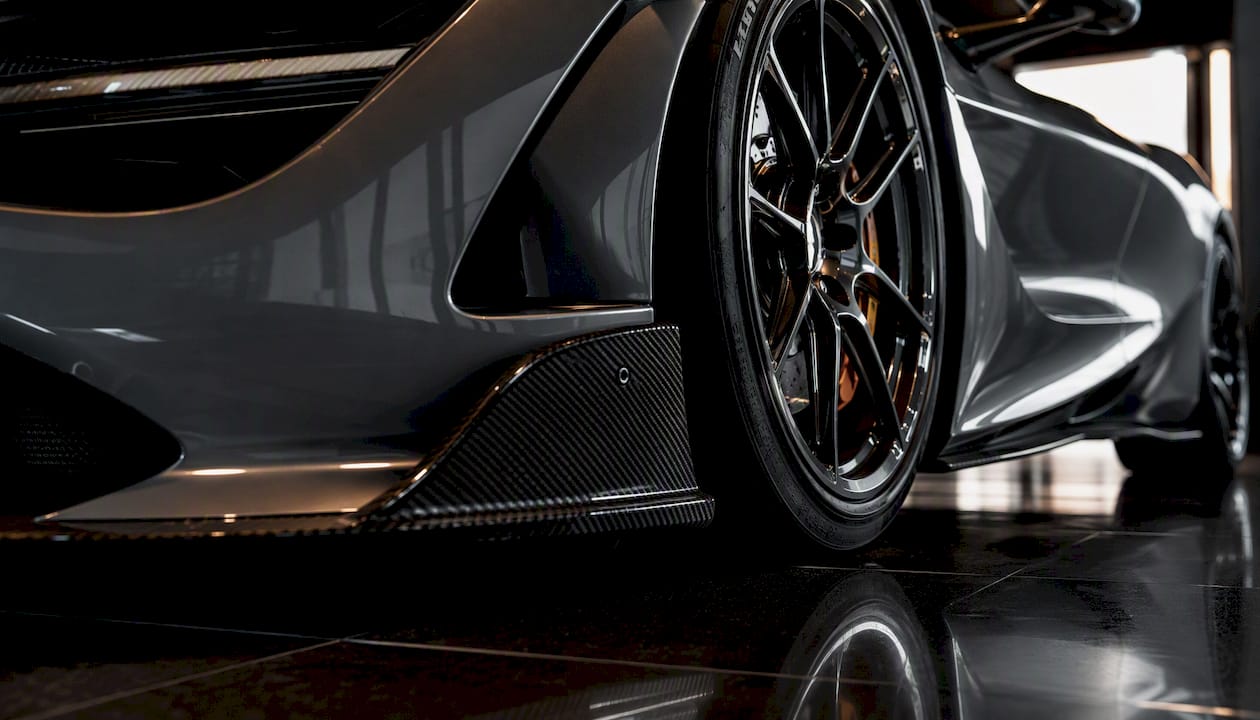
Under hard cornering, a wheel with insufficient barrel stiffness flexes. That flex changes the tire’s contact patch shape, which changes the grip level in a way the driver can’t predict or compensate for. Worse, inner barrel flex under extreme lateral load can bring the barrel into contact with the brake caliper — a scenario that ends the session and potentially the wheel. Forged monoblock wheels are engineered with the structural rigidity to prevent barrel flex and the resulting interference. The contact patch stays consistent, and the car’s behavior stays predictable.
Thermal behavior: heat sink vs. heat trap
Brake rotors on circuit can exceed 600°C during sustained hard braking. At those temperatures, unmanaged heat migrates from the rotor through the hub and into the wheel. Cast wheels, with their porous microstructure, act as insulators — heat builds in the hub area, accelerating brake fluid boil and degrading tire compound at the bead. Forged wheels, with their dense unified grain structure, conduct heat away from the hub and distribute it across the wheel mass, keeping the brake operating window stable across multiple laps.
This is why wheel material choice is part of brake bias adjustment and thermal management strategy, not just an aesthetic decision.
Failure modes: bend vs. shatter
When a forged wheel takes a hard curb strike or pothole at speed, it tends to deform plastically. The bead seat stays intact, the tire stays mounted, and the driver retains control long enough to slow down safely. Certain cast wheels, particularly those with higher silicon content for fluidity during casting, are more brittle. They can crack or fracture through the spoke or barrel, causing sudden tire deflation. At 100 mph on a circuit, those two failure modes are not equivalent.
Wheel specs that matter on track: what each number actually does
| Spec | What it controls | Track-relevant note |
|---|---|---|
| Diameter | Sidewall height, heat soak, tire availability | 17–18 in. often preferred for mechanical grip and curb compliance |
| Width | Contact patch size, tire fitment range | Match to tire width; too wide causes shoulder wear |
| Offset (ET) | Scrub radius, track width, suspension geometry | Incorrect offset alters handling and can cause caliper contact |
| Backspacing | Inner clearance to suspension/caliper | Measure carefully; affects weight distribution on circle-track setups |
| Bolt pattern | Hub compatibility | Must match exactly; no adapters on track |
| Center bore | Hub centricity | Hub-centric fit eliminates vibration; lug-centric requires precise torque |
| Load rating | Maximum static load per wheel | Must exceed 105% of corner weight for track certification |
Diameter: why smaller is often faster
Many track cars run 17–18 inch wheels rather than the 19–21 inch diameters that come on modern performance cars from the factory. A taller sidewall absorbs curb strikes without transmitting the full shock to the suspension, and it gives the tire more thermal mass to work with across a stint. Upsizing to larger diameters reduces sidewall compliance and can increase heat soak in the tire. Amateur racers frequently find that downsizing from factory diameters yields more consistent lap times and better behavior over the rumble strips.
The 105% rule
When you change wheel diameter, the overall outside diameter of the tire-and-wheel assembly should stay within 105% of the original equipment specification. Going beyond that threshold affects speedometer accuracy, but more importantly for track use, it changes suspension geometry, alters the effective final drive ratio, and can create clearance issues with the fender and brake components. The rule applies whether you’re upsizing or downsizing.
Offset, backspacing, and scrub radius
Offset is the distance from the wheel’s mounting face to its centerline, measured in millimeters. Positive offset pushes the wheel inward; negative offset pushes it outward. Backspacing is the distance from the mounting face to the inner edge of the barrel. Both values affect scrub radius — the distance between the steering axis and the tire’s contact patch center. Change scrub radius significantly and you change how the car reacts to braking forces and road irregularities. On a platform like the Mercedes-AMG GT or Lexus LC500, the factory offset is engineered to work with the suspension geometry. Deviating from it without understanding the consequences degrades handling even if the wheel itself is stronger.
Hardware: lug taper and torque
Many race wheels use a 45° lug seat taper rather than the 60° taper common on street hardware. The shallower angle increases the clamping surface area under load. Using the wrong lug hardware with a race wheel reduces clamping force and introduces the risk of wheel movement under hard acceleration or braking. Always confirm lug seat angle when sourcing hardware for a dedicated track setup.
Pro Tip: Verify brake kit compatibility before finalizing wheel diameter and offset. A 380mm front rotor with a six-piston caliper on a Mercedes-AMG C63 requires specific spoke geometry and inner barrel clearance that many catalog wheels don’t provide.
Track-specific design features worth understanding
Beyond material and manufacturing, several design features separate purpose-built track wheels from wheels that are merely light:
- Beadlock rings mechanically clamp the tire bead to the wheel, preventing de-beading at very low pressures. They’re standard in off-road and rally applications where tire pressure drops intentionally. On closed-circuit track use, most sanctioning bodies don’t require them, and the added weight of the ring partially offsets the benefit. High-lip welded bead designs offer a middle ground: a raised outer lip that resists de-beading under lateral load without the weight penalty of a full beadlock ring.
- Center-lock systems replace the multi-lug arrangement with a single large nut at the hub center. The advantages are faster wheel changes (critical in endurance racing), more even clamping load distribution, and a cleaner spoke design with no lug-hole stress concentrations. The tradeoff is hub compatibility: center-lock hubs require specific adapters or factory-equipped hubs, and the tooling is specialized.
- Reinforced lips and spokes are engineered with additional material at the highest-stress points. On a monoblock forged wheel, FEA (finite element analysis) optimization identifies where stress concentrates under cornering and braking loads, and the forging is shaped accordingly. The result is a wheel that’s heavier only where it needs to be.
- Spoke ventilation geometry channels airflow toward the brake rotor face. Open spoke designs with large windows between spokes move more air than closed or mesh designs. On a car with large-diameter rotors and aggressive brake pads, spoke geometry can measurably affect rotor temperature across a stint.
- Hard anodizing provides a surface hardness that resists the abrasion of brake dust, stone chips, and cleaning chemicals better than standard anodizing or paint. Powder coat is more impact-resistant but less chemically resistant. For a dedicated track wheel that will be cleaned frequently and exposed to brake dust and heat, hard anodizing is the lower-maintenance finish.
How to choose the right track wheel for your car
The selection checklist
- Define your track use and frequency. A car doing two track days per year has different requirements than one running a full SCCA season. Higher frequency justifies higher investment in forged construction and tighter tolerances.
- Verify brake clearance first. Measure the caliper at its widest point and the rotor diameter. Confirm the wheel’s inner barrel diameter and spoke-to-caliper clearance before anything else. This step eliminates most catalog options immediately.
- Pick diameter based on tire availability and discipline. Check what competition tires are available in your target size. If the best tire for your class comes in a 17-inch fitment, the wheel diameter decision is already made.
- Confirm offset and backspacing against your suspension geometry. Use the factory offset as a baseline. Deviations require verification against suspension travel, fender clearance, and scrub radius effects.
- Verify bolt pattern, center bore, and lug seat angle. Hub-centric fit is non-negotiable for track use. Confirm lug seat taper matches your hardware.
- Check load rating against corner weight. Weigh the car, calculate corner weights, and confirm the wheel’s published load rating exceeds 105% of the heaviest corner.
- Confirm torque specification and balancing procedure. Get the manufacturer’s torque spec and re-torque interval. Balance with the correct adapter for hub-centric wheels.
Platform-specific fitment notes
Mercedes-AMG GT / C63 / E63: These platforms run large-diameter factory wheels (19–21 inches) with aggressive positive offsets to accommodate wide tracks and big brake packages. Moving to a track-focused 18-inch setup requires careful offset verification to maintain scrub radius and avoid inner barrel contact with the AMG-specific caliper geometry. E6 Carbon’s “Fitment First” approach addresses this directly, with AMG-specific engineering guidance for offset and clearance.
Lexus LC500: The LC500’s front suspension geometry is sensitive to offset changes. The factory 21-inch front wheel runs a specific ET that keeps the steering feel neutral. Downsizing to 19 inches for track use requires an offset recalculation to preserve that geometry. Width is also constrained by the front fender arch, so tire pairing needs to account for the narrower fitment window.
McLaren and Lamborghini: Both platforms use center-lock or close-tolerance multi-lug hubs with very specific center bore requirements. McLaren’s hub-centric bore is non-standard, and Lamborghini’s Huracán and Urus platforms each have distinct fitment profiles. Aftermarket wheels for these cars require verified bore dimensions and, in many cases, platform-specific load testing.
Pro Tip: Never rely on a wheel vendor’s generic fitment chart for an exotic platform. Request platform-specific engineering documentation, or work with a manufacturer who builds to order with verified fitment data for your exact model year.
Tradeoffs, failure modes, and maintenance
Track wheels are not a free upgrade. The engineering advantages come with real tradeoffs:
- Cost: A set of quality forged monoblock wheels for an exotic platform costs significantly more than cast or flow-formed alternatives. That cost is justified by the performance and safety margins, but it’s a real number.
- Ride harshness: Stiffer construction and lower-profile tires (often paired with smaller-diameter track wheels) transmit more road noise and impact to the chassis on the street. A dedicated track set solves this; a dual-purpose set requires compromise.
- Cosmetic damage: Track environments produce brake dust, stone chips, and occasional curb contact. Hard anodized or durable powder-coated finishes help, but a track wheel will show wear faster than a garage queen.
- Consumable lifecycle: Wheels used aggressively on track should be inspected after every event and considered consumable items after sustained hard use.
Inspection checklist
- Pre-event: torque all lugs to spec, check for visible cracks at spoke roots and inner barrel
- Post-event: inspect for runout with a dial indicator, check bead seating visually, look for heat discoloration at the hub face
- After any hard impact: remove the wheel and inspect the inner barrel and spoke faces under good lighting before returning to track
- Service life: replace or have professionally inspected after significant impacts or after roughly 10–15 heavy track days, depending on the severity of use
Pro Tip: Crack initiation almost always starts at spoke roots or at the transition between the barrel and the face. Those are the areas to examine first, and a UV dye penetrant test will find cracks that are invisible to the naked eye.
How E6 Forged engineers true track-spec wheels
E6 Carbon’s forged monoblock wheels are built around the engineering requirements that the sections above describe, not around a catalog of available sizes. The manufacturing process starts with 6061-T6 aluminum billet, forged under high pressure to produce a continuous, dense grain structure through the entire cross-section. FEA optimization shapes the spoke geometry and barrel thickness to put material where stress concentrates and remove it where it doesn’t contribute to structural performance.
Key engineering proof points:
- Tight tolerances throughout: bore dimensions, offset, and balance are held to specifications that eliminate the hub-centric slop common in mass-market wheels
- Load testing and traceability: each wheel is load-tested and traceable to its manufacturing batch, which matters when you’re running a car at its limits on a closed circuit
- Platform-specific fitment: E6 Carbon’s “Fitment First” approach means offset, backspacing, and inner barrel geometry are verified against the actual suspension and brake geometry of the target platform, not estimated from a generic fitment chart
For Mercedes-AMG platforms, E6 Carbon addresses the large-caliper clearance requirement directly in the spoke design. For the Lexus LC500, the offset is calculated to preserve the factory steering geometry while accommodating the track tire size. For McLaren and Lamborghini, hub bore dimensions and load ratings are verified against the platform’s specific structural requirements.
E6 Carbon also produces autoclave-cured carbon fiber components using 2×2 twill layup schedules, for applications where wheel weight reduction beyond what forged aluminum can achieve is the priority. These components go through the same FEA-driven design process and the same traceability procedures as the forged wheel program.
Pro Tip: When evaluating any forged wheel for track use, ask for the published tolerance specifications and load test results. A manufacturer who publishes these openly is one whose engineering claims you can verify.
Key Takeaways
Track-spec wheels reduce unsprung and rotational mass, improve structural rigidity, and manage brake heat better than standard road wheels, making them a genuine performance and safety upgrade for circuit use.
| Point | Details |
|---|---|
| Weight reduction is measurable | Forged wheels can be 20–30% lighter than cast equivalents, improving suspension response and braking. |
| Thermal management matters | Dense forged grain conducts heat away from the hub; cast porosity traps it, accelerating brake fade. |
| Fitment geometry is non-negotiable | Incorrect offset or backspacing degrades handling even on a structurally superior wheel. |
| Wheels are consumables on track | Inspect after every event; plan for replacement after roughly 10–15 heavy track days. |
| E6 Carbon builds to platform spec | E6 Forged monoblock wheels use FEA optimization and verified fitment for AMG, LC500, and McLaren/Lamborghini platforms. |
The part most buyers get wrong
The conversation around track wheels almost always centers on weight. Grams saved, rotational inertia reduced, lap times improved. That’s real, and the physics are straightforward. But the engineering judgment that actually separates a good track wheel from a dangerous one is fitment geometry, and it’s the part that gets the least attention.
A wheel that’s 2 kg lighter than the factory option but runs 8mm more positive offset than the platform requires will change the scrub radius, alter the steering feel, and potentially bring the inner barrel closer to the caliper than the design allows. The weight saving shows up in the spec sheet. The fitment error shows up at turn-in speed, or worse, at the point where the barrel contacts the caliper.
Performance engineers describe the margin between a personal best lap and a mechanical failure as razor-thin. The wheel is where that margin is either protected or eroded. Buying on weight alone, without verifying offset, load rating, and brake clearance against your specific car and brake package, is the most common and most consequential mistake in the track wheel selection process. The correct approach is to treat fitment verification as the first step, not the last.
E6 Forged wheels: built for the track, fitted to your platform
If the engineering case above describes what you need, E6 Carbon’s forged monoblock wheel program is built to deliver it. Every set is manufactured from 6061-T6 billet, FEA-optimized for the target platform, and load-tested before it ships. Offset, backspacing, and center bore are verified against your specific car, not estimated from a generic fitment database.
For Mercedes-AMG, Lexus LC500, McLaren, and Lamborghini owners, E6 Carbon offers platform-specific engineering consultation alongside the wheel order, so the fitment geometry is correct before the wheels are machined. The result is a wheel that performs the way the engineering promises, on the first track day and the fifteenth.
Explore the E6 Forged wheel catalog and request a platform-specific fitment consultation to get the right specification for your car and brake package.
Further reading and useful sources
- Track Day Performance: Why Professional Racers Choose Forged Over Cast — detailed comparison of forged vs. cast manufacturing, thermal behavior, and failure modes; the most technically complete source on this topic
- Stop Choosing the Wrong Track Wheels: 5 Critical Factors Explained — practical fitment guidance covering offset, backspacing, and application-specific engineering for track platforms
- Best Wheel Specs for Track Driving — covers diameter, width, and offset tradeoffs with track-specific context; useful for the diameter and tire pairing sections
- How to Find the Ideal Wheel and Tire Size for Your Track Car — Grassroots Motorsports empirical testing on how diameter, width, and sidewall height interact in real track conditions
- Racing Wheel Guide: Design, Torque, Offset and Backspacing — Speedway Motors reference on lug taper, torque procedures, and backspacing measurement; essential for hardware and fitment verification
- How to Choose the Right Wheel Package for Track Days — practical guidance on service life, inspection intervals, and consumable lifecycle for track wheels
FAQ
What is the 105% rule for wheels?
The 105% rule states that the overall outside diameter of a new tire-and-wheel combination should stay within 105% of the original equipment specification. Exceeding this threshold affects suspension geometry, speedometer accuracy, and brake clearance on track.
What are the disadvantages of track wheels?
Track wheels cost more than standard road wheels, ride harsher due to stiffer construction, and are effectively consumable items that require inspection after every event and replacement after roughly 10–15 heavy track days.
Are bigger wheels better for track use?
Not usually. Many track cars run 17–18 inch wheels rather than larger factory diameters because the taller sidewall improves curb compliance and reduces heat soak, producing more consistent lap times. The best size depends on tire availability and the specific car platform.
What do the specs on a wheel actually mean for track use?
Diameter controls sidewall height and tire options, width determines contact patch size, offset and backspacing set the wheel’s position relative to the suspension geometry, and load rating confirms the wheel can handle the car’s corner weight under track loads. All five need to be verified, not just one or two.
How does E6 Carbon verify fitment for exotic platforms?
E6 Carbon uses a “Fitment First” engineering approach, verifying offset, backspacing, center bore, and inner barrel clearance against the actual suspension and brake geometry of each target platform, including Mercedes-AMG, Lexus LC500, McLaren, and Lamborghini, before machining begins.