
TL;DR:
- The GTR front bumper conversion improves aerodynamics by reducing front-end lift and increasing downforce at speed. Proper installation with OEM-level panel alignment and autoclave-cured carbon fiber parts ensures long-term performance and vehicle value. This upgrade delivers measurable handling enhancements, particularly in stability and cornering grip.
The Mercedes AMG GTS to GTR front bumper conversion aero blueprint is a technical aerodynamic upgrade that replaces the GTS front end with the wider, more aggressive GTR front bumper assembly, integrating autoclave-cured carbon fiber splitters and redesigned intake grilles to actively manage front-end lift and underbody airflow. This conversion is not a cosmetic swap. It is a functional aero modification that changes how the car behaves at highway speeds and through corners. Proper execution requires OEM-level panel alignment, professional installation, and correct sealing to preserve the factory luxury identity and protect vehicle asset value.
Important Notice: The front bumper conversion and all splitters require mandatory professional installation and proper sealing. E6 Carbon holds zero liability for improper fitment or home garage modifications.
What defines the GTR front bumper aero blueprint?
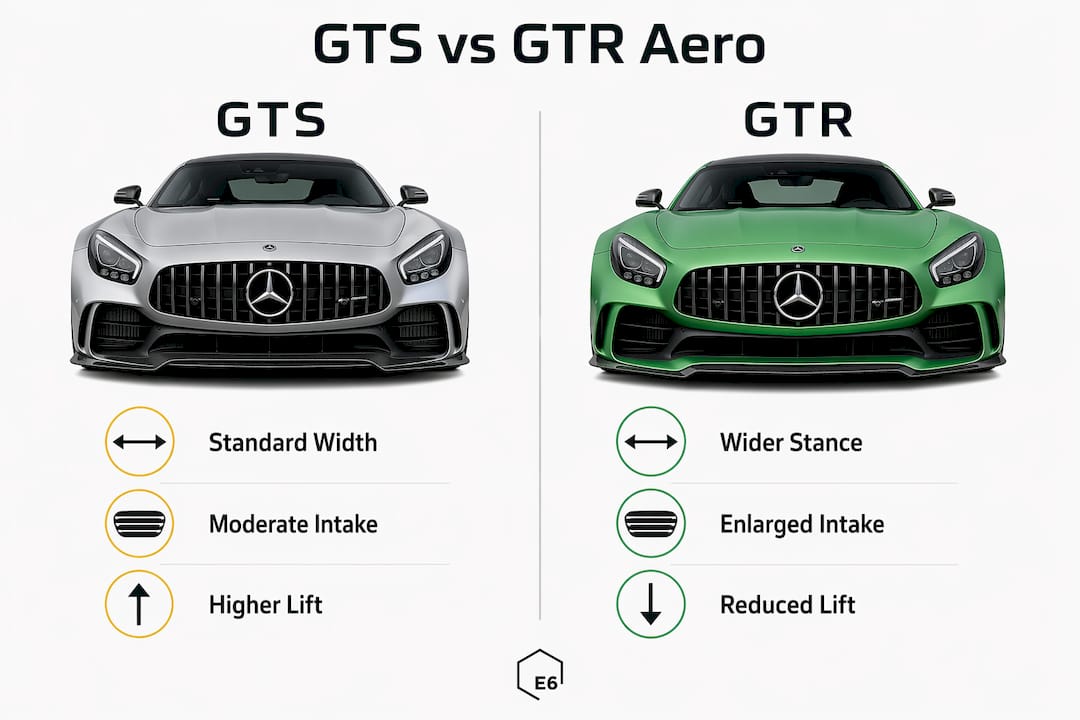
The GTR front bumper is defined by a wider track stance, enlarged lower intake openings, and a pronounced front splitter that the GTS bumper does not carry. These are not styling choices made for appearance alone. Each element serves a specific aerodynamic function that changes how air interacts with the front of the vehicle.
The GTS bumper manages airflow passively. The GTR bumper actively directs it. The enlarged intake grilles channel air more efficiently to the brakes and intercoolers, while the lower splitter creates a pressure differential between the top and underside of the front end. That differential generates downforce and reduces front-end lift at speed, which is the primary aerodynamic objective of the conversion.
Key aerodynamic and design differences between the GTR and GTS front bumpers:
- Wider front track appearance: The GTR bumper extends further at the outer edges, matching the GTR’s wider fender flares and creating a planted, low-slung stance.
- Enlarged lower intake openings: These feed more air to the front brakes and cooling systems, reducing thermal load under hard driving.
- Integrated front splitter: The splitter separates high-pressure air above from low-pressure air below, generating measurable downforce at highway speeds.
- Redesigned intake grille geometry: The GTR grille pattern smooths air turbulence entering the engine bay, reducing drag and improving cooling efficiency.
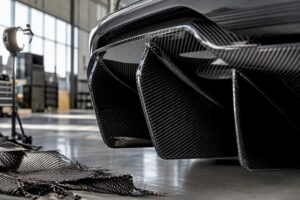
- Carbon fiber construction: E6 Carbon components use autoclave-cured 2×2 twill carbon fiber, which delivers aerospace-grade strength at a fraction of the weight of OEM plastic assemblies.
Pro Tip: Request a UV-resistant resin finish on your carbon fiber components. E6 Carbon’s autoclave-cured parts include this finish as standard, protecting the weave from yellowing and delamination over years of sun exposure.
How to select and install E6 Carbon components for the conversion
Component selection is the first decision that determines whether this conversion succeeds or fails. The AMG GT/GTS C190 platform has specific mounting geometry, sensor routing, and panel gap tolerances that generic aftermarket parts do not always respect. E6 Carbon engineers its front splitters and intake grille components specifically for the C190 chassis, using aerospace-grade 2×2 twill carbon fiber cured in an autoclave for maximum dimensional stability.
Follow this installation sequence for a factory-level result:
- Source platform-specific components. Confirm that the front splitter, intake grille, and any canards are manufactured for the C190 AMG GT/GTS platform. Fitment tolerances on the GTR bumper are tighter than on standard GT variants.
- Remove the GTS bumper assembly completely. Disconnect all sensors, parking cameras, and wiring harnesses before removal. Label every connector.
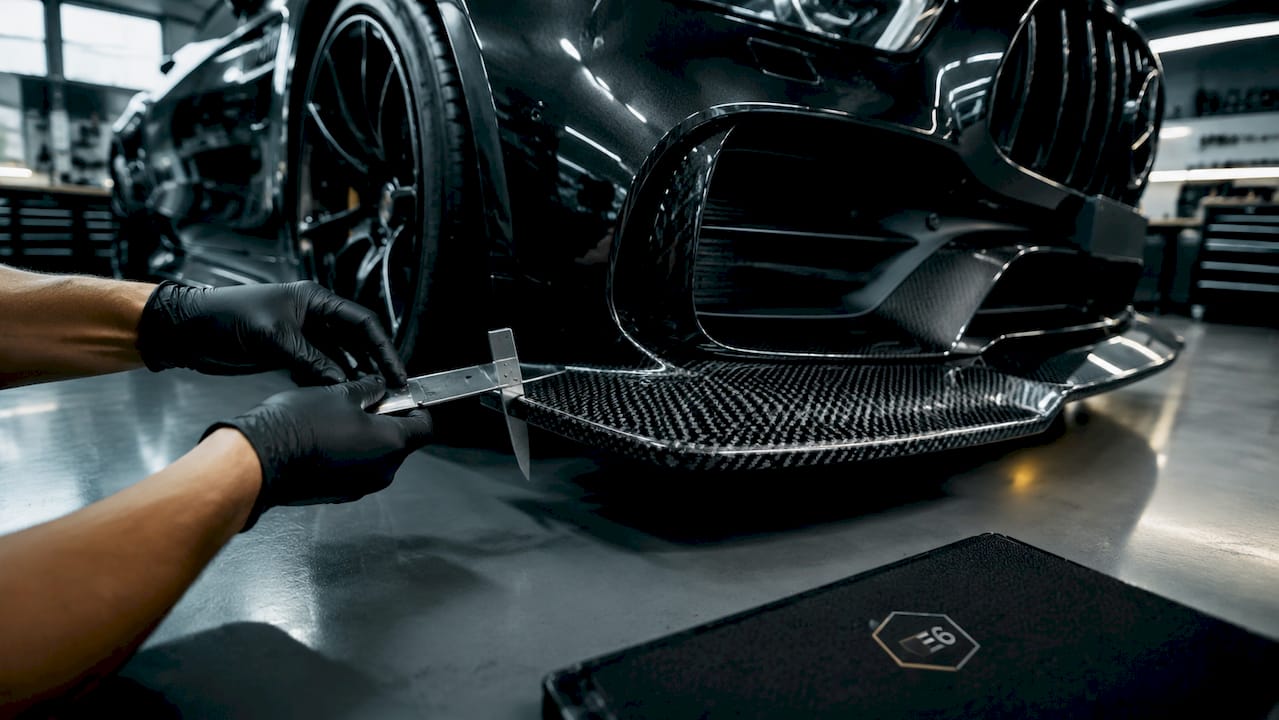
- Dry-fit the GTR bumper shell first. Mount the bumper without adhesive or final fasteners. Check panel gaps at the fender edges, hood line, and lower valance before committing to any permanent attachment.
- Test-fit all carbon fiber components. Test fitting before final installation is the most critical step most installers skip. Subtle mold variations between production runs can cause misalignment even with OEM-style parts.
- Seal all mounting points and edges. Use automotive-grade butyl tape or OEM-equivalent sealant on every edge that contacts body panels. Unsealed joints allow water ingress that accelerates corrosion behind the bumper skin.
- Reconnect and test all sensors. Verify that parking sensors, front cameras, and adaptive cruise radar are fully functional before the vehicle leaves the shop.
- Perform a final panel alignment check. Gaps at the fender-to-bumper joint should be uniform and match factory tolerances. Any deviation requires adjustment before the vehicle is returned to the owner.
Pro Tip: Have your installer use a panel gap gauge during the dry-fit stage. Factory gap tolerances on the AMG GT platform are tight. A gauge removes guesswork and catches misalignment before it becomes a permanent problem.
For a detailed step-by-step walkthrough, the E6 Carbon AMG GTS to GTR conversion guide covers component selection and fitment in full technical detail.
What installation challenges should you expect?
The GTR front bumper conversion presents specific technical challenges that separate a professional result from a compromised one. Understanding them before the build begins prevents costly corrections.
- Mold variation and panel alignment. Even high-quality aftermarket carbon fiber parts carry subtle dimensional differences from batch to batch. Flawless panel alignment preserving factory gap tolerances is non-negotiable for maintaining OEM-level luxury appearance and vehicle asset value.
- Water ingress from improper sealing. Unsealed joints between the bumper skin and body panels allow water to pool behind the assembly. Misalignments or improper sealing cause water intrusion and accelerate body panel deterioration over time.
- Paint matching. Carbon fiber components that carry painted sections require exact color matching to the vehicle’s factory finish. Poor paint matching diminishes the premium appearance regardless of part quality.
- Sensor and camera integration. The AMG GT/GTS carries front parking sensors, a front camera, and on many cars an adaptive cruise radar unit. Front sensors and camera integration must be carefully preserved to avoid interfering with safety and driver assistance features. Proper mounting and wiring routes are required during the conversion.
“Test fitting is the most overlooked step in body kit installation. Skipping it causes alignment and sealing failures that void warranties and reduce vehicle value.”
E6 Carbon’s autoclave-cured parts provide a durable high-gloss finish that resists UV fading and maintains showroom-level aesthetics longer than lower-grade carbon fiber alternatives. That durability matters when the vehicle is a long-term asset.
What performance gains does the GTR bumper conversion deliver?
The aerodynamic performance gains from the GTR front bumper conversion are measurable and driver-confirmed. The redesigned intake grilles and front splitter work together to change how air behaves at the front axle, with direct effects on stability and grip.
| Aerodynamic Factor | GTS Bumper | GTR Bumper |
|---|---|---|
| Front-end lift at speed | Higher, passive management | Reduced through splitter downforce |
| Underbody air turbulence | Unmanaged | Smoothed by splitter geometry |
| Brake and intercooler cooling | Standard intake volume | Increased via enlarged openings |
| Cornering stability | Baseline AMG GT setup | Improved front grip from downforce |
| Driver confidence at speed | Standard | Noticeably higher |
The GTR bumper’s splitter and intake grille design manages airflow under the vehicle, smoothing turbulence and increasing front grip. That is not a marginal gain. At highway speeds and on track days, reduced front-end lift translates directly into more predictable steering response and higher cornering confidence. Drivers consistently report improved road grip and precision in cornering after the upgrade is installed correctly.
Key Takeaways
The GTR front bumper conversion delivers genuine aerodynamic gains only when executed with platform-specific autoclave-cured carbon fiber components, professional installation, and OEM-level panel alignment.
| Point | Details |
|---|---|
| GTR bumper is functional aero | The wider bumper and splitter actively reduce front-end lift and manage underbody airflow at speed. |
| Autoclave-cured carbon fiber matters | E6 Carbon’s 2×2 twill construction delivers dimensional stability and UV-resistant finish that lower-grade parts cannot match. |
| Test fitting prevents failures | Dry-fitting all components before final installation catches mold variations and prevents misalignment and water ingress. |
| Sensor integration is mandatory | Front cameras, parking sensors, and radar must be fully reconnected and tested before the vehicle leaves the shop. |
| Professional installation protects value | Flawless panel alignment and proper sealing preserve factory gap tolerances and protect long-term vehicle asset value. |
The conversion detail most owners underestimate
Every AMG GT/GTS owner who asks about this conversion focuses on the visual result first. That is understandable. The GTR front end is one of the most aggressive factory-derived designs Mercedes-AMG has produced. But the owners who get the best outcomes are the ones who treat the aerodynamic function as the primary objective and let the aesthetics follow.
What I see consistently overlooked is the sealing stage. Installers who are confident in their panel alignment skills sometimes rush the sealing because the gaps look right. Water ingress does not announce itself immediately. It shows up six months later as bubbling paint behind the fender edge or corrosion on a mounting bracket. That is an expensive correction on a vehicle at this price point.
The other factor worth stating plainly: autoclave curing is not a marketing term. It is a manufacturing process that applies heat and pressure simultaneously to eliminate voids in the carbon fiber matrix. Parts cured this way hold their dimensions under thermal cycling, which matters on a car that sees track days or extended highway runs. Lower-grade wet-lay carbon parts expand and contract differently, and that movement shows up as panel gap drift over time. E6 Carbon’s carbon fiber finishing standards reflect that engineering discipline at every stage of production.
This conversion, done correctly, is one of the few aftermarket modifications that adds both performance and resale credibility to the AMG GT platform.
— E6 Engineering
E6 Carbon carbon fiber parts for your AMG GTS conversion
E6 Carbon manufactures autoclave-cured front splitters and intake grille components engineered specifically for the AMG GT/GTS C190 platform. Every part is built to OEM gap tolerances, finished with UV-resistant resin, and designed to integrate with factory sensor mounting points without modification.

The AMG GTS to GTR bumper guide on the E6 Carbon website covers fitment specifications, component compatibility, and installation requirements in full detail. For owners who want to complete the front-end transformation with matched performance upgrades, the top performance parts for luxury cars catalog covers the full ecosystem. Professional installation is required for all front bumper and splitter components. Contact E6 Carbon directly to confirm fitment for your specific build before ordering.
FAQ
What is the GTR front bumper conversion for the AMG GTS?
The GTR front bumper conversion replaces the AMG GTS front bumper assembly with the wider, aerodynamically active GTR front end, including a front splitter and redesigned intake grilles that reduce front-end lift and improve downforce.
Does the GTR bumper conversion require professional installation?
Professional installation is mandatory. Proper sealing, sensor reconnection, and OEM-level panel alignment require shop-grade tools and expertise. E6 Carbon holds no liability for improper fitment from home garage modifications.
What carbon fiber material does E6 Carbon use for the conversion parts?
E6 Carbon uses autoclave-cured aerospace-grade 2×2 twill carbon fiber with a UV-resistant resin finish. This construction delivers dimensional stability, high-gloss aesthetics, and resistance to UV fading over time.
Will the GTR bumper conversion affect my AMG’s front sensors?
Front parking sensors, cameras, and adaptive cruise radar must be carefully remounted and fully tested during the conversion. A professional installer will preserve all OEM wiring routes and verify full system functionality before returning the vehicle.
Does the GTR bumper conversion improve real-world driving performance?
Drivers report improved cornering grip, reduced front-end lift at highway speeds, and greater steering confidence after the conversion. The front splitter and redesigned intake grilles actively manage underbody airflow, which produces measurable stability gains.