
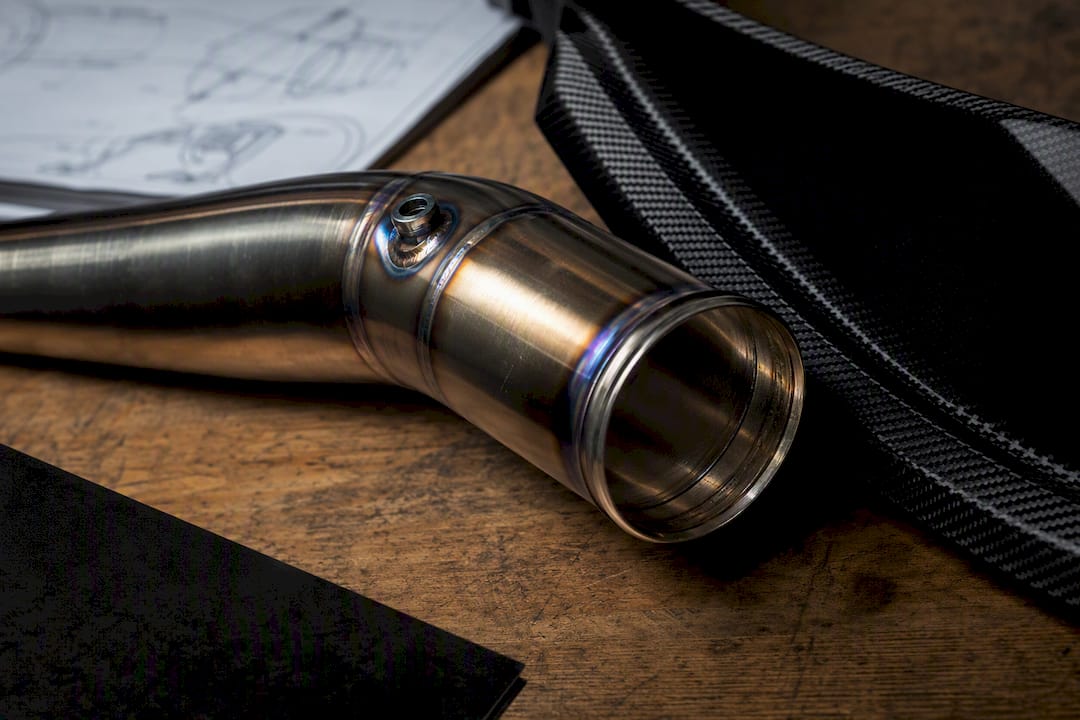
E6 Motorsports titanium exhausts deliver a crisp, high-frequency supercar pitch while cutting significant mass from the rear chassis. The material’s stiffness-to-mass ratio pushes resonant frequencies upward compared with stainless steel, producing the sharper, more metallic exhaust note enthusiasts associate with exotic machinery. Precision-engineered internal valving handles the rest: closed for a quiet, refined commute, wide open for a soundtrack that belongs on a track day.
- Higher-frequency, crisp tone from titanium’s low mass and high stiffness
- Reduced rear-chassis weight improves handling response, not just straight-line numbers
- Valved design shifts instantly between library-quiet cruising and open-valve exotic sound
- Professional installation by a certified technician is strongly recommended for proper valve integration and system alignment
Key Takeaways
Titanium’s stiffness-to-mass ratio and thin-wall construction shift exhaust acoustics toward a higher, sharper frequency range while cutting rear-chassis weight that improves handling response.
| Point | Details |
|---|---|
| Material drives tone | Titanium’s high stiffness-to-mass ratio and 1.0 to 1.2mm walls push resonance upward for a sharper, crisper note than stainless. |
| Rear mass reduction aids handling | Removing weight from behind the rear axle cuts polar moment of inertia, improving turn-in and transient response. |
| Valving solves the daily/track conflict | Closed, transitional, and open valve modes let one system handle quiet commutes and full track-day acoustics. |
| Trade-offs are real | Higher cost, specialized repair needs, and permanent heat bluing are expected parts of titanium ownership. |
| E6 Carbon engineers for fitment first | E6 Motorsports builds valved titanium systems and the E6 Carbon Elite Kit specifically around Mercedes-AMG, Lexus LC500, and exotic platform geometry. |
Table of Contents
- Why Titanium Sounds Different From Stainless Steel
- How E6 Engineers Tone Into Every System
- The Handling Payoff of Cutting Rear-Chassis Mass
- Living With a Valved System Day to Day
- What Titanium Costs You Over Time
- E6 Motorsports Engineering Behind the Sound
- Measuring the Sound: Frequency and Decibel Considerations
- What Owners Actually Notice After Installation
- How Titanium Systems Stack Up Across the Market
- What Actually Matters When You’re Chasing This Sound
- Get the Sound and the Weight Savings, Properly Engineered
- Sources
- FAQ
Why Titanium Sounds Different From Stainless Steel
Sound in an exhaust system starts with vibration, and vibration starts with material properties. Titanium’s stiffness-to-mass ratio outperforms stainless steel by a wide margin, which shifts the tubing’s natural resonant frequency higher. The result is a tone that reads as sharper and more metallic to the ear, rather than the deeper, sometimes muddier growl typical of heavier stainless setups.
Wall thickness plays an outsized role here. Titanium systems commonly run 1.0 to 1.2mm tubing walls, noticeably thinner than the 1.5mm-plus common in stainless steel exhausts. Thinner walls flex and resonate differently under exhaust pulse pressure, amplifying higher harmonics while damping some of the low-frequency content that causes cabin drone on a highway cruise.
Titanium vs. stainless steel, in practice:
- Titanium: higher-pitched, sharper harmonic content, less low-frequency drone
- Stainless steel: deeper, heavier tone with more midrange fill, but added mass and thicker walls
- Titanium tubing weighs roughly 40 percent less than comparable stainless steel tubing, concentrating the acoustic benefit exactly where mass reduction matters most
Geometry compounds the material effect. Bend radius, diameter transitions, and junction placement all interact with wall thickness to either reinforce or cancel specific frequency bands. Fabricators who understand this treat the exhaust less like plumbing and less like an afterthought, tuning it more like an instrument, and that mindset shows up directly in how E6 Motorsports approaches piping layout.
How E6 Engineers Tone Into Every System
Material alone doesn’t make a great-sounding exhaust. E6 Motorsports treats valve mechanics, wall thickness, and pipe routing as three variables to be tuned together, not three separate decisions.
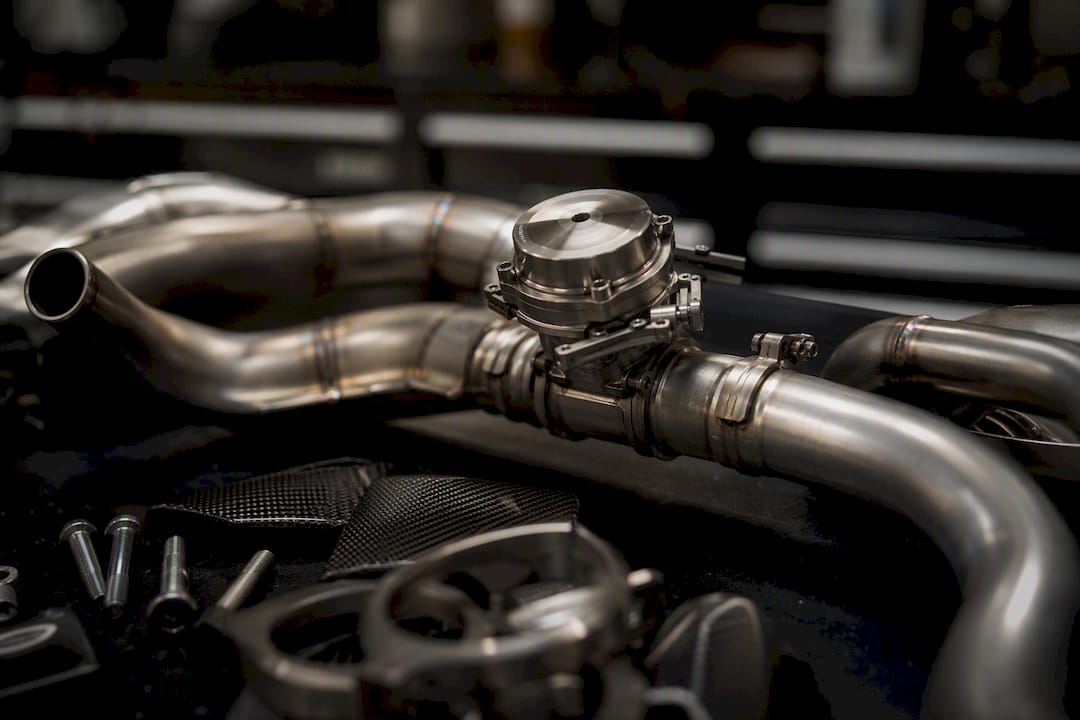
The valve itself changes the acoustic path in real time. When closed, exhaust gas routes through a secondary path or muffling chamber that raises backpressure and suppresses volume. Open the valve, and gas takes the straighter, lower-restriction route, which drops backpressure and lets the higher-frequency titanium harmonics come through unfiltered.
E6 fabricators work within the same general 1.0 to 1.2mm wall-thickness range that defines the category, adjusting locally, thicker near flanges and valve housings for structural durability, thinner through mid-pipe sections where acoustic amplification matters most. Piping routes are laid out with resonant node placement in mind, positioning bends and junctions to suppress standing waves that cause drone in the cabin, a consideration that becomes especially important on Mercedes-AMG platforms with tight rear subframe packaging and on the Lexus LC500’s long rear overhang.
Thermal cycling adds a visual signature to the acoustic one. Sustained high-exhaust-gas temperatures produce a blue-purple heat bluing gradient along the pipe, a cosmetic marker that titanium is running at its intended operating temperature rather than a sign of any defect.
- Valve position directly controls backpressure and perceived tone, not just volume
- Localized wall-thickness variation balances durability at stress points with acoustic gain elsewhere
- Bend and junction placement targets specific resonant nodes to cut drone
- Heat bluing is expected, not a failure indicator
Pro Tip: Ask your installer to document valve actuator calibration during setup. A few degrees of misalignment in the valve flap won’t damage anything, but it will blur the line between “quiet” and “open” modes you paid for.
The Handling Payoff of Cutting Rear-Chassis Mass
Where weight comes off matters as much as how much comes off. Mass sitting behind the rear axle contributes disproportionately to a car’s polar moment of inertia, the resistance to rotating around its vertical axis during a direction change. Removing exhaust mass from that extreme location produces a bigger handling gain per pound than trimming an equivalent amount from somewhere closer to the car’s center of mass.
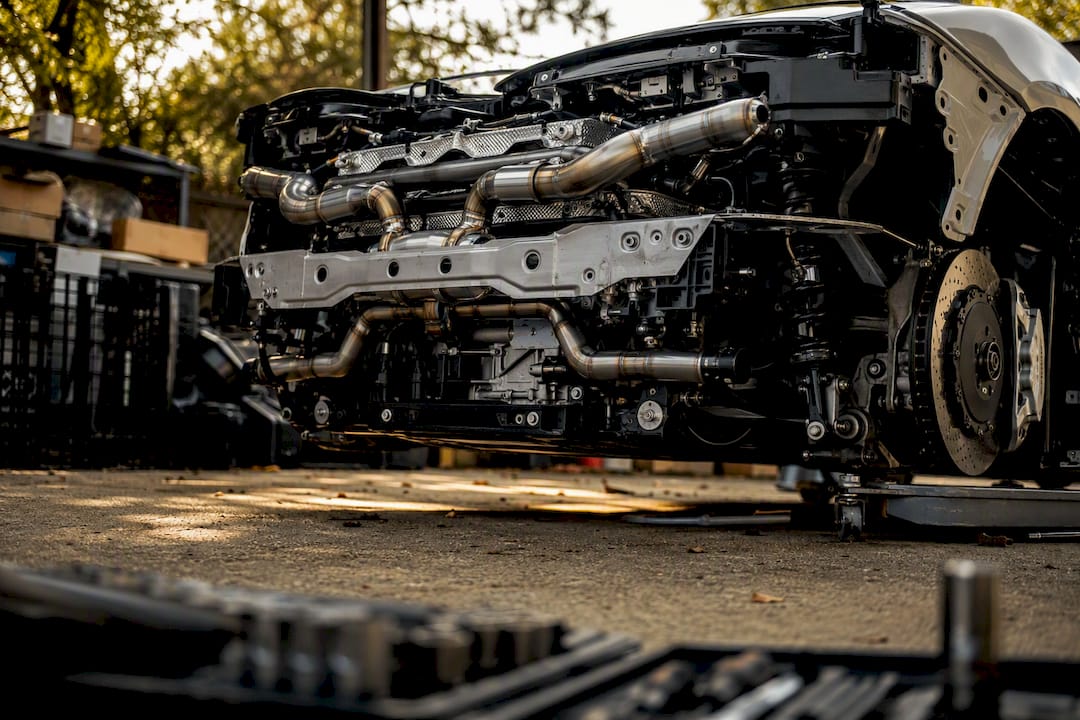
That’s the engineering logic behind swapping a stainless system for a titanium one on a performance platform. Less rotational inertia at the rear translates to quicker turn-in response and more composed transient behavior when the car changes direction abruptly, exactly the moments where a heavy factory exhaust works against the driver.
The benefits extend past outright agility:
- Reduced unsprung and chassis-extremity mass gives suspension tuning more headroom, since dampers aren’t compensating for excess rear inertia
- Ride behavior over transitions and mid-corner bumps improves subtly but measurably with less mass swinging at the rear
- Mercedes-AMG platforms see the largest share of E6’s titanium development work, reflecting demand from that owner base
- Lexus LC500 owners benefit from a long rear overhang that makes rear-mass reduction particularly noticeable in yaw response
- McLaren and Lamborghini platforms represent a growing share of E6’s fitment catalog as exotic owners look for the same acoustic and handling gains
Living With a Valved System Day to Day
A valved titanium exhaust only delivers on its promise if you understand how to use it. Three operating modes cover nearly every driving scenario.
- Closed valve for neighborhood streets, early morning starts, and highway cruising, keeping sound levels low and drone minimal
- Transitional mode for spirited backroad driving, where partial valve opening balances engagement with restraint
- Full open valve for track days or wide-open throttle pulls, unlocking the complete high-frequency titanium character
Most E6 valved systems support ECU-integrated mapping, letting the valve open automatically past a set RPM or throttle threshold rather than requiring a manual switch every time. For daily comfort, leaving the system in a default-closed state with automatic opening under hard acceleration avoids waking the neighborhood at 6 a.m. while still delivering the payoff when you want it.
Pro Tip: Set your default startup mode to closed-valve if you park near neighbors or in a shared garage. A quiet cold start avoids the single most common noise complaint valved-exhaust owners report.
Professional installation remains non-negotiable here. Valve integration and system alignment require calibration that goes beyond bolting on new piping.
What Titanium Costs You Over Time
Titanium isn’t a free upgrade, and any honest breakdown has to say so. The tradeoffs are real, even if most owners find them worth accepting.
Cost sits at the top of the list. Titanium raw material and fabrication both run higher than stainless steel, and specialized repair work requires a shop with titanium welding experience rather than a generalist muffler shop. Heat bluing, while cosmetically desirable to most enthusiasts, is a permanent finish change that some owners don’t anticipate until it happens.
Lifespan depends on more than the material itself. Hanger quality, the number of heat cycles the system endures, valve seal condition, and driving style all factor into how long a titanium system performs at its best. A car driven hard and put away wet, so to speak, sees different wear patterns than one used for gentle weekend cruising.
A basic maintenance routine keeps things running well:
- Inspect joints and flange connections for seepage after the first few hundred miles post-installation
- Check fastener torque periodically, since thermal cycling can work bolts loose over time
- Test valve actuation regularly to catch any calibration drift early
- Wipe down finished surfaces with a titanium-safe cleaner to preserve the heat-blued look without altering it
Exact pricing varies by platform and configuration, so check individual product pages for current figures rather than relying on rough estimates.
E6 Motorsports Engineering Behind the Sound
E6 Motorsports builds every titanium system around a Fitment First philosophy, meaning acoustic tuning happens alongside, not after, the fitment engineering for each platform. The catalog spans monoblock and multi-piece configurations for wheels alongside precision-engineered exhaust and carbon components, all developed with the same platform-specific rigor.
- Fitment First engineering validated against factory chassis geometry for Mercedes-AMG, Lexus, McLaren, and Lamborghini platforms
- Valved product lines including the LFA-style valved exhaust for the LC500 V8 and the AMG GT catback exhaust, both available in titanium, burnt titanium, and stainless configurations
- Acoustic development informed by real-world testing across daily-driven and track-prepared examples of each platform
Detailed engineering notes on the LC500 platform, including acoustic tuning specifics, reflect the level of platform-specific detail E6’s engineering team applies before a single pipe gets bent.
Professional installation by a certified technician is strongly recommended for proper valve integration and system alignment. E6 Motorsports holds zero liability for improper installation.
Measuring the Sound: Frequency and Decibel Considerations
Exhaust sound breaks down into two measurable dimensions: loudness in decibels and frequency content in hertz. Titanium’s contribution is almost entirely on the frequency side rather than raw volume. A titanium system and a comparable stainless system can register similar decibel readings on a sound meter while sounding dramatically different to a human ear, because decibels measure amplitude, not character.
The frequency shift toward the upper register is what listeners actually perceive as “sharper” or more race-inspired. Lower frequencies, generally below 200 Hz, tend to read as deep, rumbling, or droning, especially inside a cabin where they reflect off interior surfaces. Higher frequencies, often in the 400 Hz to 2 kHz range for exhaust harmonics, read as crisp, metallic, and exotic. Titanium’s thin-wall construction amplifies that upper band relative to stainless steel’s heavier-walled response, which favors lower harmonic content.
Valve position adds another layer to the frequency profile. Closed-valve operation routes gas through additional muffling volume, which absorbs high-frequency content disproportionately and leaves a duller, bass-heavier residual tone at low volume. Open-valve operation removes that filtering, letting the full harmonic spectrum through, which is why the same physical exhaust can sound like two completely different systems depending on valve state.
Local noise ordinances vary by municipality, and decibel limits at idle or under load differ from one jurisdiction to the next. Checking local regulations before running consistently in open-valve mode on public roads avoids unnecessary complications, particularly in areas with strict aftermarket exhaust enforcement.
What Owners Actually Notice After Installation
The most consistent feedback from titanium exhaust owners centers on the contrast between expectation and reality. Many expect a marginal upgrade over stainless and instead describe the tonal shift as immediately obvious, even to passengers unfamiliar with exhaust acoustics. The higher-frequency character reads as distinctly different rather than just louder.
Valved systems draw specific praise for solving a problem owners didn’t realize was solvable: the ability to leave for work in near-silence and arrive at a track day with a completely different acoustic personality from the same car. Owners of Mercedes-AMG platforms in particular note that the closed-valve mode addresses a common complaint with factory-aggressive AMG exhausts, drone on highway cruising, while preserving the option for full aggression on demand.
Lexus LC500 owners frequently comment on how the titanium upgrade complements the car’s naturally aspirated V8, a platform where exhaust note carries more weight in the ownership experience than on a turbocharged competitor, since there’s no turbo whoosh masking the exhaust character. The V8’s high-revving nature pairs naturally with titanium’s high-frequency emphasis, reinforcing rather than fighting the engine’s inherent sound signature.
Weight reduction gets mentioned less often unsolicited but ranks high when owners are asked directly what surprised them. Several describe noticing the rear-end agility improvement before they consciously register why, attributing it to “feeling lighter” without immediately connecting it to the specific mass removed from the rear chassis.
How Titanium Systems Stack Up Across the Market
Not all titanium exhausts deliver the same acoustic result, even when the base material is identical. Wall thickness, valve quality, and routing precision vary significantly across the aftermarket, and those variables matter more than the “titanium” label itself.
Generic titanium systems sold without platform-specific engineering often use uniform wall thickness throughout the system, sacrificing the localized thick-at-flange, thin-at-midpipe approach that maximizes both durability and acoustic gain. The result can sound sharper than stainless but without the refined harmonic balance that comes from deliberate resonant-node placement.
Valve quality separates systems more than material choice does. A poorly calibrated or underpowered valve actuator creates an abrupt, binary transition between quiet and loud rather than the smooth, intentional character shift E6 Motorsports engineers into its valved product lines. Some competitor systems also use a single valve position with limited intermediate control, missing the transitional mode that makes daily driving comfortable.
Fitment precision affects sound as much as it affects installation ease. A system engineered for a specific platform’s chassis geometry, like E6’s Mercedes-AMG and Lexus LC500 lines, places bends and junctions exactly where the resonant tuning calls for them. Generic or universal-fit titanium systems, by contrast, often require compromise routing that can introduce unintended resonances or drone the original engineering never accounted for. For a broader look at how titanium racing exhausts perform across different exotic platforms, Supercars offers useful reference points on sonic variation industry-wide.
What Actually Matters When You’re Chasing This Sound
Most of the conventional advice around titanium exhausts stops at “titanium is lighter and sounds better,” which is true but incomplete enough to be misleading. The material sets the ceiling on what’s acoustically possible; the engineering around wall thickness, valve calibration, and resonant-node placement determines whether a given system actually reaches that ceiling.
The most overlooked variable, in our estimation, is valve quality. Enthusiasts fixate on the titanium spec sheet, alloy grade, wall thickness in millimeters, and treat the valve as an afterthought, when in practice the valve determines whether you get a genuinely usable daily system or one you’re either fighting with at low RPM or apologizing for to neighbors. A mediocre valve actuator can undermine an otherwise excellent titanium build.
If you’re prioritizing one factor above others, prioritize platform-specific engineering over generic titanium claims. A system tuned for your exact chassis, whether that’s a Mercedes-AMG, an LC500, or an exotic platform, will outperform a universal-fit titanium system on both sound quality and long-term reliability, regardless of how the spec sheets compare on paper.
Get the Sound and the Weight Savings, Properly Engineered
Generic titanium kits and off-the-shelf universal systems can get you part of the way there, but they leave the fitment and acoustic tuning to guesswork. E6 Carbon’s approach is different: every exhaust system is engineered against the actual chassis geometry of the platform it’s built for, which is why the acoustic character and the handling gains described throughout this piece are repeatable outcomes rather than lucky results.
For Lexus LC500 owners looking to complete the transformation beyond the exhaust note, the E6 Carbon Elite Kit pairs autoclave-cured carbon fiber aerodynamic components with the same Fitment First philosophy that drives E6’s exhaust engineering. Mercedes-AMG and McLaren or Lamborghini owners can explore platform-specific fitment details directly through the E6 Carbon catalog to see which valved configuration matches their driving profile.
Start by reviewing fitment specifications for your exact platform and request a consultation to confirm valve configuration before ordering.
Sources
- Titanium Exhaust System Benefits: An Engineer’s Guide – HonTitan
- Titanium Exhaust Explained: Why It’s Worth It?
FAQ
Do titanium exhausts sound better than stainless steel?
Titanium produces a higher-frequency, crisper tone than stainless steel due to its lower mass and thinner tubing walls, though “better” depends on whether you prefer that sharper, race-inspired character over a deeper stainless tone.
What are the downsides of a titanium exhaust?
The main trade-offs are higher upfront cost, the need for specialized titanium welding if repairs are ever needed, and permanent heat bluing discoloration that develops under normal high-temperature operation.
How much does a full titanium exhaust system cost?
Pricing varies significantly by platform, valve configuration, and coverage, so checking current figures on individual product pages for your specific vehicle gives the most accurate answer.
How long does a titanium exhaust last?
Lifespan depends on driving style, heat cycle frequency, hanger condition, and valve seal health, with well-maintained systems typically outlasting comparable stainless setups thanks to titanium’s corrosion resistance.
Does E6 Motorsports offer valved titanium exhausts for the Lexus LC500?
Yes, E6 Motorsports produces an LFA-style valved exhaust for the LC500 V8 engineered specifically around that platform’s chassis and acoustic profile.