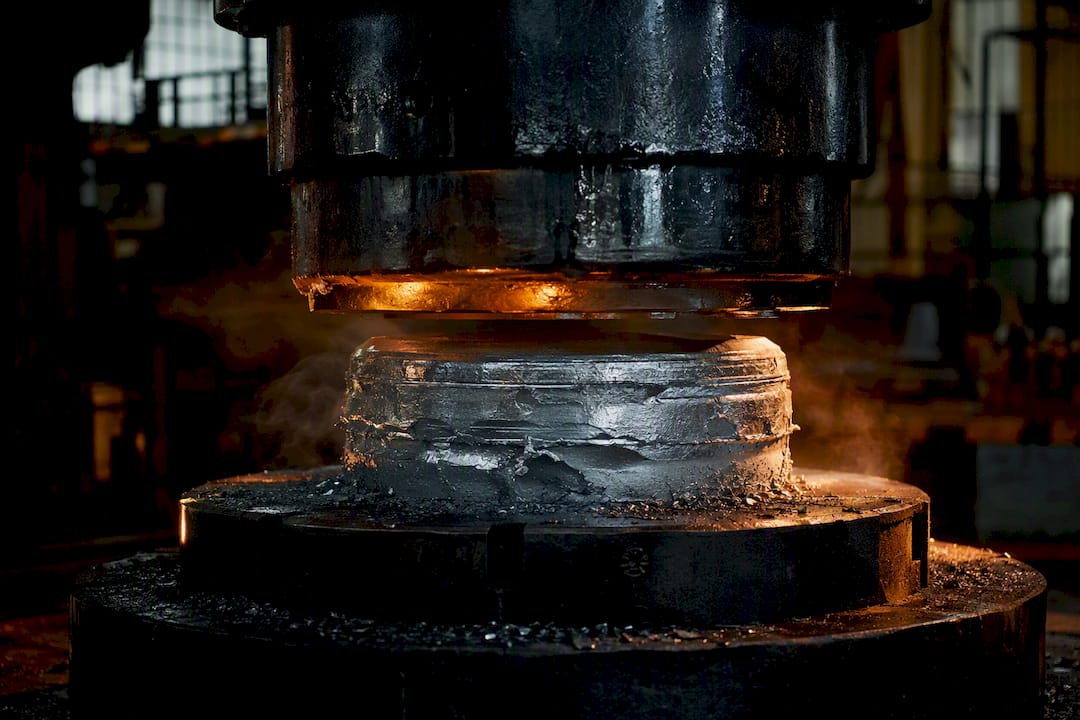
Every E6 Forged wheel starts as a solid billet of aerospace-grade 6061-T6 aluminum, compressed under roughly 10,000 tons of forging pressure before it ever sees a lathe. That single step produces a grain density and fatigue resistance that cast wheels simply cannot replicate, and it sets up everything that follows: T6 heat treatment to lock in mechanical properties, precision CNC machining to tolerances near 0.05 mm, and single bolt-pattern fixturing that delivers true hub-centric balance on platforms from Mercedes-AMG to the Lexus LC500.
That’s the whole thesis in one sentence. The rest of this article is the proof.
- 6061-T6 billet forged under high press force
- T6 solution heat, quench, and artificial aging cycle
- Precision CNC machining to tight, hub-centric bore and bolt-pattern tolerances
- Non-destructive testing (NDT) and dynamic balance verification before a wheel ships
Pro Tip: If a wheel spec sheet lists only “forged” without a press tonnage or heat-treatment temper, ask directly. Those two numbers tell you more about durability than any weight claim ever will.
Pro Tip: Grain flow, not raw alloy grade, is usually the real differentiator between two wheels made from the same 6061-T6 stock. Ask how many forging steps the blank went through, not just what metal it started as.
| Process Stage | What Happens |
|---|---|
| Forging | Billet compressed under ~10,000 tons, refining grain structure |
| Heat treatment | T6 cycle: solution heat, quench, artificial aging |
| CNC machining | Barrel, face, and bore cut to hub-centric tolerances |
| Inspection | NDT, dynamic balance, and fatigue verification |
- Forging density beats casting on nearly every fatigue metric
- T6 tempering is not optional for track-rated wheels
- CNC tolerance work protects steering feel at speed
- NDT catches defects invisible to the naked eye
- Single-bolt-pattern machining is platform-specific, not universal
- Unsprung mass reduction improves both ride and braking response
- AeroDisc construction adds aerodynamic benefit without sacrificing core strength
- Beadlock geometry exists for load cases forged monoblocks alone can’t cover
- Two-piece (2pc) construction trades some weight for barrel-width flexibility
- Every wheel batch carries its own traceability record
- Grain flow direction matters more than most spec sheets admit
- Thermal control during machining protects dimensional accuracy
- Surface finishing is a corrosion-resistance step, not just cosmetics
- Vibration testing during machining catches tool chatter before it becomes a defect
- Lead time scales with design complexity, not just wheel size
Key Takeaways
Forged wheel durability comes down to three controllable factors: forging pressure and grain alignment, a complete T6 heat-treatment cycle, and CNC tolerance control at the machining stage.
| Point | Details |
|---|---|
| Forging pressure matters | Roughly 10,000 tons of press force produces denser, flow-aligned grain than casting. |
| T6 cannot be shortened | The full 8 to 12 hour solution, quench, and aging cycle prevents latent stress and crack initiation. |
| CNC tolerance protects fitment | Precision machining to near 0.05 mm tolerances keeps hub-centric balance and reduces vibration. |
| Testing catches hidden defects | X-ray, dye-penetrant, and fatigue testing find flaws invisible to visual inspection. |
| E6 Forged builds to full process spec | E6 Carbon forges every wheel from 6061-T6 billet, runs complete T6 treatment, and machines with platform-specific single bolt-pattern fixturing. |
Selected Further Reading and Primary Sources
- Tree Wheels’ manufacturing process breakdown for full stage timing and tonnage data
- Hagerty’s explainer on forging for grain-structure fundamentals
- Southwest Aluminium’s T6 heat treatment guide for temper science
Engineers wanting E6 Carbon’s own proprietary fatigue and NDT test data for a specific platform can request it directly through a consultation.
Table of Contents
- How Are Forged Wheels Made: The Process Behind Grain Density
- Why Material Grade and T6 Heat Treatment Determine Wheel Life
- Precision CNC Machining: How Tolerances Get Held
- Testing and Quality Control Before a Wheel Ships
- Monoblock, 2pc, Beadlock, or AeroDisc: Which Design Fits Your Platform?
- What Precision Forging Actually Does for Vehicle Dynamics
- How Long Does a Bespoke Forged Wheel Take to Build?
- Inside E6 Engineering’s Process Controls
- Why Process Control Beats Spec-Sheet Marketing
- Order an E6 Forged Wheel Set Built for Your Platform
- Sources
- FAQ
How Are Forged Wheels Made: The Process Behind Grain Density
Forging starts with billet selection, and the alloy verification matters as much as the tonnage that comes after it. E6 Carbon works from aerospace-grade 6061-T6 stock, confirming composition before a billet ever gets cut to size. A one-piece forged billet typically starts in the neighborhood of 25 to 35 kilograms and finishes machining at 7 to 9 kilograms, which tells you just how much material gets removed downstream.
The billet then goes through pre-forge heating, upset forging, and final die forging. Industry presses commonly run in the 6,000 to 15,000 ton range to shape spokes, form the center bore, and establish the rim profile in a single precision operation. E6 Forged wheels are compressed under approximately 10,000 tons during this stage, a pressure level that pushes aluminum into a continuous, flow-aligned grain structure rather than the more porous, randomly oriented microstructure typical of cast parts.
That distinction is the whole point of forging. Incremental pressings remove porosity and align the grain along the geometry of the part, which is why forged aluminum resists crack propagation so much better than cast aluminum under repeated cyclic loading. You can see the mechanical case for forged aluminum here if you want the full comparison against cast and flow-formed alternatives.
Some designs add an optional spin-forming or flow-forming pass after the initial forge, stretching and compressing the barrel to align grain radially and shave additional weight from the rim. It’s a genuinely useful technique, and it can approach forged-barrel performance at a lower tooling cost. But it’s a rim-focused refinement, not a substitute for the multi-step center-section forging that carries torsional load.
What a good forged blank looks like before heat treatment
Before a blank moves to the heat-treatment furnace, it gets checked for surface indications, die flash, and dimensional envelope against the target geometry. Skipping this inspection step is how minor forging defects turn into expensive scrap after machining time has already been sunk into the part.
Pro Tip: Ask your wheel supplier whether they inspect for die flash and surface indications before heat treatment, not after. Catching a flaw pre-temper saves hours of wasted CNC time later.
Pro Tip: Grain flow diagrams look abstract, but the takeaway is simple: flow lines should follow the part’s contour, not cut across it. Crossing flow lines are a sign of insufficient forging steps.
Pro Tip: Press tonnage alone doesn’t guarantee quality. Die design and the number of incremental pressings matter just as much as peak force.
Pro Tip: A billet’s chemistry certificate should specify 6061-T6, not just “aircraft-grade aluminum.” That phrase alone means nothing without a documented alloy spec.
Pro Tip: Spin-forming is excellent for barrel weight reduction, but it’s not a replacement for a properly forged center section on a wheel rated for track loads.
Why Material Grade and T6 Heat Treatment Determine Wheel Life
Aerospace-grade 6061-T6 gets chosen for a specific reason: it machines predictably, responds consistently to heat treatment, and carries a well-documented chemistry that engineers can verify batch to batch. That predictability matters more in wheel manufacturing than raw peak strength, because a wheel with inconsistent temper response is a wheel with unpredictable fatigue behavior in the field.
The T6 process itself runs in three distinct steps: solution heat treatment, a rapid quench, and artificial aging. That full sequence typically requires a multi-hour hold schedule (https://southwestalu.com/t6-heat-treatment-for-alu-forgings/), and shortcuts here are where lesser manufacturers cut corners. Skip or abbreviate any stage and you leave latent internal stresses in the aluminum. Those stresses don’t show up on a bench test. They show up as crack initiation after months of sustained lateral loading on track, which is the worst possible place to discover a heat-treatment shortcut.
A solid T6 program does two jobs at once: it maximizes hardness and it relieves the internal stress the forging process introduces. Both are necessary for a wheel to survive repeated high-G cornering events without fatigue failure.
| Property | Typical 6061-T6 Target |
|---|---|
| Ultimate tensile strength | ~42,000 to 45,000 psi |
| Yield strength | ~35,000 to 40,000 psi |
| Hardness | Consistent Brinell hardness across the part |
- Solution heat treatment dissolves alloying elements evenly through the material
- Rapid quench locks that dissolved structure in place
- Artificial aging precipitates strengthening compounds for final hardness
- Skipping any step risks latent stress and premature crack initiation
A wheel’s stated yield strength only means something if the T6 cycle behind it was run to full spec. That’s the number that determines how a wheel behaves under sustained impact loading, not the alloy name on a marketing page.
Precision CNC Machining: How Tolerances Get Held
Once a blank clears heat treatment, it moves to the lathe for barrel profiling before final CNC work begins. Lathe turning removes bulk material efficiently and establishes the rough barrel geometry, then multi-axis CNC machining takes over for face milling, side milling, and final bore work.
The material removal involved is substantial. Forged wheels typically lose 60 to 70% of the starting billet mass during CNC machining, and that stock removal often takes 4 to 6 or more hours per wheel depending on design complexity. Face and side milling in particular is where I-beam spoke profiles get sculpted, cutting dead weight from the sidewall while preserving the stiffness that keeps a spoke from flexing under cornering load, a technique detailed in how Apex Wheels approaches forged CNC work.
Hub-centric accuracy depends on fixturing as much as the cutting tools themselves. E6 Carbon uses custom single bolt-pattern CNC fixturing tailored to each supercar chassis, indexing the bore and bolt circle in one setup rather than repositioning the part between operations. Every repositioning introduces a chance for concentricity to drift, so minimizing setups is one of the simplest ways to protect tolerance.
Cutting 6061-T6 cleanly requires the right feeds, speeds, and coolant strategy. Aluminum generates heat fast under aggressive cuts, and that heat is the enemy of dimensional accuracy: a barrel that measures true at machining temperature can show runout once it cools to ambient. Coolant flow and chip evacuation aren’t cosmetic details. They’re what keeps thermal expansion from quietly working against the tolerance you just cut.
Pro Tip: Ask what runout tolerance a wheel manufacturer holds on the mounting face, not just the bead seat. A wheel can look perfect and still shake at highway speed if the mounting surface isn’t flat within a few thousandths.
Engineers evaluating a forged wheel should ask for three numbers specifically: mounting-surface flatness, bore concentricity, and dynamic runout after final machining. You can review how E6 Carbon documents its own tolerance targets here.
| Tolerance Check | Why It Matters |
|---|---|
| Bore concentricity | Determines true hub-centric fit and vibration-free rotation |
| Mounting surface flatness | Prevents wobble and uneven clamping load |
| Dynamic runout | Directly affects high-speed steering feel |
Testing and Quality Control Before a Wheel Ships
A forged blank passing CNC inspection isn’t the finish line. Dimensional checks confirm runout, concentricity, and bolt-circle accuracy, followed by dynamic balancing to eliminate vibration at speed. From there, wheels go through non-destructive testing: radiographic (x-ray) inspection to catch internal defects invisible from the surface, and dye-penetrant testing to reveal surface-level cracks that could propagate under load.
Fatigue and impact testing protocols simulate the stresses a wheel actually experiences: repeated cornering loads for endurance, and sudden impact events that model curb strikes or track debris. These tests exist because the failure modes that matter most in forged wheels, hairline cracks at spoke roots or subsurface porosity missed during forging, don’t show up in a visual inspection.
- Dimensional inspection: runout, concentricity, bolt-circle verification
- Dynamic balance testing to eliminate high-speed vibration
- Radiographic (x-ray) inspection for internal defects
- Dye-penetrant testing for surface crack detection
- Fatigue and impact testing to simulate cornering and curb events
- Batch traceability records tied to every finished wheel
Pro Tip: A manufacturer that can’t produce a traceability record for a specific wheel serial number probably isn’t running full NDT on every batch. Ask before you buy.
Most structural failures trace back to one of two causes: internal porosity that forging should have eliminated, or a heat-treatment shortcut that left latent stress in the part. Testing exists specifically to catch both before a wheel ever gets mounted.
| Test Method | What It Detects |
|---|---|
| X-ray (radiographic) | Internal voids and porosity |
| Dye-penetrant | Surface-level cracks |
| Dynamic balance | Rotational vibration and mass imbalance |
| Fatigue/impact testing | Crack propagation under cyclic and shock loads |
Monoblock, 2pc, Beadlock, or AeroDisc: Which Design Fits Your Platform?
E6 Forged specializes exclusively in four configurations: monoblock, two-piece (2pc), beadlock, and AeroDisc. Each solves a different engineering problem, and picking the right one comes down to the vehicle and the use case, not personal preference.
Monoblock construction machines the wheel from a single forged piece, which minimizes weak points and keeps unsprung mass as low as possible. It’s the default choice for street-driven Mercedes-AMG and Lexus LC500 builds where high-speed stability and rotational mass matter more than barrel-width customization.
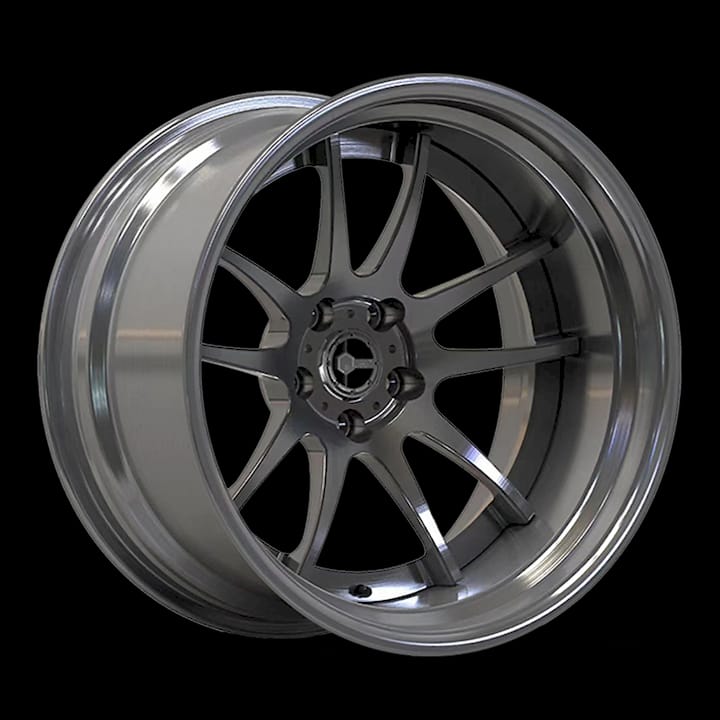
Two-piece (2pc) designs separate the center section from the barrel, joined with precision sealing and assembly tolerances that have to hold under repeated thermal cycling. That separation gives more flexibility on barrel width and finish without touching the structural center section, which is useful on platforms where fitment needs run wider than a monoblock casting allows.
Beadlock wheels add a mechanical clamping ring at the bead seat, built for extreme lateral loads where a standard bead seal isn’t enough. AeroDisc construction pairs a forged 6061-T6 core with an autoclave-cured carbon fiber face, which brings genuine aerodynamic benefit at speed. That pairing does require careful engineering around differential thermal expansion between the aluminum core and the carbon disc, since mismatched expansion rates and bonded-joint corrosion are exactly what separates a well-engineered AeroDisc from a fragile one.
| Configuration | Best Suited For |
|---|---|
| Monoblock | Lowest unsprung mass, street and track dual-use |
| Two-piece (2pc) | Flexible barrel width, wider finish options |
| Beadlock | Extreme lateral load applications |
| AeroDisc | Aerodynamic-focused, high-speed stability builds |
Pro Tip: If your build spends real time above 100 mph, ask specifically about AeroDisc thermal engineering. A poorly bonded carbon face is one of the few forged-wheel failure points that has nothing to do with the aluminum itself.
What Precision Forging Actually Does for Vehicle Dynamics
Every gram removed from a wheel is a gram removed from unsprung mass, and unsprung mass reduction pays off in ways that are easy to describe but hard to overstate. Lower rotational mass means less moment of inertia at each corner, which translates directly into quicker steering response and reduced strain on suspension components over rough pavement.
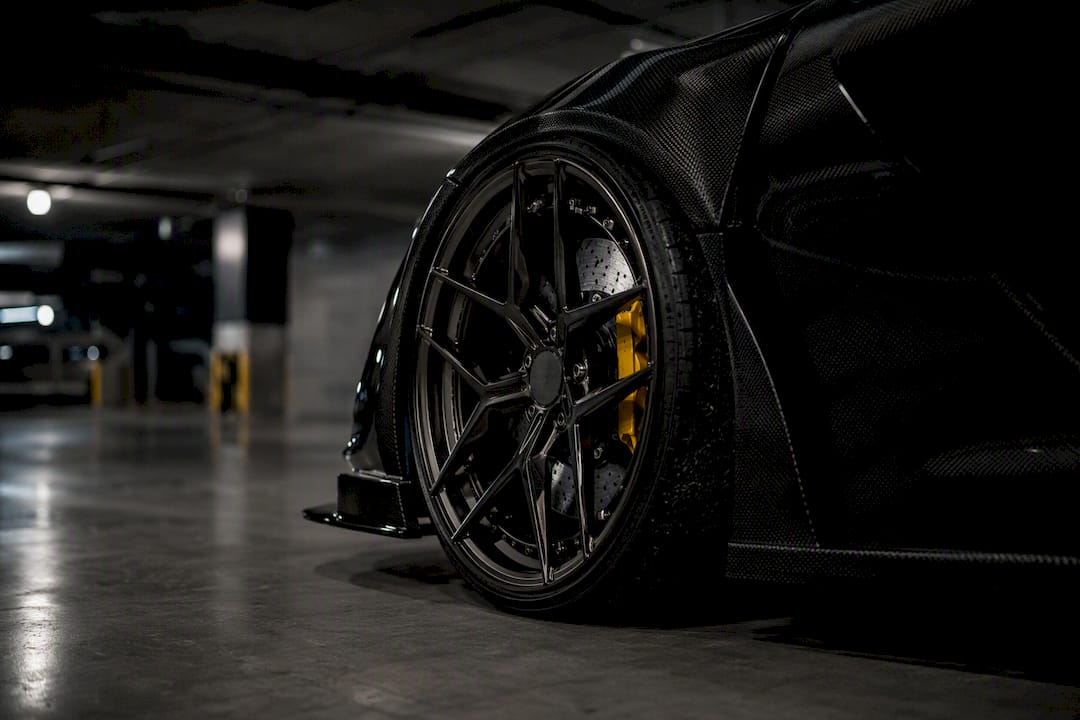
Monoblock construction delivers the biggest unsprung-mass advantage because there’s no joining hardware or overlapping material at the barrel seam. Spoke geometry matters just as much: I-beam profiles cut during side-milling keep torsional stiffness high while removing mass from areas that don’t carry primary load, which is the whole reason that CNC step takes hours instead of minutes.
Continuous grain flow from forging also means better resistance to crack propagation under impact, since a crack has to fight through aligned grain structure rather than finding an easy path along porous cast boundaries. That shows up practically as more consistent thermal stability under repeated hard braking, and a longer real-world fatigue life before a wheel needs retirement from track duty.
- Lower unsprung mass improves steering response and ride quality
- I-beam spoke profiles balance stiffness against weight
- Forged grain flow resists crack propagation better than cast structures
- Consistent thermal behavior under repeated braking cycles
Pro Tip: When comparing wheel weights between two products, ask how the weight was achieved. A lighter wheel from thinner spoke walls isn’t the same engineering achievement as a lighter wheel from optimized I-beam geometry.
You can see the broader performance case for forged construction laid out in more detail on E6 Carbon’s forged aluminum benefits page.
How Long Does a Bespoke Forged Wheel Take to Build?
Bespoke forged wheels aren’t an off-the-shelf purchase, and the timeline reflects that. Forging and T6 heat treatment alone account for a meaningful chunk of the schedule, since the 8 to 12 hour T6 hold can’t be rushed without compromising the part. CNC machining adds several more hours per wheel, and custom die design for a new fitment adds lead time before forging even starts.
The biggest cost and time drivers are custom die design, total machining hours tied to material removed, and any NDT or certification testing required for motorsport use. Complex finishes, intricate side-milling patterns, and AeroDisc’s autoclave-cured carbon face all extend the build window further.
- Die design and fitment engineering: initial phase before any forging begins
- Forging and T6 heat treatment: fixed minimum hold times that can’t be compressed
- CNC machining: scales with design complexity and finish detail
- QC, finishing, and shipping: final stage before a completed set leaves the shop
| Cost Driver | Impact on Lead Time |
|---|---|
| Custom die design | Adds time upfront, especially for new fitments |
| Machining hours | Scales directly with spoke and finish complexity |
| NDT and certification | Required for motorsport-rated builds |
Inside E6 Engineering’s Process Controls
E6 Carbon builds every E6 Forged wheel from the same starting point: a 6061-T6 billet forged under high press force, followed by full T6 heat treatment and precision CNC machining to hub-centric tolerances. That process discipline is what “Fitment First” engineering actually means in practice, not a slogan but a sequence of verifiable manufacturing steps applied to every wheel that leaves the shop.
The difference between a wheel that survives a decade of track use and one that doesn’t rarely comes down to the alloy on the spec sheet. It comes down to whether every forging, heat-treatment, and machining step was actually run to full spec, every time, on every batch.
Platform focus shapes how E6 Carbon allocates engineering attention. Mercedes-AMG fitments represent the largest share of current development work, followed closely by Lexus LC500 applications, with McLaren and Lamborghini fitments expanding as a smaller but growing share of the catalog. Each platform gets its own single bolt-pattern fixture design rather than a generic template, because hub geometry, caliper clearance, and load paths differ meaningfully between an AMG chassis and an LC500.
- Full 6061-T6 chemistry verification on every incoming billet
- T6 heat treatment run to complete spec, no abbreviated cycles
- Platform-specific single bolt-pattern CNC fixturing
- NDT and dynamic balance verification before final assembly
| Platform Focus | Configuration Emphasis |
|---|---|
| Mercedes-AMG | Monoblock and AeroDisc, high-speed stability focus |
| Lexus LC500 | Monoblock and 2pc, refined street and track dual-use |
| McLaren/Lamborghini | Beadlock and AeroDisc, expanding fitment catalog |
Pro Tip: When you request a consultation, ask to see the fitment engineering specific to your chassis generation, not a generic model-year spec sheet. Hub geometry can shift meaningfully even within the same platform’s production run.
You can review monoblock-specific engineering detail on the E6 Forged monoblock product page.
Why Process Control Beats Spec-Sheet Marketing
The wheel industry loves a headline weight number, but weight alone tells you almost nothing about how a wheel behaves after 20,000 miles of real driving. Process control, the actual T6 hold time, the actual forging tonnage, the actual NDT record for that batch, predicts durability far better than a marketing spec ever will.
A traceable QC record beats a glossy spec sheet every time, because it’s the only thing that proves the process was actually followed on the wheel you’re buying, not just the prototype used for photography.
Order an E6 Forged Wheel Set Built for Your Platform
If everything above tells you anything, it’s that a forged wheel is only as good as the process behind it, and that process is exactly what E6 Carbon puts on the table for every consultation. Rather than picking from generic sizing, you get platform-specific engineering: fitment review against your exact chassis, material spec confirmation on the 6061-T6 billet and T6 cycle, and a realistic lead-time estimate before you commit. Start by reviewing the E6 Forged wheel catalog for your platform, whether that’s a Mercedes-AMG, a Lexus LC500, or an expanding McLaren or Lamborghini fitment.
What to expect in a consultation:
- A fitment review matched to your specific chassis and hub geometry
- Confirmation of material spec and heat-treatment cycle for your build
- A realistic lead-time estimate based on configuration complexity
- Guidance on choosing between monoblock, 2pc, beadlock, and AeroDisc designs
Sources
- What Is the Complete Manufacturing Process for a Premium Forged Wheel? – Tree Wheels
- The Production Process of Forging Car Wheel Hub – PDH
- How forged wheels are made – Hagerty Media
- Southwestalu
- How Are Forged Wheels Made – Apex Wheels
FAQ
What are the disadvantages of forged wheels?
Forged wheels cost more than cast alternatives because of the tooling, press time, and machining hours involved, and some editorial coverage notes they aren’t necessary for every driving application, especially lower-performance daily commuting where a cast or flow-formed wheel often performs well.
What is the manufacturing process for forged wheels?
A premium forged wheel follows a sequence of billet selection, forging under thousands of tons of press force, T6 heat treatment, CNC machining, surface finishing, and final inspection. E6 Forged wheels follow this same sequence, starting from 6061-T6 billet and finishing with hub-centric CNC work verified through NDT and dynamic balance testing.
Who makes the best forged wheels?
Quality comes down to process discipline rather than brand name alone: full T6 heat-treatment cycles, verified 6061-T6 chemistry, and documented NDT testing on every batch. E6 Carbon builds every E6 Forged wheel to that full process standard, with platform-specific engineering for Mercedes-AMG, Lexus LC500, McLaren, and Lamborghini chassis.
What are forged wheels typically made from?
High-performance forged wheels are typically made from 6061-T6 aluminum, chosen for its machinability and predictable response to heat treatment. E6 Forged wheels use aerospace-grade 6061-T6 billet as the sole starting material for every monoblock, 2pc, beadlock, and AeroDisc configuration.
How does E6 Forged differ from a standard cast wheel?
The core difference is grain structure: forging under high press tonnage aligns and densifies the aluminum’s grain, while casting leaves a more porous microstructure with lower fatigue resistance. That process difference is why forged wheels handle repeated high-load cornering better over the long term than cast equivalents.