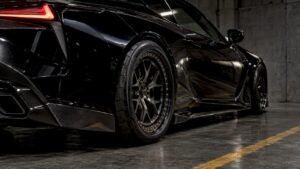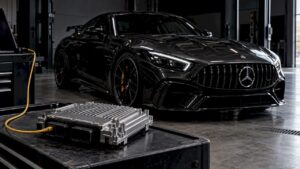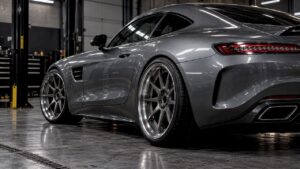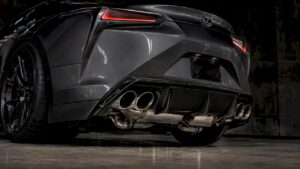
For exotic and supercar owners who want a bespoke, durable, showroom grade finish on wheels and exposed metal components, artisan hand-finished powder coating is the recommended route. E6 Forged applies it across its monoblock, 2pc, beadlock, and AeroDisc wheel lines.
The case for it comes down to a few hard facts. The coating cures in an oven at roughly 400°F, fusing to the substrate in a way wet paint cannot match. Multi-layer translucent finishes let a shop build actual visual depth rather than a flat color. And once cured, that finish shrugs off brake dust, road salt, and stone chips far better than a lacquer topcoat.
- High-temp cure bonds the powder to bare alloy for a harder, more chip-resistant shell
- Translucent and hand-brushed layering creates depth no single-stage paint can replicate
- Superior resistance to brake dust and chemical exposure versus wet paint
- Applied across E6 Forged’s monoblock, 2pc, beadlock, and AeroDisc catalog
The details on process, finish palettes, cost, and how to commission the work follow below.
Key Takeaways
Artisan hand-finished powder coating outperforms standard shop coating and wet paint on durability and personalization for supercar wheels, provided the shop follows a full strip, cure, and hand-finish process.
| Point | Details |
|---|---|
| Full strip is mandatory | Coating over existing powder risks adhesion failure, so bare-alloy strip-back should never be skipped. |
| Cure temperature matters | A proper cure around 400°F is what gives powder coating its chip resistance advantage over wet paint. |
| Sample approval prevents disappointment | Approve a physical cured sample panel before full production, especially for translucent and candy finishes. |
| Wheels beat body panels for this process | Powder coating suits wheels and exposed hardware better than large body panels or complex multi-tone graphics. |
| E6 Forged applies the full palette | Hand-grained brushed aluminum, liquid bronze, dark smoke, and satin clear are available across monoblock, beadlock, 2pc, and AeroDisc wheel lines. |
Table of Contents
- What Is Bespoke Hand Finished Powder Coating?
- How Does the Artisan Powder Coating Process Actually Work?
- Which Finish Options Work Best for Supercar Wheels?
- Is Powder Coating More Durable Than Wet Paint?
- How Do You Maintain a Bespoke Powder Coated Finish?
- How E6 Forged Approaches Artisan Finishing
- What Does the Commissioning Timeline Look Like?
- What Drives the Total Cost of a Bespoke Powder Coat?
- Craftsmanship as Identity
- Commissioning Your Bespoke Finish With E6 Forged
- Sources
- FAQ
What Is Bespoke Hand Finished Powder Coating?
Bespoke hand finished powder coating is a custom-color, artisan-applied version of the same industrial process used to coat fences and machinery, except every step is slowed down and personalized for one wheel set. Standard shop powder coating means picking from a rack of stock colors and running parts through a production line. Bespoke work means color-matching to a sample, hand-brushing grain patterns into brushed aluminum, and layering translucent topcoats to build a finish with actual dimension. Wet paint, by contrast, relies on chemical curing and clear coat rather than a fused powder shell, which is part of why it behaves differently under stone impact and road grime.
Not every component benefits from this treatment. Here’s how to think about candidates:
- Wheels are the best-suited application. High-impact exposure to brake dust, curbs, and debris rewards the hardness of a cured powder shell.
- Exposed metal aero parts, like brake calipers or structural trim, take well to powder coating because they’re rigid and simple to fixture during application.
- Visible hardware, such as lug covers or valve caps, offers an easy way to extend a bespoke theme without committing an entire panel.
- Flexible body panels and large painted surfaces should generally be avoided. Powder coating requires an oven cure, and most factory body panels aren’t good candidates for that heat cycle or the electrostatic process.
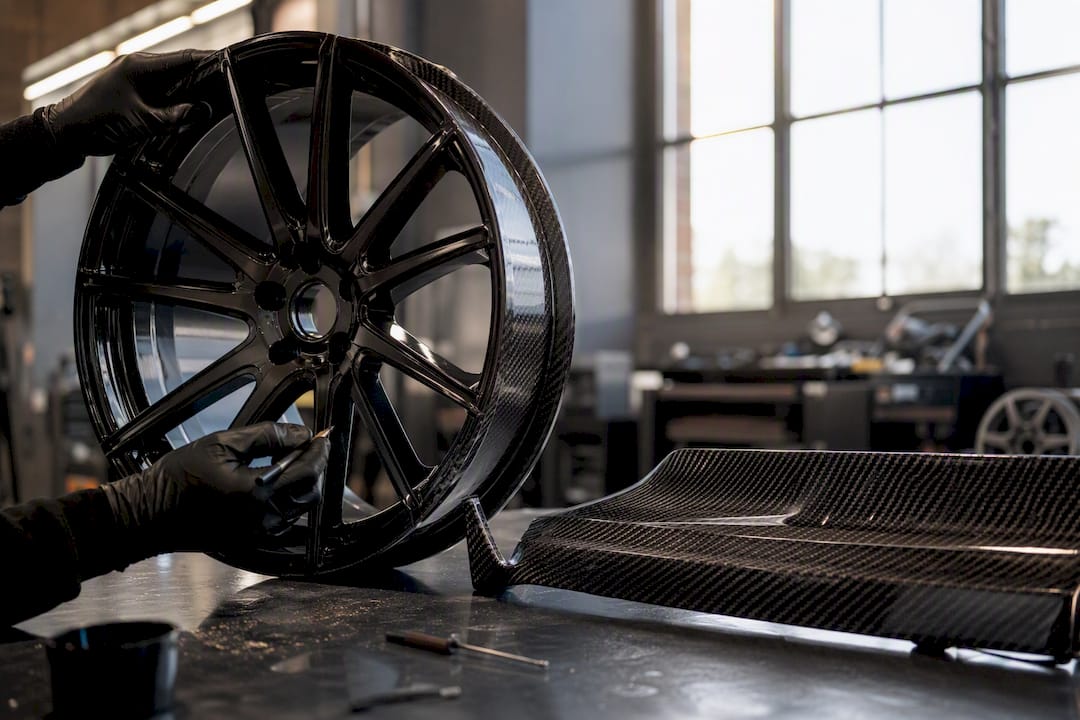
The hand-finishing part is where a shop earns its reputation. Match-to-sample work means a technician mixes and tests until the cured panel matches a swatch the client provided, not a chip off a chart. Hand brushing before the coat goes down creates a grain that catches light differently than any machine-textured surface. Layered translucents, applied in careful passes over a metallic base, are what turn a single flat color into something with visible depth from three feet away.
Pro Tip: Ask to see a cured sample panel in direct sunlight and under shop fluorescents before committing. Translucent finishes shift dramatically between lighting conditions, and a photo on a phone screen will not tell you the truth.
How Does the Artisan Powder Coating Process Actually Work?
Every legitimate bespoke powder coat job follows the same technical spine, whether the finish ends up being a subtle satin clear or a full liquid bronze. What separates an artisan shop from a production line is what happens after the base coat cures.
Strip and inspect. The wheel or component gets stripped to bare substrate first. This isn’t optional. Applying new powder over an existing coat is a known cause of adhesion failure down the line, and a proper alloy wheel refurbishment always starts from bare alloy. Once stripped, a technician inspects for cracks, porosity, or prior repair welds that could compromise structural integrity under load.
Pretreat. Aluminum substrates get a chromate-free Ti/Zr passivation treatment in most modern shops, replacing the hexavalent chromium chemistries older OEM lines relied on. This step is invisible in the finished product but does the real work of adhesion. Some shops still use chemical or media blasting for surface preparation instead of or alongside chemical pretreatment, depending on the substrate condition.
Electrostatic application. The dry powder is charged and sprayed so it clings evenly to the grounded part, including into recesses and behind spokes that a wet spray gun would struggle to reach uniformly.
Cure. The part goes into an oven at roughly 400°F, where the powder melts and fuses into a continuous shell. This is the step that gives powder coating its chip resistance over wet paint.
The 400° Threshold: Most automotive-grade powder formulations require oven curing near this temperature to fully cross-link. Skip it or shortcut it, and the coating will look fine on day one and fail within a season.
Hand finishing happens after that base cure, and it’s where the artisan work actually lives. Technicians may wet-sand between coats to level texture before a translucent goes on. Hand-grain brushing on aluminum happens before or between coats to control how light reflects across the surface. Baked satin clears go on as a final protective and tonal layer, sometimes requiring a second, shorter cure cycle.
- Adhesion cross-hatch testing on sample panels before full production runs
- Wave-scan or visual gloss inspection under multiple light sources
- Client sign-off on a physical sample panel before the full wheel set is finished
- Final QC pass checking for orange peel, edge coverage, and color consistency across the full set
Luxury bespoke finishing programs elsewhere in the industry follow a similar philosophy. Land Rover’s bespoke paint program reports a 25% smoothness improvement from thicker topcoats and extended polishing stages, a direct parallel to what happens when a powder coat shop adds hand-sanding and multi-pass translucents instead of stopping at a single base coat.
Which Finish Options Work Best for Supercar Wheels?
The finish palette is where bespoke powder coating actually becomes a personal statement rather than a maintenance decision. Specialist coaters can color-match hundreds of variations, including candies, metal flakes, and translucent effects, but a handful of finishes dominate the exotic and supercar space for good reason.
- High-gloss candies use a metallic or reflective base coat with a translucent tinted topcoat, producing depth and shift that a solid color can’t touch under direct light.
- Liquid bronze and other translucent metallics layer a warm, semi-transparent tone over a bright metallic base, giving wheels a jewelry-like quality that reads differently at every angle.
- Dark smoke finishes use a dark translucent over a lighter or chrome-like base, creating a shadowed, almost gunmetal depth without going fully black.
- Satin clear topcoats knock down gloss for a refined, low-glare finish that photographs cleaner and hides minor imperfections better than high gloss.
- Hand-brushed effects rely on a pre-coat texture pass, giving the cured finish a directional grain instead of a uniform mirror surface.
Each option carries a trade-off. High-gloss candies look spectacular in showroom lighting but show swirl marks and brake dust more readily than a satin finish. Translucent metallics depend heavily on UV-stable clear coats to avoid shifting tone over years of sun exposure, particularly on track cars that see more daylight hours than garage queens. Satin clears trade some visual drama for a finish that’s genuinely easier to live with day to day, since fine scratches and light contamination don’t scream at you the way they do under gloss.
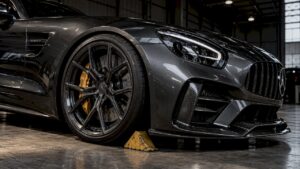
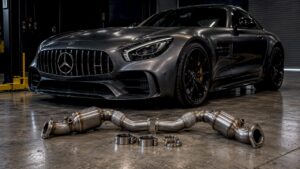
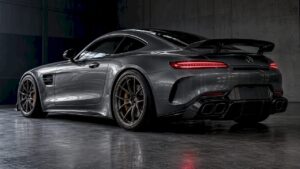
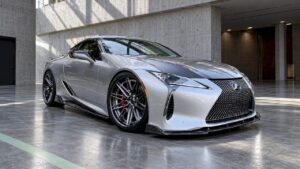
For a Mercedes-AMG build, a dark smoke or satin clear finish tends to complement AMG’s aggressive, blacked-out styling language without fighting the factory trim. On a Lexus LC500, whose sculpted bodywork and warm interior tones lend themselves to a more jewelry-forward presentation, liquid bronze or a high-gloss candy on a multi-spoke wheel design plays directly to the car’s design intent.
Pro Tip: If you’re deciding between gloss and satin, look at where the car actually lives. Daily-driven or track-active cars age better cosmetically in satin; garage-kept show cars can carry high gloss without the maintenance headache showing up as fast.
Owners exploring the full palette before committing should look at the range of artisan hand-brushed and translucent finishes available across current wheel programs.
Is Powder Coating More Durable Than Wet Paint?
For wheels and exposed hardware, yes, generally. Powder coating produces a harder, more chip-resistant shell than wet paint and clear coat, and it holds up noticeably better against the chemical assault of brake dust and road salt over a wheel’s service life.
That said, powder coating isn’t the right call everywhere on the car.
- Complex multi-tone body panels with intricate graphics are usually better suited to wet paint, since color layering and micro-polishing are more flexible in liquid systems.
- Front bumpers, hoods, and other stone-strike zones on the body often benefit more from paint protection film or ceramic coating than from a powder shell, since those panels need to stay repairable without a full strip-and-recoat.
- Repairing a chipped powder-coated wheel typically means stripping the entire piece back to bare alloy and recoating, rather than a simple touch-up.
That repair reality is worth sitting with before you commit. A wet-painted panel can often take a spot repair. A powder-coated wheel generally can’t, at least not invisibly, because feathering a powder edge the way you would with paint isn’t really possible. Under normal road use, a properly cured and hand-finished powder coat on a wheel should outlast a comparable painted finish by a meaningful margin, particularly on cars that see track days or regular highway miles where brake dust exposure adds up fast.
How Do You Maintain a Bespoke Powder Coated Finish?
Powder coating is tougher than paint, but it isn’t maintenance-free, and how you treat it in the first six months determines how it looks in year three.
- Wash with pH-neutral cleaners. Harsh wheel cleaners marketed as “acid-free” can still be aggressive on translucent topcoats. Stick to pH-neutral formulas and a dedicated wheel brush, and rinse brake dust off before it bakes on during a hot drive home.
- Decontaminate periodically. An iron-remover product every few washes helps pull embedded brake dust out of texture and hand-brushed grain before it stains.
- Inspect edges and lips regularly. Chips almost always start at the wheel lip or spoke edges first. Catch a small chip early and a shop can often address it locally instead of waiting for it to spread under the clear.
- Get warranty terms in writing. A legitimate shop warranty should specify what’s covered (adhesion failure, premature peeling) versus what’s excluded (curb rash, stone chips, cosmetic wear from improper cleaning products). Ask specifically whether the warranty covers labor to strip and recoat, or just materials.
Pro Tip: Never run a wheel through an automated car wash with abrasive brushes. That’s the single fastest way to introduce fine swirl marks into a satin or hand-brushed finish.
Partner shops in the detailing space echo the same core advice on wheel coating care: gentle chemistry, regular inspection, and prompt attention to small damage before it becomes a full recoat.
How E6 Forged Approaches Artisan Finishing
E6 Forged treats finish work as a discipline distinct from wheel engineering, even though both happen under the same roof. The team that hand-brushes aluminum or lays a liquid bronze translucent isn’t the same team optimizing unsprung weight reduction on a monoblock casting, and that separation of craft matters.
The current finishing palette spans hand-grained brushed aluminum, liquid bronze, dark smoke, and baked satin clear, applied across the full wheel catalog: monoblock, beadlock, two-piece (2pc), and AeroDisc. Development priority sits heavily on Mercedes-AMG platforms and the Lexus LC500, with expansion underway into McLaren and Lamborghini fitments.
Finish work is where an owner’s personality actually shows up on the car. Two identical AeroDisc wheels, one in satin clear and one in liquid bronze, tell completely different stories about the person who ordered them.
- Full palette available across monoblock, beadlock, 2pc, and AeroDisc designs
- Primary platform focus: Mercedes-AMG and Lexus LC500, with McLaren/Lamborghini expansion in progress
- Sample panel approval built into every bespoke commission before full production
Readers can browse AeroDisc wheel examples for a sense of how these finishes read on a completed set.
What Does the Commissioning Timeline Look Like?
A bespoke powder coat project moves through distinct phases, and knowing the shape of that timeline before you start prevents frustration later.
The process usually opens with a consultation, either in person or through submitted photos of the vehicle and wheels. If wheels need to come off the car for coating, that disassembly typically happens at drop-off, and most shops will coordinate loaner or temporary wheels if the car needs to remain drivable during the turnaround. From there, sample panel development and approval is its own phase. A technician mixes and cures a test panel matched to your reference, and you sign off on it before anything else moves forward. Rushing this step is the single most common cause of disappointment in bespoke finish work.
Once the sample is approved, full production begins: strip, inspect, pretreat, coat, cure, then the hand-finishing stages, followed by final quality inspection. Multi-stage translucent finishes with hand-brushing add real time here compared to a single-stage color, simply because each layer needs its own cure or set time before the next step.
Reassembly and final pickup close out the process. Wheels get reinstalled, torqued to spec, and the car undergoes a final visual walk-around with the client before it leaves the shop. Total elapsed time from consultation to pickup varies by finish complexity and current shop volume, so ask your shop for a specific window rather than a rule of thumb before you commit a car to the project.
What Drives the Total Cost of a Bespoke Powder Coat?
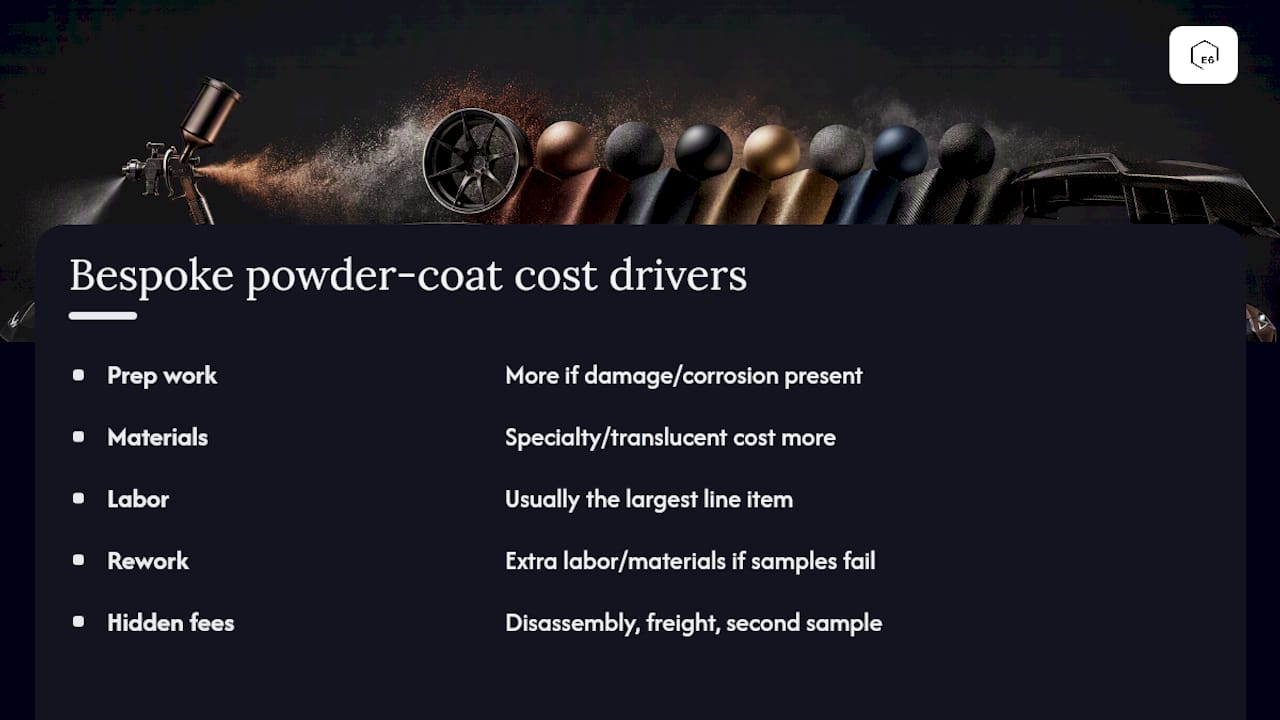
Cost on a bespoke job breaks down into several distinct line items, and understanding each one helps you evaluate a quote intelligently instead of just comparing bottom-line numbers.
Prep work is the first cost driver. A wheel with existing damage, prior repairs, or heavy corrosion needs more stripping, media blasting, and structural inspection time than a clean, undamaged set, and that labor shows up on the invoice. Materials come next: base powders are relatively inexpensive, but specialty translucents, metallic bases, and multi-layer systems cost meaningfully more than a single stock color, since they require more product and more precise application.
Labor is usually the largest line item on a genuinely bespoke job, because hand-brushing, multi-pass translucent layering, and sample panel development are all time-intensive work that can’t be rushed without compromising the result. Rework is the line item most quotes leave out entirely. If a sample panel doesn’t match on the first attempt, or a client changes direction after seeing the cured sample, that’s additional labor and material cost that should be discussed upfront rather than discovered on the final invoice.
Ask any shop directly whether their quote includes disassembly and reassembly labor, freight or shipping if wheels are shipped rather than dropped off, and any charge for a second sample panel. Those three items are where “hidden fees” most commonly show up in this industry, and a shop confident in its process will answer all three without hesitation.
Craftsmanship as Identity
A wheel finish is one of the few parts of a car an owner can make entirely their own. The color on a body panel usually came from a factory order sheet. A hand-brushed grain or a liquid bronze translucent, chosen and approved panel by panel, didn’t come from anyone’s order sheet but yours.
That’s the same instinct behind E6 Forged’s engineering priorities. Fitment First thinking and a focus on unsprung weight reduction exist because the wheel has to work as hard as it looks good, whether it’s sitting under a Lexus LC500 or an AMG. Finish is where the engineering meets the person driving the car.
Commissioning Your Bespoke Finish With E6 Forged
There are other paths to a custom wheel look. Some owners have a local shop strip and repaint existing wheels, and others buy stock colored wheels off a shelf and hope the shade holds up. Neither route gives you the layered translucents, hand-brushed grain, or sample-approved color matching that a genuinely bespoke commission delivers, because neither is built around a client-specific finish from the start.
Commissioning through E6 Forged starts with a consultation where you bring reference photos, describe the car’s intended use (street, show, occasional track day), and share any specific sample or reference color you’re chasing. From there, a sample panel gets developed and sent for your approval, full production and hand finishing follow, and the finished set gets inspected before it ships or you pick it up. Each phase includes a checkpoint so you’re never surprised by the final result.
If you’re planning a wheel project and want a finish that actually reflects what you had in mind rather than a compromise off a rack, the place to start is the E6 Forged wheel catalog, where you can review current monoblock, beadlock, 2pc, and AeroDisc configurations and begin a consultation for your build. Owners running a Lexus LC500 and looking to pair a finished wheel set with matching aero can also review the Lexus LC500 carbon aero kit for a coordinated build.
Sources
For deeper technical background, see the surface preparation guide and powder coating process breakdown. For finish inspiration, browse the custom paint finish guide.
- The complete surface preparation guide for powder coating: every metal, every method — PowderCoatPro
- The powder coating process explained — Sarcoatings
- Magnificent lustre: Range Rover develops mirror-like paint finish for Bespoke clients — Land Rover Media
FAQ
How much does custom powder coating cost?
Cost depends on prep condition, finish complexity, and labor intensity. Multi-layer translucent or hand-brushed finishes cost meaningfully more than a single stock color because of the added labor and rework risk involved.
What is the best powder coat finish for a supercar?
There’s no single best finish. Satin clear and dark smoke suit daily-driven or track-active cars because they hide minor wear, while high-gloss candies and liquid bronze suit garage-kept show cars where visual drama matters more than easy upkeep.
What are the downsides of powder coating?
Powder coating requires a full strip to bare substrate for proper adhesion, isn’t well suited to large flexible body panels, and typically requires stripping the whole piece to fix a chip rather than a spot repair.
Which supercar is considered the most beautiful in the world?
Beauty in supercars is subjective and varies by era and taste, but the Lexus LC500 is widely praised for its sculpted, jewel-like design language, which is part of why finishes like liquid bronze and high-gloss candy suit it so well.
Does E6 Forged offer bespoke hand finished powder coats?
Yes. E6 Forged applies hand-finished powder coating, including liquid bronze, dark smoke, satin clear, and hand-brushed aluminum, across its monoblock, beadlock, 2pc, and AeroDisc wheel lines.