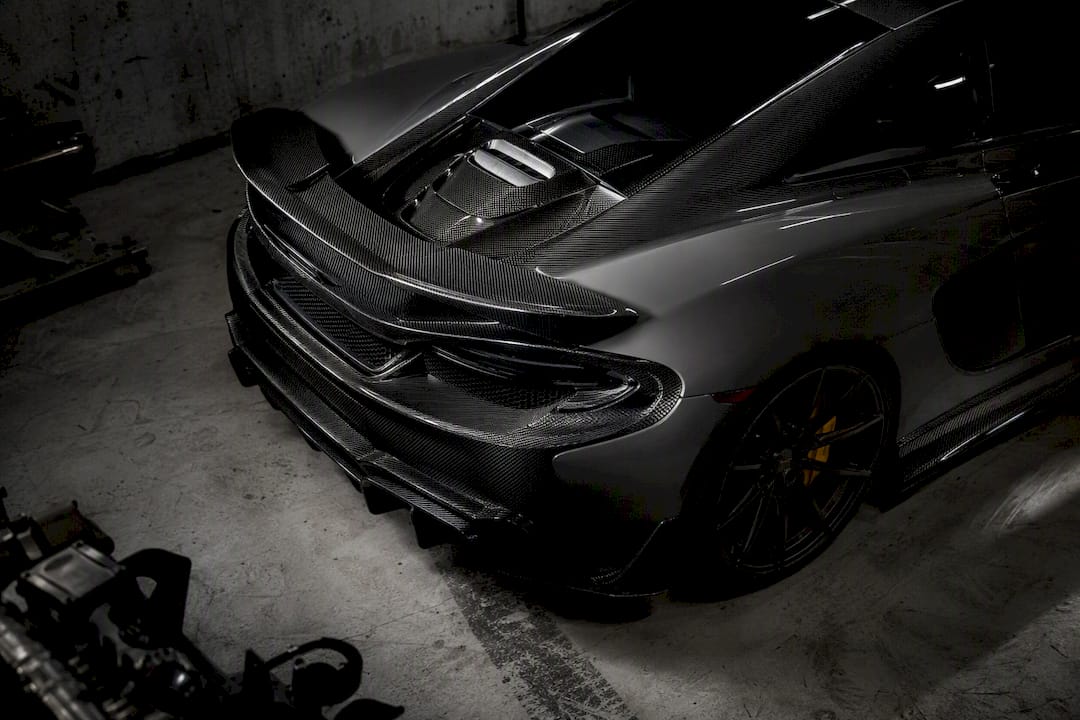
The biggest, most reliably measured gain on a C8 Z06 comes from three parts working together: a front splitter, a high rear wing, and a matched diffuser. Track data on Z07-equipped cars shows lateral grip climbing toward 1.16 g, tighter lap-to-lap consistency, and noticeably flatter high-speed transitions compared with a stock aero setup.
The tradeoff is real and worth knowing before you spend a dollar: added downforce costs you some straight-line trap speed. Owners running full carbon aero packages routinely give up a few miles per hour at the top of the straight in exchange for a car that turns in predictably at 120 mph instead of getting light and vague.
That trade only pays off when the parts are engineered as a system, not bolted on individually. Here’s the quick version:
- Splitter plus high wing plus diffuser is the combination with the strongest track-verified stability and lap-time payoff.
- Expect a modest trap-speed loss at the far end of long straights in exchange for better mid-corner and high-speed confidence.
- These parts only deliver their rated numbers when built from stable material and installed by someone who understands load paths. That’s the E6 Engineering approach, and it requires professional installation.
Key Takeaways
Splitter, wing, and diffuser deliver the largest measured lap-time and stability gains on a C8 Z06 when engineered and installed as a matched system.
| Point | Details |
|---|---|
| Prioritize splitter and diffuser first | These parts rebalance underbody pressure and give you a stable platform to tune wing angle around. |
| Expect a trap-speed tradeoff | Full aero packages that raise skidpad grip toward 1.16 g typically cost some straight-line speed. |
| Match spring rates to downforce | Project builds have needed spring-rate jumps into the 1,100 to 1,200 lb range to avoid bottoming under load. |
| Validate claims with real data | Ask vendors for CFD pressure maps, wind-tunnel correlation, and track-verified lap and load-cell numbers. |
| Professional install is mandatory | E6 Carbon’s autoclave-cured pre-preg components require pro installation and proper water-sealing, with zero liability for improper home fitment. |
Table of Contents
- Track-Tested Aerodynamics: What the Numbers Actually Show
- How Splitters, Diffusers, Dive Planes, and Wings Change Airflow
- Do You Need to Change Springs and Tires for More Downforce?
- Can You Trust an Aero Vendor’s Downforce Claims?
- What Fitment and Installation Actually Require
- Why E6 Engineering Builds Around Autoclave-Cured Pre-Preg
- Does Track Aero Hurt Cooling or Engine Performance?
- How Does Z06 Aero Compare to Stock and Rival Supercars?
- How Does Aero Change the Way the Z06 Feels to Drive?
- How Long Do Aero Parts Last Under Track Conditions?
- An Engineering Perspective on Track Aero That Actually Works
- Get Your C8 Z06 Track-Ready With E6 Carbon
- Sources
- FAQ
Track-Tested Aerodynamics: What the Numbers Actually Show
Aero claims are cheap. Track numbers aren’t. When MotorTrend put a Z07-equipped Z06 through instrumented testing, the Carbon Fiber Aero Package correlated with higher skidpad grip and better figure-eight consistency, while also trimming trap speed in straight-line runs. That single data point tells you almost everything about how aero behaves on this chassis: it buys stability, and it charges rent in top-end speed.
Three things determine whether a given upgrade shows up on a stopwatch:
- Speed regime. Aerodynamic load scales with the square of speed, so a part that feels irrelevant at 60 mph can be doing real work at 130 mph. Below roughly 80 to 90 mph, tires and mechanical grip still dominate handling; above that threshold, aero starts carrying an increasing share of the cornering load.
- Tire state. A fresh set of sticky tires can mask a mediocre aero package for a lap or two. Aero gains show up most clearly as the tires cycle through heat and wear, which is exactly when consistency matters most in a race stint.
- Track layout. A circuit with long, high-speed corners rewards wing and diffuser work far more than a tight, low-speed autocross-style layout ever will.
Track math: a Z07 package car generating 1.10 to 1.16 g on the skidpad isn’t winning that number through tires alone. Chevrolet’s own spec sheet requires the Carbon Fiber Aero Package as part of Z07, which tells you the factory considers the aero contribution non-optional for the car’s rated track performance, not a cosmetic add-on.
The honest takeaway: if your track has sweepers, fast kinks, or a long back straight into a heavy braking zone, aero investment pays off. If it’s a tight, technical go-kart-style course, spend your money on tires and dampers first.
How Splitters, Diffusers, Dive Planes, and Wings Change Airflow
Every aero part on a Z06 does one of two jobs: it manages pressure under the car, or it manages pressure over it. Understanding which job a part does tells you what handling change to expect before you ever bolt it on.
- Front splitter and lip. A splitter creates a high-pressure zone above it and a low-pressure zone beneath, pulling the nose down and feeding cleaner air into the underbody tunnels. This is usually the first part owners add because it’s the cheapest way to fix a car that pushes wide at turn-in.
- Dive planes and canards. These generate localized vortices along the front fender that manage front-wheel wake and sharpen turn-in response without the drag penalty of a bigger splitter.
- Diffuser. A properly profiled diffuser expands underbody air as it exits, dropping pressure beneath the floor and generating rear downforce with a comparatively small drag cost. Verus Engineering’s documented Ventus package data shows measurable downforce shifts and front/rear balance changes across different angle-of-attack settings, which is exactly the kind of proof you should ask any vendor for.
- Rear wing. Wing angle of attack is a balance dial. Steeper angle means more rear downforce and more drag; a flatter setting trades some stability for straight-line speed.
Pro Tip: Never add a big front splitter without a plan for the rear. A front-heavy downforce increase without matching rear grip pushes the balance toward snap-oversteer at the exact speeds where you can least afford it.
Verus’s own testing on Z51 and Stingray platforms backs this up: pairing a diffuser with a properly sized wing adds downforce with a smaller drag penalty than simply upsizing the wing alone.
Do You Need to Change Springs and Tires for More Downforce?
Downforce is free grip only until it starts compressing your suspension into the bump stops. Project builds that added large splitters and wings on the C8 platform have needed dramatic spring-rate jumps. One documented time-trial build moved from roughly 750 lb springs to 1,100 lb front and 1,200 lb rear specifically to keep the car from bottoming under the added aero load at speed.
Setup priorities once you add real aero to a Z06:
- Raise spring rates in stages, and confirm ride height under load rather than static, since aero parts change the effective ride height at speed.
- Run a tire compound and pressure that’s tuned for sustained heat cycles, not a single hot lap, since aero-heavy cars generate more consistent grip demand over longer runs.
- Prioritize unsprung weight reduction, such as lighter forged wheels, so the added spring rate doesn’t turn the ride into a jackhammer over bumps and curbing.
Lighter wheels also let the stiffer springs do their job without overwhelming the dampers’ ability to control unsprung mass on choppy pavement.
Can You Trust an Aero Vendor’s Downforce Claims?
A downforce number without a testing method behind it is marketing copy. Here’s what separates a validated claim from a guess:
- CFD data. Ask for pressure contour maps, lift-to-drag curves, and angle-of-attack sweeps, not just a single peak downforce figure. CFD is fast and cheap but only as good as the boundary conditions modeled, so it should never stand alone.
- Moving-ground wind tunnel correlation. Corvette Racing’s own C8.R development leaned on CFD paired with moving-ground tunnel testing to balance front and rear downforce against cooling needs, which is the same discipline that should back any serious aftermarket claim.
- Track verification. The final check is measured lap times, load-cell downforce data at representative ride heights, and driver feedback, with tires and powertrain held constant so the aero contribution is actually isolated.
If a vendor can’t produce at least two of these three, treat the downforce number as a guess.
What Fitment and Installation Actually Require
Track-spec aero only works if it stays exactly where it’s mounted at 150 mph in the rain. That means backing plates behind every splitter mount point, torque specs followed to the number rather than “snug,” and every seam near the underbody sealed against water intrusion before the car ever sees a wet session.
The most common failure isn’t a broken part. It’s a splitter that flexes because it was mounted without proper backing, killing the pressure differential it was designed to create, or a wing that develops a stress crack because it was torqued unevenly.
Track-spec aerodynamic splitters and wings require professional installation and proper water-sealing. E6 Carbon holds zero liability for improper fitment or home installation.
Before your first track day with new aero:
- Confirm every mounting point uses a backing plate rated for the load, not just sheet metal or thin composite.
- Verify torque specs on every fastener with a calibrated wrench, not a guess.
- Pressure-test or visually inspect water-sealing on any part that sits near brake ducting or underbody vents.
Why E6 Engineering Builds Around Autoclave-Cured Pre-Preg
Downforce is only useful if the part generating it doesn’t flex under its own load. That’s the entire argument for autoclave-cured 2×2 twill pre-preg construction over cheaper wet-layup carbon: pre-preg fiber is pre-impregnated with resin at a controlled ratio, then cured under heat and pressure in an autoclave, producing a laminate that holds its shape under cyclic aero loading instead of creeping or delaminating lap after lap.
E6 Engineering builds its C8 Z06 aero catalog around that same construction standard, with each part mapped to a specific handling job:
- Vented fenders for high-pressure air extraction and reduced under-hood turbulence.
- The Z06 Carbon Lip for front-end downforce and turn-in response.
- The E6 AeroTech Diffuser for rear downforce with a controlled drag penalty.
- The Z06 Style Wing for high-speed rear stability.
- AeroTech sideskirts for cleaner side airflow and reduced yaw sensitivity.
Pro Tip: Start with the diffuser and lip before the wing. Rebalancing the underbody first gives you a stable platform to tune wing angle around, instead of chasing balance changes every time you adjust the rear.
Every one of these parts requires professional installation, consistent with the fitment standards outlined above.
Does Track Aero Hurt Cooling or Engine Performance?
Aerodynamic parts and cooling compete for the same air, and getting that balance wrong can cost you more than lap time. A front splitter that redirects too much air away from the radiator opening, or a tightly sealed underbody that starves the brake ducts, can push coolant and brake temperatures up over a long track session even while lap times improve.
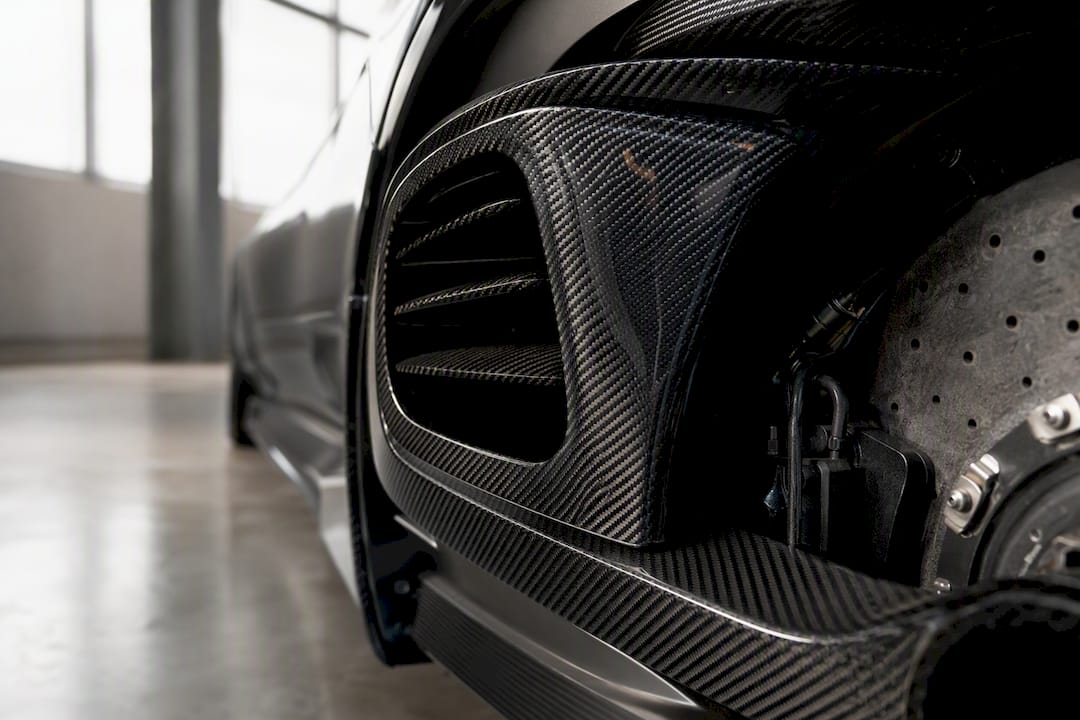
The fix isn’t avoiding aero. It’s designing intake paths and vents that work with the new airflow pattern instead of against it. A well-designed splitter and front lip combination should preserve, or even improve, airflow to the radiator by cleaning up the turbulent air that stock bumpers tend to create ahead of the intake. Vented fenders and hoods play the same role in reverse, giving high-pressure air trapped in the wheel wells and under the hood a clean exit path instead of letting it recirculate and raise underhood temperatures.
Brake cooling deserves the same scrutiny. Side splitters and rockers that route air cleanly along the rocker panel can starve brake ducts if they’re not designed with duct feed in mind, so any serious aero package should account for both jobs at once rather than optimizing downforce and treating cooling as an afterthought. The C8 Z06’s flat-plane V8 already runs hotter under sustained load than the Stingray’s engine, which makes this pairing between airflow management and thermal management more important on the Z06 than on any other Corvette trim.
How Does Z06 Aero Compare to Stock and Rival Supercars?
The stock C8 Z06 is already an aggressively aero-focused car by factory standards, with a rear-engine layout and a standard aero package that outperforms most naturally aspirated competitors in its price range. But it was engineered as a broad-use platform that has to work equally well as a daily driver and a track car, which means the factory settings are a compromise.
Chevrolet’s own Z07 Performance Package exists specifically because that compromise leaves performance on the table for buyers who only care about lap times. The Z07’s requirement of the Carbon Fiber Aero Package, paired with carbon-ceramic brakes and track-oriented tires, moves the car noticeably closer to the aero philosophy you see on GT3-derived race cars: more downforce, more drag, and a chassis tuned around holding speed through corners rather than maximizing top speed.
Compared with rival mid-engine supercars in its performance bracket, the Z06’s factory aero is competitive but not class-leading in raw downforce numbers. Where the Z06 platform holds a real advantage is cost-per-downforce: an aftermarket carbon package on a Z06 chassis can close a meaningful part of that gap at a fraction of what a factory aero upgrade costs on a comparable exotic. That’s the practical argument for aftermarket aero on this platform rather than accepting the factory ceiling.
How Does Aero Change the Way the Z06 Feels to Drive?
Numbers on a data logger tell you what happened. What drivers actually report after adding real aero to a Z06 is a shift in confidence at speeds where the stock car starts to feel vague.
The most consistent feedback centers on turn-in response. Drivers running a front splitter and dive planes describe sharper, more immediate response to steering input at highway-plus speeds, where the stock car can feel like it needs a beat to load up before it responds. That’s the front downforce doing its job, pinning the nose down instead of letting it float over small undulations in the track surface.
The flip side shows up at the rear. Add a high wing without matching front-end grip and drivers frequently report the car feels planted in slow corners but strangely nervous on lift-off at high speed, a symptom of a balance mismatch rather than a flaw in the wing itself. This is exactly the scenario Verus Engineering’s balance-shift data warns about when discussing angle-of-attack tuning: the wing and splitter need to be sized as a pair, not chosen independently based on looks or a single spec number.
The overall pattern in driver reports is consistent: well-matched aero packages make the car feel smaller and more predictable at speed, while mismatched packages make it feel twitchy in exactly the situations where predictability matters most.
How Long Do Aero Parts Last Under Track Conditions?
Track use is brutal on aero components in ways street driving never tests, so it’s important to know how to protect alloy wheels with ceramic coatings when managing brake-heat exposure near aerodynamic parts. Repeated thermal cycling from brake heat, constant vibration loading, and the occasional curb strike all stack up over a season of track days.
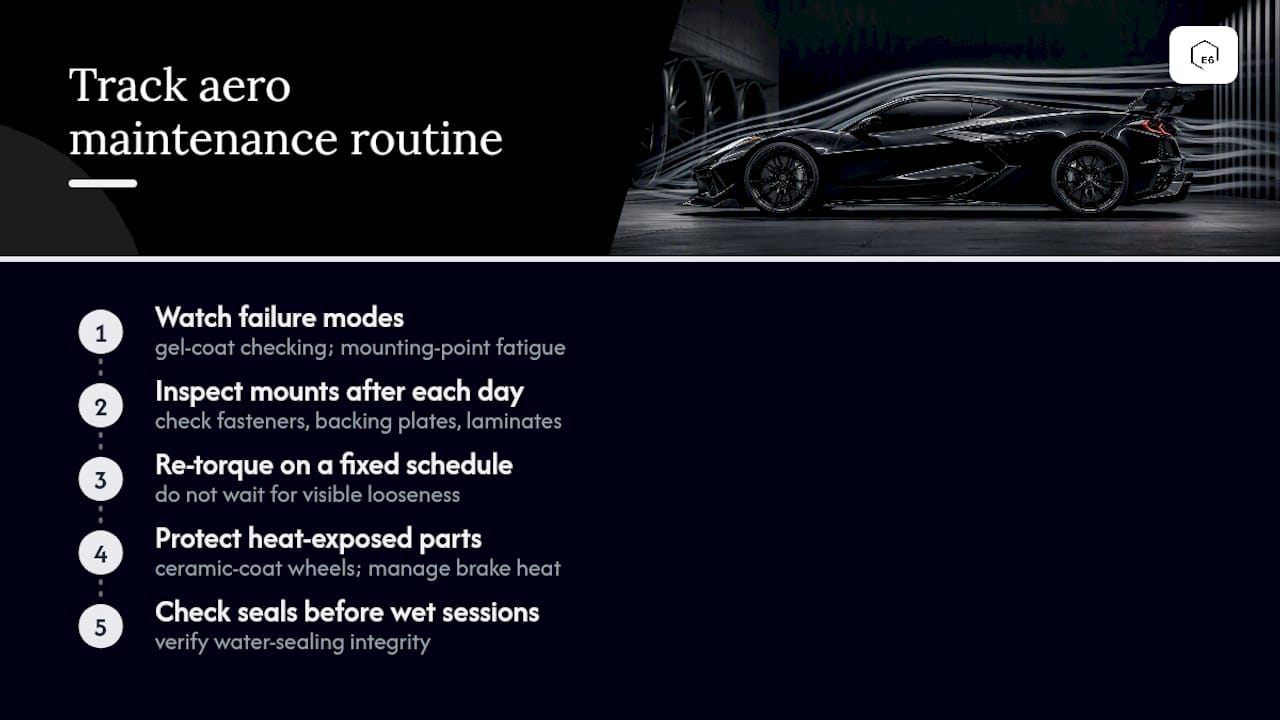
The failure modes worth watching for are predictable. Gel-coat or clear-coat surface checking shows up first on lower-grade carbon parts exposed to repeated heat cycles near the brakes or exhaust. Mounting point fatigue is the more serious issue: any splitter or wing mount that flexes slightly on every load cycle will eventually work its fasteners loose or crack the surrounding laminate, which is why the backing-plate and torque-spec requirements covered earlier aren’t optional extras.
Pre-preg autoclave-cured construction resists this kind of fatigue better than wet-layup parts because the resin-to-fiber ratio is controlled precisely during manufacturing rather than estimated by hand, producing a stiffer laminate that resists the microcracking that leads to delamination over repeated stress cycles. That stiffness matters most exactly where track parts see the highest cyclic load: wing mounts, splitter attachment points, and diffuser strakes.
A simple maintenance routine catches most problems before they become failures: inspect every mounting point after each track day, re-torque fasteners on a fixed schedule rather than only when something looks loose, and check water-sealing integrity before the first wet session of a season.
An Engineering Perspective on Track Aero That Actually Works
The conventional wisdom around Z06 aero is backwards. Most owners chase the biggest wing they can find, assuming more downforce always equals a faster car. The data says otherwise: a mismatched package, big wing and small or absent front splitter, produces the nervous, lift-off-oversteer behavior drivers report most often, not because downforce is bad, but because unbalanced downforce is worse than none at all.
What deserves more attention than it gets is the diffuser. It’s the least glamorous part on this list and consistently the best value, generating real rear downforce with a modest drag penalty when it’s properly profiled and paired with a correctly sized wing. Owners spend money on a big wing first because it’s visible, then wonder why the balance feels off.
The other overlooked variable is the chassis side of the equation. Bolting on aero without revisiting spring rates is asking for trouble, and the fact that serious project builds jump spring rates by 400 to 500 pounds tells you how much load a real aero package actually generates. Buy the parts as a system, set up the chassis to match, and insist on professional installation. That’s the entire difference between a car that’s faster and one that just looks faster.
— E6 Engineering
Get Your C8 Z06 Track-Ready With E6 Carbon
E6 Carbon builds the aero this article is describing, autoclave-cured 2×2 twill pre-preg components engineered around measured downforce and balance data rather than styling guesses. For a Z06 owner coming off a track day wondering why the car got twitchy at speed, that’s the difference between a splitter bought for looks and one engineered to work with a matched wing and diffuser.
The same manufacturing discipline extends across E6’s full catalog, including the E6 Carbon Elite Kit for the Lexus LC500, built to the same fitment-first standard that governs every Z06 component. Every part ships with the professional-install requirement covered above, non-negotiable given the water-sealing and torque tolerances a splitter or wing needs to survive real track loads.
Start by mapping which handling change you’re after, sharper turn-in, flatter high-speed stability, or both, then browse the full C8 Z06 aero catalog to build a matched package instead of guessing at parts one at a time.
Sources
- 2023 Chevrolet Corvette Z06 With Z07 Package First Test: HyperVette
- 2027 Corvette Z06 | Sports Car | Chevrolet
- Developing a C8 Corvette for time-trial competition
FAQ
Which Corvette has the best aerodynamics?
Among production Corvettes, the C8 Z06 with the factory Z07 Performance Package and its required Carbon Fiber Aero Package has the most aggressive factory aero setup, and aftermarket packages built around a matched splitter, wing, and diffuser can extend that further for dedicated track use.
Is the Z06 faster than a Hellcat around a track?
On a road course, the Z06’s mid-engine balance and aero package typically produce faster lap times and higher sustained cornering grip than a Hellcat, which carries more weight up front and relies far less on aerodynamic downforce.
What is the average salary of a C8 owner?
There’s no single verified figure for average C8 owner income, and any specific number circulating online should be treated as unsupported.
Which C8 model year should I avoid?
Early C8 production years saw more reported build-quality and infotainment issues than later model years, so buyers focused on track use should prioritize a well-documented service history over chasing the newest model year alone.