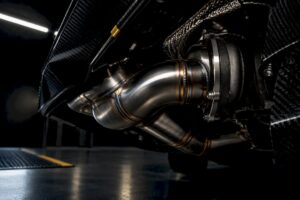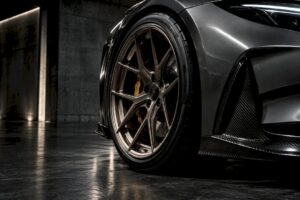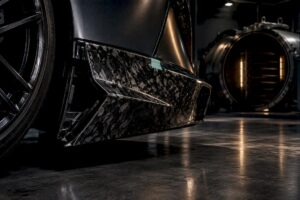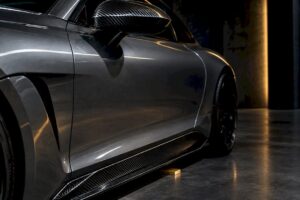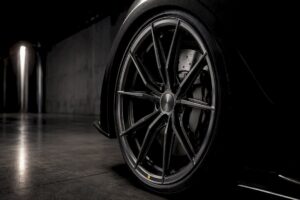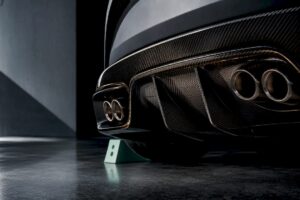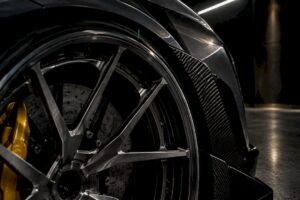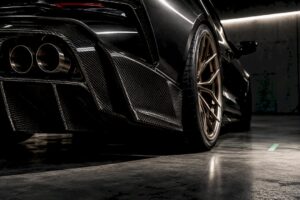
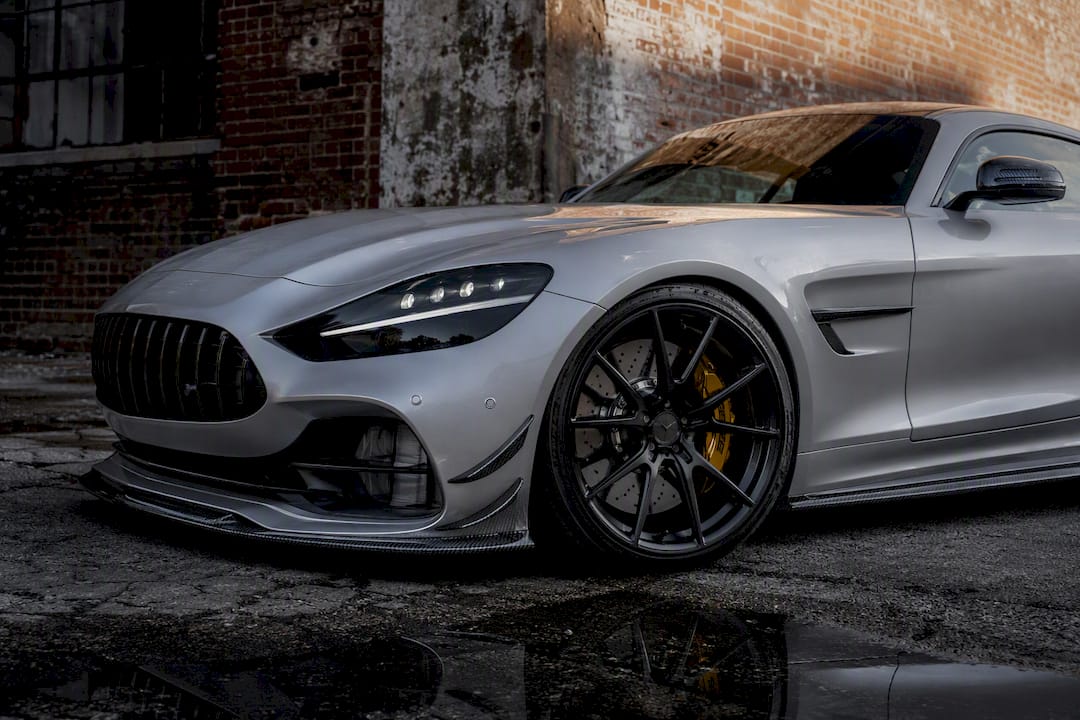
E6 Carbon’s autoclave-cured, pre-preg 2×2 twill components deliver OEM+ fitment and genuine visual harmony while cutting mass at unsprung corners. That’s the verdict for owners weighing a bespoke carbon program against generic bolt-on aero. Every panel is engineered under Fitment First principles, meaning the mold, the weave orientation, and the mounting hardware are all built around a specific chassis rather than adapted from a universal template.
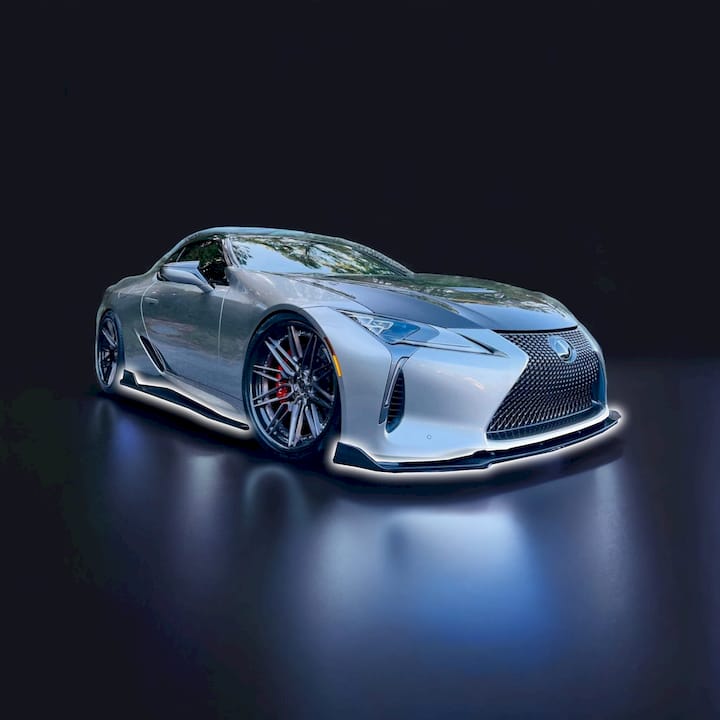
The clearest proof point is the E6 Carbon Elite Kit for the Lexus LC500, a full aerodynamic package that shows what autoclave curing and precision fitment look like when applied to one of the most sculpturally demanding coupes on the road.
The difference between a carbon panel that looks bolted on and one that looks factory isn’t the material. It’s whether the weave was aligned, cured, and jigged to that exact body before it ever left the mold.
If you’re evaluating a kit for an AMG GT, an LC500, or an exotic platform, the next step is straightforward: review the fitment data for your chassis and request a quote before committing to a design proof.
Key Takeaways
Autoclave-cured pre-preg construction, not raw carbon fiber alone, is what separates a factory-quality aero kit from a part that never quite sits right.
| Point | Details |
|---|---|
| Autoclave curing is the differentiator | Heat and pressure eliminate voids that wet-layup and vacuum-bagged parts can’t remove. |
| Fitment First drives the fixture process | Every panel is jigged to the actual chassis before production, not adapted from a generic mold. |
| 2×2 twill balances looks and function | The diagonal weave conforms to curves better than plain weave while reading as premium under light. |
| Water-sealing is mandatory, not optional | Improper sealing at mounting points is the leading cause of long-term carbon panel failure. |
| E6 Carbon leads with platform-specific kits | The Elite Kit for the Lexus LC500 shows E6’s autoclave process applied to a full aero package. |
Table of Contents
- At a Glance: What an E6 Pre-Preg Kit Actually Includes
- Core Specs: Autoclave-Cured Pre-Preg by the Numbers
- Why Autoclave Pre-Preg Beats Wet Layup for Show Cars
- Pros and Cons for the Luxury and Exotic Owner
- Which Owners Get the Most From an E6 Pre-Preg Kit
- Real-World Platform Highlights
- Pricing Bands, Ordering, and Lead Times
- Installation, Fitment, and the Water-Sealing Disclaimer
- The Engineering Behind Pre-Preg: What “Autoclave-Cured” Actually Means
- Warranty, Returns, and Compatibility Before You Order
- Choosing Finishes That Complement Your Car’s Factory Lines
- Why E6 Engineers Every Kit Around Fitment First
- How to Order Your E6 Carbon Pre-Preg Kit
- Sources
- FAQ
At a Glance: What an E6 Pre-Preg Kit Actually Includes
A pre-preg carbon kit is not a set of painted overlays glued onto factory plastic. It starts as carbon fiber cloth pre-impregnated with resin at a fixed ratio, then cured under heat and pressure inside an autoclave rather than left to harden at room temperature. That process is what separates a true aerodynamic component from a cosmetic wrap, and it’s the same distinction carpets.com draws when explaining why carbon fiber outperforms heavier composite alternatives in both stiffness and mass.
A typical E6 Carbon kit for a luxury or exotic platform includes:
- Front splitter — the single highest-visual-impact part, redefining the car’s stance from the front three-quarter view.
- Side skirts — extend the splitter’s line rearward and visually lower the car’s profile.
- Rear diffuser — the largest functional aero piece, shaping airflow exiting the underbody.
- Mirror caps — a small part with outsized visual return, especially in exposed-weave gloss.
- Roof panel — meaningful weight savings high in the chassis, improving perceived agility.
- Engine bay trim and interior accents — extend the carbon identity beyond what’s visible at a glance.
High-end owners commonly build out exterior and interior carbon packages together for a cohesive identity rather than a single standout part, a pattern well documented across luxury carbon fiber upgrades. The E6 Carbon Elite Kit for the Lexus LC500 bundles the splitter, side skirts, and diffuser as a matched set engineered specifically around the LC’s factory bodylines, which is exactly why it’s the reference example throughout this piece.
Core Specs: Autoclave-Cured Pre-Preg by the Numbers
Every E6 aerodynamic component starts life as 2×2 twill carbon fiber cloth, chosen because its diagonal weave pattern reads as depth and movement under light rather than the flatter look of plain weave. The cloth is pre-impregnated with resin at the factory, refrigerated to prevent premature curing, then laid into a fixture mold and cured inside an autoclave under simultaneous heat and pressure.
Key specs that matter when you’re comparing parts:
- Manufacturing method: autoclave-cured pre-preg, not hand-laid wet layup.
- Weave: 2×2 twill, aligned to panel geometry rather than cut arbitrarily from the roll.
- Fitment tolerance: OEM+ standard, verified against test-fit jigs built from the donor chassis.
- Weight profile: meaningfully lighter than OEM composite or metal equivalents on a part-by-part basis, with the largest relative gains on bigger panels like hoods and diffusers.
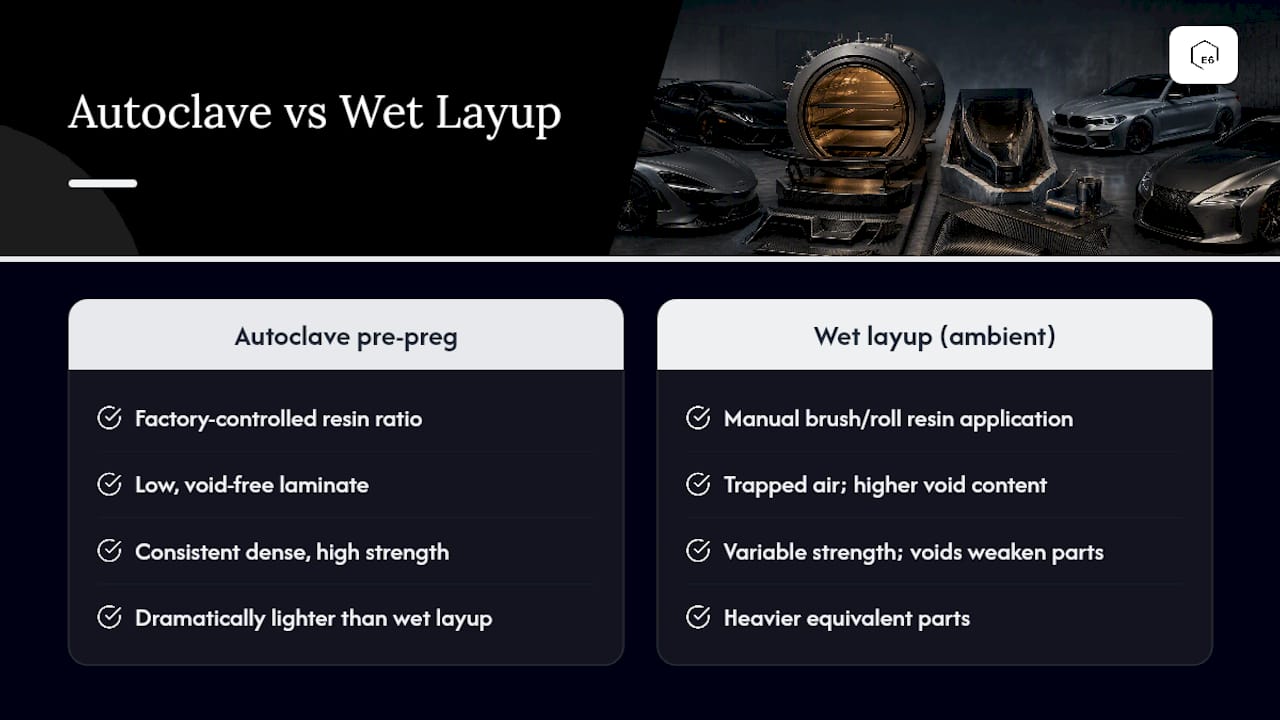
Dry, autoclave-cured carbon can run substantially lighter than a wet-layup panel of the same size, while producing a denser, pinhole-free laminate, a gap in manufacturing quality documented in detail by industry sources covering pre-preg versus wet-layup construction. That density difference is also why autoclave parts resist the surface porosity that leads to clouding or moisture ingress over time.
The data point that matters most: the strength and mass advantage of carbon fiber over heavier automotive materials isn’t a marketing claim, it’s a material-science reality confirmed by CarParts.com’s engineering breakdown of how reduced mass improves acceleration and handling. E6 applies that same physics to every panel in the LC500 kit and across the broader Elite catalog.
Why Autoclave Pre-Preg Beats Wet Layup for Show Cars
Wet layup carbon, hand-saturated with resin and cured at ambient temperature, is fine for low-stress cosmetic trim. It is not what luxury and exotic owners should accept on a splitter or diffuser that has to survive years of thermal cycling, road debris, and close inspection at every concours or cars-and-coffee meet.
The differences show up in three places:
- Finish quality. Autoclave pressure squeezes out trapped air during cure, producing a void-free laminate with a glassy, consistent surface. Wet layup traps microscopic air pockets that eventually show as dull patches or pinholes.
- Structural density. Pre-preg’s fixed resin-to-fiber ratio produces a stiffer, more predictable part. Wet layup varies batch to batch depending on how much resin the hand-laminator applies.
- Weave alignment. E6’s fixture-based process locks the 2×2 twill pattern to the panel’s contour before cure, so the weave lines flow with the bodyline instead of drifting off-axis. That’s the visual signature of a genuinely bespoke part versus a mass-produced overlay.
E6 has written at length about how cheap carbon fiber parts fail at high speeds, and the failure modes trace back almost entirely to skipped autoclave steps and poor resin control, not the raw material itself.
Pro Tip: When you’re vetting any carbon supplier, ask directly whether the part was cured in an autoclave or cured at room temperature under vacuum bagging alone. “Vacuum bagged” and “autoclave cured” get used almost interchangeably in marketing copy, but only the latter applies the pressure needed to eliminate voids.
For a deeper technical comparison, E6’s own breakdown of pre-preg versus wet layup construction walks through the resin chemistry in more depth than most buyers ever need, but it’s worth skimming before a big-ticket order.
Pros and Cons for the Luxury and Exotic Owner
What you gain:
- OEM+ fitment that closes panel gaps tighter than most factory tolerances.
- Visual cohesion across splitter, skirts, and diffuser rather than mismatched aftermarket parts.
- Reduced mass at the corners, which factors into unsprung weight reduction on suspension-adjacent components.
- Long-term resale appeal, since timeless, well-executed cosmetic upgrades tend to hold value better than trend-driven mods, a pattern Brownsville Toyota’s ownership guide confirms even outside the exotic segment.
What you’re trading off:
- Bespoke pricing reflects the tooling and autoclave scheduling behind each part.
- Lead times run longer than off-the-shelf composite kits because fixtures are often chassis-specific.
- Professional installation isn’t optional. These are structural aero pieces, not stick-on trim.
A show car owner and a weekend track driver are shopping for two different things even when they order the same splitter. One wants a mirror-flat weave under studio light. The other wants that weave to survive a curb strike at Laguna Seca. E6’s autoclave process satisfies both, but installation and care priorities diverge from there.
If your priority is showroom presence and long-term value retention, this is squarely the right category of part. If you’re chasing incremental lap times above all else, the aesthetic upside is still real, but budget for the installation and setup work that goes with it.
Which Owners Get the Most From an E6 Pre-Preg Kit
E6 Carbon’s pre-preg components are built for a specific kind of buyer, not a general aftermarket audience:
- Collectors prioritizing resale and cohesion. Owners who view their car as an asset want upgrades that look factory-sanctioned, not tacked on.
- Mercedes-AMG owners chasing OEM+ refinement. The AMG GT and related AMG platforms make up the majority of E6’s aero kit demand, and the fitment data reflects that focus.
- Lexus LC500 owners seeking a curated, factory-plus look. The LC’s complex bodylines reward precision fitment more than almost any other platform in the catalog.
- Boutique shops building client vehicles. Shops need parts that install predictably across multiple units of the same chassis, without re-engineering fitment each time.
McLaren and Lamborghini programs round out a smaller but growing share of the catalog as E6 extends its Fitment First workflow to additional exotic platforms.
Real-World Platform Highlights
The Mercedes-AMG GT remains the platform where E6’s visual-harmony philosophy is easiest to see in person. A properly fitted front splitter and side skirt set doesn’t fight the AMG’s existing lines, it extends them, lowering the visual stance without making the car look like a track-day refugee. Owners consistently note that the biggest perceived change comes from the side skirts, since they’re what ties the splitter and diffuser into one continuous silhouette.
On the Lexus LC500, the Elite Kit demonstrates the same philosophy applied to a far more sculptural factory design. The LC’s body already has aggressive character lines, so the diffuser and splitter have to match a complex surface rather than a flat panel. Owners looking to expand beyond the Elite package often pair it with the AeroTech carbon hood or the matching dashboard cover to carry the weave theme from exterior to cabin.
McLaren and Lamborghini projects, while a smaller share of current volume, follow the identical fixture-based fitment process. On these platforms, panel gaps are engineered to exceptionally tight factory tolerances, so even minor fitment drift is immediately visible, making autoclave-grade precision non-negotiable rather than a nice-to-have.
Pricing Bands, Ordering, and Lead Times
Pricing on a pre-preg aero kit isn’t a single number. It depends on scope (a single splitter versus a full Elite package), finish (exposed-weave gloss, matte, or painted-over carbon), and whether the platform requires a new fixture mold or an existing one from prior production runs.
Base costs generally scale with three factors:
- Part complexity. A diffuser with multiple mounting points and integrated brake ducting costs more to tool and cure than a simple mirror cap.
- Finish selection. Exposed 2×2 twill in gloss clear coat is the baseline; painted or color-matched finishes add labor and material.
- Fixture status. Platforms with an established Elite Kit, like the LC500, ship faster than a first-run bespoke fixture for a less common exotic.
E6 has explained in detail why premium carbon fiber costs more than commodity aftermarket parts, and the short version is that autoclave scheduling, resin-grade cloth, and fixture tooling are fixed costs that don’t shrink no matter how the part is marketed.
Before requesting a quote, have this ready:
- Full VIN and trim/package level (to confirm sensor and parking-assist cutouts).
- Clear reference photos of the current bumper, skirts, or rear fascia.
- Target finish (gloss, matte, or painted) and any color-match requirements.
- Intended use case: street presence, occasional track day, or full competition setup.
- Your installer’s contact information, if you already have one lined up.
Lead times for bespoke autoclave parts typically run longer than commodity carbon because autoclave cycles are scheduled in batches, not run on demand for a single part. Expect design proof approval, then a production window tied to the next available cure cycle for your specific mold.
Installation, Fitment, and the Water-Sealing Disclaimer
Every E6 aerodynamic component is engineered to OEM+ tolerances, but tolerance on paper only becomes a flush, factory-quality result when installation follows a disciplined process.
A professional installation typically follows these stages:
- Dry test-fit. The part is set in place without adhesive or fasteners to confirm gap consistency against the factory panel.
- Shim and jig verification. Any deviation gets corrected with shims rather than forced fasteners, which would stress the laminate.
- Fastener torque to spec. Carbon components require lower, more precise torque values than steel or plastic trim to avoid crushing the laminate at mounting points.
- Seam and edge sealing. Every mounting point and panel seam gets sealed to prevent water intrusion before the part is considered complete.
- Final inspection under multiple lighting conditions. Gloss and matte finishes both show fitment flaws differently depending on light angle, so a proper shop checks both.
Water intrusion at an unsealed mounting point is the single most common cause of long-term carbon fiber failure that has nothing to do with the material itself. It’s an installation issue, not a manufacturing one.
All E6 Carbon aerodynamic components require professional installation and strict water-sealing at every mounting point and seam. E6 Carbon accepts zero liability for damage, delamination, or finish failure resulting from improper home installation or inadequate sealing. This isn’t boilerplate. Structural aero parts mounted without proper sealing can trap moisture against the laminate, and repeated freeze-thaw cycling in that trapped moisture is what eventually causes edge delamination.
Ongoing care is simple but non-negotiable for long-term appearance:
- Use pH-neutral carbon-safe cleaning products; avoid ammonia-based glass cleaners near clear-coated weave.
- Apply UV-protective ceramic coating or film to exposed-weave panels to prevent clear-coat yellowing over time.
- Inspect mounting points and seams every six months for early signs of edge lifting or sealant cracking.
E6’s own research on why cheap carbon fiber turns yellow breaks down the resin chemistry behind UV degradation, and it’s worth a read before choosing a protective coating vendor. Pairing a new carbon kit with a quality paint protection film or ceramic coating service is one of the most effective ways to extend that finish life well beyond what raw clear coat manages on its own.
The Engineering Behind Pre-Preg: What “Autoclave-Cured” Actually Means
Pre-preg is short for pre-impregnated, meaning the carbon fiber cloth arrives from the mill already saturated with a precise, factory-controlled ratio of resin. That’s the fundamental difference from wet layup, where a technician manually brushes or rolls resin onto dry cloth by hand, introducing variability with every layer.
Autoclave curing takes that pre-impregnated cloth, lays it into a fixture mold shaped to the exact panel geometry, and cures it inside a pressurized, heated vessel, typically in the range of 90 to 120 pounds per square inch of pressure alongside elevated temperature. That combination of heat and pressure is what forces out trapped air and compacts the laminate to a consistent, void-free density that ambient-cure methods simply cannot replicate.
Myth: Carbon fiber’s strength comes mainly from the fiber count or weave thickness.
Fact: Strength and stiffness depend just as much on resin control and void content as on the fiber itself. A poorly cured panel with premium 3K cloth can perform worse than a properly autoclaved panel with a lighter weave, because trapped voids create stress concentration points.
The 2×2 twill weave gets chosen specifically for visible aero components because its diagonal interlace pattern is more pliable around complex curves than plain weave, reducing the risk of fiber distortion on tightly contoured panels like a diffuser lip or a fender vent. It also produces the visual depth that reads as “premium” under direct light, versus the flatter, more uniform look of plain weave.
On weight, autoclave-cured dry carbon can run dramatically lighter than an equivalent wet-layup part while delivering a denser, higher-strength laminate, and that mass reduction compounds when it happens at unsprung locations like a front splitter or rear diffuser mount, improving how quickly the suspension responds to road input.
Pro Tip: Ask any carbon supplier for their cure cycle pressure and temperature range, not just “autoclave cured” as a checkbox claim. A legitimate autoclave process runs a documented, repeatable cycle, and a shop that can’t answer specifics is likely outsourcing to a lower-tier facility.
Warranty, Returns, and Compatibility Before You Order
E6 Carbon backs manufacturing defects and finish inconsistencies on every component, covering issues that trace back to the autoclave process or material itself rather than events after installation.
What’s typically covered:
- Resin defects, weave misalignment, or curing flaws present at delivery.
- Clear-coat or gel-coat finish issues not caused by improper handling.
What’s typically excluded:
- Damage from improper or non-professional installation.
- Failures traced to inadequate water-sealing at mounting points or seams.
- Fitment issues on a vehicle with prior collision repair or non-factory body modifications.
Before ordering, confirm the following:
- Full VIN to verify exact model-year fitment, since mid-cycle refreshes can shift sensor or trim positions.
- Trim and package level, particularly for platforms with optional parking-assist sensors or aero packages that alter cutout locations.
- Photo documentation of your current bumper or fascia condition, which protects both you and E6 if a fitment dispute arises later.
Confirming compatibility before production starts is far easier than adjusting a cured panel after the fact, so treat the VIN and photo step as mandatory, not optional paperwork.
Choosing Finishes That Complement Your Car’s Factory Lines
The finish you choose changes how the entire kit reads from ten feet away, not just up close. E6 offers three primary directions:
- Gloss exposed weave. Maximum visual depth and the classic “premium carbon” look; best on cars where the factory paint already has strong reflective surfaces to match.
- Matte exposed weave. Reduces glare and reads more aggressive and technical; a strong choice for darker factory paint colors where gloss carbon can look mismatched.
- Painted carbon. Retains the weight savings of the carbon substrate while matching factory paint color exactly, ideal for owners who want the performance benefit without the visual contrast.
A recurring insight among owners and shops is that matching weave direction to panel flow, rather than defaulting to a single orientation across every part, makes the biggest difference in whether a kit reads as cohesive or piecemeal, a nuance iLusso’s guide to carbon fiber upgrades also highlights when discussing aesthetic signaling.
Before finalizing a finish with E6 or your installer, provide:
- Reference photos of your car in both direct sunlight and shade, since gloss and matte read very differently under each.
- Any existing carbon parts already on the car, so weave and sheen match.
- Your target balance of exposed carbon versus painted body panels, so the upgrade feels like one cohesive design rather than isolated accents.
For inspiration on how forged carbon texture pairs with different paint tones, E6’s gallery of forged carbon fiber examples is a useful reference point before you commit to a finish.
Why E6 Engineers Every Kit Around Fitment First
The temptation in this category is to chase the lightest possible part or the flashiest weave pattern and treat fitment as an afterthought. That gets the priority backward. A splitter that saves an extra fraction of a pound but sits a few millimeters proud of the bumper line looks worse than the factory part it replaced, no matter how good the carbon underneath is.
Fitment First engineering means the fixture mold comes before the marketing spec sheet. Every panel gap, every mounting point, every sensor cutout gets verified against the actual chassis before a single part goes into production for that platform. That’s why the AMG GT and Lexus LC500 catalogs are as deep as they are: those platforms have earned the fixture investment through sustained owner demand, not because they’re the easiest shapes to mold.
The payoff shows up years later, not on day one. A well-fitted, properly sealed autoclave part still looks correct at year five, while a poorly fitted one starts showing gaps and edge wear within a season. That’s the timeline E6 designs for.
How to Order Your E6 Carbon Pre-Preg Kit
Ordering a bespoke aero kit follows a predictable sequence, and knowing it up front saves time on both ends.
First, request a quote with your VIN, trim level, and reference photos in hand. E6’s engineering team confirms fitment compatibility and finish options based on your specific chassis. Once scope is confirmed, you’ll review a design proof showing weave orientation and finish before production is scheduled. Production timing depends on autoclave cycle availability for your platform’s fixture mold. After curing and quality inspection, the kit ships to you or directly to your chosen installer.
That last step matters as much as the manufacturing itself. Line up a professional installer experienced with carbon aero components before your kit arrives, and have your fitment documentation ready for them. If you’re outfitting a Lexus LC500, the Elite Kit product page shows the full scope of what’s included and is the fastest way to see exact fitment notes for your model year. Owners exploring other platforms, including Mercedes-AMG, McLaren, and Lamborghini programs, can start the same way: with a fitment inquiry rather than a generic catalog order.
For most owners, the fastest path forward starts on the E6 Carbon homepage, where you can browse platform-specific catalogs and open a conversation with the engineering team about your exact vehicle before committing to a design proof.
Sources
- What Does Carbon Fiber Do for Cars? – iLusso
- Carbon Fiber Interior Upgrades: Performance & Resale Value (2026)
- Carparts
FAQ
What is pre-impregnated carbon fiber?
Pre-impregnated, or “pre-preg,” carbon fiber is cloth saturated with a precise, factory-controlled resin ratio before it ever reaches the mold, then cured under heat and pressure in an autoclave for a denser, void-free laminate.
What is the main difference between prepreg and CFRP?
CFRP (carbon fiber reinforced polymer) is the general material category; pre-preg is a specific manufacturing method within it, distinguished by pre-impregnated cloth and autoclave curing rather than hand-applied wet-layup resin.
What are the disadvantages of using carbon fiber in cars?
Carbon fiber components cost more to produce than plastic or fiberglass equivalents, and low-quality parts can suffer from resin voids, UV yellowing, or fitment issues, though autoclave-cured, Fitment First components are engineered specifically to avoid those failure modes.
What are the negatives of carbon fiber compared with metal?
Carbon fiber can crack under sharp, concentrated impact rather than dent like metal, and repairs typically require specialized technicians rather than a standard body shop.
Does E6 Carbon offer parts for the Mercedes-AMG GT and Lexus LC500?
Yes. Mercedes-AMG platforms make up the largest share of E6’s aerodynamic catalog, with the Lexus LC500 close behind, including the dedicated Elite Kit aero package.