

Asymmetric wheels exist for one reason: to fix a tension problem that conventional wheel geometry cannot solve. When a rear hub carries a wide cassette or a front hub mounts a disc rotor, the flanges shift off-center. That offset forces the drive-side spokes to pull at a shallower angle, which drives their tension dramatically higher than the non-drive side. The result is a wheel where one set of spokes is chronically overtaxed and the other is chronically slack. An asymmetric rim corrects this by moving the spoke bed laterally, bringing both sides closer to equal tension and producing a wheel that is stronger, stiffer, and longer-lasting.
The core benefits at a glance:
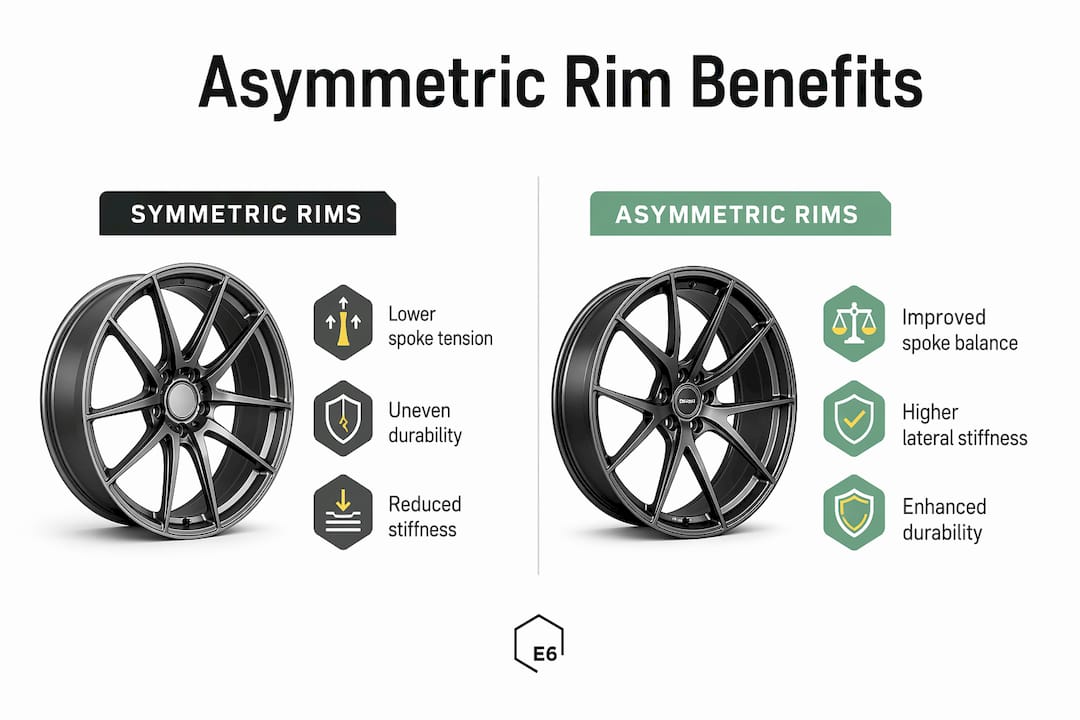
- Balanced spoke tension: Offsetting the spoke bed equalizes the bracing angles on both sides, reducing the tension gap between drive and non-drive spokes. With a 5 mm offset spoke bed (OSB), drive-side spoke tension on a front wheel improves from 70% to 96% of maximum rim tension, and non-drive tension on the rear wheel climbs from 63% to 90%, providing a substantial improvement.
- Improved lateral stiffness: More even tension across the wheel resists side-to-side flex during sprints, hard cornering, and climbing.
- Greater durability: Spokes under chronic high tension fatigue and break at the drive side first. Balancing tension extends spoke life and keeps the wheel true longer.
- Lighter build potential: Balanced tension lets builders run lighter, more flexible spokes without sacrificing structural integrity.
- Broader application: Mountain bike, gravel, and disc-brake road wheels all benefit, since each involves significant hub flange offset.
What exactly is an asymmetric rim?
An asymmetric rim is defined by one structural detail: the spoke holes are drilled off-center. On a symmetric rim, the nipple holes sit at the exact centerline of the rim bed. On an asymmetric rim, that hole pattern is shifted 2–4 mm to one side. Wheel builders call this the Offset Spoke Bed, or OSB.
The OSB exists to compensate for hub geometry. Modern rear hubs carry cassettes with 10, 11, or 12 sprockets, which push the drive-side flange inward toward the center of the axle. Disc brake rotors do the same on front hubs. Because the rim must sit centered in the frame, the spokes on the drive side end up running at a much shallower angle than those on the non-drive side. Shallow angle means higher tension for the same lateral stiffness, and that imbalance is where wheels fail.
By shifting the spoke bed toward the non-drive side, an asymmetric rim effectively moves the geometric center of the spoke triangle. The drive-side spokes gain a slightly steeper bracing angle, the non-drive side loses a little, and the two sides converge toward equal tension. Think of it as nudging the apex of an unequal triangle toward the middle without changing the base.
Key structural differences between symmetric and asymmetric rims:
- Symmetric rim: spoke holes centered on the rim bed, equal spoke length both sides, tension imbalance determined entirely by hub flange offset.
- Asymmetric rim: spoke holes offset by 2–4 mm (OSB), drive-side spokes slightly shorter, non-drive spokes slightly longer, tension gap narrowed.
- The rim cross-section profile itself may look nearly identical from the outside; the offset is internal to the spoke bed, not the outer rim wall.
- OSB values vary by application: MTB and gravel rims typically run 2–3 mm of offset; some trail and enduro rims push to 5 mm for more aggressive tension correction.
Pro Tip: When ordering an asymmetric rim, confirm the OSB direction before lacing. The offset must face toward the non-drive side on a rear wheel and toward the rotor side on a disc front wheel. Installing it backward negates every tension benefit and makes the imbalance worse.
The real performance benefits of asymmetric wheel designs
The tension improvement from an asymmetric rim is not subtle. With a 5 mm OSB, the drive-side spoke tension on a front wheel improves from 70% to 96% of maximum rim tension. On the rear wheel, the non-drive side climbs from 63% to 90%. Those are not marginal gains; they represent a fundamental shift in how load is distributed across every spoke in the wheel.
Improved spoke tension balance
The tension gap in a conventionally dished rear wheel is severe. Drive-side spokes carry roughly twice the tension of non-drive spokes, which means the drive side is always close to its fatigue limit while the non-drive side contributes little to lateral stiffness. Asymmetric rims narrow that gap significantly, and the structural consequences are immediate. As DT Swiss and Stan’s confirm, the primary function of an asymmetric design is to improve spoke bracing angles and balance tension, not to alter dent resistance. The rim wall strength stays the same; the spoke system gets meaningfully better.
Lateral stiffness
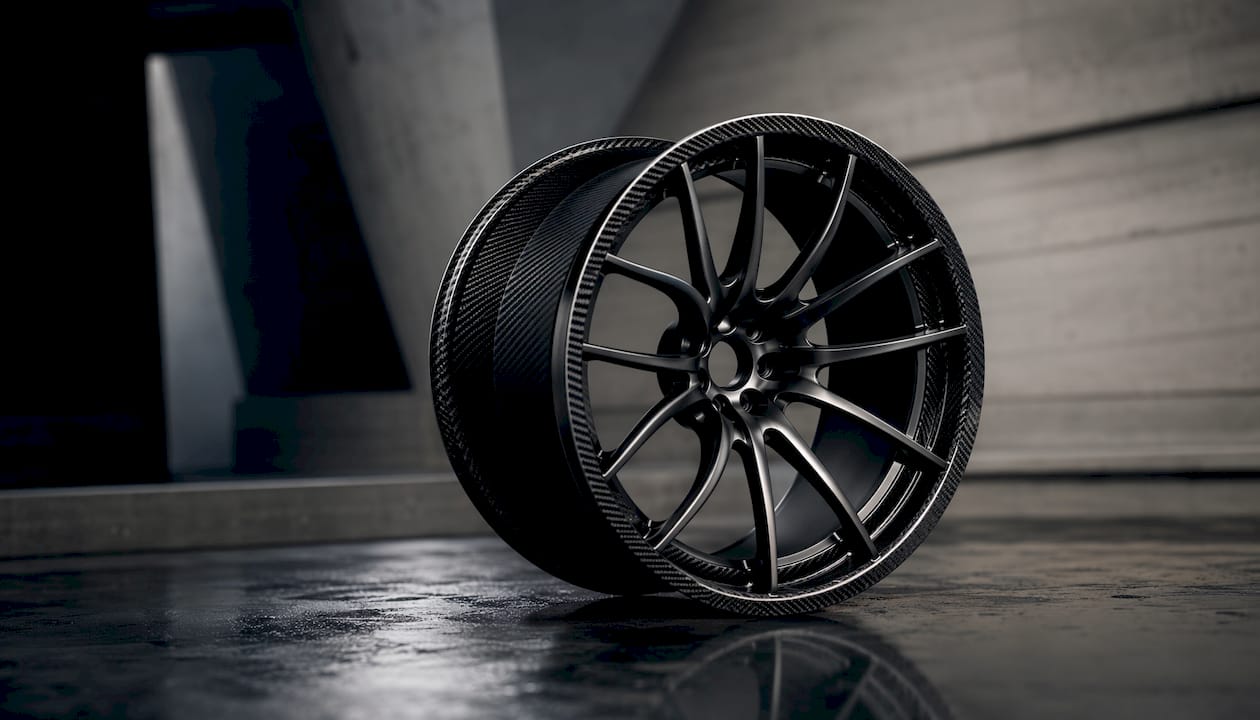
A wheel’s lateral stiffness depends on the horizontal component of spoke tension. When both sides pull with similar force, the wheel resists side-to-side deflection more effectively. Vittoria’s engineers put it plainly: a non-asymmetric rim has a longer spoke on one side, which produces a weaker wheel when comparing impacts from one direction versus the other. Balanced tension means balanced resistance to lateral load, which translates directly to sharper handling during out-of-the-saddle efforts and high-speed cornering.
Durability and spoke fatigue
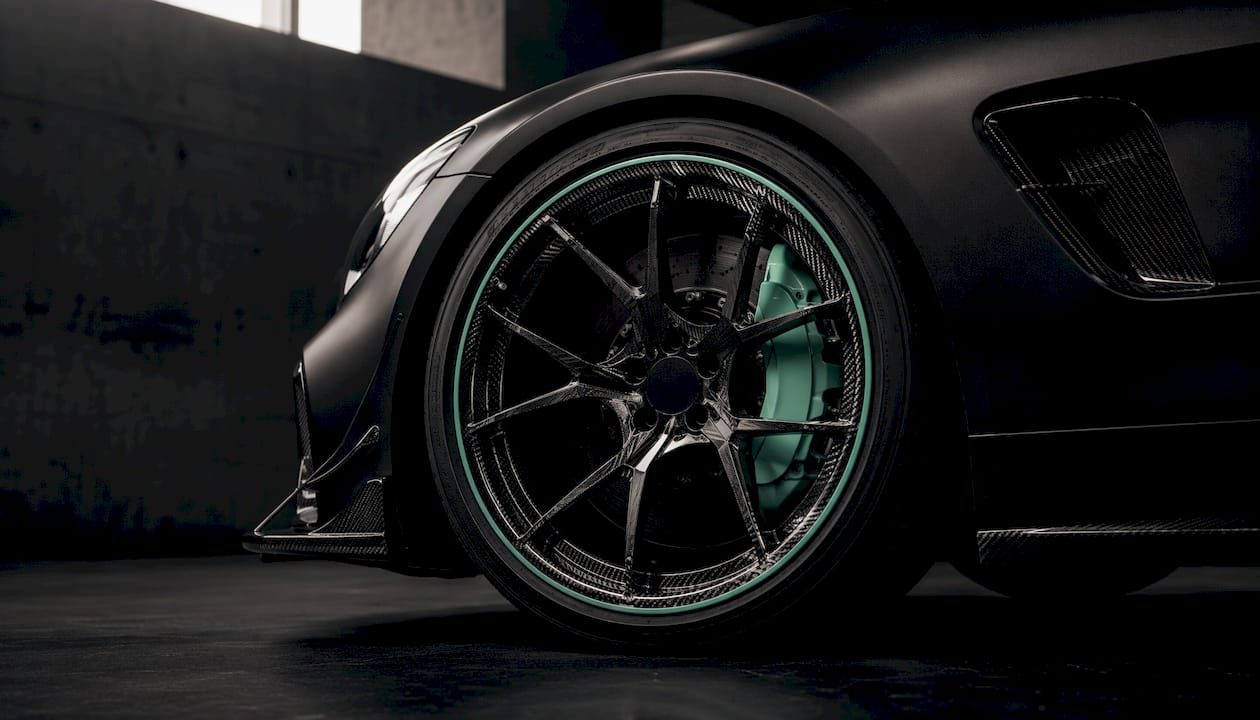
The most common spoke failure in cycling is fatigue fracture at the drive side of the rear wheel. Spokes do not snap from a single overload; they crack from repeated stress cycling at high tension. Reducing peak drive-side tension through an asymmetric rim lowers the stress amplitude on those spokes with every pedal stroke. Balanced tension also reduces spoke fatigue risk at the most common failure point, extending the service life of the entire wheelset.
Lighter spoke selection
This is the benefit most builders overlook. When tension is balanced, the drive side no longer needs to be engineered around worst-case peak loads. That headroom lets you run lighter, more flexible spoke materials without compromising rigidity or long-term stability. Wheel builder Aljaž Trenta demonstrated this directly in a build pairing featherweight spokes with an asymmetric rim, noting that the offset raised non-drive side tension by over 10 kgF, enough to confidently run ultra-light spokes that would otherwise be marginal on a conventionally dished wheel.
Tension and stiffness comparison
| Metric | Symmetric rim | Asymmetric rim (5 mm OSB) |
|---|---|---|
| Front drive-side tension (% of max) | 70% | 96% |
| Rear non-drive tension (% of max) | 63% | 90% |
| Lateral stiffness | Lower (uneven load) | Higher (balanced load) |
| Spoke fatigue risk | Higher (drive side) | Reduced |
| Lightweight spoke compatibility | Limited | Improved |
Relevance by discipline
Mountain biking and gravel riding benefit most, since wide cassettes and disc brakes are standard on both. Road cycling gains the same structural advantages but has been slower to adopt asymmetric rims, partly for aesthetic reasons. The engineering case is identical regardless of discipline: wherever hub flange offset exists, an asymmetric rim improves the wheel. Wheel builder Aljaž Trenta notes that asymmetric rims are common in MTB and gravel but remain less common on road builds, possibly for aesthetic reasons, even though they quietly improve wheel longevity and stability.
Limitations and trade-offs you should know about
Asymmetric rims are not a universal upgrade. Several practical constraints can limit their usefulness or complicate the build process.
- Spoke length calculations become more demanding. A 5 mm OSB shifts spoke lengths by approximately 0.5–0.6 mm per side. That sounds small, but stacking multiple measurement errors in a build can push the total error beyond acceptable tolerance. Builders must measure OSB precisely and recalculate spoke lengths for each side independently rather than using a single symmetric value.
- Frame compatibility is not guaranteed. Certain frames incorporate their own built-in asymmetry. Cannondale’s Ai (Asymmetric Integration) offset rear end, for example, shifts the entire rear axle to compensate for cassette dish at the frame level. Fitting an asymmetric rim to an Ai frame can cause dish misalignment or tire clearance issues. On those platforms, a symmetric rim or a minimally offset asymmetric rim (2 mm) is the correct choice.
- Aerodynamic profiles may conflict. Deep-section aero wheels are engineered around the 105% rule, where the aerodynamic profile of the rim must remain within 5% of perfect symmetry to minimize crosswind drag. Shifting the spoke bed off-center can disrupt that profile, which is why many dedicated aero wheelsets stay symmetric and accept the tension trade-off in exchange for cleaner airflow.
- Visual asymmetry bothers some riders. The offset spoke bed alters the visual geometry of the wheel when viewed from the side. On a road bike where aesthetics matter to the owner, the slightly uneven spoke angles can look wrong even when the wheel is perfectly built and true.
- Weight penalty on aluminum rims. To achieve the same impact-strength benchmark as a symmetric rim, an asymmetric aluminum rim typically needs to be approximately 20–30 grams heavier, according to HUNT’s engineering team. Carbon rims do not carry the same penalty because their strength comes from layup rather than wall geometry, but it is a real consideration for alloy builds.
- Dent resistance does not improve. Multiple manufacturers, including DT Swiss, Stan’s, and Vittoria, agree that asymmetric design neither increases nor decreases susceptibility to rim dents. A dent results from a sharp impact at the bead area, which is unrelated to spoke bed position. Expecting an asymmetric rim to be tougher against rock strikes is a misconception worth correcting before purchase.
When should you actually use an asymmetric rim?
The short answer: whenever your hub geometry creates meaningful flange offset, which covers most modern mountain bikes, gravel bikes, and disc-brake road bikes. The longer answer depends on your specific build.
Rear wheels with wide cassettes are the clearest use case. An 11- or 12-speed cassette pushes the drive-side flange well inboard, creating the tension imbalance that asymmetric rims are designed to fix. If you are building or buying a rear wheel for any bike with a modern drivetrain, an asymmetric rim will produce a measurably stronger and more durable result.
Disc-brake front wheels benefit for the same geometric reason. The rotor sits on one side of the hub, which offsets the flanges and creates a tension gap between rotor-side and non-rotor-side spokes. An asymmetric rim corrects this just as effectively on the front as on the rear.
Mountain biking and gravel riding are the disciplines where asymmetric rims have the deepest track record. The combination of wide cassettes, disc brakes, and aggressive riding loads makes balanced spoke tension especially valuable. Trail and enduro riders who push their wheels hard will see the durability benefit most clearly.
Touring and bikepacking builds also benefit. Loaded touring places sustained, heavy loads on rear wheels for extended periods. A wheel with balanced spoke tension is less likely to develop truing issues over thousands of miles, which matters when you are far from a wheel shop.
Road cycling is a valid application, though adoption has been slower. The tension physics are identical; the hesitation comes from aesthetics and the prevalence of aero-optimized rim profiles that prioritize symmetric airflow. For a non-aero road build or a training wheelset, an asymmetric rim is a straightforward improvement.
When to stay with a symmetric rim:
- Frames with built-in asymmetric offset (Cannondale Ai and similar designs) where the frame geometry already compensates for cassette dish.
- Deep-section aero wheels where the 105% aerodynamic rule takes priority over spoke tension balance.
- Single-speed or track builds where hub flange offset is minimal and tension imbalance is not a practical concern.
Pro Tip: Before specifying an asymmetric rim for a custom build, measure your hub’s flange-to-center dimensions on both sides using a spoke tension calculator like SpokeCalc. If the tension ratio between drive and non-drive side is already above 85%, the benefit of an asymmetric rim is marginal. If it is below 75%, an asymmetric rim will make a meaningful structural difference.
Understanding how directional wheel design principles apply across cycling and automotive engineering helps clarify why offset geometry consistently produces stronger, more balanced structures under real-world load.
A technical deep dive into spoke tension and wheel dishing
To fully understand why asymmetric rims work, you need to understand wheel dishing and the physics behind spoke tension distribution.
What wheel dishing means
“Dish” describes the difference in spoke angle between the two sides of a wheel. On a perfectly symmetric hub with flanges equidistant from the centerline, both sides would have identical bracing angles and identical tension at the same spoke length. That geometry produces an isosceles triangle when you view the spoke system in cross-section: two equal sides meeting at the hub, with the base at the rim.
Modern rear hubs are not symmetric. The cassette body occupies space on the drive side, pushing the drive-side flange inward. The rim must still sit centered in the frame, so the drive-side spokes run at a shallower angle to reach the offset flange. A shallower angle means a smaller horizontal force component per unit of tension, so the spokes must be tensioned higher to provide the same lateral stiffness contribution. The result is a scalene triangle: unequal sides, unequal tension, unequal fatigue loading.
As Wikipedia’s bicycle wheel entry documents, on a conventionally dished rear wheel, the right-side spokes are approximately twice as tight as those on the left. Spokes break from fatigue, not from a single overload, and the drive side is where that fatigue accumulates.
How the OSB changes the geometry
When you shift the spoke bed toward the non-drive side by 2–4 mm, you effectively move the base of the spoke triangle. The drive-side spokes now attach to a point that is slightly closer to their flange, which steepens their bracing angle. The non-drive spokes attach to a point slightly farther from their flange, which shallows their angle. The two sides converge toward equal geometry without changing the hub or the frame.
The spoke length effect of this shift is modest. A 5 mm OSB changes spoke length by approximately 0.5–0.6 mm per side, well within the range that a builder can accommodate with standard spoke length increments. The tension effect, however, is dramatic: front wheel drive-side tension improves from 70% to 96% of maximum rim tension, and rear wheel non-drive tension climbs from 63% to 90%.
Spoke fatigue and maintenance implications
Fatigue fracture follows a predictable pattern: spokes crack at the elbow or at the thread, and they crack on the drive side first. The mechanism is stress cycling. Every pedal stroke loads and unloads the drive-side spokes through a tension range that is proportional to their baseline tension. Higher baseline tension means a larger stress range per cycle, which accelerates crack initiation. Reducing that baseline through an asymmetric rim directly extends the number of cycles before failure.
Balanced tension also reduces the tendency for spokes to loosen over time. A spoke under low tension loses preload more easily than one under moderate tension, which is why non-drive spokes on conventional wheels often go slack after a few hundred miles. An asymmetric rim raises non-drive tension enough to keep those spokes stable, reducing the frequency of truing adjustments.
Statistic callout: A 5 mm asymmetric rim offset improves rear wheel non-drive spoke tension from 63% to 90% of maximum rim tension, a gain that directly reduces spoke fatigue and truing frequency over the life of the wheel.
Practical build considerations
Builders working with asymmetric rims need to treat each side of the wheel as a separate calculation. The OSB value must be measured directly from the rim, not assumed from the manufacturer’s specification, because manufacturing tolerances can shift the actual offset by 0.5 mm or more. Tools like SpokeCalc handle asymmetric rim inputs natively, allowing builders to enter the OSB and get accurate spoke lengths for each side independently.
The spoke tension dynamics that govern cycling wheel performance follow the same structural principles that apply to any precision-engineered rotating assembly: balanced load distribution across all tension members produces a stronger, longer-lasting structure than one where a single element carries disproportionate stress.
Balanced tension also opens the door to lighter spoke selection as explained in Wheel Light Express’ role of wheel lighting aesthetics, which highlights spoke tension balancing and wheel durability principles in automotive wheel applications. When the drive side no longer needs to be over-built to handle worst-case peak loads, builders can run lighter spokes without compromising rigidity. This is particularly relevant for high-performance builds where every gram of rotating mass matters, and it is a principle that applies equally to the precision-engineered wheelsets E6 Carbon produces for platforms like Mercedes-AMG and McLaren, where forged wheel tolerances and load distribution are engineered to the same exacting standard.
Key Takeaways
Asymmetric rims solve a structural problem that hub geometry creates: by offsetting the spoke bed 2–4 mm, they balance drive and non-drive spoke tension, producing a stiffer, more durable wheel with lower fatigue risk.
| Point | Details |
|---|---|
| Spoke tension improvement | A 5 mm OSB raises front drive-side tension from 70% to 96% of maximum rim tension. |
| Rear wheel non-drive gain | Non-drive tension on the rear wheel climbs from 63% to 90% with the same offset. |
| Dent resistance unchanged | DT Swiss, Stan’s, and Vittoria confirm asymmetric design does not affect rim dent susceptibility. |
| Frame compatibility matters | Frames with built-in offset (Cannondale Ai) require symmetric or minimal-offset rims to avoid dish misalignment. |
| Lighter spokes become viable | Balanced tension allows use of lighter spoke materials without compromising wheel integrity. |
FAQ
Are asymmetric rims actually better than symmetric ones?
For most modern wheels with disc brakes or wide cassettes, yes. Asymmetric rims improve spoke bracing angles and balance tension between sides, producing a stronger, stiffer wheel that stays true longer. The exception is frames with built-in geometric offset, where a symmetric rim is the correct choice.
What is the 105% rule in cycling wheel design?
The 105% rule is an aerodynamic standard used in road wheel design, where the rim profile must stay within 5% of perfect symmetry to minimize crosswind drag. It can limit asymmetric rim adoption on deep-section aero wheels, where symmetric airflow takes priority over spoke tension balance.
What are the three types of rims in cycling?
Rims are broadly categorized as clincher (the most common, with a hooked bead for tire retention), tubeless (hookless or hooked, sealed for air-tight tire mounting), and tubular (glued directly to the rim bed). Asymmetric design is a spoke bed geometry feature that can be applied to any of these three rim types.
Are wider rims better for mountain biking?
Wider rims increase tire support and allow lower pressures for better traction and compliance, which is why MTB rim widths have grown considerably over the past decade. Asymmetric rims complement wider profiles because the same wide-cassette hub geometry that benefits from offset spoke beds is standard on modern MTB builds.
Does an asymmetric rim change how I true the wheel?
The truing process itself does not change, but spoke tension targets differ between sides. Drive-side and non-drive-side spokes will be tensioned to different absolute values even on a correctly built asymmetric wheel. Builders and mechanics should use a spoke tension meter and reference the manufacturer’s recommended tension range for each side rather than assuming both sides should match.