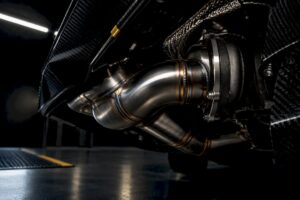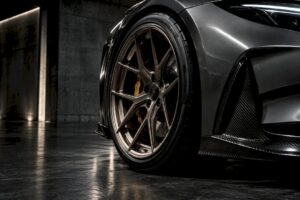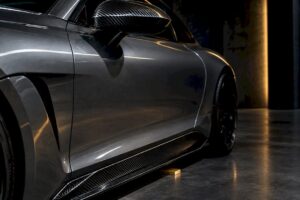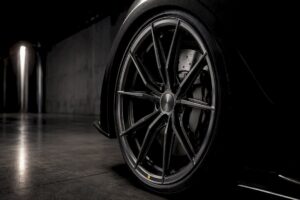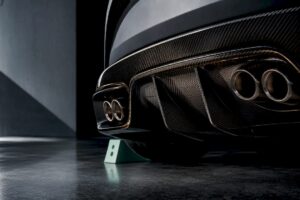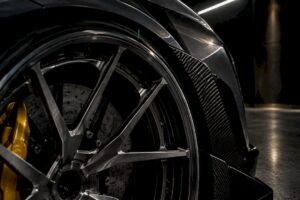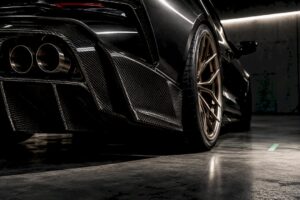
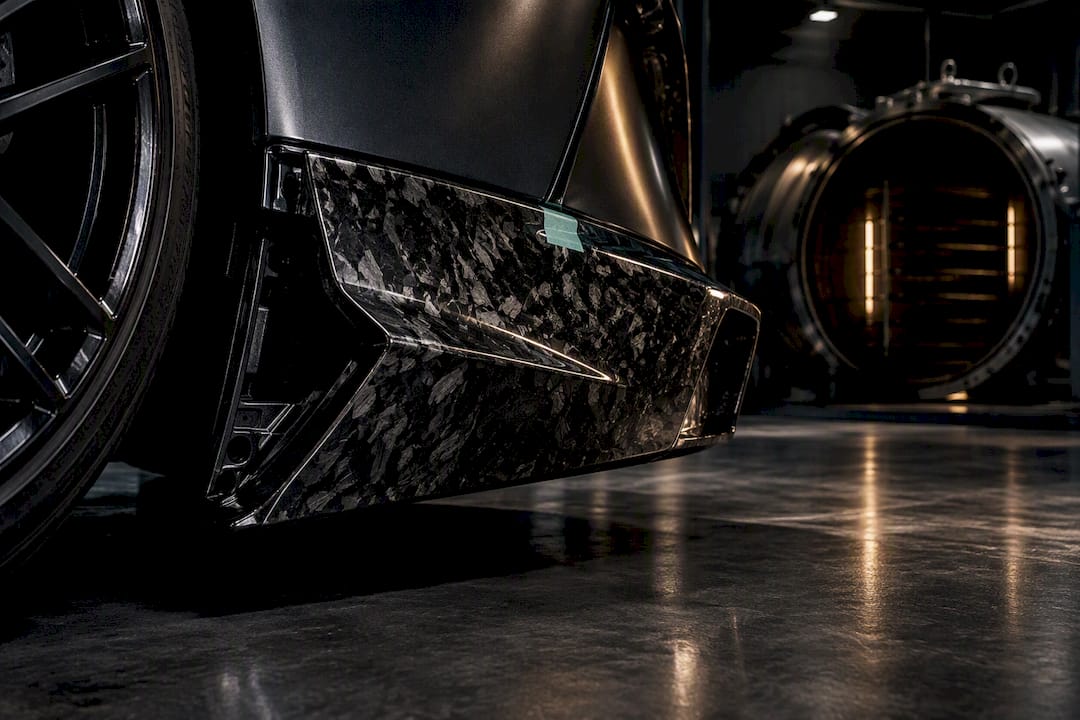
E6 Carbon builds autoclave-cured forged carbon fiber exterior components for the Lexus LC500 that pair with E6 Forged wheel families to create a marble-patterned exterior signature with measurably lower mass than comparable body panels. The combination targets unsprung and rotational weight reduction when the wheel spec matches the aero package, sharpening handling response while giving the LC500 a distinct, supercar-grade presence. Every build follows a Fitment First engineering process, backed by in-house installation and direct consultation.
TL;DR:
- Forged carbon panels, with their random marble-like pattern, improve visual appeal on large surfaces like the hood, splitter, and side skirts, especially under direct sunlight.
- Autoclave curing ensures tighter resin control and consistent laminate thickness, leading to significant weight savings and better fitment compared to wet-lay carbon parts.
- Monoblock wheels are preferable for track use due to their lower weight and higher strength, while multipiece wheels offer finish customization suitable for show builds.
- Proper installation, including ceramic coating and protective films, is crucial for maintaining forged carbon’s appearance and integrity over time.
- Careful planning around wheel size, offset, and finish selection, with professional consultation, ensures seamless integration of aero parts and future upgrades.
Table of Contents
- Forged carbon’s marble finish versus traditional twill weave
- E6 Carbon exterior components for the Lexus LC500
- Engineering behind autoclave-cured forged carbon
- Matching E6 Forged wheels to the forged carbon aesthetic
- How to choose finishes, wheel specs, and fitment for your build
- Installation, protection, and upkeep for forged carbon and forged wheels
- Personalizing a forged carbon build for your LC500
- Building for future upgrades and other modifications
- Our approach to engineering an LC500 build
- Start a custom forged carbon and wheel consultation
- Sources
- FAQ
Forged carbon’s marble finish versus traditional twill weave
Traditional 2×2 twill carbon fiber reads as an ordered, diagonal weave: consistent, repeating, and instantly recognizable as carbon fiber from ten feet away. Forged carbon fiber has no repeating pattern at all. Chopped carbon strands are compressed under heat and pressure into a mold, and the fibers settle into a random, fragmented distribution that looks closer to natural stone than to woven cloth, which is why enthusiasts describe it as a marble finish.
On the LC500, that distinction matters most where surface area is largest and viewing angle is shallow, since twill’s repeating lines can look flat under direct sun while forged carbon’s randomized grain catches light differently across every square inch of the panel.
The panels where forged carbon makes the biggest visual difference on this platform:
- Front splitter: the widest flat surface facing direct light, where the marble pattern reads clearly even at highway speed.
- Side skirts: a long horizontal plane that benefits from the broken pattern to avoid a “sticker” look under twill.
- Rear diffuser: shadowed under the bumper, so a high-gloss forged finish helps the texture stay visible.
- Hood panels: the largest single surface on the car, where twill’s repetition becomes most obvious and forged carbon’s randomness works best.
Finish selection changes how the pattern reads. High gloss deepens the marble effect and works well on the hood and splitter. Satin softens contrast for owners who want the material visible without shouting. Matte trades depth for texture, useful when the panel sits next to other matte trim. A common LC500 composition pairs a gloss splitter and side skirts with a satin diffuser, so the front and sides carry the visual weight while the rear stays understated.
E6 Carbon exterior components for the Lexus LC500
E6 Carbon’s LC500 catalog covers the full exterior, from aggressive aero to finishing trim, and each part serves a distinct visual or functional role.
- Z-Carbon Aero Kit: a coordinated front splitter, side rocker, and diffuser package designed to lower the car’s visual stance and increase perceived width without altering the factory bodyline.
- AeroTech Carbon Fiber Hood: an autoclave-cured hood built to cut mass over the front axle, which lowers the center of gravity and reduces the moment of inertia during transitional handling.
- Seibon OE Carbon Fiber Hood: an OE-style replacement option for owners who want a factory-fit profile with carbon weight savings rather than an aggressive vented design.
- Bumper vent covers and trim pieces: smaller components that extend the carbon theme to the fascia, creating visual continuity between the splitter and a rear wing.
Not every part uses the same process. The Z-Carbon Aero Kit’s splitters and side rockers and the rear diffuser are built from autoclave-cured forged or dry carbon for structural rigidity in high-load zones, while smaller trim pieces sometimes use wet-lay construction where flex tolerance matters more than outright stiffness. E6’s guide to dry versus wet carbon breaks down which process suits which part on this platform.
Engineering behind autoclave-cured forged carbon
Autoclave curing consolidates a carbon laminate under simultaneous heat and pressure inside a sealed vessel, which forces out excess resin and keeps fiber layers uniformly compacted. That control matters because resin-rich pockets are the weak points in a panel: they crack first under vibration and flex.
Forged carbon fiber and autoclave-cured 2×2 twill behave differently under load. Forged carbon’s random fiber orientation packs strands at high volumetric density in every direction, which gives it strong multi-axis stiffness and a tendency to fracture unpredictably rather than delaminate along a clean line. Twill’s uniform weave gives it more predictable, directional stiffness, since the fibers run in known planes.
Autoclave-cured forged parts achieve tighter resin control and more uniform laminate structure than typical wet-lay panels, which is a major reason fitment tolerances stay tight across a full aero kit, from the front splitter has been called critical since inconsistent thickness is what causes gaps at the bumper seam.
Weight reduction on the LC500 pays off in two places at once:
- Front-end mass cuts from the hood and splitter lower the effective center of gravity and reduce nose-heavy inertia during turn-in.
- Unsprung weight reduction at the wheels, addressed separately in wheel selection, improves suspension response faster than anybody panel change can.
- Fitment First mounting uses OE-matched hardware points and vibration-dampening fasteners to prevent panel resonance and NVH at highway speed.
Lexus’s own engineering approach reinforces the logic: the LC platform’s factory brochure describes material choices evaluated by weight, strength, and placement specifically to improve driving feel and lower the center of gravity, the same principle behind aftermarket carbon upgrades.
Matching E6 Forged wheels to the forged carbon aesthetic
Wheel choice finishes the build, both visually and mechanically. E6 Forged offers four families for the LC500: monoblock for maximum stiffness and a clean single-piece face, multipiece for finish customization and easier repairability, beadlock for track-focused grip retention, and AeroForm for aerodynamic disc-style designs that reduce drag around the brake assembly.
Show-oriented builds typically lean toward multipiece or AeroForm wheels, where finish options like brushed lips or painted centers can be tuned to sit alongside a satin or matte forged carbon panel without competing for attention. Track-focused LC500 builds favor monoblock wheels for their strength-to-weight ratio and lower rotational mass.
- Staggered sizing and offset must clear the LC500’s factory brake package without disturbing suspension geometry.
- Wheel weight feeds directly into unsprung and rotational mass, so a lighter forged wheel improves ride quality and steering response more than most single body panel change.
- Monoblock wheels win on strength and lower weight per wheel; multipiece wheels trade a small weight penalty for finish flexibility and simpler repair after curb damage.
Lexus itself lists forged alloy wheels as a factory-available weight-saving option on the LC platform, which underscores why aftermarket forged wheels remain the highest-leverage upgrade for handling.
How to choose finishes, wheel specs, and fitment for your build
Specifying a cohesive package comes down to a short sequence of decisions:
- Define the goal: a show-focused build favors gloss finishes and wider, more concave wheel faces, while a track-focused build favors matte or satin surfaces and lighter monoblock wheels.
- Select the wheel family based on that goal, monoblock for weight and track use, multipiece or AeroForm for finish flexibility on a street build.
- Confirm sizing, diameter and width, against the LC500’s factory brake caliper clearance before finalizing offset.
- Check camber and offset together, since an offset chosen in isolation can rub under compression even when static clearance looks correct.
- Match finish tone between wheels and carbon panels: a brushed lip pairs naturally with satin carbon, while a fully painted face suits high-gloss forged panels better.
Pro Tip: Bring photos of your current wheel and ride-height setup, along with brake rotor and caliper dimensions, to your consultation so E6 Engineering can confirm clearance before manufacturing begins.
Ask about required mounting hardware, whether any fender rolling is needed for the chosen wheel width, and current lead times before committing to a spec.
Installation, protection, and upkeep for forged carbon and forged wheels
Professional in-house installation matters more for forged carbon aero than for most bolt-on parts, since a splitter or diffuser mounted a few millimeters out of alignment can disrupt the airflow it was shaped to manage. In-house fitment also protects the factory bodyline where the Z-Carbon Aero Kit meets the bumper.
- Ceramic coating on visible carbon clearcoat helps resist UV fading and makes road grime easier to remove without abrasive cleaning; learn more about protecting wheels with ceramic coatings here.
- Paint protection film on the splitter’s leading edge and rocker undersides guards against stone chips, the most common damage point on low-hanging aero.
- Fastener torque checks after the first 500 miles catch any settling in new mounting hardware.
- Seasonal finish inspection catches clearcoat wear before it reaches the carbon weave underneath.
If your build includes any change to lighting or bumper-mounted aero that projects beyond factory dimensions, confirm local road-use rules with your regional authority before driving on public roads.
Personalizing a forged carbon build for your LC500
Every LC500 owner’s build starts from the same catalog but rarely ends up looking the same. Panel-by-panel finish selection, gloss on the splitter, satin on the rockers, matte on the diffuser, lets owners control exactly how much visual weight each component carries without changing the underlying part.

Color-matched accents are common on bumper vent covers and small trim pieces, where a painted edge or contrast stripe ties the carbon component back to the car’s factory paint. Some owners request panel-specific weave orientation on twill-based trim pieces to align the diagonal pattern intentionally across adjoining panels, a detail that separates a coordinated build from a parts-bin assembly.
Because each part is engineered to Fitment First tolerances, owners can order components incrementally, a splitter this year, a diffuser and wing next, without worrying that a later addition will clash in fit or finish. That staged approach is common among LC500 owners building toward a full Z-Carbon Aero Kit over time rather than all at once.
Building for future upgrades and other modifications
A forged carbon aero package and E6 Forged wheel set do not close off other modifications, they tend to make later ones easier to integrate. Because the splitter, side skirts, and diffuser are engineered around the factory bodyline rather than replacing it outright, they remain compatible with factory or aftermarket suspension changes, provided ride height adjustments are accounted for in splitter clearance.
Wheel choice also affects what comes next. A monoblock wheel selected for its lower rotational mass leaves headroom for future brake upgrades, since larger calipers are the most common reason an LC500 owner later needs to revisit wheel offset. Planning that clearance at the time of the original wheel order avoids a second fitment consultation down the line.
Owners who add a rear wing after their initial aero purchase, such as pairing a Carbon-Elite Wing with an existing Z-Carbon Aero Kit, benefit from matching the wing’s carbon finish to the original splitter and rocker gloss level so the whole car reads as one build rather than two separate purchases.
Our approach to engineering an LC500 build
We treat every LC500 project as a balance between motorsport-grade structural engineering and the visual standard of a show car. Wheel selection and forged carbon aero are specified together, not separately, so mass reduction, offset, and finish all support the same outcome: a cohesive, lighter, better-handling car.
— E6 Engineering
Start a custom forged carbon and wheel consultation
Building a bespoke LC500 starts with a conversation, not a checkout cart. E6 Engineering works through fitment specs, finish selection, and wheel pairing before any part is manufactured, then handles installation in-house so the finished result matches what was specified.
- Browse the Carbon Fiber Parts catalog for LC500-specific splitters, hoods, and aero components.
- Review E6 Forged wheel collections to compare monoblock, multipiece, beadlock, and AeroForm options for your build goal.
- Schedule a consultation and bring wheel, ride-height, and brake photos so fitment can be confirmed before production begins.
Sources
Factory weight-saving and material-placement claims reference Lexus LC 500 newsroom materials and the 2019 LC brochure.
FAQ
What makes forged carbon fiber look different from regular carbon fiber?
Forged carbon fiber has a random, fragmented pattern created by compressing chopped strands under heat and pressure, while traditional carbon fiber shows an ordered 2×2 twill weave. The result is a marble-like texture rather than a repeating diagonal pattern.
Does forged carbon aero actually reduce weight on the LC500?
Yes, autoclave-cured forged carbon panels are engineered for tight resin control and consistent laminate thickness, which keeps mass down compared to heavier OEM or wet-lay alternatives. Lexus’s own LC platform materials point to similar weight-saving logic with factory carbon roof and forged wheel options.
Should I choose monoblock or multipiece wheels for my LC500?
Monoblock wheels generally offer lower weight and higher stiffness, making them the stronger pick for track-focused driving. Multipiece wheels trade a small weight penalty for finish customization and easier repair, which suits owners building primarily for show.
How do I know which E6 Carbon parts fit my LC500 build?
E6 Engineering uses a Fitment First process that confirms mounting points, brake clearance, and wheel offset before manufacturing any component. A consultation with photos of your current setup and brake dimensions is the fastest way to confirm compatibility.
What maintenance does a forged carbon exterior need?
Regular care includes ceramic coating on visible clearcoat to resist UV fading, paint protection film on leading edges prone to stone chips, and periodic fastener torque checks after installation. Seasonal finish inspections help catch clearcoat wear before it reaches the carbon weave underneath.
Recommended
- Z-Carbon Aero Kit | Lexus LC500
- AeroTech Carbon Fiber Hood | Lexus LC500
- Bumper Vent Covers | Lexus LC500
- E6 Motorsports LFA-Style Exhaust | Lexus LC500
Pricing, custom fitment options, and surface finishes subject to availability. Please contact E6 Carbon or E6 Forged directly to confirm vehicle-specific offset parameters, brake clearances, and current lead times prior to placing your order.