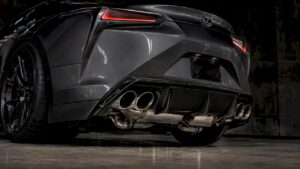

For lap-focused builds, we recommend HS2 Monoblock wheels in 18" to 19" diameters with moderate 9.0" to 10.5" widths to minimize rotational inertia and sharpen transient response. Move to 20" to 22" only when big-brake clearance or OEM caliper packaging demands it. The trade-off is simple: smaller and lighter wins lap time, larger wins brake room. Below, we break down sizing by role, platform, and fitment math.
TL;DR:
- When adding 1 inch of wheel width, increase offset by roughly 12.7mm to keep the outer lip in the same fender position.
- Calculate scrub radius change from stock and new offset, including spacers; keep shifts within about 10mm on FWD or AWD, and 20mm on RWD.
- Before ordering, verify the exact trim’s bolt pattern and hub bore, and provide caliper and rotor dimensions because clearance varies by caliper model.
- After installation, schedule road force balancing, retorque fasteners within the first 50 to 100 miles, and check them again after the first hard track session.
Table of Contents
- Quick HS2 Sizing Reference and Fitment Checklist
- HS2 Technical Specs: 6061-T6 Monoblock Construction and Track Performance Benefits
- Offset, Backspace, Spacers, and Scrub Radius for Track Cars
- Diameter and Width Trade-offs: 18 Inch Through 22 Inch for Lap-Focused Setups
- Mounting, Hub Bore, Lug Pattern, and Brake Clearance for Track Use
- Fitment Notes for Mercedes-AMG, Lexus LC500, and McLaren or Lamborghini Platforms
- E6 Engineering Fitment-First Approach and the Full Track Ecosystem
- Why We Default to the Lightest Wheel the Brakes Allow
- Ordering an HS2 Monoblock Wheel and Starting a Fitment Consultation
- FAQ
- Sources
Quick HS2 Sizing Reference and Fitment Checklist
Matching a diameter and width to your car’s role takes less guesswork when you start from how the wheel will actually be used. A time-attack sedan chasing turn-in speed has different priorities than a GT car running massive carbon-ceramic calipers. The table below groups common track roles with the HS2 diameter and width pairings that tend to work for each.
| Track role | Diameter | Width | Typical offset window | Primary benefit |
|---|---|---|---|---|
| Lap-time focused, moderate brakes | 18" | 8.0" to 10.5" | Mid-range, platform specific | Lowest rotational mass, widest tire choice |
| Sport sedan / balanced track day | 19"-20" | 8.0" to 13.0" | Mid to high, platform specific | Brake clearance with manageable inertia |
| Big-brake or OEM carbon-ceramic setup | 21"-22" | 10.5"-13.0" | Custom, engineered per caliper | Clears oversized rotors and multi-piston calipers |
| Exotic/supercar staggered fitment | 20"-21" | 9.0"-13.0" (front/rear split) | Bespoke per chassis | Matches factory stagger and fender clearance |
Before placing an order, work through a short checklist so the wheel arrives ready to mount rather than ready to argue with your fender liner:
- Confirm bolt pattern and hub bore against your exact trim, since AMG and LC500 variants sometimes differ between model years.
- Measure caliper pocket depth and rotor diameter if you are running an aftermarket big-brake kit.
- Decide on a target tire size and sidewall profile before locking width, since tire section width shifts the optimal offset.
- Define your acceptable offset window using the backspace math covered later in this guide.
- Ask about current lead times and starting price ranges on the product page for your chosen size, since pricing and availability shift by diameter and width.
HS2 Monoblock wheels are built to order through our E6 Forged Monoblock catalog, where diameter, width, and offset are specified per vehicle rather than sold off a fixed shelf.
HS2 Technical Specs: 6061-T6 Monoblock Construction and Track Performance Benefits
The HS2 Monoblock starts life as a single billet of 6061-T6 aerospace-grade aluminum, forged under extreme pressure rather than cast or gravity-poured. Forging aligns the metal’s grain structure along the load paths of the wheel, which is why forged aluminum consistently outperforms cast or flow-formed construction in strength-to-weight ratio and fatigue resistance. That density advantage lets us remove material everywhere it is not structurally necessary, which is the entire point of a track wheel.
The HS2’s slim split-spoke profile is where that removed material shows up. A thinner spoke section, paired with a monoblock barrel that eliminates the bolted joints and reinforcement rings of a multi-piece design, pushes mass closer to the wheel’s center and reduces the polar moment of inertia. For a deeper comparison of why a single forged piece beats a bolted assembly for rotating mass, see our breakdown of monoblock versus multi-piece performance.
Lower rotational inertia changes how the car behaves in every phase of a lap:
- Sharper turn-in, since less rotating mass resists the initial steering input at corner entry.
- Faster acceleration out of apexes, because the drivetrain spends less energy spinning up wheel mass instead of propelling the car forward.
- Shorter braking distances, since a lighter rotating assembly is easier for the brake system to decelerate relative to vehicle speed.
- Cleaner suspension damping telemetry, as dampers respond to road input rather than compensating for wheel mass oscillation.
Independent research on unsprung mass supports the mechanism behind that last point. A recent SAE technical paper on splitting unsprung mass between axle and wheel found that shifting part of the unsprung mass toward the wheel can reduce vertical acceleration of the unsprung mass, though it noted this can raise relative dynamic load on the wheel itself, a nuanced trade-off worth understanding before chasing the lightest possible wheel regardless of load rating.
Beyond raw weight, HS2 Monoblock wheels are machined with track use in mind: hub-centric bore machining for precise centering under load, anti-slip knurling options on the mounting face to resist micro-movement during hard cornering, bespoke offsets engineered per chassis, and width ranges from 8.0" to 13.0" to clear everything from street tires to oversized track brake kits.
Pro Tip: When ordering, specify your exact caliper make and rotor diameter rather than a generic “big brake kit” note, since pocket clearance varies more between caliper models than between wheel widths.
Offset, Backspace, Spacers, and Scrub Radius for Track Cars
Getting the diameter and width right is only half the fitment equation. Offset and backspace determine where that wheel and tire package actually sits relative to the hub and fender, and getting this wrong causes rubbing, poor steering feel, or accelerated bearing wear long before anyone notices the wheel looks slightly off-center.
Offset is the distance from the wheel’s hub-mounting surface to its centerline, measured in millimeters. Backspace measures from the mounting surface to the back lip instead. The two describe the same physical position from different reference points, and a complete fitment guide from Mechanics Calculator lays out how to convert between them for any given wheel width.
Follow this sequence when sizing a wider HS2 wheel against a factory or previous fitment:
- Start from your current or factory offset as the baseline reference point.
- For every 1 inch of added width, increase offset by roughly 12.7mm to keep the outer lip in the same position relative to the fender, per the offset and backspace guide.
- Calculate the resulting scrub radius change using ΔSR = (Stock ET minus New ET) plus spacer thickness, a method confirmed by WrenchRig’s scrub radius calculator.
- Check that change against drivetrain-specific windows: keep scrub radius shifts within roughly ±10mm for FWD and AWD platforms and ±20mm for RWD platforms, per the same scrub radius guidance.
- If a spacer is required to reach the target offset, choose a hub-centric spacer over a bolt-on type, since hub-centric spacers maintain the wheel’s centering reference and reduce vibration risk.
- Re-torque all fasteners after the first 50 to 100 miles following any wheel or spacer change, and again after the first hard track session.
Scrub radius targets exist because steering geometry is sensitive to small shifts in where the tire’s contact patch meets the steering axis. A RWD platform with a wide tolerance can absorb a larger offset change without feeling nervous under trail braking, while a FWD or AWD platform transmitting both steering and power through the same wheels needs a tighter window to avoid torque steer or vague turn-in. Spacer thickness is not a free variable here. It adds directly to the scrub radius equation, so stacking a spacer on top of an already aggressive offset compounds the shift rather than canceling it out.
Diameter and Width Trade-offs: 18 Inch Through 22 Inch for Lap-Focused Setups
Every inch of diameter and width you add changes the car’s behavior in a direction that is rarely free. The right call depends on what is actually limiting your lap time: rotating mass, tire selection, or brake clearance.
- 18": The lightest rotational package available in the HS2 lineup, and the diameter most compatible with deep-sidewall R-compound and DOT semi-slick tires that still offer meaningful sidewall compliance for mechanical grip.
- 19"-20": The practical compromise for most modern sport sedans, since it clears the larger brake packages common on performance trims while keeping rotational inertia close enough to 18" that lap time penalties stay small.
- 21"-22": Justified mainly when factory or aftermarket big-brake calipers physically require the extra wheel diameter to clear, or when a stretched-tire aesthetic is part of the build goal; expect a measurable handling penalty in transient response compared to an 18" setup on the same car.
Width changes the contact patch shape more than its area, since a wider wheel and tire combination spreads the same tire footprint across a shorter, broader patch. That affects camber strategy too: wider setups often need slightly more negative camber to keep the outer shoulder loaded evenly under cornering load. Tire selection follows the same logic as diameter. Going wider opens up a larger range of track-compound tires at the cost of some straight-line rolling resistance, and research on in-wheel mass and ride dynamics confirms that added rotational mass at the wheel remains a critical variable for handling even when suspension tuning tries to compensate for it.
Mounting, Hub Bore, Lug Pattern, and Brake Clearance for Track Use
A correctly sized wheel still needs to be installed correctly to perform safely under track loads. Follow this sequence before the car ever sees a hot lap:
- Verify hub bore concentricity against the HS2’s hub-centric machining spec, since even a small mismatch creates vibration that worsens at speed.
- Confirm lug pattern and thread pitch against the exact trim and model year, not just the general platform.
- Measure caliper pocket clearance and rotor offset directly against the physical wheel before the first mount, not just against published spec sheets.
- Check anti-slip knurling contact and valve stem placement to avoid interference with larger aftermarket calipers.
- Torque to the manufacturer’s sequence and specification, then schedule a road-force balance and re-torque check within the first 50 to 100 miles.
Road-force balancing catches imbalance that static balancing misses, particularly on wider track wheels paired with stiff-sidewall tires, and a road-force balancing guide covers what the process catches and when it is worth scheduling. Wheel bearing load also deserves a second look after a width increase, since a wider track width changes the moment arm acting on the bearing under cornering load.
Pro Tip: Re-torque every lug after your first full track session, not just after the first street drive, since heat cycling on track settles fasteners faster than normal road use.
Spacers can close small gaps acceptably when the base offset is close to correct, but once the required shift exceeds a few millimeters, a bespoke wheel offset engineered for your exact hub and caliper combination is the safer route, which is where fitment-first engineering replaces generic hardware.
Fitment Notes for Mercedes-AMG, Lexus LC500, and McLaren or Lamborghini Platforms
Fitment windows shift meaningfully across these platforms, and treating them identically is where most sizing mistakes start.
- Mercedes-AMG: AMG performance trims typically run a staggered setup with noticeably wider rear offsets than the front axle, and many AMG models ship with large factory brake packages that narrow the available offset range on 19" and smaller wheels. We machine HS2 offsets per AMG chassis code to clear these calipers without pushing the wheel face outside the fender.
- Lexus LC500: The LC500’s chassis rewards a diameter and width pairing that preserves its factory ride quality while still adding track grip, typically a 19" or 20" HS2 in a moderate width rather than the largest diameter available. Owners pairing an HS2 wheel upgrade with the E6 Carbon Elite Kit for Lexus LC500 get reduced rotational mass and added aerodynamic downforce working together rather than in isolation.
- McLaren and Lamborghini: Exotic platforms demand particular attention to bolt pattern accuracy and hub bore tolerance, since factory calipers on these chassis are often larger and more unusually shaped than anything in the mainstream market. Bespoke offsets are standard practice here rather than an upsell, and our engineer-verified fitment process for luxury and exotic platforms is built around exactly this kind of caliper-specific packaging challenge.
E6 Engineering Fitment-First Approach and the Full Track Ecosystem
Every HS2 recommendation in this guide comes from a fitment-first engineering process: hub bore, caliper clearance, and offset are worked out per chassis before a wheel ever reaches production, which is why bespoke offset ordering is standard rather than an afterthought on our monoblock wheel catalog.
Reduced rotational inertia from an HS2 Monoblock does not operate in isolation on a track car. Paired with downforce-generating dry carbon aero and high-flow exhaust components, the lighter rotating mass compounds with better aerodynamic grip and improved engine response to shift the entire performance envelope, not just one corner of it. Lead times and bespoke offset ordering details are listed on each product page, and our engineering team reviews vehicle, brake, and tire specifications before confirming a build.
Why We Default to the Lightest Wheel the Brakes Allow
If there is one principle worth holding onto through all of this sizing math, it is that diameter should follow brake clearance, not the other way around. Too many track builds start with a wheel diameter chosen for looks and then force a big-brake kit to fit around it, when the better sequence is to lock in the brake package first and size the wheel to clear it with the least material possible.

Unsprung weight reduction delivers its biggest returns at the smallest diameter your calipers allow, which is why we push lap-focused owners toward 18" or 19" HS2 Monoblock wheels unless there is a specific, measurable reason to go larger. Oversized wheels chosen for aesthetic stretch alone trade away real lap time for a look that a well-chosen 19" setup can often match anyway.
For owners running oversized or aftermarket big-brake calipers, a consultation with our fitment engineering team before ordering is worth the extra step, since the offset math changes meaningfully once a caliper outgrows its factory envelope. And regardless of diameter, professional installation, road-force balancing, and a disciplined re-torque schedule are not optional extras. They are what keeps a lightweight forged wheel safe under the loads a track session actually generates.
— E6 Engineering
Ordering an HS2 Monoblock Wheel and Starting a Fitment Consultation
Choosing the right HS2 size comes down to matching diameter, width, and offset to your car’s brakes and your track goals, and we handle that matching as part of the ordering process rather than leaving it to guesswork. Our E6 Forged Monoblock catalog is the starting point for HS2 options across the full 18" to 22" range, with bespoke offsets engineered per vehicle.
To get an accurate fitment quote, have the following ready: your exact vehicle make, model, and year, your brake caliper and rotor specification, your target tire size, and your preferred offset or width window. From there, our engineering team confirms hub bore, caliper clearance, and offset before production begins. Reach out through our E6 Forged wheels page to request a quote or schedule a fitment consultation for your build.
FAQ
What HS2 wheel size is best for track driving?
For most lap-focused builds, an 18" or 19" forged monoblock wheel in a moderate width offers the lowest rotational inertia while still supporting common track tire sizes. Larger 20" to 22" diameters are recommended mainly when big-brake or OEM carbon-ceramic calipers require the extra clearance.
Why is 6061-T6 aluminum used for forged track wheels?
6061-T6 is an aerospace-grade aluminum alloy that offers a strong strength-to-weight ratio and good fatigue resistance once forged, which lets manufacturers remove extra material without compromising structural integrity. That combination is why it is the standard material behind HS2 Monoblock construction.
How does wheel weight affect lap times?
Lighter rotating wheel mass reduces the energy needed to accelerate, decelerate, and change direction at each corner, which shows up as sharper turn-in, quicker acceleration out of corners, and shorter braking distances. Research on unsprung and rotational mass confirms that shifting mass away from the wheel measurably changes vehicle dynamics, including vertical acceleration behavior.
How much does an offset change affect scrub radius?
Scrub radius change can be estimated as the difference between your stock and new offset, plus any spacer thickness added, using the scrub radius calculation method. Keeping that change within roughly ±10mm for FWD or AWD cars and ±20mm for RWD cars helps preserve predictable steering feel.
Can HS2 wheels fit oversized aftermarket brake kits?
HS2 Monoblock wheels are available in widths from 8.0" to 13.0" with custom offsets engineered to clear oversized OEM and aftermarket track brake calipers. Exact clearance depends on your specific caliper and rotor dimensions, so we confirm fitment per vehicle before production.
Sources
- Wheel Offset and Backspace: A Complete Fitment Guide | Mechanics Calculator
- 2026-01-5057: Analysis of the Impact on Ride Comfort from Splitting the Unsprung Mass in Vehicle Modeling – Technical Paper
- Scrub Radius Calculator | WrenchRig
Recommended
- Fitment First E6 Two Piece Forged Wheels With Carbon Aero for LC500
- How to Spec High-End Wheels for Performance Cars
- Track Focused Wheels for the AMG GT: Engineering Guide
- Fitment First: E6 Forged 6061 T6 Wheels for C192 AMG GT63 5×112
Pricing, custom fitment options, and surface finishes subject to availability. Please contact E6 Carbon or E6 Forged directly to confirm vehicle-specific offset parameters, brake clearances, and current lead times prior to placing your order.