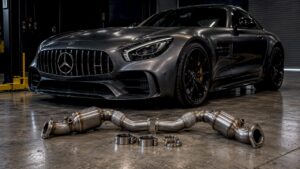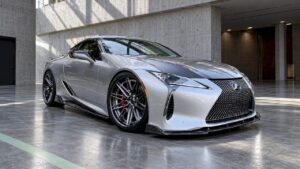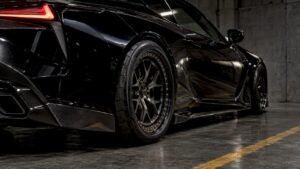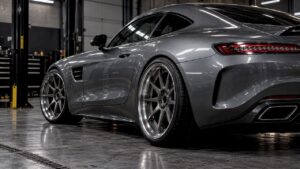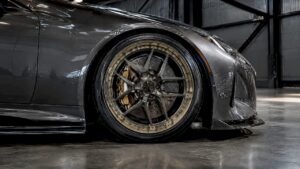
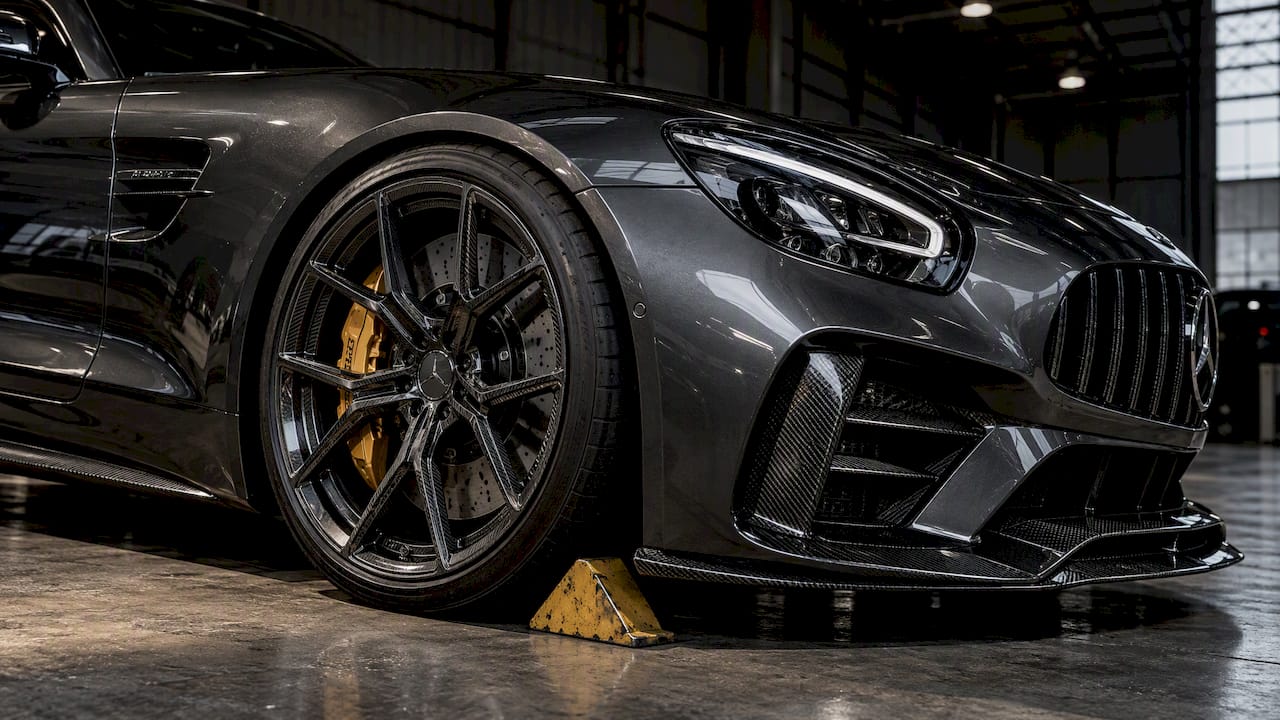
The MS10 monoblock wheel supports 18 to 22 inch diameters with custom widths from 8.0 to 13.0 inches, precision hub-centric machining, and forged 6061-T6 aluminum construction that cuts unsprung weight. For most Mercedes-AMG builds, we recommend starting at 20×10 front and 21×12 rear, then refining offset against your caliper package before placing an order through our E6 Forged wheels catalog.
TL;DR:
- The MS10 spans 18 to 22 inch diameters and 8.0 to 13.0 inch widths, with offsets and center bores machined for each vehicle.
- Match tire width to the wheel: 10 inch wheels suit 275 to 295 tires, while 12 inch wheels suit 315 to 335 tires.
- McLaren and Lamborghini builds need a width one step below the theoretical maximum, with offset confirmed by an engineer and a physical mockup before machining.
- Brake clearance depends on caliper dimensions, rotor hat depth, and barrel shape; custom MS10 contours can clear many packages without spacers.
Table of Contents
- MS10 Core Specs: Material, Sizing, and Hub-Centric Fitment
- Sizing Matrix: Matching Diameter, Width, and Offset to Your Build
- Fitment Checklist for Mercedes-AMG, Lexus LC500, and McLaren or Lamborghini Platforms
- Big Brake Kit Clearance: What Actually Determines Fit
- Building a Complete Track-Ready Platform: Wheels, Aero, and Exhaust
- Finishes, Bespoke Machining, and Installation Best Practices
- Pricing and Lead-Time Expectations for MS10 Builds
- Example Specs: AMG GT, Lexus LC500, and Exotic Platforms
- Why Fitment-First Engineering Changes How Wheels Get Designed
- Order MS10 Monoblock Wheels Built to Your Exact Fitment
- FAQ
- Sources
MS10 Core Specs: Material, Sizing, and Hub-Centric Fitment
The MS10 is built as a true monoblock forging, meaning the wheel face, barrel, and lip come from one solid billet of 6061-T6 aluminum rather than being welded or bolted from multiple pieces. That one-piece structure is what separates monoblock from multi-piece forged wheels: fewer joints mean less material needed for structural redundancy, which translates directly into lower rotational mass at the corner where weight matters most for acceleration, braking, and turn-in response.
Forging the aluminum under extreme pressure aligns the metal’s grain structure along the wheel’s load paths, rather than leaving it in the looser, more porous state typical of cast construction. We detail this process on our 6061-T6 monoblock wheels page, where the same forging approach underpins fitment for C192 AMG GT63 platforms.
Key specification ranges for the MS10 platform:
- Diameter: 18 to 22 inches, machined to each platform’s OEM or plus-size fitment target.
- Width: 8.0 to 13.0 inches, custom-specified per axle for staggered applications.
- Offset and backspacing: tailored per order rather than fixed to a single catalog number, since even small ET changes shift scrub radius and fender clearance.
- Center bore: precision hub-centric machining to the vehicle’s exact hub diameter, eliminating the slop that comes with universal-bore wheels and spacers or rings.
- Bolt pattern (PCD): configured to match the platform, with common luxury and exotic patterns supported across our catalog.
Because the MS10 is custom-machined rather than mass-produced to a handful of stock offsets, every set is also checked against the vehicle’s gross axle weight rating before it ships. A wheel rated below what the axle demands is a safety issue, not a styling one, and matching load rating to GAWR is part of the baseline engineering check on every order.
Sizing Matrix: Matching Diameter, Width, and Offset to Your Build
Picking a diameter is the easy part. The harder decisions are width and offset, and those two numbers determine whether a wheel tucks cleanly or rubs on the first hard cornering input.
A practical starting framework by diameter:
- 18 and 19 inch: widths of 8.5 to 10.5 inches suit street-focused builds where ride comfort and tire sidewall height still matter, with offsets generally staying closer to OEM.
- 20 and 21 inch: widths of 9.5 to 12.0 inches cover most performance street and track-day builds, where a moderate offset shift opens up brake clearance without pushing the wheel face past the fender lip.
- 22 inch: widths of 10.0 to 13.0 inches are typically reserved for show-oriented exotic builds or rear-only stance applications, where rotational mass trade-offs against unsprung weight need the most scrutiny.
Staggered setups, meaning a narrower front and wider rear, make sense whenever the platform is rear-biased in power delivery or when the factory fender profile already supports a wider rear track. AMG GT, LC500, and most mid-engine exotics all fall into this category, which is why our AMG GT case study pairs a 20×10 front with a 21×12 rear rather than running a square setup.
Tire width needs to track wheel width or the sidewall will bulge or stretch unnaturally. As a general guide:
- A 10.0 inch wide wheel pairs well with tires in the 275 to 295 range.
- A 12.0 inch wide wheel pairs well with tires in the 315 to 335 range.
- Anything wider than 12.5 inches typically needs a tire specifically rated for that width to avoid uneven tread wear.
For readers cross-checking tire options against a chosen wheel width, a tire size calculator can help narrow candidate tire widths before you commit to a final spec.
PCD adapters exist, but we avoid recommending them on MS10 builds. Hub-centric rings or direct hub machining are the preferred route whenever a platform’s bolt pattern doesn’t match a universal bore size, because an adapter plate adds a second mechanical interface and a second point of potential failure under load.

Fitment Checklist for Mercedes-AMG, Lexus LC500, and McLaren or Lamborghini Platforms
Before any MS10 order is finalized, we run every build through the same checklist regardless of platform:
- PCD confirmation: bolt pattern matched exactly to the vehicle, never approximated.
- Center bore machining: hub-centric fit to the vehicle’s measured hub diameter.
- Offset (ET) and backspacing: calculated against fender lip, suspension arc, and steering lock.
- Load rating versus GAWR: verified so the wheel’s rated capacity meets or exceeds the vehicle’s axle rating, consistent with the safety principles outlined in NHTSA’s rulemaking framework for vehicle equipment standards.
- Suspension and ride-height interaction: checked against any lowering springs or coilovers already installed, since a lowered ride height shrinks the clearance margin at full compression.
Mercedes-AMG platforms, which make up the bulk of our MS10 fitment requests, typically run a five-bolt pattern with offsets that respond well to a staggered 20×10 front and 21×12 rear configuration on GT-chassis cars. Our AMG GT fitment case study documents the tested spec in detail, including the offset window that cleared the factory brake package without spacers.
Lexus LC500 fitment is more forgiving on width than on diameter. Wheel-sizes shows the factory offset range is narrow enough that most aftermarket 20-inch builds stay close to stock ET to avoid fender contact, even when width increases. We machine MS10 center bores to the LC500’s specific hub diameter rather than relying on the stock hub-centric ring, which tightens runout tolerances versus a universal-bore wheel.
McLaren and Lamborghini platforms get the most conservative treatment in our process. Exotic chassis often have tighter wheel wells and more sensitive suspension geometry, so we recommend starting one width step narrower than the theoretical maximum and verifying offset against a physical mockup before cutting the final hub bore.
Pro Tip: Always request an engineer-verified offset confirmation before ordering on a McLaren or Lamborghini chassis. The margin for error on exotic suspension geometry is smaller than on most luxury sedans or GT coupes.
Big Brake Kit Clearance: What Actually Determines Fit
Diameter alone tells you almost nothing about whether a wheel will clear a big brake kit. What matters is the internal barrel contour, the depth and shape of the wheel’s inner pocket, and how that geometry lines up with the caliper body, caliper bracket, and rotor hat.
A wheel with a shallow or poorly contoured inner barrel can fail to clear a six-piston caliper even at a diameter that looks generous on paper, which is why spacers get used so often as a workaround on off-the-shelf wheels. Spacers solve the clearance problem but introduce a second mounting interface, extend the wheel further from the hub, and increase leverage on the wheel bearing and studs.
The clearance check we run on every MS10 BBK fitment follows a fixed sequence:
- Measure the caliper envelope: full width, height, and depth of the caliper body and bracket, not just the pad contact area.
- Record rotor diameter and hat depth: the rotor hat often dictates how far inboard the wheel’s barrel floor needs to sit.
- Check dust shield clearance: a factory dust shield can contact the back of a wide-lip wheel even when the caliper itself clears.
- Cross-reference against the wheel’s inner barrel profile: a custom-contoured barrel built for that specific caliper is what lets the MS10 clear most BBK packages without spacers.
Because the MS10’s inner barrel is machined per order rather than built to a generic template, we can shape that contour around the specific caliper package a buyer has installed, which keeps the wheel-to-hub mounting a single solid interface instead of a stacked one.
Building a Complete Track-Ready Platform: Wheels, Aero, and Exhaust
Wheel choice does not exist in isolation on a serious build. Unsprung mass at each corner affects how quickly the suspension can react to road input, and that interacts directly with aerodynamic load and exhaust-driven weight distribution elsewhere on the car.
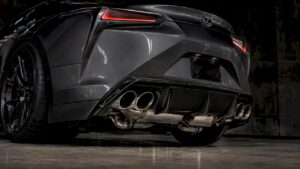
Pairing MS10 forged wheels with autoclay-cured dry carbon fiber aero components addresses both sides of that equation at once. Our dry carbon parts use an autoclave-cured 2×2 twill layup, which produces a lighter, stiffer panel than wet-layup carbon while holding tighter dimensional tolerances for a precise panel fit. A lighter splitter and diffuser reduce front and rear overhang mass, which shifts the car’s center of pressure and changes how much downforce the suspension needs to manage at a given speed, something our Lexus LC500 carbon fiber parts guide breaks down in more depth for that platform specifically.
A representative complete build pairs:
- MS10 forged monoblock wheels sized per axle for the platform’s power delivery and brake package.
- Dry carbon splitter and diffuser from our E6 Carbon Elite Kit for Lexus LC500, tuned to work with the chosen ride height.
- A high-performance exhaust upgrade, which sheds mass toward the rear axle and changes how quickly the rear end settles under throttle.
Reducing rotational mass at each wheel has a more direct effect on acceleration and braking than an equivalent weight savings anywhere else on the car, which is why forged construction gets prioritized before aero on most builds we spec.
Suspension tuning should follow the aero and wheel package, not precede it. A wider, heavier wheel and tire combination changes spring and damper requirements even before aerodynamic downforce enters the equation, so final alignment and suspension settings get dialed in after both the wheel spec and aero kit are locked.
Finishes, Bespoke Machining, and Installation Best Practices
Every MS10 set ships in a finish chosen for the build’s use case as much as its looks. A brushed or satin finish tends to hide brake dust and minor curb contact better than a high-polish finish, which shows every mark but delivers the strongest show presence.
- Available finishes range from matte and satin to full gloss and custom-matched paint codes for color-specific builds.
- Bespoke machining options include custom center bore sizing, directional lip profiles, and caliper-specific inner barrel contours.
- Typical lead time depends on how much customization a set requires, with simpler finish-only orders moving faster than fully bespoke machining and color-match requests.
- Installation best practices include torquing to the vehicle manufacturer’s specification in a star pattern, cleaning the hub face of corrosion or old adhesive before mounting, and confirming hub-centric machining sits flush before final torque.
Protecting the finish after installation matters as much as the install itself. A ceramic coating designed for alloy wheel protection helps resist brake dust buildup and makes routine cleaning faster, particularly on darker or polished finishes where contamination shows quickly.
Requesting engineer-verified fitment at order time, rather than after the wheels arrive, is the step that prevents most returns. We confirm offset, center bore, and BBK clearance against your specific vehicle and brake package before machining begins.
Pricing and Lead-Time Expectations for MS10 Builds
Budgeting for a monoblock build depends heavily on diameter, width, and how much bespoke machining the fitment requires.
- Base diameter pricing scales upward from 18 inch sets, with 20 and 22 inch configurations commanding higher pricing due to material volume and machining time.
- Bespoke finishes such as custom color-matching or directional lip profiles add to both cost and lead time versus a standard catalog finish.
- Custom machining for non-standard center bores or caliper-specific inner barrel contours extends production time beyond a stock-spec order.
- Shipping and installation should be planned together: booking our in-house installation service at the same time as your order avoids a second scheduling gap after the wheels arrive.
Because MS10 pricing varies by exact spec, we quote each build individually rather than publishing a single flat number. Reach out through our E6 Forged wheels catalog for a configuration-specific quote.
Example Specs: AMG GT, Lexus LC500, and Exotic Platforms
Concrete starting points make the sizing conversation easier, even though every final spec gets verified against the individual vehicle.
- Lexus LC500: a 20 inch square or mild staggered setup works within the platform’s narrow offset window, with center bore machined to the LC500’s specific hub rather than relying on a universal ring, per LC500 wheel spec data.
- McLaren and Lamborghini platforms: a conservative width one step below the theoretical maximum, with final offset confirmed through a physical mockup rather than spec-sheet calculation alone, given how sensitive exotic suspension geometry is to even small ET changes.
These examples are starting references, not universal answers. Ride height, tire choice, and any non-stock suspension components all shift the final number slightly, which is why we treat each order as its own fitment project rather than a catalog lookup.
Why Fitment-First Engineering Changes How Wheels Get Designed
Most wheel shopping starts with looks and works backward to fitment, and that order of operations is exactly backward for anything built to be driven hard. A wheel that looks correct in a rendering but gets the offset wrong by even a few millimeters can contact a strut, rub a fender liner under compression, or load a wheel bearing in ways it was never designed for.
The industry default of offering a handful of fixed offsets per diameter works fine for a commodity daily driver. It fails on a platform-specific exotic or a car running a big brake kit, because the margin between “fits” and “rubs under load” is often a single offset step. Treating fitment as the starting constraint, rather than an afterthought solved with spacers or adapters, is what separates a wheel that looks right in a parking lot from one that holds up on a track day.
— E6 Engineering
Order MS10 Monoblock Wheels Built to Your Exact Fitment
We build every MS10 set to the fitment data gathered from your specific vehicle, not from a generic size chart, which means the offset, center bore, and inner barrel contour that reach your door are already matched to your brake package and ride height.
- Browse diameter and width options in our E6 Forged Monoblock catalog and select a starting spec close to your platform.
- Request an engineer-verified offset and center bore check for your exact vehicle before machining begins, especially on exotic chassis.
- Add professional in-house installation to your order for correct torque sequencing and hub-face preparation at mount time.
For builds that pair wheels with aero, our Carbon Fiber Parts catalog covers splitters, diffusers, and full kits designed to complement a lighter, forged wheel setup. Start your configuration through our E6 Forged Monoblock page and we’ll confirm fitment before your set goes into production.
FAQ
Are forged monoblock wheels good for performance driving?
Forged monoblock wheels generally reduce unsprung weight and rotational mass compared to cast wheels, since the one-piece forged structure needs less material to achieve the same strength. That weight reduction improves suspension response and can shorten braking distances, which is why monoblock construction is common on track-focused and exotic platforms.
Does wheel center bore need to be exact?
Yes. A center bore that doesn’t match the hub diameter exactly relies on the lug bolts alone to center the wheel, which increases vibration risk and uneven load distribution over time. Hub-centric machining to the vehicle’s specific bore, rather than a universal-fit ring, keeps the wheel centered on the hub itself.
What is a monoblock forged wheel?
A monoblock forged wheel is machined from a single piece of forged aluminum, with the face, spokes, and barrel all coming from one billet rather than being welded or bolted together from separate sections. This differs from multi-piece forged wheels, which join a separate face and barrel, typically for width and finish flexibility.
What diameter and width range does the MS10 cover?
The MS10 is available in 18 to 22 inch diameters with widths from 8.0 to 13.0 inches, each customized per vehicle and axle. Offset and center bore are machined specifically for the platform rather than fixed to a small set of catalog sizes.
Do MS10 wheels clear big brake kits without spacers?
In most cases, yes, because the inner barrel contour is machined to the specific caliper package rather than built to a generic shape. Confirming caliper envelope and rotor hat depth during the fitment check is what allows the wheel to clear the brake package without relying on a spacer.
Sources
Recommended
- Engineer Verified E6 RF20 Fitment for Luxury & Exotics, $3,500–$7,000
- Fitment First: E6 Forged 6061 T6 Wheels for C192 AMG GT63 5×112
- Fitment First E6 Two Piece Forged Wheels With Carbon Aero for LC500
Pricing, custom fitment options, and surface finishes subject to availability. Please contact E6 Carbon or E6 Forged directly to confirm vehicle-specific offset parameters, brake clearances, and current lead times prior to placing your order.