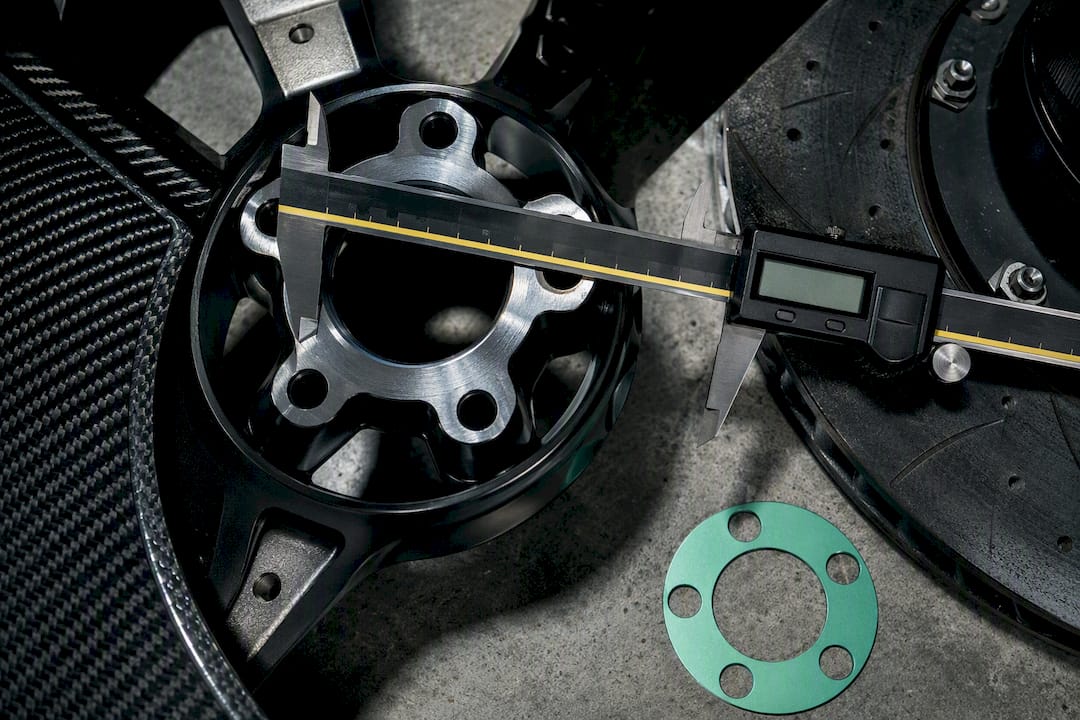
A bolt pattern, also called PCD (pitch circle diameter), is the lug count times the diameter of the circle running through the centers of the lug holes, written as something like 5×114.3. Before you buy wheels for any car, confirm this exact spec against the door jamb sticker, owner’s manual, or a physical measurement. Getting it wrong by even a few millimeters means the wheel simply will not bolt on.
TL;DR:
- A mismatch of even 2.3mm in bolt pattern diameter can cause improper seating, wheel wobble, and long-term safety issues under load.
- Measuring bolt pattern accurately requires using a caliper or bolt pattern gauge, especially for five-lug wheels, rather than relying on rough tape measurements.
- Confirming bolt pattern with factory data from door stickers, manuals, or OEM resources is essential before aftermarket wheel purchase, particularly for modified vehicles.
- Proper fitment also depends on exact center bore, offset, and lug seat type; a match in bolt pattern alone does not ensure proper wheel fit or safety.
- Forged wheels engineered for your platform’s precise tolerance stack provide the safest and most reliable fitment, especially on performance or exotic vehicles.
Table of Contents
- What Is a Bolt Pattern (PCD) and How Do You Read It?
- How Do You Measure a Bolt Pattern Yourself?
- Bolt Pattern Charts: Converting Metric to Imperial
- What Else Determines Fitment Beyond Bolt Pattern?
- Are Dual-Drill Wheels and Adapters a Safe Fix?
- How Should You Verify Bolt Pattern Before Ordering Wheels?
- E6 Engineering Perspective: Fitment First for Performance Platforms
- What Should You Actually Prioritize?
- Get Wheels Engineered to Your Exact Fitment Specs
- Where to Verify Your Specs
- Sources
- FAQ
What Is a Bolt Pattern (PCD) and How Do You Read It?
Every wheel bolt pattern carries two numbers. The first is the lug count. The second is the diameter, in millimeters or inches, of the circle that passes through the center of every lug hole. A Mercedes-AMG C63 running a 5×112 pattern has five lugs arranged around a circle exactly 112mm across, measured hole center to hole center through that imaginary circle.
That second number is where people get tripped up, and it’s also where real engineering consequences show up. Take 5×112 versus 5×114.3. Those two patterns differ by just 2.3mm, but they are not interchangeable. On a 5-lug wheel, that gap is enough to prevent the bolts from seating straight, which throws off clamping load across the hub face. Under acceleration, braking, or cornering loads, an improperly seated lug bolt can work loose over time, and the wheel starts to wander off-center under load, a problem that gets worse, not better, the harder you drive.
This is why “close enough” doesn’t exist in wheel fitment. A pattern that’s off by 2mm will occasionally let the bolts start threading, which can trick an installer into thinking the fitment is correct until vibration shows up weeks later.
Where you can find the factory spec without measuring anything:
- Door jamb sticker: most manufacturers print bolt pattern and torque specs on the driver-side door jamb placard.
- Owner’s manual: usually listed in the wheel and tire section, sometimes alongside recommended torque values.
- OEM parts catalog or dealer parts department: reliable for older vehicles where the jamb sticker has faded.
- Manufacturer wheel spec sheets: performance brands publish exact PCD, offset, and center bore for each trim.
Bolt pattern determines whether a wheel will physically bolt to your hub. It says nothing about whether that wheel will actually fit your fender clearance, suspension geometry, or load requirements. That’s a separate conversation, and it’s arguably the more important one for anyone stepping up to forged wheels.
How Do You Measure a Bolt Pattern Yourself?
Measuring bolt pattern is straightforward on even-lug wheels and slightly trickier on 5-lug setups, which is most passenger cars and nearly every performance platform on the road today.
What you’ll need:
- A metric tape measure or, better, a digital caliper for precision.
- A bolt pattern gauge, if you’re working with a 5-lug wheel or want to skip the math entirely.
- A flat, level surface and good lighting.
- The wheel off the car, or at minimum the center cap and hubcap removed.
For even-lug patterns (4, 6, or 8-lug wheels):
- Remove the hubcap or wheel cover so all lug holes are visible.
- Measure straight across, center to center, between two lug holes directly opposite each other.
- Record that number in millimeters. That’s your PCD, full stop.
- Repeat the measurement on a second pair of opposite holes to confirm consistency, since a bent wheel or worn hub can throw off a single reading.
Even-lug measurement works because the diameter runs in a straight, symmetrical line across the hub. There’s no math involved, just a direct measurement.
For 5-lug patterns, the geometry gets more complicated. With an odd number of lugs, no two holes sit directly opposite each other, so you can’t measure straight across. LA Car’s step-by-step measurement guide outlines the standard workaround:
- Pick any lug hole as your starting point.
- Measure from the center of that hole to the outer edge of the hole that sits two positions away (the “third hole” counting around the circle).
- That center-to-outer-edge measurement approximates the PCD, though it’s not exact.
- For an exact reading, use a bolt pattern gauge, a flat template with pre-marked hole patterns that you lay directly against the wheel or hub.
Pro Tip: A $15 to $30 bolt pattern gauge pays for itself the first time you use it. It eliminates the odd-lug guesswork entirely and gives you a direct visual match against known patterns, which is a lot more reliable than eyeballing a tape measure against a curved edge.
A few mistakes show up again and again. Measuring from outer edge to outer edge instead of center to outer edge on a 5-lug wheel throws the number off by the diameter of the hole itself, often 2 to 3mm, which is exactly the margin that separates 5×114.3 from 5×112. Measuring with the wheel still mounted and the lug nuts in place can also distort the reading, since the nut heads obscure the true hole center. And measuring only one side of the wheel without a second confirmation pass means a warped rim or corroded stud can slip through unnoticed.
Once you’ve got a number, measure at least one more wheel on the same vehicle and compare both readings against the factory documentation. Discount Tire’s fitment guidance recommends this cross-check specifically because hub wear and aftermarket modifications can occasionally shift a reading by a millimeter or two, enough to cause confusion if you’re relying on a single measurement.
Bolt Pattern Charts: Converting Metric to Imperial
Bolt patterns get specified in either millimeters or inches depending on the manufacturer’s origin and the era of the vehicle, and the two systems don’t line up on round numbers. A pattern listed as 5×4.5 inches is the same physical spec as 5×114.3mm. Older American trucks and some Japanese applications default to inch notation, while European and most modern global platforms specify in millimeters.
The conversion math is simple once you know the rule: multiply inches by 25.4 to get millimeters. So 4.5 inches becomes 114.3mm, and 4.25 inches becomes 108mm. Summit Racing’s bolt pattern conversion reference lists the standard equivalent pairs, which is worth bookmarking if you’re cross-shopping wheels listed in different units.
Here are the patterns you’ll run into most often, spanning economy cars through high-performance platforms:
The distribution data from Wheel-Size.com’s PCD reference shows that 5×114.3 and 5×112 rank among the most common five-lug patterns on the road, which is exactly why they’re also the two most frequently confused. If your measurement lands close to 112mm or 114.3mm, don’t round. That 2.3mm gap is the entire margin of error in this hobby, and it’s the single most common return reason wheel retailers report.
Lexus LC500 owners specifically will find their platform specified at 5×114.3, a detail worth confirming directly since some aftermarket catalogs list adjacent Toyota Group patterns that look similar on paper but aren’t identical once offset and center bore enter the picture.
What Else Determines Fitment Beyond Bolt Pattern?
Bolt pattern gets you in the door, but it’s only one of four dimensions that have to align for a wheel to actually work on your car. Miss any of the other three and you’ll get vibration, rubbing, or worse.
Center bore and hub bore. The center bore is the machined hole in the back of the wheel that fits over the vehicle’s hub. Hub bore refers to the hub’s own diameter. When those two numbers match exactly, you have a hub-centric fit, where the hub itself carries the wheel’s weight and centers it precisely. When the wheel’s center bore is larger than the hub, manufacturers rely on the lug bolts alone to center the wheel, called lug-centric mounting. Discount Tire’s fitment guide notes that hub-centric fitment is strongly preferred for performance applications because it removes the guesswork of the lug bolts alone bearing the centering load, particularly under repeated hard cornering.
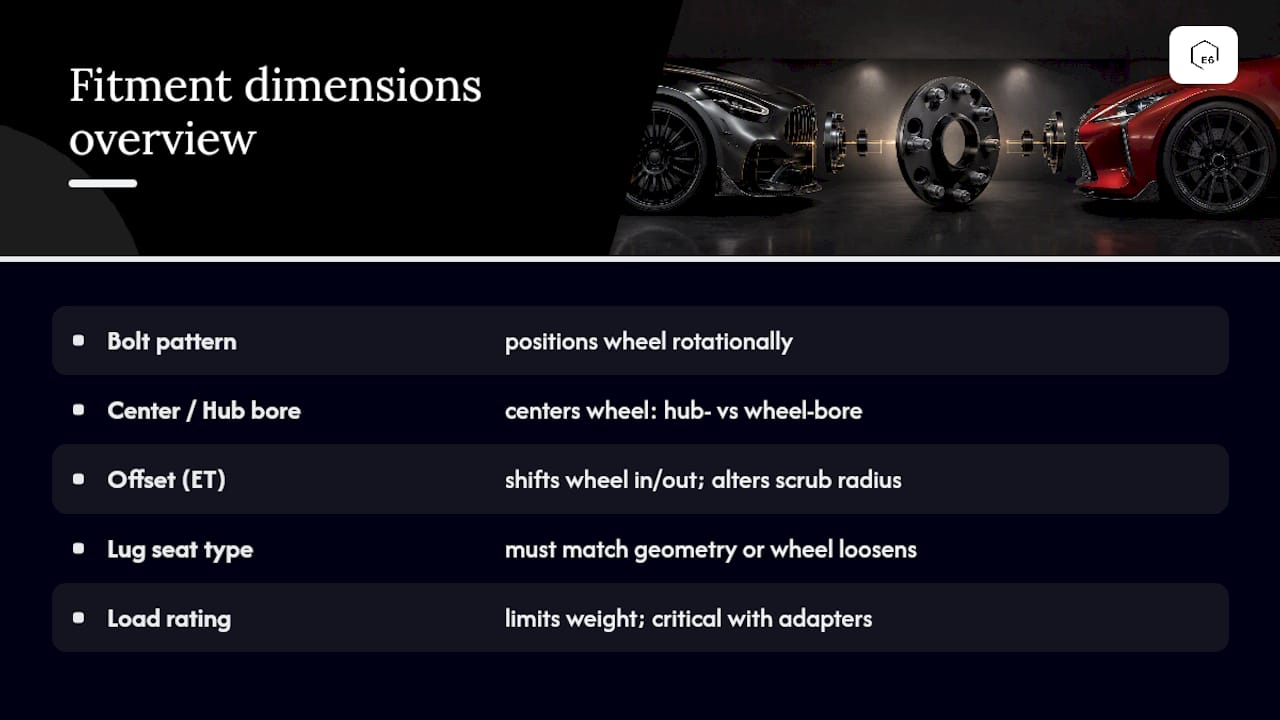
Offset (ET). Offset measures the distance between the wheel’s mounting face and its centerline, stamped in millimeters, often with an “ET” prefix (from the German Einpresstiefe). A wheel with too little positive offset pushes the tire outward, which can rub the fender lip. Too much offset pushes the wheel inward, potentially interfering with brake calipers or suspension components. Offset also shifts the scrub radius, the geometric relationship between the steering axis and the tire’s contact patch, which changes how the steering feels and how the suspension handles bump steer.
Lug seat type. Lug nuts and bolts come with different seat geometries: conical (60 degree), ball seat (rounded), and flat with a separate washer. These are not interchangeable. A conical seat lug nut on a wheel drilled for a ball seat will contact the wheel at the wrong angle, concentrating clamping force on a narrow ring instead of distributing it evenly across the seat, which is a slow path toward a loosened wheel.
Load rating. Every wheel and lug assembly carries a rated load capacity, and it matters more than most buyers realize when adapters or spacers enter the picture.
Bearing loads that a factory hub and lug assembly handle comfortably at stock spec can rise meaningfully once an adapter plate or non-hub-centric wheel shifts load paths, a distinction that becomes critical the moment a car sees sustained track use rather than commuting.
If you want the deeper mechanics of how offset, center bore, and load rating interact across different platforms, E6 Carbon’s wheel fitment guide for luxury and sports cars walks through the engineering relationships in more detail.
Are Dual-Drill Wheels and Adapters a Safe Fix?
Dual-drill, or multi-drill, wheels are machined with two overlapping bolt patterns to fit more than one vehicle platform. A common example pairs 5×114.3 with 5×120, letting the same wheel bolt onto both a Lexus and certain BMW applications.
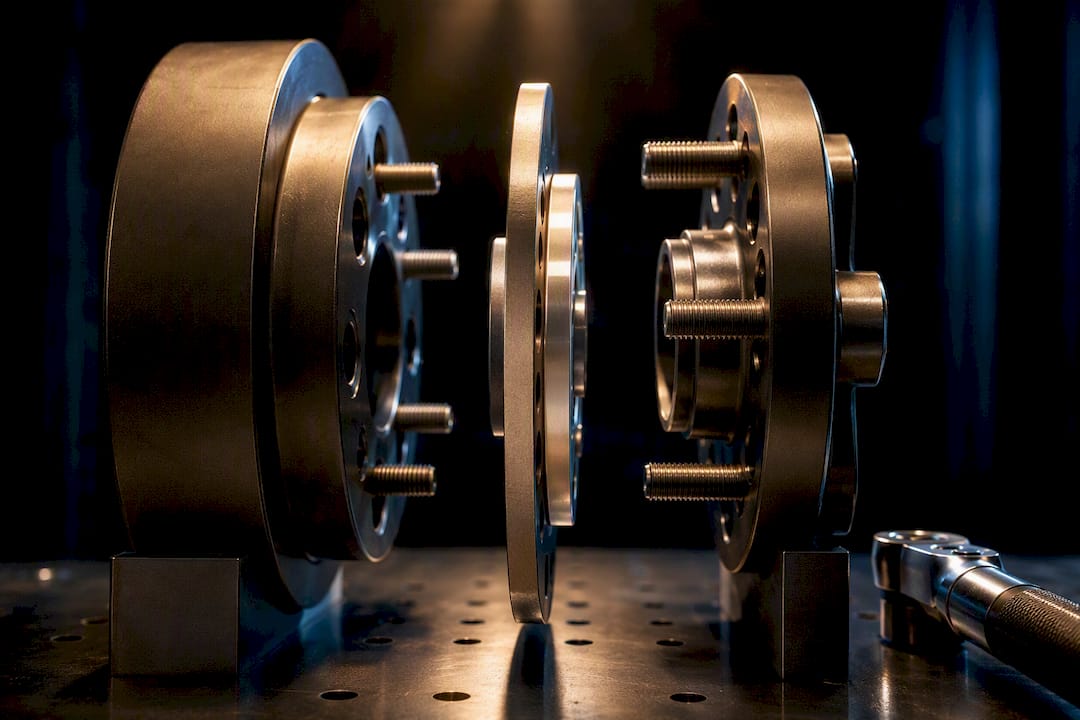
Bolt pattern adapters take a different approach. Instead of drilling two patterns into one wheel, an adapter plate bolts to your existing hub on one side and presents a different bolt pattern on the other, letting a wheel drilled for a different vehicle bolt on. Bolt-pattern puts typical adapter plate thickness at 15mm to 20mm, which is a real mechanical addition to your wheel assembly, not a cosmetic spacer.
That extra thickness changes your effective offset, pushes the wheel outward, and adds another mechanical interface where things can go wrong: another set of bolted joints, another surface that has to stay perfectly flat, and additional leverage on the wheel studs since the load now transfers through a longer moment arm.
A few practical rules on when each option makes sense:
- Dual-drill wheels are convenient for daily-driven cars switching between compatible platforms, but Discount Tire’s guidance points out that not every dual-drilled wheel is machined to tight tolerance on both patterns; some prioritize one pattern’s fit quality over the other.
- Adapters can work for low-speed, low-load applications such as show cars that rarely leave the driveway.
- For cars exposed to regular hard driving, track days, or high-speed highway use, a wheel forged and drilled for the exact factory bolt pattern and offset is the safer choice. The added mechanical interfaces in an adapter stack are additional failure points under the kind of sustained cornering and braking load a track day generates.
How Should You Verify Bolt Pattern Before Ordering Wheels?
Before you spend money on a new wheel set, run through this sequence in order. Skipping steps is how mismatched wheels end up getting returned.
- Start with the door jamb sticker. It’s the fastest, most reliable source, and it’s specific to your exact trim and production year, not a generalized platform spec.
- Cross-check the owner’s manual. Some manufacturers list bolt pattern alongside recommended tire pressures and torque specs, giving you a second confirmation from the same source.
- Run a database lookup. Sites like Wheel-size and Bolt-pattern.com maintain searchable records by year, make, and model, and they’re faster than pulling a wheel off the car if you just need a quick confirmation before browsing options.
- Physically measure as your final check. Documentation can be wrong for modified vehicles, swapped hubs, or vehicles with regional trim differences. A direct measurement, backed by a bolt pattern gauge on 5-lug applications, is the only way to catch a mismatch that paperwork missed.
- Confirm torque specs at the same time. If you’re pulling a wheel to measure it, note the manufacturer’s recommended torque value so reinstallation is done correctly the first time.
This workflow matters more on modified or older vehicles, where a hub swap, aftermarket brake upgrade, or regional trim variation can mean the printed spec doesn’t match what’s actually on the car anymore.
E6 Engineering Perspective: Fitment First for Performance Platforms
Bolt pattern is the easy part of the fitment equation. Where things get demanding is on platforms where the margin for error shrinks to fractions of a millimeter, which is exactly the territory occupied by Mercedes-AMG chassis, the Lexus LC500, and exotic platforms from McLaren and Lamborghini.
E6 Carbon builds around a principle we call Fitment First: bolt pattern, center bore, and offset are engineered together as a single tolerance stack, not specified independently and hoped into agreement. On a Mercedes-AMG platform running 5×112 with a tight hub-centric bore, a wheel that’s “close enough” on PCD but loose on center bore tolerance will still transmit uneven load into the hub bearing every time the car goes through a hard corner. That’s tolerable on a commuter car. It’s not tolerable at the loads an AMG chassis generates on a track day.
The same logic applies to the Lexus LC500’s 5×114.3 pattern. It’s a common spec, which is exactly why buyers get complacent about it. A monoblock or multi-piece forged wheel machined specifically for LC500 offset and center bore delivers a fundamentally different load path than a generic 5×114.3 wheel with an approximate center bore and a shim kit to make up the difference.
Pro Tip: If you’re speccing wheels for a car that sees any track time, treat center bore and offset with the same seriousness as bolt pattern. A PCD match with a sloppy center bore is still a mismatch, it’s just one that takes longer to show up.
For McLaren and Lamborghini platforms, where carbon ceramic brakes and extreme camber settings are common, offset tolerance becomes even less forgiving, since caliper clearance margins are often measured in single-digit millimeters.
The decision point is simple: if your bolt pattern, offset, and center bore all match factory spec exactly and you’re running stock-diameter wheels, a well-made off-the-shelf wheel is fine. The moment you’re changing wheel diameter, running a wider fitment, or pushing the car on track, bespoke forged wheels engineered to your platform’s exact tolerance stack stop being a luxury and start being the mechanically sound choice. E6 Carbon’s modular two-piece forged wheels for AMG and LC500 platforms are built around exactly that tolerance discipline.
What Should You Actually Prioritize?
The conventional advice on bolt pattern treats it as the whole problem: measure the lugs, match the number, done. That’s incomplete, and it’s the reason so many wheel returns happen over fitment issues that have nothing to do with lug count.
The research is clear that bolt pattern, center bore, offset, and lug seat type function as one interdependent system, not four separate checkboxes. A wheel can match your PCD perfectly and still be the wrong wheel if the center bore is loose or the offset pushes your tire into the fender liner. That’s the gap conventional buying guides gloss over.
If you’re building toward performance driving rather than a static show car, prioritize hub-centric fitment and correct offset over the convenience of an adapter or a dual-drilled wheel. Adapters and multi-drill setups have legitimate uses, but they add mechanical interfaces exactly where you don’t want them: at the load path between your hub and your tire’s contact patch. Measure carefully, verify against documentation, and treat a wheel engineered for your exact platform as the baseline, not the upgrade.
— E6 Engineering
Get Wheels Engineered to Your Exact Fitment Specs
Adapters and generic-fit wheels solve the bolt pattern problem and stop there. E6 Carbon solves the whole tolerance stack: bolt pattern, center bore, and offset engineered together as one system, forged and machined specifically for your platform instead of approximated with shims and spacer plates.
- Monoblock and multi-piece forged construction with hub-centric mating machined to platform-specific tolerance.
- Fitment engineering built around Mercedes-AMG, Lexus LC500, and exotic platforms including McLaren and Lamborghini.
- A fitment consultation before you order, so center bore and offset are confirmed against your exact chassis, not a generic trim listing.
If you’re running stock wheels at stock diameter with zero modifications, an off-the-shelf wheel matched to factory spec will do the job. The moment you’re changing diameter, width, or offset, or putting the car on track, bespoke forging closes the tolerance gaps an adapter stack leaves open. Explore E6 Carbon’s forged wheel lineup and start a fitment consultation for your platform.
Where to Verify Your Specs
- Wheel-size covers PCD lookups by year, make, and model, and includes distribution data for cross-referencing common patterns.
- Bolt-pattern offers a comprehensive lookup table alongside guidance on adapter thickness and dual-drill considerations.
- Summit Racing’s conversion chart lists standard metric-to-imperial bolt pattern equivalents for quick reference.
- Pair any of these with a ceramic coating guide for wheel protection once your new wheels are mounted and ready for long-term care.
Sources
- Wheel-size
- How to Measure Bolt Pattern: Complete Step-by-Step Guide | LA Car
- Measure Wheel Bolt Pattern | Discount Tire
- Wheel Bolt Pattern Conversion Chart · Help Center (Summit Racing)
FAQ
What Are the Common 5-Lug Bolt Patterns?
The most common five-lug patterns are 5×100, 5×10⁸, 5×112, 5×114.3, 5×120, and 5×130, with 5×114.3 and 5×112 ranking among the most frequently seen across mainstream and performance vehicles.
How Do I Find Out My Car’s Bolt Pattern?
Check the door jamb sticker or owner’s manual first, since both list the factory spec directly, then confirm with a database lookup or physical measurement if you’re shopping for aftermarket wheels.
Is 5×4.5 the Same Bolt Pattern as 5×114.3?
Yes, 5×4.5 inches and 5×114.3mm describe the identical physical pattern, just expressed in different units, and this equivalent pair is a standard entry on any bolt pattern conversion chart.
How Do I Measure a 5-Lug Bolt Pattern?
Measure from the center of one lug hole to the outer edge of the hole two positions away, or use a bolt pattern gauge for an exact reading, since odd-lug patterns can’t be measured straight across like even-lug wheels can.
Does Matching Bolt Pattern Guarantee a Wheel Will Fit?
No. A correct bolt pattern only confirms the lug holes align; center bore, offset, and lug seat type also have to match for the wheel to fit and perform correctly, which is why bespoke forged wheels are engineered around all four dimensions together rather than PCD alone.