The BMW G80 M3 runs a 5×112 bolt pattern with a 66.6mm center bore, and most owners stay safe running wheel widths between 9.5 and 11 inches with offsets from roughly ET18 to ET35 depending on the fitment goal. OEM+ builds hold close to factory dimensions, aggressive/flush setups push wider and lower offset, performance street and track fitments prioritize sidewall and heat management, drag setups go narrow up front, and winter setups drop a size for snow clearance and cost. Pick your category below and work from there.
TL;DR:
- Most aftermarket wheels for the G80 M3 should match OEM bolt pattern of 5×112 and a 66.6mm center bore, but offset and width must be verified to avoid clearance issues.
- Aggressive and track setups often involve wider wheels (up to 11 inches) and lower offsets (ET18–ET35), requiring clearance checks for calipers, struts, and fenders before purchase.
- Forged wheels are preferred for performance and weight savings, especially in track or aggressive fitments, and require precise engineering to ensure clearance under load.
- Overall diameter consistency within 1–2% of factory size is critical to maintain speedometer accuracy and stability control, influencing tire selection based on wheel size.
- Custom fitment considerations, including caliper clearance and suspension geometry, are best addressed through detailed modeling and physical verification rather than relying solely on catalog specifications.
Table of Contents
- Understanding G80 Wheel Fitment: OEM Specs and Reading the Numbers
- Fitment Setups by Use Case: OEM+, Aggressive, Track, Drag, and Winter
- How to Choose Wheels and Tires for a G80 M3
- Pre-Purchase Fitment Checklist: How to Verify Before You Buy
- Tire Sizing Rules: Keeping Overall Diameter in Check
- Winter and Track Fitment Notes: When to Break From Daily Setup
- Fitment-First Engineering: What Actually Goes Into a Wheel That Fits
- Get Your G80 Fitted Right With E6 Forged Wheels
- Sources
- FAQ
Understanding G80 Wheel Fitment: OEM Specs and Reading the Numbers
Before touching an aftermarket catalog, know what you’re replacing. The G80 M3 (2024–2027 LCI included) ships on a 5×112 bolt pattern with a 66.6mm center bore, according to Wheel-size. That’s the same PCD BMW has used across its M lineup for years, but the bore and offset windows shift generation to generation, so don’t assume an E92 or F80 wheel bolts on cleanly without rechecking these numbers.
Factory staggered fitment on most trims runs a 9.5Jx18 ET20 front paired with a 10.5Jx19 ET20 rear, though some model years and option packages shift to a full 19 inch or 19/20 staggered setup. Lug bolts are cone-seat, and BMW spec’s a specific torque value your installer should already know. If you’re shopping aftermarket, confirm your exact trim’s OE offset before assuming these numbers apply.
Three terms determine whether a wheel tucks, rubs, or sticks out past your fender:
- Offset (ET): the distance in millimeters from the wheel’s centerline to its mounting surface. Higher ET tucks the wheel inward; lower ET pushes it outward toward the fender lip.
- Wheel width: measured bead to bead in inches. Going wider without adjusting offset pushes both the inner and outer lip further from centerline.
- Backspacing: the distance from the mounting pad to the back edge of the wheel. It determines how close the barrel sits to your strut, control arm, and brake caliper.
Change one number and the other two shift the entire geometry. A 10.5 inch wheel at ET35 might clear everything comfortably, but drop that same width to ET18 and you’ve moved the barrel 17mm closer to the fender and further from the suspension, which is exactly why caliper and strut clearance checks matter more than the width number alone.
Fitment Setups by Use Case: OEM+, Aggressive, Track, Drag, and Winter
Apex Wheels’ G80 M3 fitment guide organizes recommendations by intended use rather than by wheel brand, and that structure holds up because it matches how owners actually shop: nobody searches for a specific spoke design, they search for “aggressive fitment” or “track setup.” Here are five setups that cover the range from conservative to purpose-built.
- OEM+ (staggered): 19×9.5 ET25 front, 19×10.5 ET22 rear, running 275/35R19 front and 285/30R19 rear. This stays within a few millimeters of factory geometry, requires no fender work, and keeps ride quality closest to stock. It’s the safest starting point if you’re new to aftermarket fitment and want to avoid rubbing entirely.
- Aggressive/flush (staggered): 19×10.5 ET22 front, 19×11.5 ET18 rear, paired with 285/30R19 front and 305/30R19 rear tires. Community threads on BimmerPost’s G80 offset guide consistently warn that this range needs a mock-up before purchase, since fender liner trimming or a mild roll is common at full lock with stock suspension.
- Performance street/track (staggered): 18×9.5 ET25 front, 18×10.5 ET18 rear, wrapped in 265/35R18 front and 305/35R18 rear tires. WheelPrice’s fitment guide lists this exact combination as one of the most common owner setups, and dropping to an 18 inch diameter opens room for a taller sidewall, which helps on track curbing and absorbs heat cycling better than a low profile 19 or 20 inch tire.
- Drag setup (square or staggered narrow front): 18×9 ET35 front with a narrower 245/40R18 tire for reduced rolling resistance at launch, rear stays wide at 18×10.5 ET18 with a sticky 305 width drag radial. This isn’t a daily fitment. It’s built around straight-line grip, and the narrow front trades cornering feel for lower rotational mass off the line.
- Winter (square): 18×9 ET35 all four corners, running a 245/40R18 winter compound. Square fitment lets you rotate tires evenly across all four positions, which matters more in winter because uneven wear from staggered setups shows up faster on a compound built for cold-weather grip rather than dry traction.
Trade-offs run through every one of these choices. Wider, lower-offset setups look flush but increase scrub radius and can transmit more road noise and harshness into the cabin, especially paired with stiffer coilovers. Staggered setups also mean you can’t rotate front to rear, so front tires (which carry more braking and steering load) wear faster and need earlier replacement, adding to your annual tire budget. Aggressive fitments frequently require a spacer, a mild fender roll, or camber adjustment to avoid rubbing at full steering lock or under hard compression, and any of those changes can affect how your car handles at the limit, not just how it looks parked.
How to Choose Wheels and Tires for a G80 M3
Construction method matters more than most buyers realize. Forged wheels start as a single billet of aluminum compressed under extreme pressure, which aligns the grain structure and produces a stronger, lighter wheel than a cast or flow-formed equivalent at the same dimensions. Flow-formed wheels spin-form the barrel after casting, which improves strength over basic cast wheels at a lower cost than full forging, but doesn’t match forged construction for unsprung weight reduction. That distinction is why serious track builds and aggressive fitments almost always run forged, since every pound saved at the wheel improves acceleration, braking, and steering response more than the same pound saved anywhere else on the car.
Barrel profile and spoke design also determine whether a wheel physically clears your calipers. A shallow inner barrel or a spoke that intrudes too far inward can contact the caliper body even when the ET number looks compatible on paper, which is why clearance verification has to happen before the wheel ships, not after.
Before you buy from any manufacturer, ask these questions directly:
- Do you provide a clearance template or 3D model specific to my trim and brake package?
- Is the wheel hub-centric to a 66.6mm bore, or does it require centering rings?
- What fastener type and thread pitch does the wheel require, and are they included?
- Will you guarantee fitment for my exact trim, or is the spec sheet generic across the model line?
Pro Tip: Ask for the wheel’s exact backspacing measurement, not just the offset. Two wheels with identical ET numbers can have different backspacing if the wheel width differs, and backspacing is what actually determines strut and caliper clearance.
Red flags to walk away from: a listing that omits ET or backspacing entirely, vague language about “universal fitment,” no clear answer on hub bore size, or a seller who can’t tell you whether the wheel needs TPMS-compatible valve stems. If a company can’t answer these questions before you buy, they won’t be able to help you after a wheel doesn’t clear. For a deeper breakdown of forged versus flow-formed construction and where the weight savings actually matter, the forged wheel buying guide covers the engineering trade-offs in more detail.
Pre-Purchase Fitment Checklist: How to Verify Before You Buy
Every reputable shop runs the same verification sequence before a wheel goes on for good. Skipping steps here is how owners end up with a wheel that fits perfectly parked in the driveway and rubs the moment they turn the wheel at low speed in a parking lot.
- Dry-fit the wheel and tire assembly before final mounting, checking caliper clearance visually from multiple angles with the wheel off the ground.
- Turn to full lock in both directions with the car on a lift or jack stands to check for contact between the tire, fender liner, and any suspension components.
- Compress the suspension fully (or simulate it) to catch clearance issues that only appear under load, since ride height drops several inches under hard braking or a curb strike.
- Confirm TPMS compatibility, either by transferring your factory sensors or installing new ones matched to your tire pressure monitoring system before the tire goes on.
- Install hub-centric rings if the aftermarket wheel’s center bore is larger than the G80’s 66.6mm hub, which prevents vibration that a lug-centric mount alone won’t fix. Road Runner Wheels notes this is one of the most common causes of comeback vibration complaints in custom fitment work.
- Torque lug bolts to spec in a star pattern, then re-torque after the first 50 to 100 miles as the wheel seats fully against the hub.
On spacers: a modest spacer (typically under 15mm) is generally considered safe when paired with extended studs or bolts rated for the added stack height, but stacking a spacer on top of an already aggressive offset compounds bearing load and can accelerate wear on wheel bearings over time. If your target fitment needs more than 15 to 20mm of spacer to clear, you’re better off sourcing the correct offset directly.
Tire Sizing Rules: Keeping Overall Diameter in Check
The number that matters most when you change wheel diameter isn’t the wheel size, it’s the tire’s overall diameter. Go up a wheel size without adjusting tire sidewall height, and you shrink the tire’s rolling diameter, which throws off your speedometer, odometer, and can even affect stability control calibration since those systems reference wheel speed sensors calibrated to stock diameter.
Wheel-Size.com’s guidance recommends staying within roughly 1 to 2 percent of your factory overall diameter when sizing aftermarket tires. Here’s the math on a real example: factory 275/35R19 has an overall diameter of about 26.7 inches. Step up to an 18 inch wheel and you’d want a 265/35R18, which comes in around 25.6 inches, a difference close to 4 percent, so many owners instead choose a 265/40R18 to land closer to the original diameter while gaining sidewall height for track use.
Tire construction matters as much as size. Summer performance compounds work best for street and mixed track duty. True track days benefit from a stickier UTQG-rated tire with reinforced sidewalls. Winter demands a dedicated winter compound, not an all-season, since rubber compounds designed for warm weather stiffen and lose grip below roughly 45°F regardless of tread pattern.
- Staggered setups can’t be rotated front to rear, which shortens front tire life and raises long-term replacement cost.
- Square setups allow full four-tire rotation, extending overall tread life and evening out wear.
- Track-focused tires often need replacement more frequently than street tires regardless of setup, due to heat cycling and aggressive compounds wearing faster under sustained cornering loads.
Winter and Track Fitment Notes: When to Break From Daily Setup
Winter and track use both call for departures from your daily aggressive fitment, and for good reason. A wider, low-offset summer wheel wrapped in a narrow winter tire looks wrong and performs worse, since winter compounds work best with more sidewall flex and a narrower contact patch that cuts through snow rather than floating on top of it.
For winter, most owners drop to an 18×9 or even 18×8.5 flow-formed wheel, which costs less than forged construction and takes the inevitable curb rash and road salt exposure without the same financial sting as damaging a forged set. Flow-formed strikes a reasonable balance of strength and cost for a wheel that only sees a few months of use each year.
Track and drag setups often go the opposite direction: some owners choose an 18 inch square fitment specifically because it opens room for a taller, more heat-tolerant tire sidewall and simplifies tire selection since you only need to stock one size. Wheel strength matters more here too, since track use puts repeated high-load cycling through the barrel and spokes that a daily-driver wheel isn’t necessarily rated for.
- Rotate and inspect winter wheels each season for corrosion under the clear coat, especially around the bead seat where road salt collects.
- Check caliper pad wear more frequently on track-driven cars, since aggressive fitments with less airflow can run calipers hotter than stock.
- Store off-season wheels indoors when possible. Repeated freeze-thaw cycles on exposed aluminum accelerate corrosion at the bead.
Fitment-First Engineering: What Actually Goes Into a Wheel That Fits
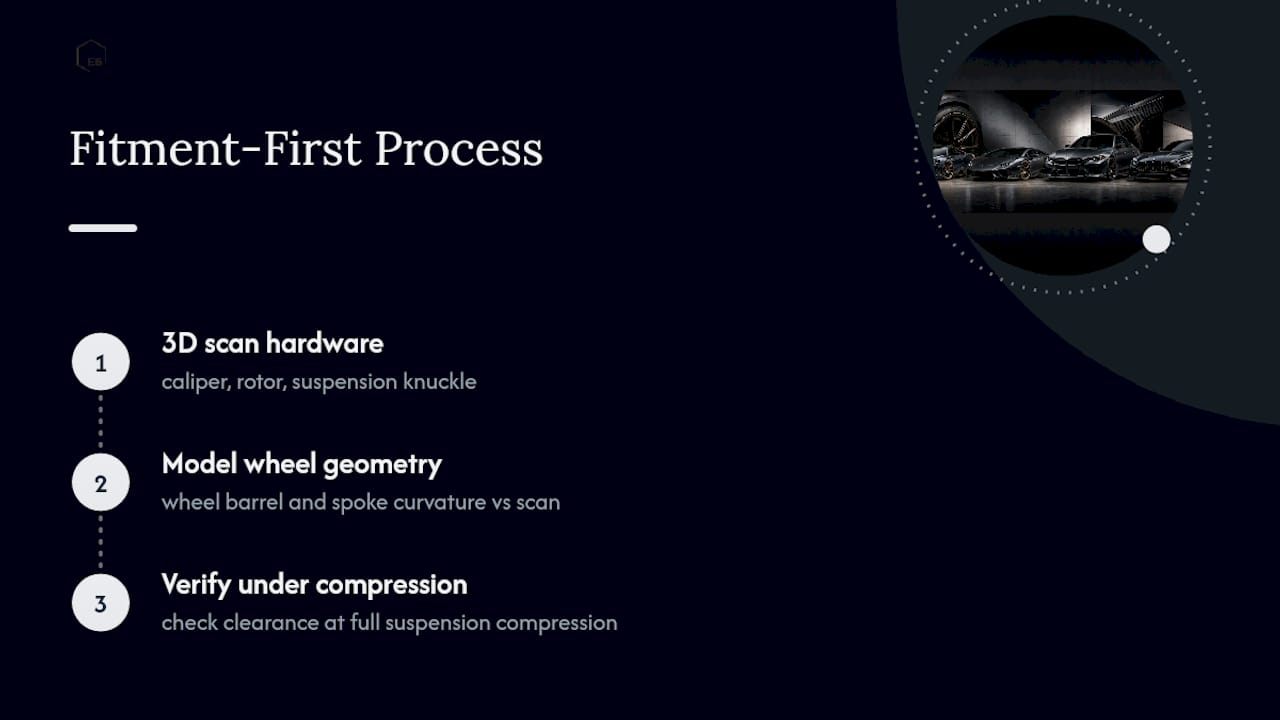
Most fitment problems trace back to a wheel designed around a spec sheet rather than the actual brake hardware. An advanced engineering approach starts with 3D scanning the caliper, rotor, and suspension knuckle, then modeling the wheel’s barrel and spoke curvature against that scan to confirm clearance under full compression, not just at static ride height. This is where a lot of off-the-shelf fitment charts fall short: a wheel can satisfy the ET and bolt pattern on paper and still contact a big-brake kit or an aftermarket caliper the moment the suspension compresses under hard braking.
The broader wheel industry has moved toward more sophisticated design tooling in recent years, a shift SEMA has documented across manufacturers adopting better modeling workflows. That tooling helps, but it doesn’t replace a physical clearance check against your specific trim and brake package.
Custom forged wheels earn their premium when a stock fitment chart simply doesn’t cover your setup, whether that’s a big-brake upgrade, a widebody conversion, or a track build chasing a very specific offset that no off-the-shelf wheel hits cleanly. For owners exploring what that process actually involves, E6 Carbon’s guide to specing high-end wheels walks through how barrel depth and caliper clearance get engineered together rather than treated as separate problems.
— E6 Engineering
Get Your G80 Fitted Right With E6 Forged Wheels
Off-the-shelf fitment charts get you close. They do not account for specific caliper packages, ride height, or the exact offset that clears everything without compromise. Custom forged wheels can be engineered against a car’s actual brake hardware and suspension geometry, monoblock or multi-piece, so the barrel depth and spoke design are solved before the wheel ships. That fitment-first approach is especially important on cars where the gap between a stock offset chart and an aggressive, track-ready setup is wider than most vendor guides indicate.
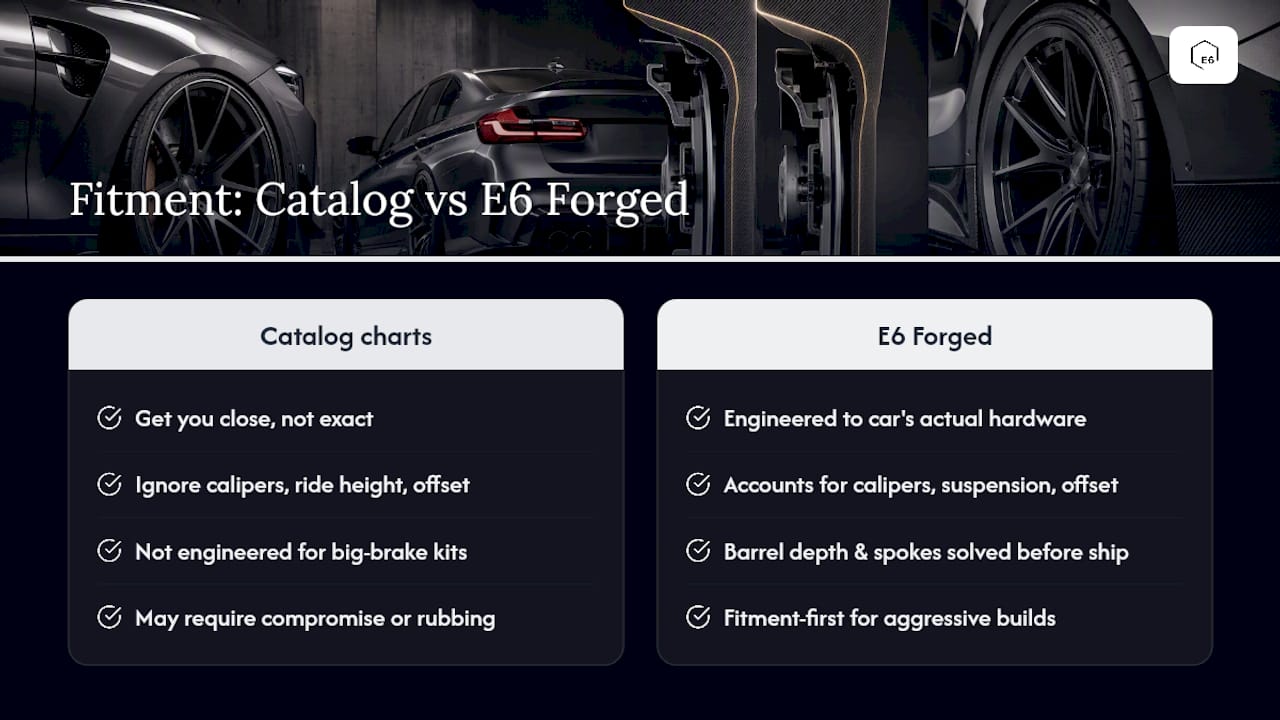
If your build calls for something a catalog wheel can’t cover, whether that’s clearing a big-brake kit or hitting a precise flush stance, explore E6 Forged Wheels and start a fitment consultation for your G80.
Sources
FAQ
What Is the Best Wheel Fitment for a G80 M3?
Most owners find the safest all-around fitment sits close to OEM+: 19×9.5 ET25 front and 19×10.5 ET22 rear with 275/35R19 and 285/30R19 tires. Aggressive or track fitments can go wider or drop to 18 inch wheels, but each requires its own clearance verification.
Is BMW 5×112 or 5×120?
BMW’s M3 and M4 lineup, including the G80, uses a 5×112 bolt pattern, which is shared with several Mercedes-Benz models.
Are G80 Wheels 5×120?
No. The G80 M3 uses a 5×112 bolt pattern with a 66.6mm center bore, confirmed by Wheel-Size.com’s spec data. The bolt pattern differs for older BMW chassis generations.
What Are the Wheel Sizes for the Genesis G80?
The Genesis G80 is a separate vehicle from the BMW M3 and runs its own bolt pattern and offset specifications, detailed in Genesis’s official spec documentation. Don’t cross-reference Genesis G80 wheel specs when shopping for a BMW M3, since the naming similarity doesn’t extend to shared fitment.
Do I Need Spacers for an Aggressive G80 Fitment?
Some aggressive fitments need a spacer under 15mm to clear properly, but many wider, lower-offset wheels are designed to hit the target stance without one. Confirm the exact offset with your wheel supplier before assuming a spacer is required.