TL;DR:
- Building a track car requires evaluating thermal tolerance, safety compliance, and durability beyond basic performance parts. Regular inspection, proper maintenance, and understanding tech requirements ensure safety and reliability during high-heat heat cycling. Focus on proper parts selection, thorough documentation, and preventative care to improve track performance and longevity.
Building a track car without a system is how you end up replacing parts you just bought. A proper track performance parts checklist covers more than just swapping pads and checking tire pressure. It accounts for thermal thresholds, safety certification compliance, tech inspection rules, and the wear patterns that only show up after heat cycling. Whether you’re prepping for your first HPDE event or tuning a dedicated race build, this guide gives you a structured framework to evaluate, select, and maintain performance parts with confidence.
Table of Contents
- Key takeaways
- 1. Your track performance parts checklist starts with evaluation criteria
- 2. Brakes: the highest-priority item on every track car build list
- 3. Tires and wheels: your only contact with the track surface
- 4. Suspension and chassis: the foundation of consistent lap times
- 5. Comparison of key track performance parts options
- 6. Cooling, drivetrain fluids, and electrical systems
- 7. Practical steps for maintaining your track car maintenance checklist
- My honest take on what most builders get wrong
- Why E6 Carbon builds parts that pass inspection and survive the heat
- FAQ
Key takeaways
| Point | Details |
|---|---|
| Thermal tolerance drives selection | Parts rated for sustained heat cycles outperform street-spec components on track, regardless of brand prestige. |
| Tech inspection shapes your build | Many aftermarket parts fail tech not by design, but due to poor installation security and missing compliance documentation. |
| Post-track data closes the loop | Logging pad thickness and fluid condition after each event turns inspection into a feedback system, not just a formality. |
| Brakes are a consumable category | Treat brake fluid, pads, and rotors as wear items with event-specific replacement schedules, not annual service items. |
| System-wide failures start small | Neglected support systems like cooling lines, battery mounts, and wheel bearings cause the most preventable track failures. |
1. Your track performance parts checklist starts with evaluation criteria
Before you buy a single part, you need a set of non-negotiable criteria that every component must meet. The most common mistake track newcomers make is using street-performance specs as a proxy for track suitability. A part can be excellent on the road and completely wrong for circuit use.
Thermal management is where track evaluation diverges most sharply from street use. Sustained lap driving generates heat in brakes, tires, and drivetrain components at a rate that street driving never approaches. Any part you select needs a thermal margin rated for your car’s output and the specific track conditions you’re running. A thermal ratings priority approach means evaluating heat tolerance first, before considering price or aesthetics.
Safety certifications are the second filter. Tech inspectors check for items most enthusiasts overlook: lug nut torque, battery mounting security, a firm brake pedal, and properly mounted seats and harnesses. Tech inspection requirements demand that parts not only perform but also install correctly and stay in place under load. A poorly mounted aftermarket seat fails tech just as fast as no seat at all.
Durability across repeated heat cycles matters more than peak performance. A brake rotor that survives one hot track day but warps by session three is a liability. Document part condition before and after each event. That data tells you more than any spec sheet.
Pro Tip: Before purchasing any performance part, search for that part’s tech inspection history on marque-specific forums. Real-world pass/fail data from other drivers at your target events is more reliable than manufacturer compliance claims.
Compatibility with your specific track regulations is the final filter. Some organizations restrict wheel size, restrict aero modifications, or require specific roll bar certifications. Build your checklist for track setup around the rules of the events you actually plan to attend.
2. Brakes: the highest-priority item on every track car build list
No system degrades faster on track than brakes, and no failure is more dangerous. Your brake checklist has four layers: pads, rotors, fluid, and lines.
Pad thickness should be measured at all four corners before every event. Track-appropriate pads require at least 50% life remaining as a minimum threshold, and carrying a spare set is standard practice. Pads wear two to three times faster on track than on the street, and compound selection matters as much as thickness. High-temperature track compounds resist fade but often need a warm-up lap before they reach operating range.
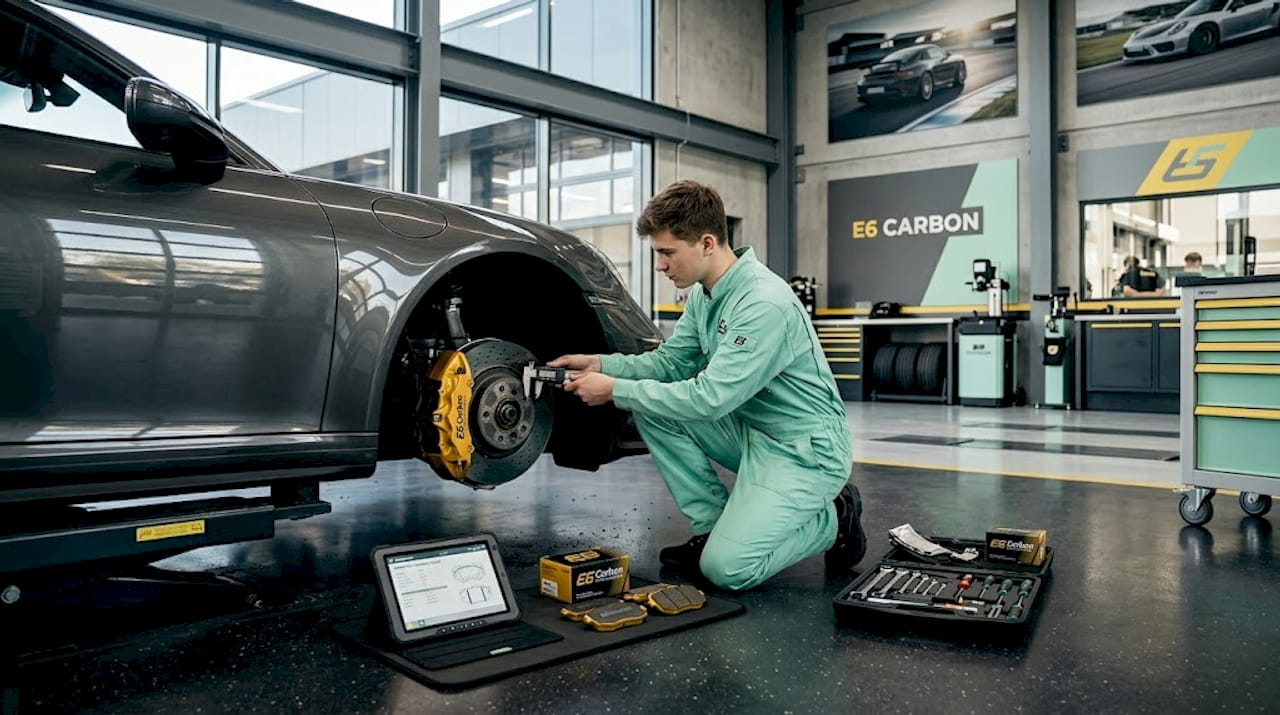
Brake pads under 3mm require immediate replacement. Rotors need visual inspection for scoring, heat cracks, and warping. A rotor that looks fine cold can reveal problems under the first hard stop of the day.
Brake fluid is a consumable, not a service interval item. Standard fluid has a dry boiling point around 446°F. Racing-grade DOT 4 fluid raises that threshold to approximately 594°F, which is the margin that separates a confident brake pedal from a spongy one mid-corner. Flush before every event, not once per season.
Steel braided lines replace the factory rubber units to eliminate expansion under pressure. Inspect for chafing, cracking at fittings, and secure routing away from heat sources.
3. Tires and wheels: your only contact with the track surface
Tire compound selection for track days is one of the most consequential decisions in your performance parts guide. Street tires overheat and blister under sustained circuit loads. A dedicated track compound or at minimum a high-performance road tire rated for sustained heat will hold its grip window far longer.
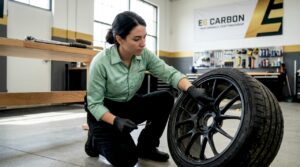
Check tread depth before every session. Beyond depth, look at wear patterns. Uneven wear across the contact patch signals alignment or pressure issues that no tire compound can fix. Inspect sidewalls for bubbling, cuts, and heat cracking. A compromised sidewall that holds air on the street can fail catastrophically at track speeds.
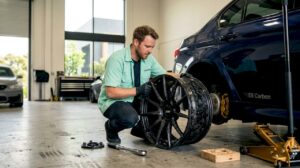
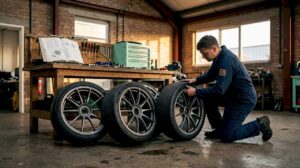
Wheel condition is part of your track-ready wheels evaluation. Inspect for cracks at the spoke roots, corrosion around the barrel, and impact damage on the lip. These are failure initiation points under load. Wheel bearings should be checked for play by grabbing the tire at 9 and 3 o’clock and testing for movement. Any detectable play means replacement before the event.
Lug nut torque is a tech inspection item and a safety requirement. Torque to spec cold, then re-check after the car reaches operating temperature during your first session.
4. Suspension and chassis: the foundation of consistent lap times
Suspension work is where most track car builds either unlock performance or introduce unpredictable handling. Start with alignment. Track alignment specs differ significantly from street settings. More negative camber increases contact patch under cornering load, but too much kills straight-line braking. Document your baseline alignment numbers and record how the car behaves at each setting change.
Bushings are the most neglected suspension component on street-to-track conversions. Soft factory rubber bushings flex under lateral load, introducing inconsistency that no amount of shock tuning can correct. Polyurethane or spherical replacements tighten the chassis response immediately. Inspect them for tearing and deformation before each event.
Dampers should be checked for oil leaks and consistent rebound across corners. A damper that is bleeding down will produce corner-to-corner handling imbalance that feels like a tire or alignment issue. Sway bar end links and mounting points should be torqued and inspected for cracks.
5. Comparison of key track performance parts options
Choosing between part types requires understanding the real trade-offs, not just spec sheet numbers.
| Component | Option | Thermal rating | Durability | Tech compliance | Cost range |
|---|---|---|---|---|---|
| Brake pads | Street-performance compound | Low (fade above 400°F) | High on street | Generally compliant | $ |
| Brake pads | Track compound (Ferodo, Hawk) | High (700°F+) | Medium on track | Generally compliant | $$ |
| Brake fluid | Standard DOT 3/4 | ~446°F boiling point | Annual service | Compliant | $ |
| Brake fluid | Racing DOT 4 / DOT 5.1 | ~594°F boiling point | Pre-event service | Compliant | $$ |
| Wheels | Cast aluminum | Moderate heat tolerance | Good for street | Compliant if sized correctly | $$ |
| Wheels | Forged aluminum | High heat tolerance | Excellent for track | Compliant | $$$ |
| Wheels | Carbon fiber composite | Highest heat dissipation | Excellent | Varies by org | $$$$ |
| Roll protection | Bolt-in roll bar | Moderate protection | Event-specific lifespan | HPDE compliant with proper padding | $$ |
| Roll protection | Full weld-in cage | Maximum protection | Long-term | Required for competitive classes | $$$$ |
Forged versus cast wheels is one of the most debated choices in any track car build list. Forged wheels are denser and more impact-resistant than cast alternatives. Under repeated heat cycling, the material structure holds up without the microcracking risks that affect lower-grade casting alloys.
Pro Tip: Carbon fiber wheels are the lightest option but require organization-specific approval before your event. Confirm regulatory acceptance before purchasing.
Proper roll bar installation with specified tubing diameter and padding is mandatory for advanced HPDE groups and any convertible running at events. The installation quality matters as much as the product spec.
6. Cooling, drivetrain fluids, and electrical systems
Cooling failures cause more DNFs than almost any other system on a track car. Your checklist for track setup should include a visual inspection of all coolant hoses for softness, cracking, and swelling at the clamps. Check the radiator for core damage and confirm the overflow tank is at the correct level cold.
Engine oil condition and level are non-negotiable pre-event checks. Track driving cycles oil temperature far beyond street use, which accelerates oxidation and viscosity breakdown. Many experienced track drivers move to a slightly higher viscosity oil or add an oil cooler before committing to full track sessions. Gearbox and differential fluid are often overlooked entirely. These oils degrade with heat and contamination just like engine oil. Service intervals on track are significantly shorter than factory recommendations.
Weak supporting systems like fuel delivery, timing components, and electrical connections cause cascading failures that are almost always preventable. Check battery terminals for corrosion and confirm the battery is secured in its tray without movement. Loose batteries fail tech inspection and create fire risk. Inspect wiring runs for chafing against chassis components and confirm fire suppression equipment is charged and accessible.
7. Practical steps for maintaining your track car maintenance checklist
Maintaining your track car is a process that runs before, during, and after each event.
- Build a pre-event inspection sheet. Document every measurement you take: pad thickness per corner, fluid levels, torque values. This sheet becomes your baseline for post-event comparison.
- Pack a paddock kit with predictable spares. Anticipating consumable failures with spare brake pads, wheel studs, lug nuts, fresh brake fluid, and basic hand tools eliminates the need to withdraw from an event over a 30-dollar part.
- Confirm tech inspection compliance before you arrive. Review the organizing club’s rules for your car class and build. Many parts fail tech due to installation issues rather than design flaws. Tighten, secure, and document.
- Log performance data during the event. Note any changes in brake pedal feel, steering behavior, or unusual sounds. These are early warning signals that a post-event inspection should investigate specifically.
- Run a structured post-event inspection. After every track session, inspect brakes and log pad and rotor condition, check fluids for contamination, and re-torque wheel bolts. This is where you catch wear before it becomes a safety issue.
- Prioritize upgrades by safety system first, performance second. A stronger brake setup delivers more lap time and more safety value than a power upgrade on a car with marginal brakes.
- Budget for consumables separately from build upgrades. Brake fluid, pads, and tires are operating costs. Treating them as upgrade expenses distorts your build budget and leads to under-prepared cars.
My honest take on what most builders get wrong
I’ve seen more first-time track builds go sideways from neglected thermals than from any single wrong part choice. Everybody wants to talk about horsepower and aero. Almost nobody talks about whether their brake fluid is actually rated for the heat their caliper sees on lap five.
The post-track documentation habit is where most casual track day drivers leave real value on the table. You did six sessions, you came home tired, and you skipped writing down pad thickness. Now you show up three months later without a baseline. That habit, logging everything after every event, turns your checklist from a one-time safety exercise into a long-term performance feedback system. It genuinely changes how you build a car over time.
Tech inspection shapes your parts choices whether you want it to or not. I’ve watched expensive aftermarket seats fail inspection because the mounting hardware wasn’t correct for the chassis. The part was excellent. The installation failed. Learning the compliance requirements for your specific events before you spend money is not optional. It’s the first research step.
If I had to give one piece of advice to anyone building their first serious track car: buy less and inspect more. The data you collect from a properly prepped stock or lightly modified car teaches you more about what to upgrade than any performance parts guide.
— Kunal
Why E6 Carbon builds parts that pass inspection and survive the heat

E6 Carbon’s forged wheels are built specifically for the demands that expose the limits of lesser components. The forging process produces a denser, more uniform grain structure that handles repeated heat cycling without the microcracking that affects cast alternatives. Every wheel E6 Carbon produces for track application is designed with thermal dissipation and structural integrity as the primary engineering targets, not just visual weight reduction.
For any track enthusiast working through a serious build, the forged wheel safety inspection guide from E6 Carbon walks through exactly how to evaluate wheel condition before and after track use, including what failure signs actually look like in real inspection conditions. If you’re considering multi-piece wheel construction for your next build, the AR03 Multipiece Wheels represent what precision-engineered track hardware looks like. E6 Carbon’s team understands what track inspectors look for and what sustained circuit driving actually demands from a wheel.
FAQ
What brake fluid should I use for track days?
Use a racing-grade DOT 4 or DOT 5.1 fluid with a dry boiling point of at least 500°F. Standard DOT 3 fluid boils around 446°F, which creates a dangerously soft pedal under sustained track braking.
How often should I replace brake pads for track use?
Measure pad thickness before every event and replace when any corner drops below 3mm or 50% of original thickness. Track driving wears pads two to three times faster than street driving, so event-by-event measurement is more reliable than mileage intervals.
What does a tech inspector actually check?
Inspectors typically verify lug nut presence and torque, battery security, a firm brake pedal, seat and harness mounting, and roll bar padding compliance. Parts that fail tech usually do so due to installation problems, not design issues.
Are forged wheels worth it for track use?
Yes. Forged wheels handle heat cycling and impact loads significantly better than cast alternatives. The denser grain structure resists cracking under the repeated thermal and mechanical stress that circuit driving generates.
What is the most overlooked item in a track car maintenance checklist?
Gearbox and differential fluid service is consistently skipped by track day drivers. These fluids degrade from heat as rapidly as engine oil under track conditions, but most drivers only service them on street-based intervals.