TL;DR:
- Proper beadlock wheel installation is essential for safety and performance during extreme off-road conditions. It requires meticulous preparation, correct tools, staged torquing, and ongoing maintenance, including regular re-torquing and inspection. Without these precise procedures and commitment, even the best beadlock systems can fail dangerously.
Getting the beadlock wheel installation process right is not optional. It’s the difference between a tire that stays put at 5 psi on a rock crawl and one that rolls off the bead mid-trail at the worst possible moment. Beadlocks use a mechanical ring to clamp the tire bead against the wheel, allowing you to run extreme low pressures without losing the tire. That capability comes with a real cost: complexity, precision, and an ongoing maintenance commitment that standard wheels never demand. This guide walks you through every stage, from tools to torque verification.
Table of Contents
- Understanding beadlock wheels and the installation process
- Preparing your wheel and tire for beadlock installation
- Step-by-step beadlock ring assembly and bolt tightening
- Torque verification, break-in, and ongoing maintenance for safety
- Advanced tips and common mistakes from expert installers
- Why beadlock wheel installation demands respect and precision
- Explore precision forged wheels and installation support from E6 Carbon
- Frequently asked questions
Key Takeaways
| Point | Details |
|---|---|
| Essential toolset | Proper installation requires a calibrated torque wrench, valve core remover, anti-seize, lubricant, and thorough cleaning supplies. |
| Preparation matters | Fully deflate tires, clean bead and ring surfaces, and apply lubricant to ensure good ring seating and safety. |
| Torque sequence | Follow a staged, star-pattern bolt tightening sequence to evenly clamp the beadlock ring without warping. |
| Maintenance commitment | Beadlock bolts need re-torquing after initial break-in and regular monthly checks to maintain clamp integrity. |
| Expert technique | Hand-thread bolts and use cleaning plus a wait period post-inflation to prevent common installation failures. |
Understanding beadlock wheels and the installation process
Before you touch a wrench, you need to understand what you’re working with. Beadlock wheels use mechanical clamping to secure tires, allowing very low pressures for maximum traction, rather than relying on air pressure alone to keep the bead seated. That distinction matters enormously for installation. A standard wheel is forgiving. A beadlock is not.
There are two main types: bolt-on and weld-on. Bolt-on beadlocks use a ring bolted to the outer wheel face that clamps the outer tire bead. These are the type serious DIY installers actually work with. Weld-on kits require professional TIG welding to bond the ring directly to the wheel. Skip that route unless you have certified welding expertise and proper equipment. For this guide, we are focused on bolt-on beadlocks, which represent the vast majority of beadlock wheel types in the performance and racing market.
Here is what you need on your workbench before starting:
- Calibrated torque wrench (capable of reading in Newton-meters, typically up to 40 Nm)
- Valve core remover
- Anti-seize compound for bolt threads
- Bead lubricant or tire lube
- Brake cleaner and wire brush for surface prep
- Rubber mallet
- Thread-locking compound (Loctite medium-strength, not permanent)
- Soapy water solution for leak testing
Torque accuracy is not negotiable here. Undertorqued bolts allow ring movement under load. Overtorqued bolts strip threads or deform the ring. Both outcomes are dangerous.
| Tool | Purpose | Notes |
|---|---|---|
| Torque wrench | Staged bolt tightening | Calibrate before use |
| Valve core remover | Full tire deflation | Required for safe disassembly |
| Anti-seize | Thread protection | Apply to every bolt |
| Bead lubricant | Tire bead seating | Use evenly around full circumference |
| Brake cleaner | Surface degreasing | Essential before assembly |
With a solid grasp of beadlock wheel types and tools, we can now focus on meticulous preparation steps critical to successful installation.
Preparing your wheel and tire for beadlock installation
This stage gets skipped or rushed more than any other part of the DIY beadlock wheels workflow. That’s where most failures actually start.
Follow this sequence precisely:
- Remove the wheel from the vehicle and place it face-up on a flat, stable surface. A wheel stand is ideal. A rubber mat on concrete works. Never work on a sloped or soft surface.
- Remove the valve core completely using your valve core remover. Pressing the valve stem is not sufficient. The tire must be fully deflated. Manufacturer instructions emphasize full deflation by removing the valve core and cleaning all surfaces before assembly for long-term reliability.
- Break the tire bead from the wheel seat. A bead breaker tool is best. Do not use a pry bar against the ring mating surface; you’ll score it and ruin the seal.
- Clean the outer bead seat on the wheel thoroughly with brake cleaner and a wire brush. Remove all old lube, dirt, rubber residue, and corrosion. Repeat for the inner mating surface of the beadlock ring. You need bare, clean metal on both contact faces.
- Inspect the ring for warping, cracks, or damaged threads before proceeding. A compromised ring is not worth the risk. Replace it.
- Apply bead lubricant evenly around the full circumference of the tire bead. This helps seating without introducing contamination at the clamping interface.
Following wheel and tire preparation best practices is not about being cautious for its own sake. An unclean bead seat prevents full ring contact, which creates micro-movement under load, which loosens bolts faster than you’d expect.
| Preparation step | Why it matters |
|---|---|
| Full deflation via valve core removal | Enables safe bead manipulation |
| Brake cleaner on bead seat and ring face | Ensures metal-to-metal contact for clamping |
| Bead lube on tire bead | Aids seating without contaminating ring interface |
| Ring inspection before assembly | Catches damage before it becomes a trail emergency |
Pro Tip: Wipe the ring bolts clean and apply a light coat of anti-seize to each thread before assembly. It prevents galling and makes future re-torque checks far easier, especially after exposure to mud and water.
Having prepared your components properly, you are ready to begin the step-by-step assembly and bolt torquing procedure.
Step-by-step beadlock ring assembly and bolt tightening
This is the stage where custom beadlock wheel assembly either goes right or catastrophically wrong. Do not rush.
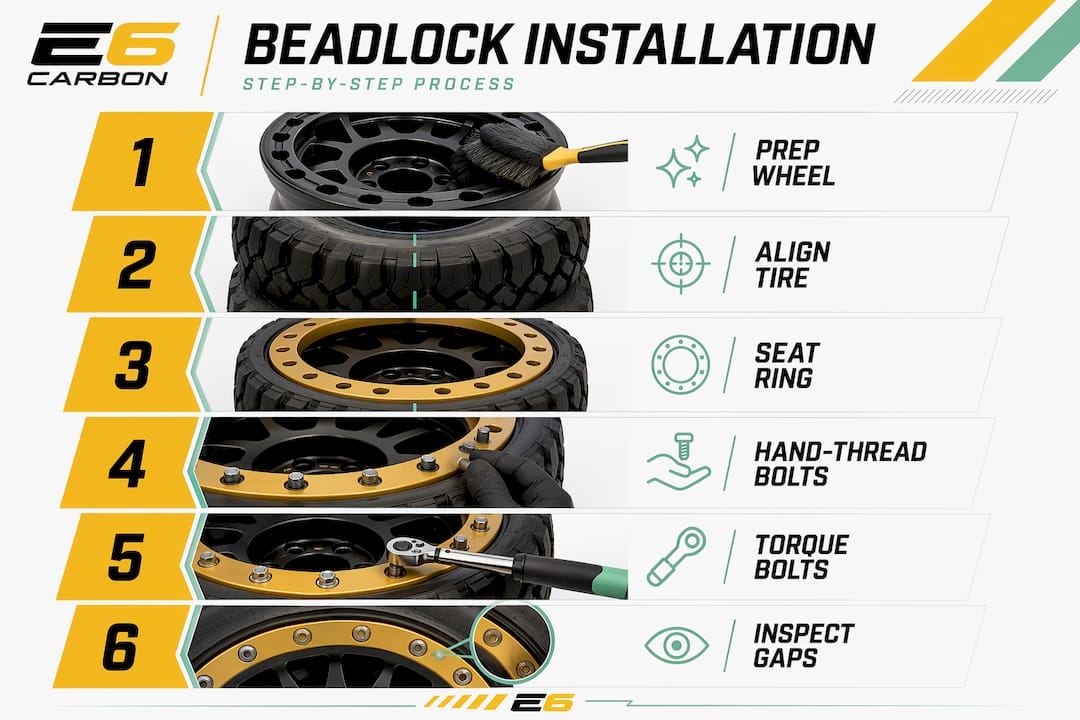
- Seat the inner bead of the tire onto the inner wheel lip completely before touching the outer bead.
- Position the outer tire bead over the outer wheel lip, working around the circumference with your hands. Use a rubber mallet gently if needed. Never use metal tools that could damage the bead.
- Place the beadlock ring over the outer tire bead, aligning the bolt holes with the wheel’s threaded holes. Center the ring visually before starting any bolts.
- Hand-thread every single bolt before tightening any of them. This is critical. Pre-threading all bolts ensures the ring seats evenly. Tightening one bolt before others are started pulls the ring off-plane and causes uneven clamping.
- Begin tightening in a star pattern. Think of it like lug nuts on a wheel: opposite sides, not sequential. On a 16-bolt ring, jump across to the opposite bolt each time, working your way around.
- Use a three-stage torque sequence:
- Pass 1: 10 Nm on all bolts in star pattern
- Pass 2: 20 Nm on all bolts in star pattern
- Pass 3: 32 Nm on all bolts in star pattern (or follow your wheel manufacturer’s specification)
“Assemble the tire and ring on a deflated wheel, hand-thread all bolts before tightening in a star pattern with staged torque passes (10 Nm, 20 Nm, 32 Nm), then inflate and leak test with soapy water.” — Peach Overlanding, Dirty Life beadlock installation
- Inflate to approximately 1.8 to 2 bar (26 to 29 psi) and let the tire settle for at least 30 minutes.
- Perform a leak test by applying soapy water around the entire bead and ring interface. Any bubbling means you have a leak. Deflate, identify the issue, and correct it before driving.
| Tightening method | Ring seating result |
|---|---|
| Sequential (clockwise) | Uneven clamping, ring lifts on one side |
| Star pattern, single pass | Improved but not fully even |
| Star pattern, three staged passes | Even clamping force distribution |
Pro Tip: After the initial inflation, physically walk around the tire and inspect the ring gap against the wheel face. It should be visually consistent all the way around. Any variation of more than 1 mm in gap width means the ring did not seat evenly.
Torque verification, break-in, and ongoing maintenance for safety
You are not done after initial assembly. Not even close. This is where most enthusiasts underestimate what the installing beadlock wheels workflow actually requires long-term.
Beadlock bolts typically require re-torquing after about 30 minutes of settling and on a monthly basis thereafter, due to the mechanical exposure of the bolts to vibration, thermal cycling, and load stress. After your first 25 to 50 miles of driving, pull the wheels and run through all bolts again at full specified torque. Components settle. They will be slightly loose.
Your ongoing maintenance routine should include:
- Monthly torque checks on all beadlock bolts, ideally before any off-road outing
- Visual inspection for visible gaps between ring and wheel, rust, or damaged bolt heads
- Immediate replacement of any stripped, corroded, or cracked hardware
- Re-cleaning and re-lubrication of threads during any scheduled re-torque
Monthly inspection and re-torquing of 96 to 128 beadlock bolts per four-wheel set is standard practice for serious users, with checks before every trail run. That math is real: a full four-wheel check takes time and discipline.
Skipping even one re-torque cycle after installation is the most common path to a loose ring on the trail. The first miles are when settling is greatest.
Pro Tip: Keep a torque log. Write down the date, mileage, and any bolts that came up short on each check. Patterns in bolt loosening can indicate a ring seating issue, thread damage, or contamination that needs to be addressed before it becomes a failure.
Never over-torque in an attempt to compensate for loosening. Thread stripping or ring deformation from excess torque is not recoverable without replacing hardware, and a deformed ring will never seat correctly again. Check the beadlock wheel maintenance standards for your specific wheel model and follow them exactly.
Advanced tips and common mistakes from expert installers
Experience with beadlock rim installation reveals patterns. The same mistakes show up repeatedly, and they are all avoidable.
Uneven ring seating from skipped cleaning, missed lubrication, or incorrect bolt sequencing is the most common failure mode in real-world beadlock use. Here is what separates a clean install from a problem install:
- Never skip the cleaning step, even on a brand-new wheel. Manufacturing residue, packing oil, and debris are present on new rings and can compromise metal-to-metal contact.
- Apply anti-seize to every bolt, every time. Not just the first installation. Every reassembly.
- Never use an impact wrench for final torquing. An impact gun is acceptable for running bolts down quickly, but final passes must always be done with a calibrated torque wrench. Impact tools give no feel for torque value.
- Plan for related tasks before you start. Balancing after beadlock installation, leak testing, break-in re-torquing, and valve stem inspection all add time. Budget for them.
- If a bolt feels tight before it reaches torque spec, stop. Investigate cross-threading immediately. Forcing it strips the thread and potentially the ring.
Pro Tip: Do a dry run without the tire first. Align the ring to the wheel, hand-start all bolts, and confirm every hole lines up before adding a tire to the equation. It takes five minutes and eliminates alignment surprises.
For anyone following an expert beadlock installation process, these additional professional maintenance tips can mean the difference between a bulletproof setup and one that fails at the worst moment.
Why beadlock wheel installation demands respect and precision
Here is the honest take from years of working with performance wheel systems. The beadlock installation itself, when done correctly, is not the hard part. The hard part is everything after.
Most enthusiasts treat installation as the finish line. It’s actually the starting line. Beadlocks shift wheel ownership from “set and forget” to demanding regular integrity checks and torquing due to mechanical exposure, making them tools for the committed enthusiast. That is not a warning designed to discourage anyone. It is the real operating model.
The mechanical advantage of a beadlock, which allows traction at pressures that would pull a standard bead right off the rim, is real and significant. But that same external bolt ring is exposed to everything the trail throws at it. Rocks, mud, water, thermal swings. Those bolts do not care about your maintenance schedule. They respond to physics.
What we have seen consistently is that skipped re-torque cycles compound. One missed check becomes two, and by the time the ring has moved enough to be visible, the damage is done. For racing applications, a loose ring at speed is not a trail annoyance. It is a safety event. Check the beadlock ownership insights before committing to a full set.
The performance case for beadlocks is overwhelming. But they belong on vehicles and in hands where the maintenance commitment is taken as seriously as the performance gain. If you are willing to treat your beadlock wheels the way a race team treats its equipment, the rewards are real. If not, a high-quality standard wheel or bead grip system will serve you better.
Explore precision forged wheels and installation support from E6 Carbon
If this guide has shown you anything, it’s that beadlock wheel setup demands quality components as much as it demands proper technique. Weak hardware and poor manufacturing tolerances make even a perfect installation unreliable.

E6 Carbon’s forged multipiece wheels are engineered for the kind of performance environments where these details matter. Their forged wheel installation guide mirrors the precision standards this process requires, covering torque procedures, assembly sequences, and long-term care. For anyone serious about keeping their wheel and tire setup performing safely, the forged wheel safety inspection framework provides a maintenance structure that translates directly to beadlock care. Explore the full range of performance wheel solutions at E6 Carbon and build your setup on components that meet the same standard you are holding your installation to.
Frequently asked questions
What tools do I need to install beadlock wheels correctly?
A calibrated torque wrench, valve core remover, anti-seize compound, tire bead lubricant, brake cleaner, a wire brush, and a compressor or inflator are essential. Beadlock installation demands specialized tools, particularly a calibrated torque wrench, to achieve safe and consistent clamping force.
How often should I re-torque the beadlock bolts after installation?
Re-torque after your first 25 to 50 miles, then perform monthly torque checks and add verification before every major off-road outing to account for component settling and vibration exposure.
Can I install weld-on beadlocks myself?
No. Weld-on kits require certified welding expertise and are not suitable for DIY installation; improper welding risks wheel warping and structural failure that makes the wheel unsafe at any pressure.
Why is hand-threading bolts important when installing beadlock rings?
Hand-threading ensures the ring seats evenly and prevents cross-threading, which is critical because skipping hand-starting bolts is the leading cause of uneven ring seating and premature bolt failure in real-world installations.
Are beadlock wheels street legal?
Most aftermarket beadlocks are not DOT-approved for highway use because exposed bolts can loosen at sustained high speeds, posing a hazard that standard air-retention wheels do not present. They are designed for off-road and racing use.