
TL;DR:
- Carbon fiber splitters are crucial for performance because their rigidity maintains aerodynamically designed shape at high speeds, generating consistent downforce. Properly manufactured dry carbon parts are significantly lighter, stiffer, and more durable than wet-layup alternatives, resulting in better handling and performance. Regular inspection and prompt repairs are essential to preserve their structural integrity and aerodynamic benefits.
Most people looking at a carbon fiber splitter see a styling upgrade. That’s the wrong frame entirely. The real reason why carbon fiber splitters matter for performance builds comes down to a single engineering principle: a splitter only generates downforce if it holds its shape at speed. Once it flexes, the geometry changes, the airflow separates, and you lose exactly the downforce you paid for. Carbon fiber front splitters, the industry standard term for this class of aero component, solve that problem at a weight penalty no other material can match. This article breaks down the aerodynamics, the material science, and the real-world numbers so you can make an informed decision.
Table of Contents
- Key Takeaways
- Why carbon fiber splitters change the aerodynamic equation
- Dry carbon vs wet carbon: the manufacturing difference that matters
- Quantifiable gains: what the numbers actually show
- Durability, maintenance, and what quality actually looks like
- Choosing and installing a carbon fiber splitter for your build
- My honest take after years of watching builds go wrong
- Upgrade your aero with parts built to perform
- FAQ
Key Takeaways
| Point | Details |
|---|---|
| Stiffness drives performance | Carbon fiber’s rigidity keeps splitter geometry intact at speed, preserving consistent downforce output. |
| Dry carbon outperforms wet carbon | Autoclave-cured pre-preg carbon is 20 to 40% lighter and meaningfully stiffer than hand lay-up alternatives. |
| Real downforce numbers are significant | A properly designed carbon splitter can add over 500 lb of front downforce compared to stock at 120 mph. |
| Repair speed matters | Cracks in carbon fiber splitters need prompt attention because delays make structural restoration harder and more costly. |
| Manufacturing quality beats visual appeal | Fiber-to-resin ratio and void content determine performance far more than the weave pattern you can see. |
Why carbon fiber splitters change the aerodynamic equation
Before you can appreciate what carbon fiber brings to the table, you need to understand what a front splitter actually does. A splitter sits at the leading edge of the front bumper, extending horizontally outward. Its job is to split the incoming airflow into two streams: one that travels over the car and one that gets pushed beneath it.
The stream moving beneath the car is where the magic happens. By accelerating air under the body while managing the pressure above it, a splitter creates a low-pressure zone underneath the front of the car. That pressure differential generates downforce, pushing the front tires harder into the pavement. More front-end grip means faster cornering speeds, better braking stability, and more predictable handling at the limit.
Here is where material choice becomes critical. Consider what happens to a flexible splitter at 120 mph:
- Aerodynamic load pushes up on the underside of the splitter
- A flexible splitter deflects upward, reducing the effective angle and surface area working against the airflow
- The low-pressure zone weakens and downforce drops, often unpredictably
- The driver experiences less front-end grip precisely when they need it most, at high speed
Carbon fiber resists that deflection. Dry carbon splitters flex less at highway-speed aero loads than wet carbon or plastic alternatives, preserving the geometry the aerodynamicist designed. That geometry retention is not a luxury feature. It is the fundamental requirement for a splitter to do its job consistently.
The secondary benefit is weight. A front splitter sits ahead of the front axle, which means its mass directly affects front axle load. A heavier splitter adds unsprung and sprung mass in the worst possible location for handling. Carbon fiber keeps that penalty minimal while delivering maximum structural contribution.
Dry carbon vs wet carbon: the manufacturing difference that matters
Not all carbon fiber is created equal, and the distinction matters more for splitters than for almost any other aero component. The two main manufacturing processes are dry carbon (pre-preg) and wet carbon (hand lay-up), and they produce parts with meaningfully different performance characteristics.
| Property | Dry carbon (pre-preg) | Wet carbon (hand lay-up) |
|---|---|---|
| Fiber-to-resin ratio | High (controlled by pre-impregnation) | Variable (dependent on builder skill) |
| Curing method | Autoclave at elevated pressure and temperature | Room temperature or oven cure |
| Weight vs wet carbon equivalent | 20 to 40% lighter | Baseline |
| Stiffness per unit weight | Superior | Moderate |
| Surface finish | Consistent, high quality | Variable |
| Cost | Higher | Lower |
Dry carbon uses sheets of carbon fiber pre-impregnated with a precise amount of resin. Those sheets get laid up in a mold and cured under pressure in an autoclave. The elevated pressure removes air pockets and compacts the laminate, producing a part with minimal void content and a very high fiber-to-resin ratio. The result is a part that is both lighter and stiffer than anything you can achieve through hand lay-up.
Wet carbon, by contrast, involves applying dry carbon cloth and then wetting it with liquid resin by hand. The fiber-to-resin ratio depends entirely on the skill and consistency of the laminator. Poor lamination quality or excess resin in wet carbon manufacture causes higher flex and aero loss despite what may look like a perfect weave on the surface.
Material science confirms this. Studies on carbon fiber composites show that at optimized fiber content, flexural strength increases by up to 25% and impact strength by up to 41% compared to lower fiber-content alternatives. Those gains only materialize when fiber content is controlled precisely, which is exactly what autoclave curing enables.
Pro Tip: When evaluating any carbon fiber splitter, ask the manufacturer specifically about their curing process and void content testing. A beautiful weave pattern tells you nothing about the laminate quality underneath. Structural performance lives in the details you cannot see.
Quantifiable gains: what the numbers actually show
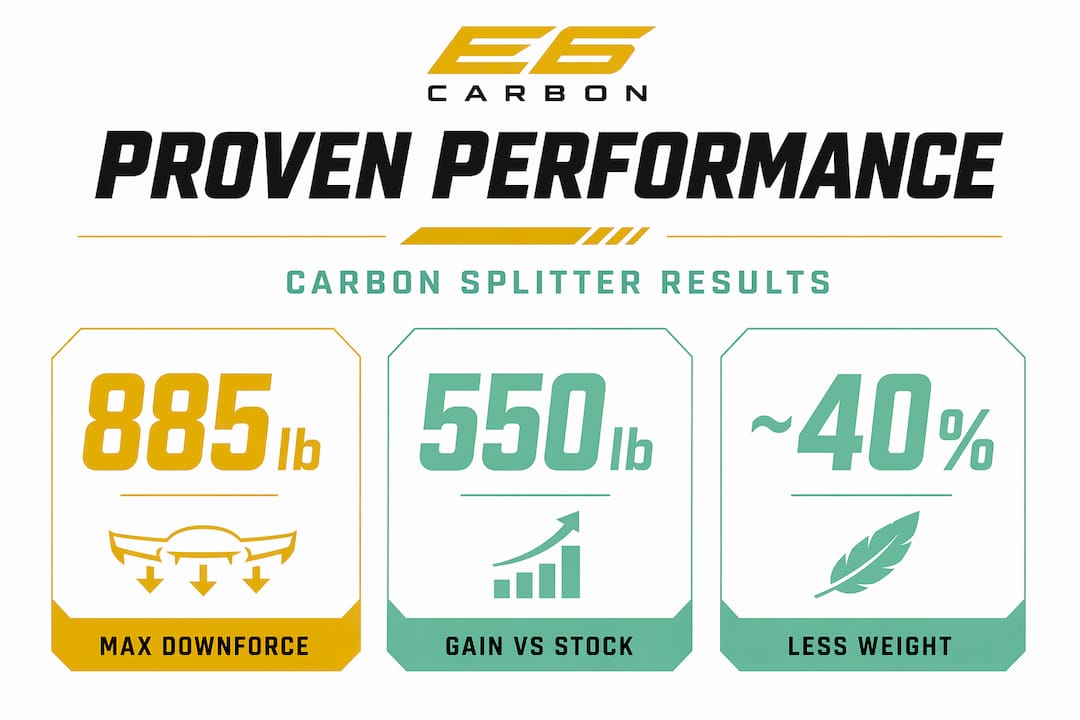
Theory is useful. Data is better. The most concrete evidence for carbon fiber splitter performance comes from Dundon Motorsports, which tested a carbon front splitter on a 991.2 Porsche GT3RS in a ‘Valkyrie’ aero configuration.
At 120 mph with a ride height of 90 mm and a wing angle of attack of 5 degrees, the carbon splitter generated 885 lb of front downforce. Stock configuration produces approximately 335 lb at the same speed. That is 550 lb of additional front downforce from a single aero component.
To put that in real terms: 550 lb of additional front load at 120 mph is the difference between a car that pushes wide in fast corners and one that tracks precisely on your chosen line. At track speeds, that figure also affects braking distances, mid-corner stability, and the point at which the front end starts to understeer.
| Configuration | Front downforce at 120 mph | Delta vs stock |
|---|---|---|
| Stock GT3RS | ~335 lb | Baseline |
| Carbon splitter (Valkyrie setup) | 885 lb | +550 lb |
The weight story is equally compelling. Carbon fiber adds less weight and provides more downforce than plastic or fiberglass, which is critical for components attached near the front axle where mass has an outsized effect on handling dynamics. A front-heavy car resists direction changes. A car with a lightweight carbon splitter gets the aerodynamic benefit without compounding the handling penalty of added nose weight.
Durability, maintenance, and what quality actually looks like
Carbon fiber splitters are durable, but they are not indestructible. Understanding how to assess quality and maintain a splitter protects your investment and keeps the aero performance working as intended.
Signs of a well-made carbon splitter worth buying:
- Consistent laminate consolidation with no visible resin pooling or dry spots
- Clear coat finish that is even and free of orange peel, which indicates proper mold quality
- Mounting point reinforcement at all attachment locations
- Even weave pattern alignment, though this is cosmetic rather than structural
The most important maintenance principle is speed of response to damage. Carbon fiber splitters require prompt repair the moment cracks form. Once a crack propagates through the laminate, it compromises both the structural integrity and the surface finish. Delaying repair makes restoration harder and significantly more expensive, and a cracked splitter is no longer holding its designed geometry under load.
Compared to plastic alternatives, carbon fiber holds a clear advantage in longevity and sustained performance. Plastic splitters tend to flex and crack more readily under aerodynamic load and road impacts. Plastic also creeps over time under sustained load, meaning the geometry drifts even without visible damage. Carbon fiber does not creep. The stiffness you have on day one is the stiffness you have after three track seasons.
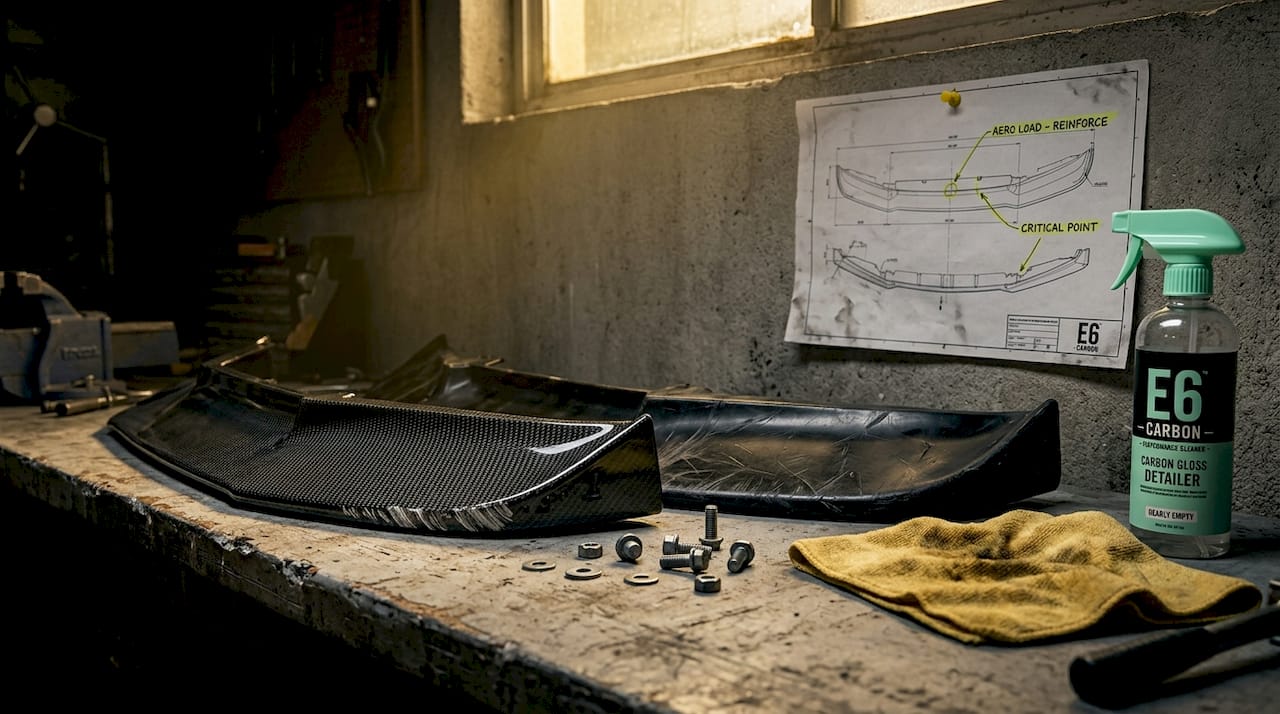
Pro Tip: After any incident where the splitter contacts the ground or a curb, inspect the underside for delamination by pressing gently across the surface. A hollow sound or soft spot under pressure indicates an internal void that needs repair before the next track session.
You can read more about how aftermarket carbon parts compare across different applications and manufacturing standards to sharpen your buying criteria.
Choosing and installing a carbon fiber splitter for your build
Getting the right splitter starts with matching the component to your vehicle and your performance goals. A daily-driven sports car on public roads has different requirements than a dedicated track car. Here is how to work through the decision:
- Define your priority. Street use favors a splitter with a modest extension and protective skid plates on the underside. Track use justifies maximum extension and full dry carbon construction for geometry retention at race speeds.
- Verify chassis mounting points. Quality carbon splitters use four-bolt mounts to frame rails with validated fitment. Generic universal splitters that rely on bumper cover attachment points alone will flex under load, defeating the purpose.
- Check fitment validation for your specific model. A splitter designed for a BMW M3 G80 will not transfer its aero benefits to a car it was not engineered for. The gap between the splitter and the road surface, and the angle relative to the body, must be calibrated for the specific vehicle.
- Assess manufacturing process, not just appearance. Ask whether the part is autoclave cured. Request information on layer count and fiber orientation. A reputable manufacturer will answer these questions directly.
- Plan integration with other aero components. A splitter works best as part of a matched aero package. Pairing it with carbon fiber side skirts and a rear diffuser creates a coherent pressure management system rather than isolated individual gains.
Budget matters, but the cost of a poorly made splitter is higher than the price difference. A flex-prone splitter gives you the weight of carbon without the aero performance, which is the worst outcome: you spent more money and got less result than staying with a quality plastic alternative.
My honest take after years of watching builds go wrong
I’ve seen this mistake more times than I can count: an enthusiast spends serious money on a car, then sources the cheapest carbon fiber splitter they can find because “it’s just the splitter.” The weave looks identical at a glance. The weight saving is real. And then they wonder why the car still pushes in fast corners.
In my experience, the stiffness gap between low-grade wet carbon and properly cured dry carbon is the single most underestimated factor in aero builds. I’ve watched cars with genuinely impressive power figures get outrun by lighter, less powerful cars that simply kept their front tires loaded through corners because the aero was doing its actual job.
The uncomfortable reality is that most carbon fiber products marketed to enthusiasts are wet lay-up parts with a great finish. That finish will fool your eyes every time. What it won’t fool is physics. At 100 mph, the aerodynamic load on a front splitter reaches the point where manufacturing quality stops being theoretical and starts showing up in lap times, or more seriously, in handling that surprises you when you’re committed to a corner.
My advice: budget for dry carbon if you are running the car on track at any serious pace. If budget is a genuine constraint, a quality fiberglass splitter with a proven mounting system will outperform cheap carbon every time. The goal is downforce that is actually there when you need it.
The performance benefits of carbon fiber extend well beyond splitters, and understanding the material across multiple components will sharpen your instincts for quality.
— Kunal
Upgrade your aero with parts built to perform

At E6 Carbon, every carbon fiber aero component goes through strict quality controls that start at the fiber-to-resin ratio and end with fitment validation on the specific vehicle platforms we support. Whether you are building a BMW, Ferrari, McLaren, or Lamborghini, the splitters, body kits, and aero parts in our catalog are engineered to generate the downforce the design promises, not just look the part. If you are serious about what a splitter can do for your build, explore our performance carbon parts lineup and pair them with our forged wheel options. For full system builds, our wheel selection guide helps you match wheel specs to your aero setup for a complete performance upgrade.
FAQ
Why do carbon fiber splitters perform better than plastic ones?
Carbon fiber splitters maintain their geometry under aerodynamic load at high speed, while plastic alternatives flex and lose the downforce they were designed to generate. The stiffness-to-weight advantage of carbon fiber is the core reason for the performance gap.
What is the difference between dry carbon and wet carbon splitters?
Dry carbon uses pre-impregnated fiber cured in an autoclave, producing parts that are 20 to 40% lighter and stiffer than wet carbon hand lay-up alternatives. Wet carbon is less expensive but has variable fiber-to-resin ratios that reduce aero effectiveness.
How much downforce can a carbon fiber splitter add?
Testing on a 991.2 GT3RS showed a carbon splitter generating 885 lb of front downforce at 120 mph, compared to approximately 335 lb in stock configuration. Results vary by vehicle and splitter design.
How do I know if my carbon fiber splitter is high quality?
Look for consistent laminate consolidation, no resin pooling, reinforced mounting points, and ask the manufacturer whether the part is autoclave cured. Visual weave quality alone does not indicate structural performance.
How often should a carbon fiber splitter be inspected?
Inspect the underside after any ground contact or curb strike, and do a full surface check before every track event. Prompt repair of cracks prevents structural compromise and keeps restoration costs manageable.