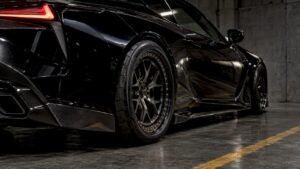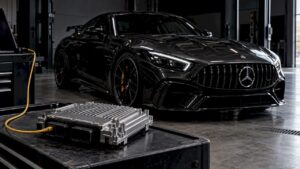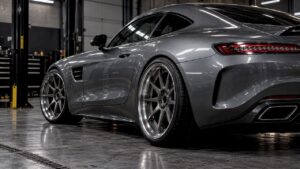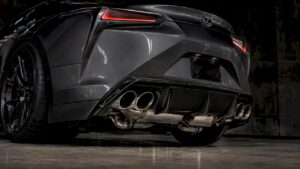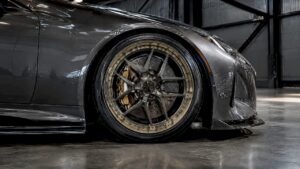
Autoclave-cured 2×2 twill dry carbon is the correct call for every Class-A surface on the C192 AMG GT63, including front lips, side skirts, and diffuser structure, because it holds directional stiffness and tight fitment tolerances better than compression-molded alternatives. Forged carbon still earns its place on mirror caps or decorative inserts where its marbled pattern and moldability solve shapes a twill layup cannot. Both materials are built by manufacturers specializing in carbon components, and a fitment consult is recommended to determine which one suits a specific GT63 model.
TL;DR:
- Autoclave-cured 2×2 twill dry carbon provides higher directional stiffness and tighter dimensional tolerances suitable for load-bearing parts like front lips and diffusers.
- Forged carbon’s marbled appearance and isotropic toughness make it ideal for decorative inserts and impact-prone components such as mirror caps or trim pieces.
- Proper clearcoat selection with UV stabilizers significantly prolongs the appearance and prevents yellowing in both finishes, especially under prolonged sun exposure.
- Precise fitment relies on trial fits, manufacturer-provided CAD data, and careful installation to maintain panel gaps and prevent damage, with autoclave parts offering tighter tolerances.
- The choice between materials should be based on load case needs: use autoclave dry carbon for structural and load-critical panels, and forged carbon for visual or impact-resist elements.
Table of Contents
- Autoclaved Dry Carbon Versus Forged Carbon Finishes for the C192 AMG GT63: How Each Is Made
- How Do Stiffness and Strength Compare Between the Two Materials?
- What Does Each Finish Look Like on the Car?
- Which Material Fits Which GT63 Exterior Part?
- How Do You Prevent Yellowing and Resin Degradation?
- How Precise Is the Fitment on Each Material?
- E6 Engineering’s Approach to Material Selection on AMG Platforms
- Which Finish Should You Actually Order?
- A Builder’s Take on Material Trade-Offs
- Ready to Spec Your GT63 in Autoclave Dry Carbon?
- Sources
- FAQ
Autoclaved Dry Carbon Versus Forged Carbon Finishes for the C192 AMG GT63: How Each Is Made
The manufacturing process is the whole story here. Everything downstream, weight, stiffness, surface quality, cost, traces back to how the fiber gets laid up and cured.
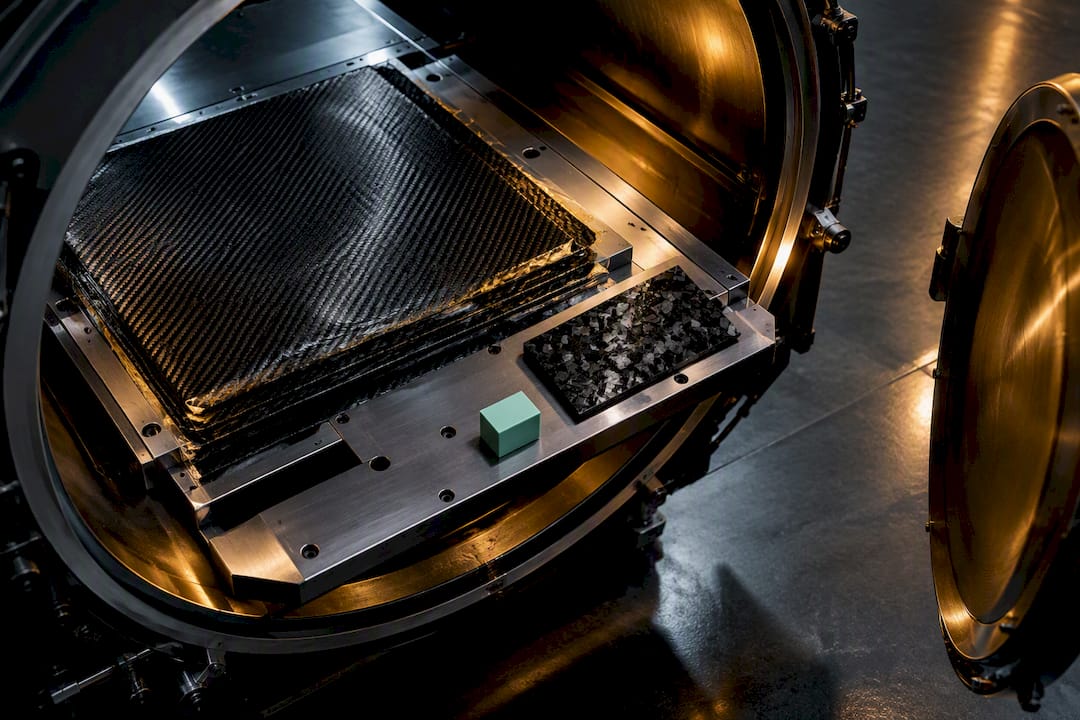
Autoclave-cured prepreg starts with continuous carbon fiber tow woven into a 2×2 twill sheet, pre-impregnated with a controlled resin ratio. Technicians hand-lay the plies into a tool at specific orientations, bag the part, and cure it inside a pressurized, heated autoclave chamber, typically running elevated temperature under several atmospheres of pressure for a set dwell time. That pressure squeezes out excess resin and trapped air, which is why autoclave parts read as denser and more uniform than anything cured at ambient pressure.
Forged carbon works differently. Manufacturers chop carbon fiber tow into short random-length segments, mix it with resin into a sheet-molding compound, and compression mold it inside a heated matched-tool press. The randomly oriented chopped fibers are what produces the signature marbled look, and it’s also why forged carbon behaves almost the same way in every direction, unlike a woven laminate that is made by compression molding short, randomly oriented carbon fibers with resin, giving it strong isotropic toughness but sacrificing the directional stiffness a twill layup delivers.
The architectural consequence matters more than it sounds. Continuous oriented plies in an autoclave part carry load along a predictable path, engineers can calculate exactly how a front lip will flex under aero pressure. Randomly oriented chopped tow in forged carbon has no such predictable path, which is fine for a mirror cap but a liability on a structural splitter.
A few production realities separate the two processes further:
- Autoclave tooling is cheaper to build but the cure cycle runs longer, often several hours per batch, which caps daily throughput.
- Forged carbon’s compression press cycle is dramatically faster once the mold exists, and forged carbon typically has lower scrap and faster cycle times than traditional prepreg layups, making it cost-advantageous at medium production volumes.
- At true one-off or bespoke quantities, cost between the two methods can be roughly comparable, with forged carbon’s advantage widening only as batch size grows.
- Autoclave-cured laminates achieve higher fiber-volume fraction and lower void content because the pressure phase physically compacts the plies, a step forged carbon’s mold cycle does not replicate the same way.
For a limited-production platform like a GT63 aero kit, where most owners order one set of parts rather than a thousand, the volume math tilts toward autoclave dry carbon even before you factor in the mechanical advantages.
How Do Stiffness and Strength Compare Between the Two Materials?
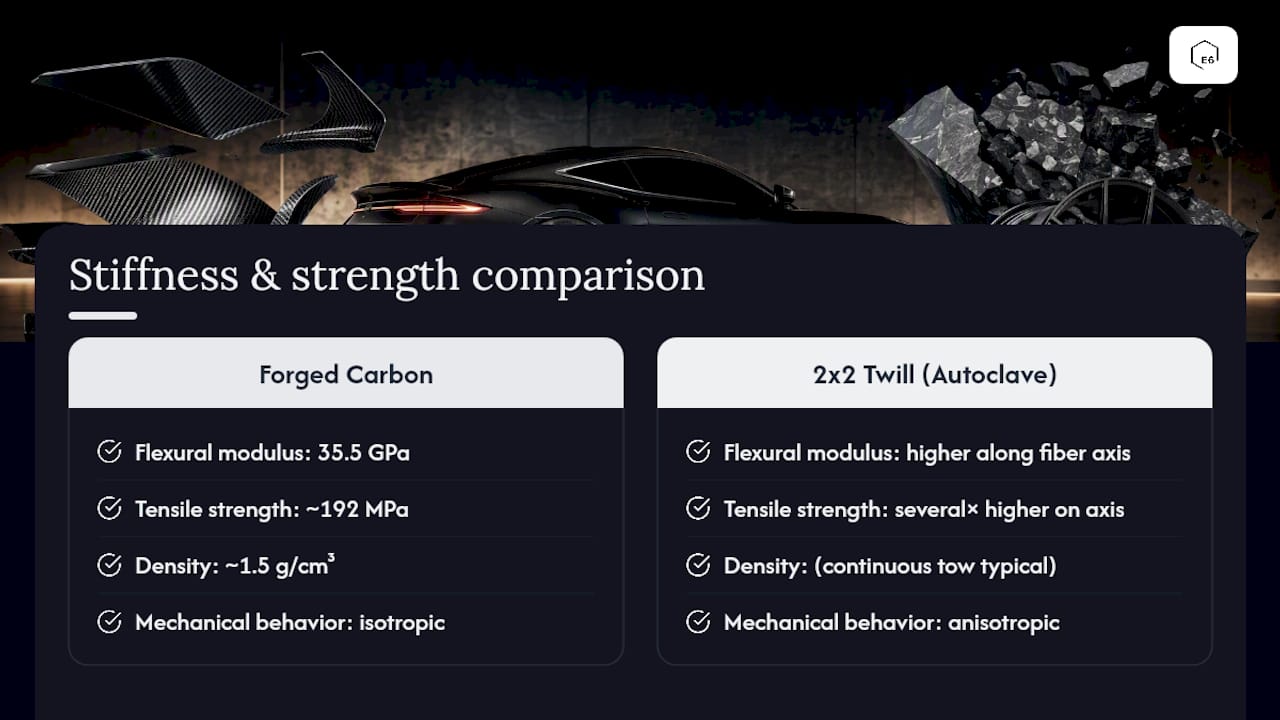
Numbers settle arguments that opinions can’t. Independent bench testing on forged carbon samples put flexural modulus at 35.5 GPa and tensile strength around 192 MPa, with density near 1.5 g/cm³, according to Easy Composites’ published test data. Those are respectable numbers for a molded composite, but they sit well below what a well-oriented autoclave-cured 2×2 twill laminate delivers along its primary fiber axis, where continuous tow can push tensile strength several times higher in the loaded direction.
Statistic Callout: Forged carbon’s isotropic profile means that 35.5 GPa flexural modulus and 192 MPa tensile figure hold roughly steady no matter which direction you load the part. An autoclave twill laminate, by contrast, is anisotropic. Stiffness peaks along the fiber orientation and drops off the axis, which is exactly why engineers orient plies deliberately rather than treating carbon fiber as a uniform material.
That anisotropy is a feature, not a limitation, when the load path is known. A front lip splitter takes downward aero load and road strike almost entirely in one predictable direction. Orienting plies to resist that specific load gets you more stiffness per gram than any isotropic material can offer in that same direction. Autoclave-cured continuous-fiber laminates achieve higher directional stiffness and tighter dimensional tolerances precisely because the layup schedule can be engineered around the actual forces the part will see on the road or track.
Forged carbon’s isotropy earns its keep elsewhere. A mirror cap or a small trim insert takes impact loads from unpredictable angles: stone chips, car wash brushes, an errant door swing in a parking garage. Because compression-molded forged carbon shows near-isotropic mechanical behavior, it resists cracking under those multi-directional hits better than a single-axis-optimized skin would if struck off-axis.
Fatigue life follows the same logic. A splitter lip flexing thousands of times per drive under aero load benefits from a laminate engineered to resist that specific cyclic bending. A decorative insert that never sees structural cycling doesn’t need that specialization, so forged carbon’s toughness is plenty.
What Does Each Finish Look Like on the Car?
Appearance is where owners usually make the final call, and it’s worth being honest about what each material actually looks like up close. Autoclave-cured 2×2 twill produces the repeatable diagonal weave pattern most enthusiasts picture when they hear “carbon fiber”: uniform tow spacing, consistent weave angle, and a pattern that lines up predictably across a panel seam. Getting that pattern to Class-A gloss takes real process discipline: wet sanding through progressive grits, machine polishing, and a final clearcoat pass that levels without burying the weave definition.
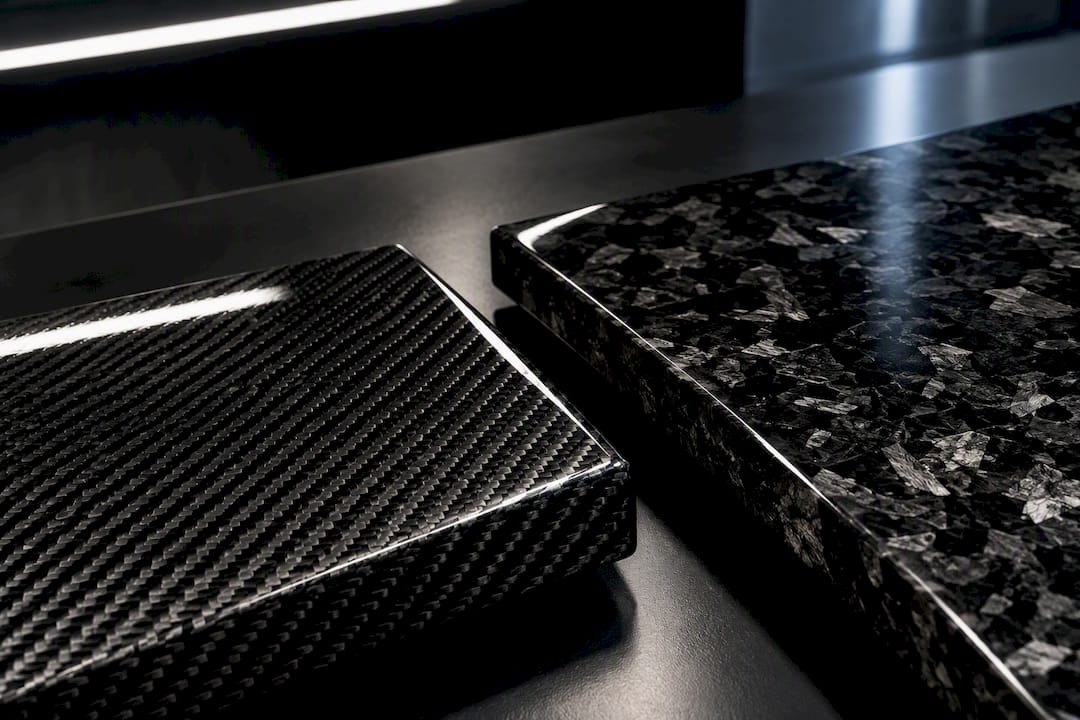
Forged carbon looks nothing like that. Its chopped-fiber structure creates a marbled, almost granite-like surface where no two parts share the exact same pattern, because the random fiber orientation can’t be reproduced by weaving or repeated tooling. Some owners want that uniqueness specifically. Others find it visually busy against the twill weave already present on factory AMG trim, and it can clash if you’re not deliberate about where you place it.
Clearcoat choice matters as much as the base material. A UV-stable aliphatic polyurethane clear resists chalking and yellowing far longer than a generic acrylic clear, and that gap widens the longer a car sits outside. E6 Carbon’s forged carbon example gallery shows how finish quality varies even within the forged category depending on tooling and clearcoat discipline.
Before accepting delivery on any exterior carbon piece, run this checklist:
- Inspect under raking light for orange peel or uneven gloss across the panel.
- Check weave alignment (twill parts) or pattern consistency (forged parts) at every visible seam.
- Look for pinholes or bubbling near edges, a common tell of a rushed clearcoat cure.
- Confirm the clearcoat spec sheet names a UV-stable polyurethane system, not a generic automotive clear.
Pro Tip: Ask your fabricator for the clearcoat’s UV stabilizer package by name, not just “UV resistant” marketing language. A specific additive class on the spec sheet is the difference between a hood that still looks wet in five years and one that starts chalking by year two.
If long-term gloss retention matters more to you than raw material choice, pairing either finish with a dedicated ceramic or film protection system extends the honeymoon period considerably.
Which Material Fits Which GT63 Exterior Part?
Not every panel on the car has the same job, so the material choice should follow the load case, not just the look.
- Front lip. This is the highest-load, highest-consequence panel on the front end. Autoclave-cured 2×2 twill in a multi-ply layup handles aero downforce and curb strikes predictably, and a reinforced mounting flange (extra unidirectional plies bonded around the bolt bosses) prevents the cracking that undersized lips are known for at speed.
- Side skirts. These see less aerodynamic load but more incidental impact from curbs and jacking points. Forged carbon can be an acceptable choice here for cosmetic-only skirt extensions, but any skirt that also functions as a structural rocker cover or ties into splitter end plates should stay in dry carbon for load predictability.
- Mirror caps. Complex compound curves around the mirror housing favor forged carbon’s moldability, and its marbled aesthetic reads well as a standalone accent piece. Owners chasing an exact OEM-style match to a twill hood or lip should specify autoclave 2×2 twill instead, since mixing patterns across adjacent trim pieces is the most common cosmetic mistake we see.
- Rear diffuser. Split-material strategy works best here. Structural fins and the main diffuser body should run in autoclave dry carbon to handle the load transfer at the mounting points, while decorative inserts or trim strips can use forged carbon inlays without compromising the part’s structural role.
The theme across all four: dry carbon where the part does mechanical work, forged carbon where it does visual work.
How Do You Prevent Yellowing and Resin Degradation?
Yellowing is the single most common complaint on aftermarket carbon parts, and it’s almost never the carbon fiber’s fault. UV radiation attacks the resin matrix and the clearcoat above it, breaking down polymer chains and producing the amber discoloration owners notice first around badges, hood edges, and anywhere the clearcoat runs thin.
Resin fraction plays a bigger role than most owners realize. Because high-grade epoxy systems combined with reduced resin fraction from autoclave pressure lower long-term yellowing risk compared with thicker, resin-rich laminates that lean on heavy clearcoat to hide surface imperfections, autoclave-cured parts generally age better in direct sun. Forged carbon parts, which carry a higher relative resin content by nature of the molding process, depend more heavily on clearcoat quality to hold their color over time.
Practical steps that actually extend service life:
- Specify a UV-stable aliphatic polyurethane clearcoat at the manufacturing stage, not as an aftermarket add-on.
- Apply a ceramic coating or paint protection film within the first few months of ownership, before UV exposure has a chance to start breaking down the clear layer.
- Garage or cover the car during extended sun exposure in peak summer months, especially for matte-finish carbon, which has no gloss clearcoat buffer.
- Inspect annually for hazing or micro-cracking; caught early, a cosmetic reclear can restore gloss without replacing the part.
Pro Tip: If a hood or lip has started yellowing only at the edges while the center panel still looks fresh, that’s usually a clearcoat thickness problem from the original cure, not a resin failure. A qualified refinisher can often strip and reclear that panel rather than replacing the whole part.
Once yellowing has penetrated past the clearcoat into the resin matrix itself, visible as a dull, deep amber rather than a surface haze, cosmetic repair won’t hold and replacement is the only real fix.
How Precise Is the Fitment on Each Material?
Panel gaps make or break the visual impact of any aero kit, and this is where manufacturing process shows up most obviously in daily driving. Autoclave-cured prepreg can hold dimensional tolerances around ±0.1 mm across production runs, which is tight enough to maintain consistent seam lines against factory AMG panels without shimming or trimming on install. Forged carbon parts see more dimensional variability run to run, since mold-fill consistency and press pressure both influence final part geometry, though matched tooling and careful trimming close most of that gap.
Before installation day, run through this checklist:
- Trial-fit every panel dry, without adhesive or fasteners, and check gap consistency at every seam.
- Follow the fabricator’s specified torque sequence on mounting hardware to avoid warping thin-wall carbon sections.
- Verify seam alignment against factory panel lines before any adhesive cures permanently.
- Apply paint protection film to high-wear edges immediately after fitment confirmation, before the car goes back on the road.
Ask any vendor for CAD offset data, physical part templates, and trial-fit photos from a prior installation on the same chassis before you commit. A shop that can’t produce those documents is asking you to gamble on fitment, and cheap carbon fiber parts fail at high speeds far more often than owners expect from a panel that looked fine in photos.
E6 Engineering’s Approach to Material Selection on AMG Platforms
Fitment-first engineering means the material decision happens before the layup schedule, not after. On every AMG GT63 aero project, The material decision process ideally starts from the mounting geometry and load case for each specific component to select autoclave dry carbon or forged carbon based on the expected loads.
A few proof points define how that plays out in practice:
- Autoclave-cured 2×2 twill components can achieve dimensional tolerance standards around ±0.1 mm across production batches.
- Class-A exterior surfaces typically undergo multi-stage polishing before final clearcoat to minimize orange peel and weave distortion.
- Structural components receive localized ply reinforcement at mounting points rather than uniform wall thickness throughout.
- Our track-focused wheels engineering guide documents the same fitment-first logic applied to unsprung weight reduction on wheel selection, the same principle, different component.
Customers requesting bespoke fitment often receive CAD offset documentation and trial-fit photos before final installation for quality assurance.
Which Finish Should You Actually Order?
Boil the whole comparison down to three lines and the decision gets easy. Structural, load-bearing, or Class-A visible panels: autoclave-cured 2×2 twill dry carbon. Decorative inserts, complex compound-curve trim, or accent pieces where a unique marbled look is the goal: forged carbon. Anywhere the two jobs overlap, like a diffuser with both structural fins and cosmetic inlays, split the material by function within the same part.
Next steps are straightforward. Request the material spec sheet from your fabricator before ordering, insist on a trial-fit photo set from a prior installation on the same chassis, and schedule installation with a shop familiar with carbon torque sequences rather than a general body shop. Expect autoclave dry carbon to carry a premium over forged carbon at low volumes, with lead times running longer given the cure cycle, but the tolerance and durability payoff on a car this size is worth the wait for anything structural.
A Builder’s Take on Material Trade-Offs
Every AMG platform we’ve engineered for reinforces the same lesson: the material argument is really a load-path argument wearing a finish debate as a disguise. Owners ask which carbon “looks better,” but the question that actually determines whether a part survives its first year is which carbon was engineered for the load that panel will see. We’ve watched too many gorgeous forged hood inserts get retired early not because the material failed, but because someone specified it for a job that needed directional stiffness the mold-fill process was never built to provide.
The forged carbon skeptics get one thing wrong too, though. Written off as a “cheaper” material, it’s really a specialized one, isotropic toughness and moldable geometry solve real problems that a twill layup can’t touch on complex curves. Treat both materials as tools with a job description, not competitors, and the whole decision gets simpler.
If you’re weighing a GT63 build and want a second opinion on where the load actually goes on your specific panel set, that’s a conversation worth having before you order anything.
— E6 Engineering
Ready to Spec Your GT63 in Autoclave Dry Carbon?
Some manufacturers provide autoclave-cured 2×2 twill exterior components engineered around each panel’s actual load case rather than generic molds from mass-market body kits. Unlike some providers of one-size-fits-all forged shells, a tailored approach starts from the mounting geometry on a specific chassis and chooses the appropriate material and ply schedule for each panel. The E6 Carbon Elite Kit for the Lexus LC500 shows the same fitment-first approach applied across a full exterior kit, and it’s a useful reference point if you’re picturing what a matched set looks like on your own platform.
A consult starts with your chassis details and the panels you’re targeting. From there, expect a materials spec proposal, a fitment documentation package, and a realistic lead-time estimate before you commit to anything. If wheels are part of the build too, our brake upgrade page for the AMG GT platform covers a complementary upgrade path worth considering alongside any aero work. Start your GT63 project by requesting a fitment consult at E6 Carbon.
Sources
The mechanical and manufacturing claims in this guide draw on published composite testing rather than marketing copy. Managing Composites supplied the manufacturing description and isotropic behavior analysis for forged carbon. Easy Composites provided the bench-tested flexural modulus, tensile strength, and density figures cited in the mechanical properties section. Hyperx Carbon backed the dimensional tolerance and Class-A finishing claims for autoclave-cured prepreg. SGS supplied the production economics and per-part cost comparison at varying volumes.
- The Truth About Forged Carbon Fiber: What It Can (and Can’t) Do – Managing Composites
- Comparing the Mechanical Properties of Forged Carbon Fibre – Easy Composites
- What Is Forged Carbon Fiber? A Beginner’s Guide To Its Unique Properties And Uses – Hyperx Carbon
- Forged Carbon vs Carbon Fiber: Differences & Cost | SGS
FAQ
Is autoclave dry carbon better than forged carbon for a GT63 front lip?
Yes, for a structural front lip specifically. Autoclave-cured 2×2 twill offers higher directional stiffness and tighter dimensional tolerance around ±0.1 mm, which matters more on a load-bearing splitter than forged carbon’s isotropic toughness does.
Why does forged carbon look different on every part?
Forged carbon uses randomly oriented chopped fiber rather than a woven pattern, and that randomness means no two forged parts share the exact same marbled pattern. Autoclave 2×2 twill, by contrast, produces a repeatable diagonal weave that matches panel to panel.
Does forged carbon yellow faster than autoclave dry carbon?
Forged carbon generally carries a higher resin fraction, and since higher-grade epoxy with lower resin content reduces long-term yellowing risk, autoclave-cured parts tend to hold their clarity longer under UV exposure. Clearcoat quality still matters more than material choice on either finish.
What does an E6 Carbon Elite Kit cost?
Pricing varies by platform and component scope, so current prices are listed on the E6 Carbon Elite Kit page for the Lexus LC500. Request a quote directly for GT63-specific components.
Is the AMG GT 63 S considered a supercar?
The AMG GT 63 S sits in the grand tourer and super-sedan category rather than the traditional two-seat supercar class, but its power output and chassis engineering put it in direct competition with cars that wear that label. Most enthusiasts treat it as a four-door supercar rival rather than a strict genre match.
Which is faster, the M8 or the GT63?
Straight-line performance between the two is close and depends heavily on trim level and options, with both platforms capable of sub-4-second acceleration in their higher-output variants. Track handling favors whichever car carries the lighter curb weight and better-matched tire package for that specific comparison.
Recommended
Pricing, custom fitment options, and surface finishes subject to availability. Please contact E6 Carbon or E6 Forged directly to confirm vehicle-specific offset parameters, brake clearances, and current lead times prior to placing your order.