TL;DR:
- Forged aluminum improves grain structure, strength, and fatigue resistance, making it essential for high-performance automotive parts. It involves shaping solid billets under pressure to achieve superior internal consistency compared to cast aluminum, which has a more random grain orientation. This manufacturing process results in lighter, stronger components ideal for wheels, suspension parts, and safety-critical applications, but it requires careful quality control and appropriate alloy selection.
Plenty of people in automotive circles throw around “forged aluminum” the way others say “hand-stitched leather” or “carbon fiber trim,” treating it as a luxury label more than a legitimate engineering advantage. That assumption is wrong, and it costs enthusiasts real performance. Forged aluminum’s core benefit is a fundamentally improved microstructure that changes how a component behaves under load, heat, and repeated stress. For anyone running a track day build, speccing out a Lamborghini, or upgrading a BMW M car, the difference between forged and cast aluminum is not cosmetic. It is measurable, repeatable, and felt in every corner.
Table of Contents
- What is forged aluminum?
- Why forged aluminum excels in automotive applications
- Forged vs cast aluminum: A practical comparison
- How forged aluminum components are made
- A balanced take: When forged aluminum is and isn’t the best choice
- Explore performance upgrades and custom forged wheels
- Frequently asked questions
Key Takeaways
| Point | Details |
|---|---|
| Superior strength and durability | Forged aluminum delivers higher fatigue resistance and reliability for automotive performance parts. |
| Lightweight performance benefits | Weight savings from forging translate into better handling, acceleration, and efficiency in luxury vehicles. |
| Not always the best value | Casting or hybrid methods may be more cost-effective for non-critical components or high-volume production. |
| Forging process quality matters | Proper temperature control, grain alignment, and post-forging treatment are essential for achieving top performance. |
| Applications beyond wheels | Forged aluminum is used in suspension, control arms, and other load-bearing parts, not just wheels. |
What is forged aluminum?
Forged aluminum is not simply aluminum that has been shaped. The forging process subjects raw aluminum billets to enormous compressive force, often combined with elevated temperature, to physically reshape the metal’s internal grain structure. Where casting pours molten metal into a mold and lets it cool, forging works the metal while it is solid, steering and compressing its natural grain flow to follow the contours of the final part.
That distinction matters enormously. Forging improves grain alignment and minimizes internal defects like porosity, voids, and inclusions that are common in cast parts. The result is a part where the metal’s natural fiber structure is continuous and unbroken, running through the geometry rather than being interrupted by the shape.
Cast aluminum, by contrast, has a random grain orientation determined by how the molten metal flowed and solidified. That random structure is weaker along certain axes and more susceptible to crack propagation under fatigue loading.
Key characteristics that define forged aluminum:
- Continuous grain flow aligned with the part’s geometry
- Reduced porosity compared to cast equivalents
- Higher fatigue resistance under cyclic loading
- Superior strength-to-weight ratio at equivalent thickness
- Better surface integrity for machining and finishing
“Forged aluminum is not a single material. It is a family of alloys and processes, and the gap between a well-forged part and a poorly executed one can be wider than the gap between forged and cast.” This is why knowing the process details matters as much as the label.
Pro Tip: When evaluating any forged aluminum component, ask the manufacturer which alloy series they use (6061 and 7075 are common in performance applications) and whether post-forging heat treatment is applied. Those two factors will tell you more about real-world durability than any marketing claim.
If you are thinking about where forged aluminum fits into your build, reading up on performance wheel upgrades gives a useful frame for understanding how material choice ripples into overall vehicle behavior.
Why forged aluminum excels in automotive applications
With the basics clear, let’s see why forged aluminum dominates in high-performance automotive roles. The automotive environment is genuinely brutal for materials. Wheels and suspension components experience millions of cyclic stress events over their service life. Every pothole, every track apex, every hard braking zone sends shock loads through those parts. Fatigue failure, not a single overload event, is how most automotive components eventually give out.
Forged aluminum is used in performance-critical automotive parts precisely because its strength-to-weight ratio and fatigue resistance are difficult to match with cast methods. A forged aluminum wheel weighing the same as a cast counterpart will handle cyclical bending loads significantly better, and a lighter forged wheel versus a heavier cast one reduces unsprung mass, which directly sharpens steering response, ride quality, and acceleration.

Here is how the numbers compare in practical terms:
| Property | Forged aluminum | Cast aluminum |
|---|---|---|
| Tensile strength | 400 to 570 MPa (7075-T6) | 200 to 350 MPa typical |
| Fatigue resistance | High, grain-aligned | Moderate, grain-random |
| Internal defect rate | Very low | Moderate to high |
| Weight at equivalent strength | Lower | Higher |
| Surface finish quality | Excellent | Good |
| Impact on unsprung mass | Significant reduction | Less reduction |
Beyond wheels, forged aluminum appears in suspension arms, control arms, uprights, brake calipers, and even steering components on high-end platforms. Each of those parts benefits from the same core properties: more strength per gram, fewer failure-prone internal flaws, and consistent mechanical behavior across production batches.
Forged aluminum’s advantages in automotive applications include:
- Lower unsprung weight for better suspension response
- Higher load capacity without a weight penalty
- Consistent mechanical properties across production runs
- Greater resistance to stress cracking under repeated loading
- Better machining precision for tight tolerances
Understanding racing wheel performance gains puts those properties in context: lighter, stronger wheels reduce the rotational inertia your engine has to overcome on every acceleration, and they respond faster to steering inputs because the suspension can move them with less effort. The physics are not subtle.
For anyone working through performance wheel selection for a luxury or sports car, understanding these material properties should come before considering finish, spoke design, or sizing.
Forged vs cast aluminum: A practical comparison
Understanding the performance advantages, let’s directly compare forged and cast aluminum options. Both have genuine roles in automotive manufacturing. The real mistake is applying the wrong method to the wrong application.
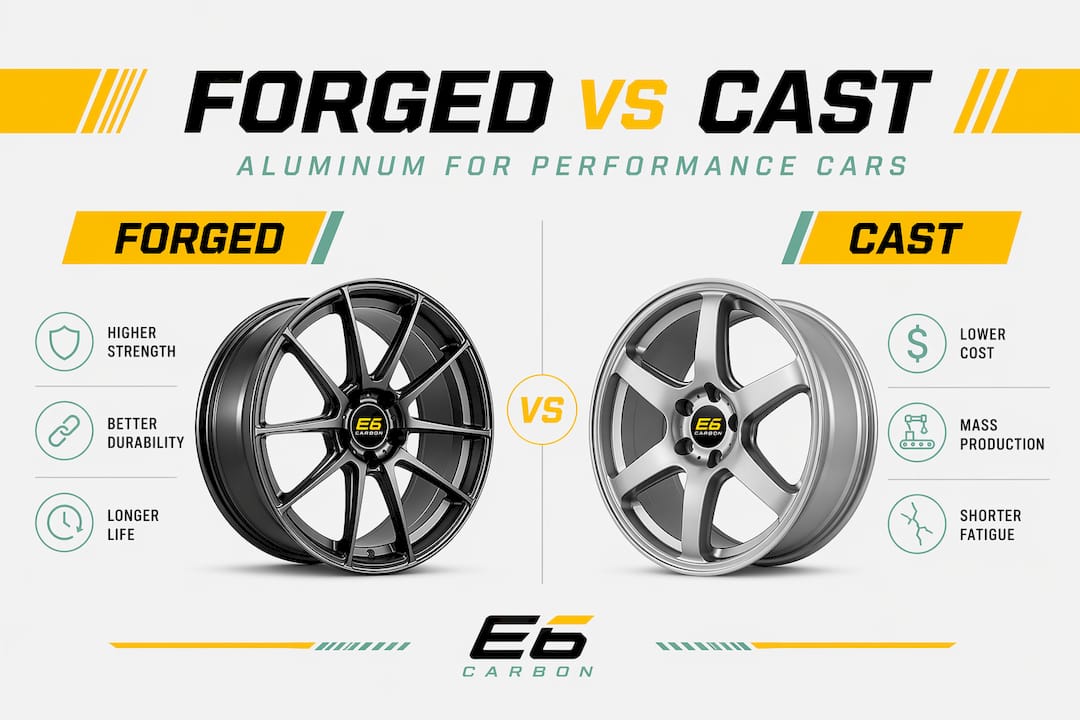
| Factor | Forged aluminum | Cast aluminum |
|---|---|---|
| Fatigue life | Significantly longer | Shorter under repeated stress |
| Manufacturing cost | Higher (per unit) | Lower (especially at scale) |
| Design freedom | Limited by tooling | Very high |
| Minimum wall thickness | Thicker (material constraints) | Thinner possible |
| Ideal application | High-load, safety-critical parts | Complex shapes, lower-stress parts |
| Production volume | Better at lower volumes | Scales well at high volume |
Forged offers superior fatigue resistance but cost and production volume economics can make casting or hybrid methods a smarter call for certain applications. This is not a flaw in cast aluminum. It is an honest engineering trade-off.
Here is a numbered breakdown of when each method makes practical sense:
- High-performance wheels and racing components: Forged aluminum is the clear choice. Fatigue resistance and weight savings justify the cost premium decisively.
- Suspension arms on performance street cars: Forged is preferred for its durability under repeated loading, but quality cast arms work well on non-track applications.
- Decorative or non-structural trim pieces: Casting is entirely appropriate. There is no load-bearing justification for the forged premium here.
- High-volume OEM parts: Casting or die-casting often wins on economics without meaningful performance compromise.
- Complex geometries that forging cannot easily achieve: Casting allows design freedom that forging tooling cannot replicate affordably.
Pro Tip: Flow-forming is a hybrid manufacturing method that starts with a cast or forged blank and then uses high-pressure rollers to stretch and work the barrel of a wheel. This process improves strength and reduces weight without the full cost of a monoblock forged wheel. For enthusiasts on tighter budgets who still want material performance gains, flow-formed wheels bridge the gap meaningfully.
When building out a wheel spec for a luxury or track vehicle, consulting a custom wheels guide helps you align manufacturing method with your actual performance requirements. And if you are weighing forged aluminum against more exotic options, understanding carbon fiber wheels gives you the full material spectrum to work from.
How forged aluminum components are made
To appreciate why forged aluminum delivers such performance, consider how it is actually made. The process is not simply “press aluminum into shape.” It involves precise temperature management, controlled deformation sequences, and often post-forging thermal treatments that lock in the final mechanical properties.
Here is the general sequence for producing a forged aluminum wheel or performance component:
- Billet selection: A cylindrical billet of aluminum alloy (commonly 6061 or 7075 series) is cut from bar stock. Alloy selection determines the base mechanical properties and how the metal responds to working and heat treatment.
- Preheating: The billet is heated to a precise temperature range, typically 650 to 900 degrees Fahrenheit for aluminum, depending on alloy. Too hot and the grain structure coarsens. Too cold and the metal cracks under forging pressure.
- Initial forging pass: The billet is placed in a forging press and subjected to thousands of tons of compressive force. This first pass shapes the rough geometry and begins aligning the grain structure.
- Intermediate stages: Complex parts often require multiple die sets and intermediate annealing steps to prevent cracking as the metal is progressively worked into its final shape.
- Finishing forge: The final die brings the part to near-net shape, completing grain alignment and producing consistent dimensions across the part.
- Heat treatment and aging: Aluminum forging involves careful temperature control and may include post-forging heat treatment or aging to reach target hardness and strength levels. T6 temper, for example, involves solution heat treatment followed by artificial aging, and it is what gives 6061-T6 and 7075-T6 their reputation for high strength.
- Machining: The forged blank is then CNC machined to final dimensions, drilled for bolt patterns, and prepared for finishing.
- Surface finishing: Anodizing, powder coating, polishing, or custom paint are applied depending on specification.
Key variables that separate high-quality forged components from mediocre ones:
- Consistency of billet quality and alloy certification
- Precision of temperature control during heating and forging
- Number and sequence of forging passes
- Quality of post-forging heat treatment
- Rigor of dimensional inspection after machining
“The forging process is only as good as the quality controls that surround it. A press and a die are not enough. The metallurgical discipline applied before, during, and after forging is what separates a race-grade component from a shelf item that only looks the part.”
If you want to see how those manufacturing differences translate into fitment and installation outcomes, reviewing forged wheel installation steps or exploring wheel finish insights gives practical guidance on getting the most from a quality forged set.
A balanced take: When forged aluminum is and isn’t the best choice
Here is an honest perspective that most forged aluminum content skips: the word “forged” has become so commercially attractive that it gets applied loosely, and that creates real risk for buyers.
Forged aluminum absolutely shines in race applications, track-day builds, and any vehicle where unsprung weight reduction directly translates to lap time or driver feel. On a McLaren 720S or a Lamborghini Huracán, the investment in properly forged wheels pays off in ways you can measure and feel. On a daily-driven crossover running mostly highway miles, the performance argument weakens, and a quality cast or flow-formed wheel might represent a smarter financial decision without meaningful performance sacrifice.
Where it gets complicated is in the middle market. Cost and production volume economics matter enormously, and some manufacturers label parts “forged” while using abbreviated processes that skip critical heat treatment steps or use lower-grade alloys. The label is not a guarantee. A part can be technically forged and still be inferior to a rigorously cast and heat-treated alternative from a disciplined manufacturer.
Our strong recommendation: always ask for alloy documentation, heat treatment records, and any relevant certifications before buying forged aluminum components marketed as performance-grade. Legitimate manufacturers will provide this without hesitation. Ones who cannot or will not are telling you something important.
For enthusiasts who want to invest wisely in luxury car accessories and performance components, the discipline of asking the right questions before purchase is as valuable as the technical knowledge itself. Forged aluminum, done right, is genuinely one of the best material choices available for high-performance wheels and structural components. Done carelessly or marketed dishonestly, it is just a word.
Pro Tip: Always ask for the specific forging alloy designation (such as 6061-T6 or 7075-T6), the forging process type (open-die, closed-die, or rotary), and any third-party certifications or testing data. If a supplier cannot provide these details, look elsewhere.
Explore performance upgrades and custom forged wheels
If this breakdown has clarified what to look for in forged aluminum components, the natural next step is finding products built to the standard you now know to demand.

E6 Forged builds wheels that meet every benchmark discussed in this article: certified alloys, controlled forging sequences, proper heat treatment, and full customization for platforms ranging from BMW M cars to Ferrari and Lamborghini. The AR03 forged wheels are a strong starting point for anyone speccing a multi-piece forged wheel with serious track or show credentials. When you are ready to move from research to installation, the forged wheel installation guide walks you through fitment, torque specs, and best practices to protect your investment from day one.
Frequently asked questions
Does forged aluminum really last longer than cast aluminum?
Forged aluminum components have superior fatigue resistance and fewer internal defects, so they typically outlast cast parts under repeated loading conditions common in performance driving.
Are forged aluminum wheels worth the extra cost?
For performance-focused driving or luxury vehicles, the strength-to-weight and safety advantages justify the premium, but casting or hybrids can be entirely adequate for daily use or budget-sensitive builds.
Can forged aluminum be used for non-wheel automotive parts?
Yes. Forged aluminum applications include suspension arms, control arms, uprights, and other load-bearing components where consistent strength and fatigue resistance are essential.
Is forging always better than casting for aluminum parts?
Forging delivers better material properties, but cost and production volume may favor casting or hybrid methods for less demanding applications or when design complexity exceeds forging’s geometric limitations.
How do I check if forged aluminum parts are high-quality?
Request alloy documentation, heat treatment records, and third-party certifications, since rigorous forging methodology including temperature control and post-forging aging is what separates performance-grade parts from lesser alternatives.