TL;DR:
- Knurled bead seats are machined textured ridges on wheels that prevent tire slippage during high-performance driving. They create a mechanical interlock between the tire bead and rim, improving grip without added weight or legality issues. This technology benefits high-torque platforms like the AMG GT, C8 Corvette, and McLaren by maintaining tire stability during launches and high-G corners.
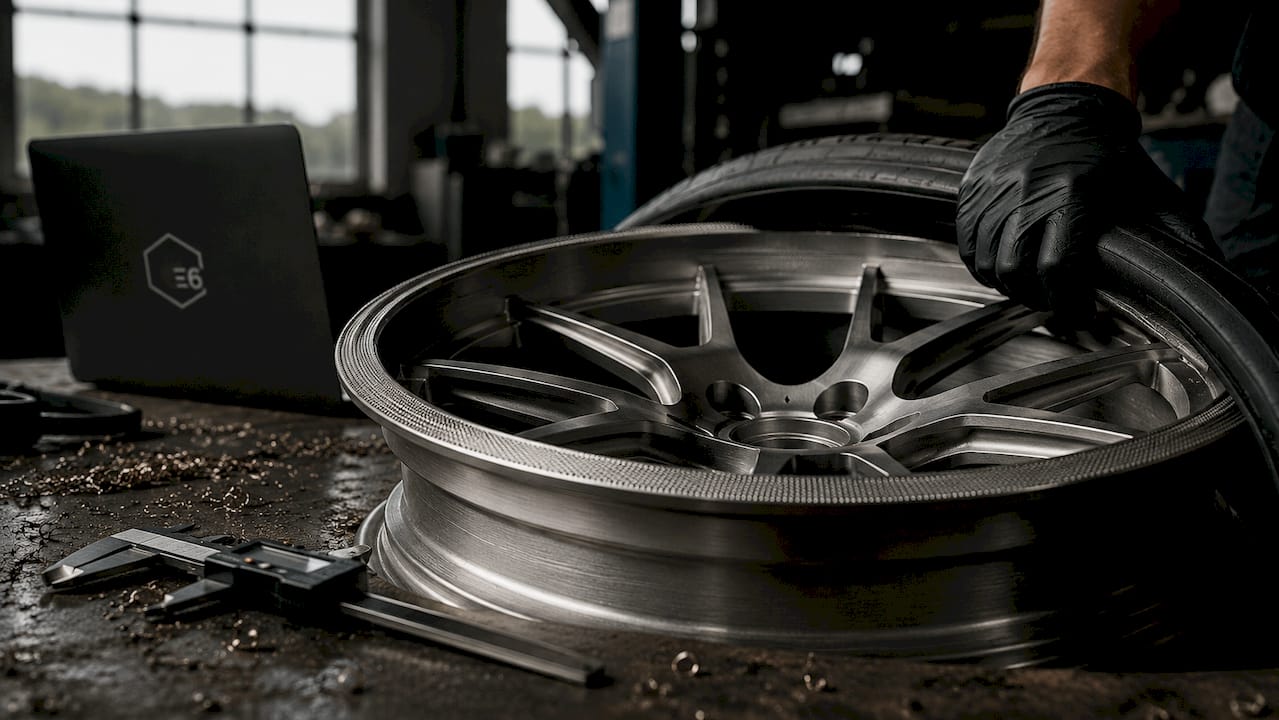
Knurled bead seats are machined textured ridges cut directly into the wheel rim’s bead seat to prevent tire slippage in high-performance builds. The knurling physically grips the tire bead rubber, creating a mechanical interlock that resists rotation under extreme torque and high-G cornering loads. On platforms like the twin-turbo Mercedes-AMG GT and built C8 Corvette, where launch forces can overwhelm a smooth bead seat, this feature is the difference between a clean 0-60 and a wasted run. Manufacturers like RAYS Engineering have built this feature into premium forged lines including the Nismo LMGT4 EVO and Regamaster EVO II precisely because the physics demand it.
How do knurled bead seats prevent tire slippage under high torque?
Knurled bead seats work by converting a friction-only interface into a mechanical interlock. A smooth bead seat relies entirely on tire inflation pressure to hold the bead in place. Knurling adds a second layer: the textured ridges physically bite into the tire bead rubber when the tire is inflated at track pressures, locking the bead against rotational movement. This is not a subtle effect. Under a hard launch in a high-horsepower build, the torque trying to spin the tire on the rim is substantial.
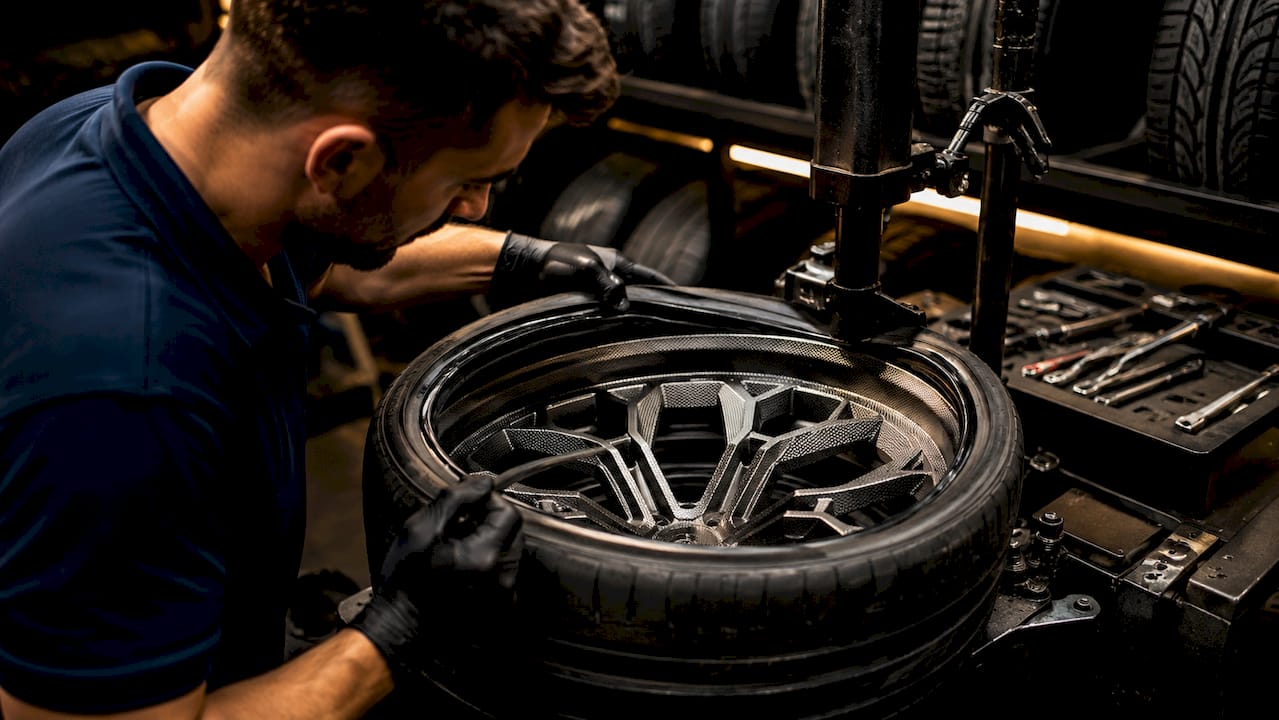
The textured surface acts as a mechanical interlock gripping the tire bead rubber when inflated. That grip directly counters the torque-induced creep that causes the tire to rotate relative to the rim barrel. On a smooth bead seat, that creep shifts the valve stem position and degrades tire balance over time. On a knurled seat, the bead stays locked.
The trade-off is real. Knurling slightly affects tire mounting ease and can stress the bead compound during frequent changes. A tire technician mounting rubber on a knurled wheel needs to use proper lubrication and care. The pattern is precisely engineered to optimize friction without overly damaging tire beads, providing a repeatable grip advantage at track pressures.
Pro Tip: Always use a high-quality tire mounting lubricant when fitting tires to knurled bead seats. Dry mounting forces the bead over the texture aggressively and can cause micro-tears in the bead compound that reduce the interlock’s effectiveness over time.
Knurled bead seats vs. beadlocks vs. high-grip compounds
Three methods address tire slippage prevention at the rim interface. Each has a distinct engineering profile and a different cost-benefit equation for street and track use.
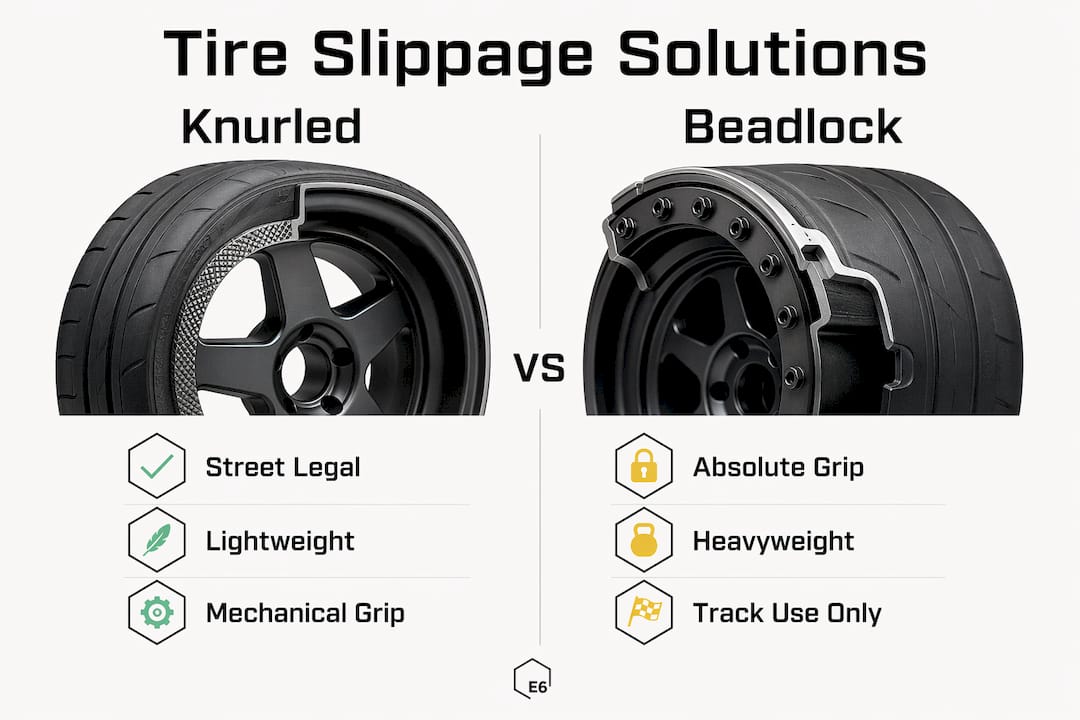
Beadlock wheels clamp the tire bead mechanically with a bolt-on outer ring, offering the most absolute prevention of tire slip. The drawback is significant. Beadlocks add weight, require periodic bolt torque checks, and are not street legal in most jurisdictions. They belong in extreme off-road and dedicated race scenarios, not on a street-driven AMG GT or Lexus LC500.
High-grip tire compounds and reinforced sidewalls address slippage from the tire side of the equation. Reinforced sidewalls complement the grip benefits of knurled bead seats by maintaining bead stability and contact patch geometry. Tire construction is the final layer in the system, not a standalone solution.
Knurled bead seats occupy the middle ground. They are street-legal and lightweight, adding no meaningful mass to the wheel while substantially reducing tire slippage. They work best when paired with a quality UHP tire that has a firm bead compound.
| Method | Street legal | Weight impact | Slip prevention | Best use case |
|---|---|---|---|---|
| Knurled bead seats | Yes | None | High | Street and track performance builds |
| Beadlock wheels | No (most regions) | Significant | Maximum | Dedicated race and off-road |
| High-grip tire compounds | Yes | None | Moderate | Complements knurling; not standalone |
The key insight from this comparison: knurling is the only method that delivers near-beadlock grip levels without sacrificing street legality or adding unsprung weight. For a track-ready wheel that also sees street miles, it is the correct engineering choice.
Which builds benefit most from anti-slip bead seat technology?
High-torque, high-horsepower platforms gain the most from knurled tire bead design. The physics are straightforward: more torque at the wheel means more rotational force trying to spin the tire on the rim. The following platforms represent the clearest use cases.
- Twin-turbo Mercedes-AMG GT: The AMG GT’s twin-turbo V8 generates torque figures that overwhelm a smooth bead seat on hard launches. Reduced tire slip directly improves 0-60 and quarter-mile times by keeping the tire locked to the rim during peak torque delivery.
- Built C8 Corvette: A modified C8 with a built LT2 or LT6 produces wheel-speed events that cause measurable valve stem migration on smooth bead seats. Knurling eliminates that variable from the launch equation.
- Lexus LC500 track builds: The LC500’s naturally aspirated V8 rewards precision. Knurled bead seats keep the tire geometry consistent through high-G corners where lateral forces push the bead sideways.
- McLaren and Lamborghini platforms: Mid-engine layouts concentrate torque delivery at the rear axle. Knurling on rear wheels is particularly effective on these platforms during aggressive corner exits.
RAYS Engineering’s motorsport-heritage design philosophy prioritizes performance and durability over decorative features. The Nismo LMGT4 EVO and Regamaster EVO II both carry knurled bead seats as standard features precisely because the target use cases demand it. This is not an afterthought. It reflects engineering consideration of extreme cornering, braking, and launch forces.
Practical considerations: mounting, tire selection, and maintenance
Knurled bead seats require a different service approach than smooth rims. The texture that creates grip also creates resistance during tire mounting. Follow these steps to protect both the tire and the wheel.
- Use a quality tire mounting lubricant. Apply it generously to both the tire bead and the knurled seat before mounting. This reduces the force required and prevents bead compound tearing.
- Select a compatible tire compound. Firm-bead UHP tires work best with knurled seats. Soft-compound tires with flexible beads can deform around the texture and lose the mechanical interlock benefit.
- Set track-appropriate tire pressures. The mechanical interlock is most effective at the inflation pressures the knurling was engineered for. Running significantly lower pressures reduces bead tension and weakens the grip.
- Inspect the bead seat after every tire change. Check for metal burrs or debris in the knurling pattern. Contamination reduces grip and can damage the next tire’s bead.
- Limit unnecessary tire changes. Each mounting cycle works the bead compound against the texture. Proper tire mounting technique and compatible compounds maximize knurled bead seat benefits and minimize premature rubber wear.
Pro Tip: When running a dedicated track tire on knurled wheels, mark the valve stem position relative to the rim after the first heat cycle. If the mark shifts, your inflation pressure is too low for the torque load. Raise pressure in 2 PSI increments until the stem stays fixed.
Knurling strikes a balance enabling enthusiasts to upgrade from factory wheels to more track-capable forged wheels without losing street drivability. That balance depends on correct tire selection and disciplined service practices.
Key takeaways
Knurled bead seats are the most effective street-legal method for preventing tire rotation on the rim in high-torque performance builds, combining mechanical interlock with zero weight penalty.
| Point | Details |
|---|---|
| Mechanical interlock principle | Knurling physically bites into the tire bead rubber, not just friction, to resist rotation. |
| Street-legal advantage | Knurled seats deliver near-beadlock grip without added weight or legality issues. |
| Best platforms | Twin-turbo AMG GT, built C8 Corvette, Lexus LC500, and mid-engine McLaren and Lamborghini builds benefit most. |
| Tire selection matters | Firm-bead UHP tires maximize the mechanical interlock; soft compounds reduce its effectiveness. |
| Service discipline required | Proper mounting lubricant and pressure management preserve knurling effectiveness across multiple tire changes. |
The detail most builders overlook
After years of working with AMG, Corvette, and exotic platforms, the knurled bead seat remains the most undervalued feature in a performance wheel spec. Builders spend hours selecting tire compounds, dialing in suspension geometry, and tuning boost curves. Then they bolt on a wheel with a smooth bead seat and wonder why their launch data is inconsistent.
The tire-to-rim interface is a dynamic system, not a static clamp. Under a hard launch in a 700-horsepower AMG GT, the bead is fighting rotational force every millisecond. A smooth seat loses that fight incrementally. Knurling wins it by design. Knurled bead seats exemplify the motorsports philosophy of designing wheels to withstand dynamic loads beyond static strength tests.
My caution is this: knurling is not a substitute for the complete system. Pair it with the right tire, the right pressure, and a wheel with tight forged tolerances. The wheel and tire system works as a cohesive unit for ultimate handling and stability. Knurling is one critical node in that system, not the whole answer.
— E6 Engineering
Explore E6 Carbon’s forged wheels with knurled bead seat engineering
E6 Carbon engineers every forged wheel to the tolerances that make knurled bead seat technology work correctly. Sloppy machining defeats the purpose of knurling. Our forged wheel lineup for Mercedes-AMG, Lexus LC500, McLaren, and Lamborghini platforms is built to the exacting standards that high-torque builds demand.
Every wheel in the E6 Forged catalog is machined to tight dimensional tolerances, with bead seat geometry engineered for track pressures and real-world launch loads. If you are building a platform where tire slippage costs you tenths, start with the wheel. Explore the full E6 Forged wheel lineup and see how forged wheel tolerances directly affect bead seat performance and overall grip consistency.
FAQ
What are knurled bead seats on a wheel?
Knurled bead seats are machined textured ridges on the wheel rim’s bead seat surface. They physically grip the tire bead rubber to prevent the tire from rotating on the rim under high torque or lateral G-forces.
Are knurled bead seats street legal?
Yes. Knurled bead seats are a standard machined wheel feature and carry no street legality restrictions. They are the street-legal alternative to beadlock wheels, which are prohibited for road use in most jurisdictions.
Which wheels use knurled bead seat technology?
RAYS Engineering integrates knurling into premium forged lines including the Nismo LMGT4 EVO and Regamaster EVO II. These wheels target motorsport and high-performance street applications where tire slip prevention is a priority.
Does knurling damage tires during mounting?
Knurling can stress the tire bead compound if mounted dry or with excessive force. Using proper tire mounting lubricant and compatible firm-bead UHP tires eliminates meaningful bead damage risk.
How does knurling improve 0-60 and quarter-mile times?
Tire slippage on the rim causes power loss and inconsistent wheel speed during launch. Knurled bead seats lock the tire to the rim, delivering torque directly to the contact patch and reducing the wheel-spin variable in acceleration runs.